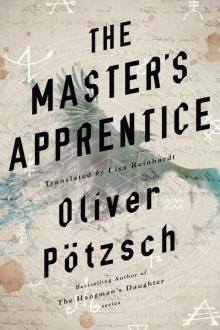
The Master's Apprentice, page 40
part #1 of Faust Series


Maybe I should have waited a little longer with the angel, he sometimes thought. He didn’t know how much longer he could keep up the farce. Valentin was growing suspicious, Johann could tell. And it wasn’t an easy feat, smuggling the laterna out of the shed each time and reassembling it inside the cave. Sooner or later, Valentin would find out.
“What is it?” asked Margarethe, tracing his lips with her finger. “You’re brooding, admit it. Even if I can’t see you in this darkness, I can tell when you’re brooding.”
Johann laughed. “I’m Johann Faustus, remember? I always brood.” He sighed theatrically and hoped Margarethe wouldn’t notice the uncertainty in his voice.
She sat up, her eyes gleaming like stars in the night. “So you even brood while you’re with me?”
Johann greedily kissed her, virtually drinking her in. “The brooding is fading, Margarethe. With every kiss, with every sip. You’re my medicine, don’t forget. Better than any quack’s theriac.”
She laughed. “I very much hope so!”
He kissed her again and they made love passionately.
It was the best time in Johann’s life, and even though he refused to listen to it, an inkling told him that it wouldn’t last forever.
It was mid-June when Conrad Celtis asked him up to the castle once again. It had been a while since they last saw each other. Celtis had been lodging at other courts—Dresden and Mainz—and Johann had focused entirely on his studies. He wanted to gain the degree of magister as fast as possible so he could finally take Margarethe away from Heidelberg.
Celtis received him in the same austere chamber as on previous occasions. The only change was that there now stood a table full of books, parchment scrolls, and documents. Johann had never seen any food or drink in Celtis’s room. It was as if the scholar lived solely on literature and iron gall ink.
“So?” asked Celtis once they were both seated by the fire. “How are your studies progressing?”
Johann nodded. “I’m almost done with the works of Plutarch, and I’m well acquainted with Archimedes’s mathematical formulas now. Only the Cyrenaics still give me trouble. Aristippus of Cyrene, Arete, Theodorus—”
Celtis waved dismissively. “The Cyrenaics hardly ever feature in the exams, because the doctors don’t understand them, either. The sensation of lust appears to be foreign to our learned scholars, even though the Cyrenaics only mean gentle movements by that term.” He laughed. “The quality of the teaching staff in Heidelberg is rather below average, as you’ve probably figured out for yourself by now. With the exception of my old friend Jodocus, of course.”
Johann looked at Celtis expectantly. He didn’t know what the purpose of this conversation was. Ever since his embarrassing faux pas at Heidelberg Castle, he’d tried not to criticize the magisters and doctors—even if he’d sometimes had to bite his tongue.
“Have you ever considered studying in another city?” asked Celtis abruptly.
Johann straightened up on his stool. He was glad about the question—it would make leaving Heidelberg so much easier. “Indeed, following my magister, I could imagine—”
“I meant sooner. This summer.”
Johann’s jaw dropped with surprise. He thought he must have misheard. “But . . . but . . . how? I’m in the middle of studying for my magister—”
“Which you can also complete somewhere else. A student of your scope—child’s play!” Celtis grinned. “And you would have me as your sponsor.”
Johann said nothing for a while. “I’m afraid you’ll have to elaborate.”
“I will.” Celtis leaned forward and lowered his voice. “I’m going to move to Vienna this very summer. The German king, Maximilian himself, has asked me to create a chair for rhetoric and poetics. A great honor! Vienna is the center of the Holy Roman Empire and boasts one of the largest universities.”
“I know,” whispered Johann. “I . . . I’ve heard of Vienna.” Suddenly he felt like the floor was swaying beneath him, and he clutched his seat tightly.
“I could do with a young assistant by my side. Someone to comb the libraries for old manuscripts for me, archive documents, and separate the wheat from the chaff. Maybe someone who will uncover long-forgotten knowledge.”
“And . . . and you thought of me?”
Celtis laughed. “Who else? You may be a little arrogant, and you lack respect for us old folks, but you’re smart and ambitious, just like I used to be. And you’re by far the best student the university has seen in a long time. Good old Jodocus and I spoke of you just the other day. He told me you pass all your exams summa cum laude.”
“You’re too kind.” Johann lowered his head. Inwardly, he was shaking.
What Celtis had said was true. He was one of the best, and even old Partschneider had to admit it. His intelligence, coupled with everything he’d learned from Tonio and Archibaldus, raised him above the other students. He was predestined to become a great scholar, and with Celtis’s offer, there was nothing in the way of this career. Going to Vienna as Celtis’s assistant was more than he’d ever hoped for. What would his mother say if she were still alive? Would he get to meet the German king?
But what about Margarethe? He’d always planned on completing his magister here at Heidelberg and then taking her with him. But as an itinerant scholar at the side of Conrad Celtis? How was that going to work?
“You hesitate?” asked Celtis and frowned. “I didn’t expect that. If it’s about money—”
“It’s not about money,” said Johann quickly. “It’s . . . it’s just that there are a few things I still need to see to in Heidelberg.”
“Oh, I see!” Celtis winked at him. “A girl. Well, hear this advice from an old rake: love is hot and burns out fast—only art is everlasting. The desire for art—for the sciences, philosophy, literature, and painting—is the only love worth cultivating. Wouldn’t you agree?”
Johann said nothing but slowly nodded.
“Your girl will understand,” continued Celtis and gave him a pat on the shoulder. “Men like us are meant for greater things, Faustus. Not for child minding and church on Sunday.” He stood up. “I expect your answer in two weeks at the latest. I trust you won’t disappoint me.”
Johann could see in Celtis’s eyes that he wouldn’t tolerate any objections. But he thought he also saw something else in the man’s look. Celtis was studying him closely, as if trying to read his thoughts. Evidently, he wasn’t inviting Johann just because he wanted a capable assistant and to support Johann’s career.
He wanted to keep an eye on him.
That afternoon, Johann staggered through the lanes of Heidelberg in a daze. What should he do? An offer like this would never come again. The whole world stood open to him, and all he had to do was say yes.
He would have liked to discuss this matter with Valentin. But then he’d have to admit that he was still seeing Margarethe, and Valentin would probably draw the right conclusions. After thinking it over for a long while, Johann finally decided to do what he hadn’t done in a long time: get completely and utterly drunk.
In a tavern near the university quarter, he ordered a large jug of wine. There weren’t a lot of people drinking at this hour of the afternoon; most students wouldn’t arrive until the evening. The sounds of laughter and music wafted in through the door. Preparations for Saint John’s Eve were in full swing throughout the city, and Johann realized that he’d been studying at Heidelberg for one whole year now. He had come to find Margarethe, and he had found her. He was happier than ever before in his life, and now he was supposed to leave her again? The more he thought about it, the clearer it became to him that he couldn’t do it. He couldn’t possibly leave without Margarethe. But he couldn’t turn down Celtis’s offer, either. So what was he supposed to do?
He emptied the jug in no time. The wine was sour and cheap, but at least it was strong. He ordered another one right away. Johann’s mood improved with each sip. There was a solution. He’d have to tell more lies, but he’d lied so many times in the last few years that it hardly mattered. He would take Margarethe with him to Vienna—as his maidservant. It was so easy! Celtis was bound to travel with a large household, and one girl more wouldn’t even be noticed. Later, once Johann had his magister and was earning his own money, he would take Margarethe for his wife. Surely Celtis would understand. Until then, Johann would rent a room close to the university for her, and they’d be able to see each other whenever they wanted. All would be well.
Johann took another long sip while his world became simpler by the minute. His plan was genius, really, because Margarethe’s husband wouldn’t be able to touch them. Who would dare to bother the great Conrad Celtis just because they were looking for some runaway nun? The elector or the bishop, perhaps, but certainly no drunken Heidelberg vintner.
Johann was so thrilled about his plan and so drunk from the two jugs of wine that he didn’t notice the man approaching his table.
It was Hans Altmayer.
“Look at that, the great Faustus deigns to have a drink with the common people,” jeered Altmayer. His nose, which Johann had broken during their brawl, had long healed, but now it was crooked and made him look even more of a ruffian.
“Better watch out that the alcohol doesn’t go to your head,” he hissed, glowering at Johann from bloodshot eyes.
Altmayer had been drinking heavily in recent months and had failed his baccalaureus exams. The rector himself had cautioned him and told him that he’d be kicked out of school if he failed another test. The only thing keeping Altmayer at the university right now was the protective hand of his father, who was an influential merchant.
“Pale little students with their noses always in books can’t handle anything,” Altmayer went on with a smirk. “Real life looks quite different.”
Johann rose to his feet. He swayed a little, and his head felt heavy and light as a feather at the same time. More than usual he felt a strong urge to pick a fight with Altmayer. A fury welled up in him like he hadn’t felt in years—since his time with the jugglers. Underneath his jerkin, his fingers felt for the knife on his belt. Perhaps he needed to teach Altmayer a proper lesson so he’d finally leave him alone. Johann thought how easily the knife had glided into the eye of the French mercenary back then, as if it were butter. He’d enjoyed the feeling.
“You’re right, I lack a lot of practice at drinking,” he began quietly. “I’m not as lucky as a drunkard like you—drinking day in, day out, and one day ending up as a red-nosed village teacher in some godforsaken hole, unless you become a traveling student and die in the gutter like a mangy dog. Congratulations!”
Altmayer raised his fist. He, too, was drunk and ready to fight. But suddenly his lips twisted into a strange smile, and he lowered his hand again. “Why should I beat you up, Faustus? Revenge will be much more satisfying.”
Then he turned around and walked away. Johann, flushed from the alcohol, staggered after him for a few steps. “Hey, stop, you useless twit, you flat-nosed newt—”
He was about to pounce on Altmayer from behind when someone held him back. He spun around angrily and saw Valentin’s worried face.
“So this is where I find you,” exclaimed Valentin. “And just in the nick of time, methinks.” He grabbed a pitcher from a table and threw cold water into Johann’s face. “Wake up before something bad happens!”
“How dare you!” Johann clenched his fist at his side. Then he felt the knife again, and it was as if it slipped into his hand all by itself. The face before him blurred and was replaced by a grinning visage.
Tonio!
Johann raised the knife, ready to strike. Only at the last moment did he realize that it wasn’t Tonio standing in front of him but his sole friend. The hallucination vanished, and with it the hatred and anger. Johann dropped his arms. Suddenly he felt awfully tired and empty. What had he done? He’d almost destroyed everything he’d worked so hard for during the last year.
With a groan he collapsed into Valentin’s arms.
“I . . . I’m so sorry,” he mumbled. “Believe me, I didn’t want to do this. Something . . . something came over me.”
Johann realized what it was that had made him so angry. He had wanted to stab Tonio del Moravia! Or had it been Tonio who had nearly brought him to stab his friend to death? Would he never be rid of that evil man? The master seemed to stick to him like a curse.
Johann shook himself; his legs felt like they were made of wax. “I want to go . . . home,” he slurred. “Sleep.”
“No problem.” Valentin grinned and caught Johann before he landed on the tavern floor. “The great Faustus, bested by a jug of wine. Finally we’ve found an adversary you can’t outsmart.”
The headache the next morning was horrendous, and when it finally subsided, all that was left behind was a feeling of emptiness. That and the realization that Johann had almost stabbed his only friend. He wasn’t entirely sure what exactly had happened at the tavern and whether the wine alone was to blame. He decided to cut back on drinking wine and beer from then on. He had never handled alcohol well—it seemed to dissolve the thin wall between his reasonable self and the animal behind it. And every time he got drunk, the nightmares returned.
Small, squirming bundles . . .
Well, at least the alcohol had been good for one thing: he had come to a decision. He would travel to Vienna and take Margarethe with him. How exactly that was going to work, Johann wasn’t sure yet. But he felt certain he’d find a solution—he’d always found one so far. But first he had to share the news with Margarethe.
And that meant Saint Michael would have to speak to her one more time.
Johann hadn’t intended to make the angel appear anymore. He no longer needed it to, and it was just too dangerous. He wouldn’t be able to keep it secret from Valentin for much longer. And he’d lately had the feeling again that he was being watched. He needed the angel just this one final time. Saint Michael would ask Margarethe to follow Johann to Vienna. The angel had to appear one last time, and then Johann would never use such hocus-pocus again. Margarethe was healed. She never spoke of the boogeyman and Satan now.
All would be well. He no longer needed the lies—at least not with Margarethe.
On the day of Saint John’s Eve, children ran through the streets, holding sticks adorned with colorful paper ribbons. On the surrounding hills, the young lads were piling up pyres, which they’d set alight after sunset. Fires would also be lit on Heiligenberg Mountain. Margarethe had told Johann that all nuns had to gather at the convent on the feast day of Saint John the Baptist, but not before the late mass. Until then, the sisters enjoyed one of their few days off. And with a hushed voice Margarethe had also told him that the river liked to help itself to an offering on Saint John’s night. Many times in the past, dead girls had been fished out of the Neckar the following day.
Carrying the laterna in a pack covered with cloths on his back, dressed like a plain peddler, Johann headed toward their hiding place late in the afternoon. He’d walked this way so many times now that he knew every tree and every bush. The basketlike pack on his back was bulky and heavy, holding not just the laterna but also a long fuse, the oil for the lamp, and another apparatus.
Johann had told Valentin that he was going to the library to study. But instead, he’d waited for Valentin to leave, then gone to the shed to put on his disguise and load his pack. Johann’s heart was beating fast, and he kept looking back to check that he wasn’t being followed. A few times, as he walked through the woods, he thought he could hear branches snapping behind him, but he guessed his nerves were playing tricks on him. He couldn’t wait for all this to be over.
Once Johann arrived at the cave, he lit a torch before setting up the laterna behind the altar, like he’d done so many times before. He took the fuse out of the pack and laid it along the cave wall. The most time-consuming part of the process was setting up the water clock at the laterna. It had taken him a while to figure out how he might change the images in the laterna without having to operate the apparatus himself. Finally he’d found something in old drawings by Hero of Alexandria. The Greek mathematician had constructed machines that used the power of water to move levers. Large levers required a large quantity of water, but for Johann’s mechanism, a few gallons sufficed. The water slowly dripped from one container into another, and once it reached a certain weight, the lever was pushed and the image of Saint Michael with his sword raised fell into the slot. After a while, when enough water had dripped back into the first container, the image with the lowered sword appeared. Johann had experimented until the intervals were roughly the same length. The result was a fluid movement that made the archangel appear almost real.
After about two hours, he was finished with his preparations. He covered the apparatus with a gray cloth, making it practically invisible in the dark cave. Then he went outside and waited for Margarethe.
Afternoon had turned to evening, and the first Saint John’s fires had been lit on Heiligenberg Mountain. Johann thought he could hear the laughter of young folks from afar. They were probably leaping across the flames, celebrating the shortest night of the year like people had done since time immemorial. Sometimes straw puppets were burned to chase away sickness and demons. Johann had read in old books that they even used to burn real people on that night, and he thought of the alleged witches the bishop had condemned to fire only a few weeks ago—a sacrifice like the heathens used to offer to their dark deities.
A sudden noise made Johann jump, and he breathed a sigh of relief when Margarethe emerged from between the trees. As always, she wore her black nun’s habit and a thin woolen scarf around her shoulders. The nights could still be chilly in June, and the cave never warmed up at all. Margarethe shivered and rushed into his arms.
“We can’t go on like this for much longer,” she whispered. “Living with a lie like this . . . I can’t take it anymore. Would you really go away with me?”