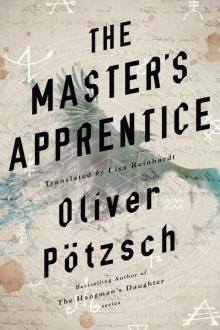
The Master's Apprentice, page 17
part #1 of Faust Series


“And this road leads to Krakow?” asked Johann.
Tonio laughed. “Not quite. But it’ll get us close. It’s a long way to Krakow. We’ll be traveling for many weeks—weeks I can use to teach you many things.” He looked up at the sky and squinted. “I only hope we’ll make it in time.”
Indeed, the master used their time on the road and the evenings to teach Johann more about astrology and the basics of alchemy.
“Many believe alchemy is just about finding a way to make gold,” he explained. “I, too, was once obsessed by this desire. But alchemy is much more than that. Alchemy, as it was taught by the great Hermes Trismegistus in Egypt and later by the Greeks and Arabs, grants us an insight into that which the world contains in its innermost heart and finer veins. Do you understand what I mean?”
Johann nodded, though he felt like he’d only tasted the tiniest drop of a vast ocean of knowledge.
The master was much nicer to him now than before their time at the tower. They had all but stopped practicing their juggling tricks, and Tonio rarely read palms and no longer compiled horoscopes at taverns. He seemed in a hurry to reach Krakow. On clear nights, the master spent a lot of time gazing at the stars. Something seemed to excite him very much.
“It’s happening much faster than I thought,” he’d say again and again, almost to himself. “Much faster. Who would have thought, this early in the year. The day is near . . .”
When Johann asked what he meant, Tonio merely shook his head and told him he’d find out in Krakow.
“You can’t keep walking around looking like that,” Tonio said one day, eyeing Johann critically. “You look like a scarecrow, not like the promising apprentice of an itinerant chiromancer and astrologer.”
Johann looked down at himself. It was true: his clothes were dirty and torn and much too small.
“We’ll need a new outfit for you,” the master continued. “Nothing in the garish patterns of jugglers’ clothing, nor the colorful garb of a dandy. It wouldn’t suit you—you’re a student of the arcane arts now, so we’ll need something serious, something plain.”
They visited a tailor in the next town, and Johann was fitted with a long black tunic, a warm black coat, and shiny leather boots. On his head, instead of a hat he wore a gugel—a type of fashionable hood that covered head and shoulders and was ideal in bad weather. His new trousers were made of the finest wool and felt nice against his skin. The master grinned.
“You look like an honorable scholar. Folks are going to doff their hats and ask you to write up documents for them.”
The countryside they were passing through now looked much like the Kraichgau. Johann learned that this region was called Swabia. Small villages were dotted among the patches of forests and the fields. The snow was melting, and it was nearly time for the first sowing. The wheel of life kept turning. Hungry faces marked by hardship stared at them from the fields. It looked as though Swabian farmers, too, had suffered much in recent years.
Once they passed a group of Dominican monks clad in black, chanting loudly and calling on people to repent their sins. The monks were accompanied by heavily armed mercenaries pulling a cart containing a chest with several padlocks. The chest bore metal fittings and, on the front, a painting of the devil with his fork, torturing souls in purgatory.
“Damned shavelings!” groused Tonio before spitting on the ground. “Don’t the farmers pay enough in tithes? Now they have to pay for a place in heaven, and one for the long-dead great-grandfather on top!”
Johann had heard of priests selling indulgences as a means of gaining forgiveness for sins. In the past, the only way to atone for one’s sins was through prayer or pilgrimage, but now people could shorten the amount of punishment they’d have to undergo with money. It was even possible to reduce the time long-deceased ancestors had to spend in purgatory—provided one had enough coins for the chest.
“People are as stupid as pigs,” Tonio continued as they drove past the chanting train. “And why? Because the church and the high and mighty deny them knowledge. But all that is going to change soon. Oh yes, soon! Homo Deus est!”
Johann had heard the last phrase from Tonio before. By now he could not only read Latin, but also speak it reasonably well. Despite understanding those three words, however, he still didn’t understand what they were supposed to mean together. The phrase didn’t make any sense to him.
Man is God . . .
There were more and more crossings in the road now, and increasing numbers of villages and towns. Trading routes led off in all directions, and every road seemed to be busy. Knights cantered past on their mighty steeds; expensively dressed merchants drove their heavily loaded carts along at a snail’s pace. Johann and Tonio heard some travelers talking about King Maximilian holding an imperial diet in Worms. The French had invaded Italy, and the accursed Ottomans threatened the borders of the German empire. Merchants were conducting business with faraway lands that had hitherto existed only in legends. The whole country seemed to be in a state of excitement, as if spring was liberating the entire empire from a long frost.
Five days later, the walls of a city appeared in front of them. Countless towers jutted into the sky, a large cathedral in their center. The greenish-gray ribbon of a large river gleamed in the spring sunshine. Hordes of pilgrims and merchants flocked toward the gates. Johann had never seen such a huge city before.
“Augsburg,” said Tonio grimly.
Johann had heard of Augsburg. He’d heard travelers in Knittlingen talk about this city; it was one of the largest in the German empire. They said it was ruled by patricians—powerful families of merchants and councilors who were unbelievably wealthy, owning properties all over the world and lending money to bishops, dukes, and even the emperor himself. It seemed like those men were the new masters of the world—not knights, counts, and barons, like in his mother’s days.
After spending the last few nights in the wagon by the roadside, Johann was glad they’d soon be staying at an inn again—and in such an interesting place. But, much to his disappointment, Tonio gave Augsburg a wide berth, and soon Johann lost sight of the city’s battlements, towers, and cathedral.
“Augsburg is far too dangerous a place for the likes of us,” Tonio said. “The bishop gives short shrift to sorcerers. Not too long ago they boiled an alchemist alive because he claimed he could turn iron into gold.”
“Could he?” asked Johann.
“Only very few are privy to that secret. The quack in question definitely wasn’t one of them. I’m guessing he couldn’t even tell the difference between copper and bronze.” The master gave a laugh. “Do you know what boiled human flesh smells like? Just like pork! At the end of the day, we all wallow in the same mudhole.”
Johann said nothing. Once again he realized that magic was a dangerous business. Something that counted as a harmless weather spell in one place could mean heresy and death in the next town. White magic like astrology, chiromancy, and some alchemy was allowed, but black magic like necromancy and sorcery wasn’t.
Soon enough, he’d experience the difference between the two worlds firsthand.
Their journey took them to the north, toward Franconia. The snow had all melted now, and the hawthorn and fruit trees were full of buds, birds chirping among their branches. The master whistled a tune and seemed to grow more cheerful with every mile. At night, he barely glanced up at the sky anymore. It seemed he had reached a decision.
“I am hopeful we’ll soon be meeting our friends,” he said. “In the town of Nördlingen, we’re going to meet a man who can help us on our journey. I’ve known him for a very long time. If the message I sent off in the mountains has been delivered, he should already be there.”
Johann had long since given up asking Tonio about his mysterious friends. The master didn’t volunteer any more information, but Johann hoped he’d learn more in Nördlingen. He was itching to know why his arrival was eagerly anticipated in Krakow. The only explanation he could come up with was that he’d shown, during their time at the tower, that he was a gifted student. He was a fast learner, interested in everything the master told him—be it the power of steam as taught by Hero of Alexandria, which Johann observed each night above their cauldron, or the technical secrets of mechanical clocks like the ones they sometimes saw on town halls or church spires. The master also taught him about the herbs growing by the roadside. Their lessons often started with Tonio spotting something and jumping off the wagon.
“Black hellebore,” he said one time, pointing at a pretty white flower by the wayside. “You can extract a poison from this plant strong enough to kill emperors and kings. In very small doses, it can ease insanity. If you ever pick black hellebore, make sure you wash your hands thoroughly—or you won’t live long enough to regret your mistake.”
Another time, he pointed at the black smoke rising from a charcoal pile in the woods. “Grind the coal from an alder buckthorn and mix it with sulfur and saltpeter. The resulting powder is powerful enough to burst the walls of Constantinople—I saw it with my own eyes!”
Johann, sitting on the box seat, listening to Tonio, realized he was learning much faster than back at school in Knittlingen. Thoughts and ideas flew into his mind as if Tonio had tapped some sort of spring inside him that couldn’t be stopped.
After two more days, they reached a curious area. A ridge of hills forming a gigantic ring spread before them. It looked to Johann like a giant had thrown a rock into an ancient ocean. Once again he was struck by the perfection of nature, the symmetry of the natural world, as though it had been built by a clock maker. He thought of the beautiful crystals of snowflakes melting in his hand; the wings of butterflies; and flower petals following the sun all day. When he told Tonio his thoughts, the master laughed.
“God as a clock maker—don’t let the church hear you talk like that. They suspect heresy behind every rock these days. But I like the image. It makes God kind of human, doesn’t it? Homo Deus est!”
Finally, they reached another large town surrounded by a high wall. The master explained that this was Nördlingen, where he hoped to meet his friend. The lanes and squares in the town were busy; a cattle market was in full swing. Pigs squealed and geese with tied wings cackled in their baskets. A calf on its way to the butcher’s block stared at Johann with big eyes. A huge newly completed church stood in the town’s center, still partially enclosed by scaffolding. The tall tower showed all travelers that Nördlingen considered itself on par with Augsburg.
“You should see this place at Whitsuntide,” Tonio said, carefully steering the wagon through the narrow lanes. “The fair is so spectacular that you even forget the stink.”
The air did smell strongly of blood and urine. Johann guessed the stench came from the many tanneries along the city stream. Old and young tanners washed skins in the water and hung them in their airy attics to dry.
They headed toward a tavern near the church. The tavern was several stories high, with a large gate in the center that led into a courtyard. To the gate’s left and right were pub rooms, and a wide set of stairs led up to guest rooms. Heavy oaken floorboards and gilded decorations made the tavern look almost palatial.
“The Golden Sun Inn,” Tonio explained. “Emperors have stayed here, and His Majesty King Maximilian just visited a few years ago. I thought we’d treat ourselves to some nice accommodation.”
Following their long, arduous journey and the many nights spent by the roadside, Johann went to bed early. The down quilt and fresh reeds on the floor seemed like heaven on earth. He slept like a log and only woke late in the morning to drumrolls and flourishes.
When he rushed to the window, he saw crowds of people heading toward the western gate. The master awaited him downstairs in the taproom.
“Quick, have some thinned beer and honeyed barley porridge,” he commanded, gesturing toward a jug and a bowl on the table. “We don’t want to miss the show. We’ve arrived at just the right time,” Tonio said, rubbing his hands. “A stroke of luck! My old friend hasn’t arrived yet, but there’s another acquaintance I wouldn’t mind seeing one last time.”
“Who is it?” asked Johann, curious.
“Oh, you’ll know him,” Tonio said with a smile.
Johann still didn’t understand. After a hasty breakfast, he followed Tonio out into the street. They joined the crowd heading out of town. Not far from the city walls, Johann saw a hill that had been cleared of trees and was crowned by a large rock.
The people seemed merry, buying nuts and pastries from itinerant merchants who carried their wares through the crowd on large back frames. Children squealed and ran after the drummers, and everyone seemed bound for the rock on the hill. It looked like an enormous table or altar and was more than five heads high. A pile of wood as tall as a man had been stacked on top, and a ladder led to a stake in the center of the pile. Dark-clad monks were swinging incense burners, and the smoke seemed to Johann like the harbinger of a much larger fire.
He understood now what kind of a show the crowd had come for.
“Everything’s ready,” the master said with a smile, his eyes appraising the hill in front of them. “All that’s missing is our friend.”
Johann was waiting with Tonio and all the people of Nördlingen, who were shouting and cheering, when a tumbrel pulled by a mangy donkey came jolting up the road. The hangman stood atop the cart, wearing a red shirt and a mask, and next to him, a man bound with ropes swayed back and forth as if he was drunk. Despite his torn shirt, blood-encrusted face, and arms twisted like those of a broken doll, Johann recognized him immediately: Freudenreich von Hohenlohe, the young minstrel from the Black Eagle Inn.
“They arrested him two months ago,” Tonio explained as he joined in the rhythmic clapping of the crowd. A kettledrum provided the beat. “The poor bugger conjured up a calf with two heads and a hailstorm that devastated the fields around Nördlingen. If you ask me, he probably didn’t pay his bill at the tavern or screw the landlady hard enough. Folks around here are easily angered. Apparently, good old Freudenreich was stubborn during torture, and that’s why it took so long to get him sentenced.”
The hangman dragged the trembling minstrel down from the cart. He barely resisted. The hangman’s assistants had to carry him for the last few yards because he could no longer walk. It looked as though his legs were broken, along with his arms, which were bent at unusual angles.
Tonio began to sing quietly. It was the same song Freudenreich had performed when they’d seen him at the Black Eagle at the start of winter.
“Winter, O winter, you frighten me not. I sit by the stove and my fire burns hot. O winter, keep howling, I show thee no mercy . . .”
Rough-hewn steps led up the rock to the pyre. The assistants tied Freudenreich to the stake and held a burning torch to the wood. The sticks were dry, and the flames devoured them hungrily. Soon the stake was enshrouded in thick white smoke.
Like a giant incense burner, Johann thought.
The crowd fell silent, tense with expectation, even the children. Then a scream rose out from the smoke, animalistic and shrill. Johann thought about how beautifully the minstrel had once sung. And he thought about the master’s words back at the Black Eagle.
He won’t find happiness in these harsh climes, oh no, he won’t.
Johann shuddered despite the heat of the fire. They had denied the great Tonio del Moravia his winter quarters, and he had taken terrible revenge. First the inn had burned down, and now the minstrel burned, too.
Freudenreich’s screams turned into inhuman screeching and finally a wailing that stopped abruptly. Then the smoke turned black. Johann smelled burned flesh, and it smelled like pork. He felt sick.
“Keep howling, I show thee no mercy,” Tonio sang once more, clapping his hands.
The execution was over, and after staring at the glowing embers for a while, the crowd began to make its way back to town. Johann was still in a daze, snapping out of it only when Tonio tapped him on the shoulder.
“I like fires,” he declared cheerfully. “Even though they remind me of darker times. Once I watched a young maiden I was very fond of burn in France. We were like siblings—that’s when it all began.” He turned around and didn’t look at the smoking pyre again. “And now let’s go. If we’re lucky, my friend has finally arrived.”
The master’s friend arrived in the evening. Tonio had been awaiting him impatiently at a corner table of the Golden Sun. Johann sat next to him, reading a book. The master had been drinking expensive Rhenish wine for hours but didn’t seem to be getting drunk—not even tipsy, although Johann noticed that he looked paler than he had back at the tower.
A broad-shouldered man entered the inn, dressed entirely in black, wearing a long coat and a floppy hat like Tonio. He was so tall that he was forced to stoop as he walked through the door. He carried a long staff, like that of a shepherd, except it looked like a little twig in his huge fingers. He smiled as he walked toward their table, but his smile seemed false, as if someone had painted it onto his pockmarked, bearded face.
“Mon baron, it is an honor to see you again after such a long time,” greeted the man with a rough voice, bowing low. Like Tonio, he spoke with a French accent, but his was much stronger.
“Don’t, Poitou,” said Tonio. “Not in front of the boy.”
The man scrutinized Johann, who suddenly felt naked.
“That’s him, yes? Looks rather unremarkable. Pale as a bookworm.”
“I’m a bookworm, too, if that’s what you want to call it. When will you learn that appearance doesn’t matter, Poitou? On the contrary. You may be big and strong, but your mind doesn’t allow you to think further than the next meal.”
“Oh yes, I like thinking about the next meal.” The giant gave a grin. “You’re right, milord. I can eat as much as my horse munching on his barley outside the door. I rode for two days and one night straight to proclaim your arrival and meet you here. There is much to talk about.”
“Parle français,” said Tonio, waving to the innkeeper to bring them more wine.