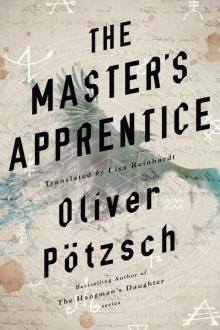
The Master's Apprentice, page 44
part #1 of Faust Series


Satan licked its jowls and gazed at its master from bloodshot eyes, evidently hoping for more. Johann stroked the mastiff behind the ears.
“Good dog,” he said in a low voice. “You’re a good dog.” He looked over at Karl. “Let’s see how we get on with our new friend. You don’t like Karl very much, do you? I guess you’re jealous.” Satan gave a growl, and Johann laughed.
When he’d seen Karl’s drawings in Leipzig, a shiver had run down his spine. The images had immediately reminded him of Valentin in Heidelberg, and so he’d continued to watch the student. The young man’s slightly clumsy yet proud demeanor had awakened memories in Johann. He had seen himself as a student in Heidelberg. And then he’d almost lost Karl in the same way he had lost Margarethe and Valentin; he’d arrived just in the nick of time. On the Warnheim market square he’d sworn to himself: never again shall a student burn as a heretic. He would take Karl with him and care for him.
But if he was completely honest with himself, he wasn’t doing it because of charitable, Christian feelings or because he merely needed a glass painter for his laterna. He could have hired a painter in one of the larger cities.
No, he did it because he could no longer bear the loneliness.
Despite his fame, despite all his freedom and the knowledge he had gained in recent years, Johann wasn’t happy. He had forgotten how to love, because it would seem his love brought misfortune to people. He loved his dog, but the dog didn’t know how to play chess. And so he wanted to give it a go with young Karl—in part also to assuage his guilt and atone for Valentin’s death.
Johann hoped very much that Karl wouldn’t be the next person he led into ruin.
The sound of flapping wings caused him to start from his thoughts. He looked up and saw a crow staring down at him from the branches of a nearby beech tree.
“Beat it, you damned beast!” Johann picked up a rock and threw it at the crow.
With a mocking caw, it flew away just to land on a different branch, where it continued to stare at him. Since his time with Tonio, Johann had hated crows and ravens. Perhaps that was why he always felt like they were watching him. Those birds seemed to be everywhere—in the mountains, lowlands, villages, towns, and cities. They circled above him in the sky and sat on rooftops, on the edges of wells, and on spires.
Sometimes Johann thought it was always the same three birds. Two crows and an old raven with a scuffed, jagged beak.
“Kraa!” called the crow. “Kraa, kraa!” Johann threw another stone and missed, and then he gave up with a sigh.
The noise woke Karl. The student rubbed his eyes and looked about. It seemed to take him a while to remember where he was and what had happened the day before. The scrapes and bruises he had suffered during his arrest would heal, but the trauma—Johann wasn’t so sure. Karl had come as close to death as a man could.
Johann gave the young man a nod and threw him a piece of bread. “Here, eat,” he said. “We must leave soon.”
“Why so early?” asked Karl with a yawn. He was pale, and dark shadows lay beneath his eyes; a scabby scratch went right across his forehead. But even in that state, Johann noted, he was handsome.
I’m going to have to look after him, thought Johann. Better than I looked after Martin, Margarethe, Valentin, and the others.
“Because this area isn’t safe,” he replied. “The Warnheim peasants might still be out looking for us. And I won’t be able to save you from the fire a second time.”
“And where are you headed?” asked Karl.
“North, east, south, west—I’m at home anywhere.” Johann shrugged. “But I think we’ll head north. There’s too much unrest in the south of the empire. Swabia, Bavaria, the Swiss confederacy . . . war seems to love these climes.” He grinned. “And I’ve never seen the North Sea. The cold ocean beating against the shore.”
“The . . . the North Sea?” Karl was suddenly wide awake. “But that’s awfully far! It’s going to take us many months.”
“We have all the time in the world,” said Johann. “Remember? You’re coming with me, no matter where! Otherwise the next post rider is taking a bundle of letters to Leipzig. Your old life is over.” He walked to the wagon. “And now hurry up, you lazybones. You can eat the bread on the way. And I swear I’ll teach you Lucena’s chess rules before we’re out of this goddamned Hegau.”
When the horse pulled the wagon back onto the road, the crow was still sitting in the trees. It tilted its head to one side as if listening intently. More flapping of wings came from the low-hanging clouds, and another crow and an old raven with a scuffed beak descended from above. They greeted the first crow with a hoarse croaking that sounded almost human.
When the wagon had rolled out of sight, they spread their wings and took off together.
20
THUS JOHANN AND his young companion headed north from Lake Constance. The air became colder, and the autumn wind tore at the wagon’s faded canvas. Most of the time, the two very different men sat side by side in silence, Karl occasionally eyeing his eerie companion furtively. Karl still couldn’t believe that of all people, the famous Doctor Johann Georg Faustus had saved his life, and that he was now traveling the empire at the man’s side. He was torn between admiration and fear. The doctor’s black eyes were deep and mysterious, like pools in the woods; dark secrets appeared to lie at their bottom, hidden from regular mortals like him. They seemed to magically draw Karl in as well as frighten him. Even after many days on the road together, Faust remained a mystery to him—not least because the doctor wasn’t particularly communicative.
“Is it true that you once found a treasure near Wittenberge by the Elbe?” asked Karl, trying to strike up conversation. They had not long left the city of Ulm.
“What? Is that what they say?” The doctor turned and met Karl’s inquisitive gaze. “And? Was it gold ducats, diamonds, or the philosopher’s stone? Although according to another rumor, I already found the latter in Krakow.” Clearly, the never-ending questions of his new travel companion had begun to annoy Faust, and yet Karl thought he could see a vain side in the itinerant scholar.
“Well, apparently you were digging in an old cellar when you found a worm who guarded a treasure. You chased the worm away with a mirror, and the treasure—”
“Do you really think I would sit on this rickety old wagon and sell cheap swill if I’d found a treasure?”
“It makes for a good story, at least.” Karl sighed. “I’m beginning to get the impression that not even half of what they say about you is true.”
“You’ll have plenty of time to find out what’s true and what isn’t. Giddyup!”
The doctor flicked the reins and the wagon rattled on, always toward the next rise, the next mountain range on the horizon. Satan stormed ahead, occasionally howling with pleasure, its jowls dripping. Satan was the hellish messenger announcing the famous Doctor Faustus, magician, chiromancer, miracle worker, and astrologer, in the townships along the imperial road. As alternative means of defense, the wagon also carried a sword and a newfangled wheel-lock pistol, but they hadn’t needed the weapons so far. The sight of Satan alone made wayside robbers take to their heels.
They usually stopped in larger cities, where Faust and his assistant stayed for several days at a time. In the course of the following weeks they visited Rothenburg ob der Tauber, Würzburg, Mainz, and Frankfurt am Main, a large city of commerce, where they set up shop at the cloth market in front of the city hall and thrilled the crowds. Leipzig aside, Karl hadn’t seen much of the empire.
Every city had its own smells. The pungent stench of lime kilns, the delicious smell of baked gingerbread, the numbing scent of hop mash, and the blood odor of freshly slaughtered pigs—but most of all, the stink of the gutter. Dialects changed and so did the people, who gaped at the two travelers as if they were kings from the Orient, and made the sign of the cross once they’d passed. After his initial reservations, Karl began to like this way of traveling. He enjoyed the wide world of the highway, which was so different from the drab routine at the university. His role as the announcer, assistant, and joker was growing on him, even if he’d never become an outstanding juggler.
Faust’s reputation preceded him. Even from afar, people recognized the wagon with the strange-looking symbols and the mysterious man on the box seat with the blue-and-black star cloak and the floppy hat. The doctor usually rented a room in one of the better inns and set up on the market square to sell his foul and potent theriac. Faust read palms, cast quick horoscopes, and placed his hand on people’s foreheads after previously rubbing his palm with his stinking miracle cure. It was one of Karl’s jobs to appear as a blind young soldier who was healed by the famous Doctor Faustus.
But the biggest attraction by far was always the laterna magica.
They’d use the biggest room with shutters at the tavern. People paid two hellers’ admittance and had the experience of a lifetime inside the darkened room. They’d never seen anything like it. The spectators trembled with fear as the ghastliest figures appeared on a white sheet stretched at the front of the room: devils, fiends, witches, and ghosts that Faust invoked with a loud voice and then chased away with the help of Latin spells. The cries of the audience could be heard in the streets, and people staggered outside at the end of the show and told others what they’d seen with a mix of fear and delight.
Karl usually worked on the glass paintings at night, in the flickering glow of an oil lamp. For inspiration he used whatever mythical creatures were known in the region where they had stopped: the wild man, evil Trude, the Tatzelworms, werewolves, and malevolent little elves. Occasionally the doctor would watch him at work and mutter strange words.
“Your drawings are different from his,” Faust said with a nod, more to himself. “But no less good. Hmm. Not as creative, but more accurate. I think the people like them, and that’s the main thing.”
Karl never received an answer to the question of who the doctor was talking about.
In the course of weeks, Karl developed a sense for which sort of pictures they just got away with and which would land them at the stake. The church and the cities permitted the game with evil as long as it served their purposes. But still, it was a perpetual balancing act. More than once they had to make a hasty retreat before the town’s guards threw them into jail, because some of the images seemed so real that people thought the apocalypse had begun. Karl’s wolves had sharp fangs with saliva dripping from the points, and the eyes of the gnomes shone in an eerie light that couldn’t stem from this world. Sometimes Karl tried his hand at flowery landscapes or handsome youths, but Faust threw them into the fire every time.
“People must be frightened—that’s your job,” he’d growl at Karl. “Leave the pretty and angelic to the church.”
“But what we’re doing here is nothing but cheap trickery!” retorted Karl indignantly. “We could put the laterna to much better use. At universities, for example, to show anatomical—”
“You paint what I tell you to paint and that’s the end of it!” snapped Faust grumpily. “I’d rather work on improving your chess skills than watch you waste time on drawing muscular torsos of handsome boys. You’re still a lousy player. Now go and sweep the wagon—it’s like a pigsty in there.”
In moments like those Karl considered leaving the doctor, even though he knew that would turn him into an outlaw. Faust possessed those accursed letters that would forever brand him as a sodomite. If they fell into the wrong hands, he would never be able to return home to Leipzig, nor set foot in any other university towns. He wasn’t sure how far-reaching the doctor’s influence in the empire was. He seemed to have been everywhere already, which made their travels seem strangely aimless. As far as Karl could tell, Faust’s life had been one long, never-ending journey. He wasted all his knowledge, all his wisdom, on dumb peasants and thrill-seeking burghers, as if throwing pearls to the pigs.
When, in fact, the doctor was a walking library. In one of his chests, Faust was keeping books each worth several gold ducats. Karl had leafed through some of them in secret. Lucena’s accursed chess book was one of them, but also Gregor Reisch’s Margarita Philosophica, a precious encyclopedia in twelve volumes, which seemed to contain the collective knowledge of men. Karl also discovered the Speculum Astronomiae by Albertus Magnus, who was considered a sorcerer by scholars at Leipzig University and whose name was blacklisted. So was Faust a real magician, too?
Karl sighed deeply and packed away the juggling balls, the garishly colorful costumes, and the bottles of theriac, which reeked of cheap liquor. Then he swept out the wagon before the doctor had one of his infamous tantrums. Faust was like a haunted man, forever on the run, but Karl didn’t know what from.
It would be months yet before he’d find out.
They took up winter quarters in Erfurt, one of the largest cities of the German empire and roughly in its center.
Johann called Satan back with a shrill whistle as they passed through the wide city gate. The guards, clad in thick woolen coats and fur hats, eyed the strange travelers skeptically at first, but when Johann gave his name and asked Wagner to hand out a few bottles of theriac, the guards allowed them through. Johann had visited the city several times before. The University of Erfurt was considered one of the best in the country, and the rector usually allowed him to hold a few lectures. The students attended in droves and relished the doctor’s witty observations and theological discourse, which always bordered closely on heresy. Until a few years ago, Erfurt had been a wealthy city, but the duties the citizens had to pay the Saxon elector and the Mainz bishopric had brought the city to the brink of ruin. When they’d tried to raise the taxes again the year before, the people had rebelled and hanged one of its aldermen.
Erfurt wasn’t the only place where the common people had begun to rise against the high and mighty. Johann had seen many rebellions. A few years ago, thousands of farmers had rebelled in the bishopric of Speyer, and their leader, a certain Joß Fritz, had escaped and had been busy riling up people in other regions ever since. The whole country was seething, and Johann waited for the spark that would set off the powder keg.
It couldn’t be much longer.
Winter came over Erfurt with icy temperatures and snow, which piled up knee deep in the lanes. Beggars froze beneath bridges, and the poorer households struggled for firewood. The honorable and widely traveled Doctor Faustus and his assistant lodged at one of the better inns on Michaelsgasse Lane, not far from the university. In the evenings, when the musicians struck up a tune and harlots visited the tables with big smiles and low-cut dresses, Johann mostly sat in a corner by himself, while Karl—under the disapproving looks of his master—drank with the younger fellows.
Johann loved his quiet time after the shows and lectures; he despised idle gossip. He enjoyed the fact that while people respected him, they basically feared him and avoided his company—partly, of course, because of the calf-sized dog lying under his table and growling at any unwanted intruder.
Over the years, several women had tried to get close to Doctor Faustus, the mysterious man with raven-black hair and equally black eyes. He had pushed them all away. A few times, when the urge became too strong, he’d visited whores, but the moaning and sighing, the rubbing together of naked bodies, soon repulsed him. When he closed his eyes he saw Margarethe—and then he felt sick. And so he gave up on whores. He lived like a restless monk. Karl’s presence didn’t change that, even though the young man tried occasionally to encourage Johann to have a little fun.
In Erfurt, Johann decided to be a little nicer to his assistant. The boy was doing a decent job, and even though Karl’s endless questions got on his nerves, at least he didn’t feel quite as lonely.
One evening, when they sat together at a table at the back—avoided and yet watched by the locals—dining on roast meat and enjoying a jug of wine after a particularly successful show, Johann raised his goblet.
“To your latest paintings,” he said to Karl with a smile. “I particularly like the hell-dragon. Three women fainted today. You’re doing well!” He threw Satan a bone, which the dog caught in the air and snapped in half with one bite. Johann patted the beast’s head lovingly before turning back to Karl. “But we must work on your performance as a blind soldier. People may be dumb, but they are not as stupid as sheep.” He shook his head. “No one buys how easily you saunter across the stage as a blind man.”
“I’m a student of medicine, not a dishonorable juggler, remember?”
“Don’t mock jugglers,” replied Johann with sudden coldness in his voice. “They enchant people just like we do.”
He emptied his goblet in one gulp and brought it down so hard that several other guests turned their heads and whispered to one another. Karl’s remark had woken memories in Johann—memories from his time in Venice, of Salome, Emilio, and Peter the fiddler, whose death he’d foreseen a long time ago. Every now and then this strange gift had befallen him again, but he had learned to handle it. He still struggled when it was young adults and children, but he never told them the truth.
He wondered if he would have foreseen Margarethe’s death.
“May I ask you something?” said Karl hesitantly.
Johann forced himself to shake off the memories. When he nodded, Karl cleared his throat. It seemed something had been bothering the young man for a while.