

Habits for Healing, page 1


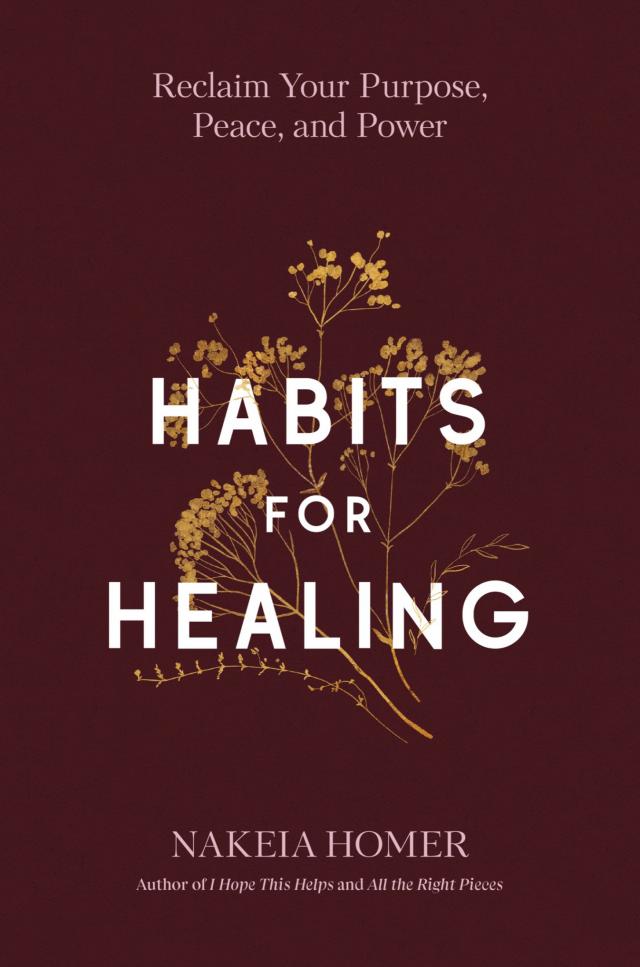
Copyright © 2024 by Nakeia Homer
All rights reserved.
Published in the United States by Convergent Books, an imprint of Random House, a division of Penguin Random House LLC, New York.
Convergent Books is a registered trademark and the Convergent colophon is a trademark of Penguin Random House LLC.
Library of Congress Cataloging-in-Publication Data
Names: Homer, Nakeia, author.
Title: Habits for healing / by Nakeia Homer.
Description: New York, NY : Convergent, [2024]
Identifiers: LCCN 2024016311 (print) | LCCN 2024016312 (ebook) | ISBN 9780593727782 (hardcover) | ISBN 9780593727799 (ebook)
Subjects: LCSH: Self-actualization (Psychology) | Burn out (Psychology) | Mental health.
Classification: LCC BF637.S4 H6443 2024 (print) | LCC BF637.S4 (ebook) | DDC 158.1—dc23/eng/20240506
LC record available at https://lccn.loc.gov/2024016311
LC ebook record available at https://lccn.loc.gov/2024016312
Ebook ISBN 9780593727799
convergentbooks.com
Cover design: Laura Palese
Cover artwork: Creative Market
ep_prh_7.0_148318219_c0_r0
Contents
Dedication
Introduction: Healing My Way Out
Taking Notes
Part One: Reclaim Your Purpose
Chapter 1: The Habit of Selfish Time: How Self-Care Heals Our Relationship with Worthiness
Chapter 2: The Habit of Editing Your Life: How Letting Go Heals Our Relationship with Change
Chapter 3: The Habit of Playing Your Role: How Personal Accountability Heals Our Relationship with Control
Part Two: Reclaim Your Peace
Chapter 4: The Habit of Lowering Expectations: How Acceptance Heals Our Relationship with Bitterness
Chapter 5: The Habit of Knowing Your Limits: How Self-Forgiveness Heals Our Relationship with Progress
Chapter 6: The Habit of Daily Investigation: How Not Taking Things Personally Heals Our Relationship with Truth
Part Three: Reclaim Your Power
Chapter 7: The Habit of Protecting Your Energy: How Minding Your Business Heals Your Relationship with Focus
Chapter 8: The Habit of Confrontation: How Setting Boundaries Heals Our Relationship with Connection
Chapter 9: The Habit of Not Settling: How Remembering Who You Are Heals Your Relationship with Possibility
A Word on Healing
Acknowledgments
About the Author
To the one who made me:
Thank you for being strong enough to wear all the heavy things that came with being a teenage mother on your back and choosing to carry and deliver me into my destiny.
To those I am called to:
Thank you for inviting me on your journey and allowing me to contribute to the work you are already doing for yourself.
Introduction
Healing My Way Out
Circumstance does not make the man; it reveals him to himself.
—James Allen, father of self-help writing and author of As a Man Thinketh
At thirty-one years old, I embarked on a major life pivot when my family and I moved eight hundred miles south, from Delaware to the Metro Atlanta area. We were in search of new opportunities, new relationships, new creative energy, and ultimately a fresh start.
I was in my “new state, new me” era—eager to continue uncovering my purpose, to become a better wife, a better mother, and basically a better version of myself.
Books and YouTube videos were my teachers at the time. I must have spent a hundred hours those first few months absorbing every Zig Ziglar video or Jack Canfield book I could find. At one point, I literally ran out to my local public library to pick up As a Man Thinketh, the latest book I had learned about while watching a self-help lecture.
I’m not going to lie, reading that book was tough. Plowing through the thinkeths, thous, and suffereths was as difficult as a six-year-old trying to read (and understand) the King James Version of the Bible in Sunday school. But when I read the words “Circumstance does not make the man; it reveals him to himself,” my world stood still. I finally felt seen. Those words helped me make sense of my entire life.
I grew up in what social workers would consider dysfunctional circumstances. My parents were fifteen and seventeen when I was born, so my paternal grandmother stepped in to foster me. My mother lived close enough that I could walk to and from her house, freely. When I was nine, my grandmom petitioned to gain custody (a necessary step so she could add me to her health insurance). One day after school, I found myself sitting in a judge’s chamber, being asked who I wanted to live with. I told the judge I wanted both: my grandmom and my mom. He said I had to choose one. I picked my grandmother.
Looking back, I see my choice that day as my first major act of self-care, but it was a heavy decision for a nine-year-old to make. Many of my family members didn’t understand. The order of custody was supposed to be temporary, a chance for my mom to come of age and start cultivating a home for us. It turned out to be permanent.
By the time I was seventeen, my Adverse Childhood Experiences (ACEs) score was 10, the highest one can earn. I grew up around adults who experienced depression, were in and out of prison, and were addicted to drugs and alcohol. And every time I left my mom’s house, I had an overwhelming feeling of loss and rejection. Wherever I turned, I felt like I never truly belonged. There was always some reminder that I wasn’t kept, chosen, or “normal.”
As a child, I used to sit on the steps that led up to the door of our apartment in the projects, and daydream of a better life. I hadn’t yet experienced it, but part of me hoped that I could find a life outside of the struggles I had seen in my family and community—like teenage pregnancy, drug addiction, domestic violence, and poverty. I believed if I committed myself to doing things differently, I’d eventually experience it.
Over time, I came up with a strategy: I would do the opposite of every bad habit I saw around me. That’s all my little mind could think of at that age. The overtly bad habits were obvious: Say no to drugs, stay away from men who were controlling and aggressive, and get a good education. It seemed simple enough. But on a deeper level, I was unaware of the catch: Having to grow up fast, take on grown-up duties, and navigate pressures even the adults in my life couldn’t handle put me in a constant state of survival mode. Eventually, that pressure had its consequences. I became tough and verbally aggressive. I grew hypervigilant and overly sensitive to the needs and wants of family members with addictions. Every moment of struggle felt like something I needed to overcome—not just for me, but also for the family members and friends who couldn’t.
Today, I am a first-generation college graduate, working as a mental well-being professional, business owner, and author. I made it out of the hood, physically. I broke generational cycles of abuse, poverty, and addiction. But my upbringing left scars that I’ve spent the majority of my adult life working through and trying to heal. Guilt and shame clung to me as I tried and failed to save family members from hardship. I became an overachiever, the kind of person who worked, studied, and researched, and left no room for a social life. This led to serious burnout, migraines, lower back pain, digestive problems, and other stress-related issues. My day-to-day was dictated by a constant fear that something bad was going to happen.
When I was earning my degree in psychology, my textbooks and lectures contained no mention of “healing” those habits I had developed over the years. We were taught about diagnosing, coping, and predicting outcomes but given little to no information on how to help restore and mend survivors back to a place of mental and emotional health and well-being.
I wanted more. I wanted to build a life that had room for me to just be without struggle, without the lack of security and stability, and without the lingering habits of trauma. I wanted to uncover my gifts, explore my talents, and choose a path driven by joy and pleasure. I wanted to know what it felt like to walk through a safe neighborhood and someday cultivate a functional family dynamic of my own. I wanted to replace worry, hardships, and chaos with peace, power, and purpose.
Your circumstances might be different from mine, but I’m guessing you know what it’s like to be at war with a pattern or cycle. Maybe you are honest about your trauma, but you think that because it’s in the past, you are “okay.” You’ve moved on. Or maybe you’re conscious of the emotional bruises and scars you still carry. You know that you can’t change the past, but now that you are on the other side of it, you’re struggling to change the habits and the mindsets you had to develop to survive it.
I wonder if, like me, you’ve been on a mission to set things right in your life. Maybe you’ve worked hard so you would never be broke again. Maybe someone hurt you, and you’ve developed thick skin so that wouldn’t happen again. Maybe you’ve learned how to let things slide, how to shelve certain issues, and how to ignore simmering conflict because you are tired of negativity sucking the energy out of your life. Or maybe you went out of your way to prove you were different from the people who hurt you, and now you feel like the black sheep of the family.
People like us are riddled with burnout, emotional exhaustion, toxic relationships, somatic symptoms (like headache
Habits for Healing extends an invitation for you to take back control of your life. Your past or your current circumstances may have upset you, hurt you, confused you, or caused you to do things you never thought you’d do—but they didn’t make you. It’s your habits that are to blame for where you are today.
Forming a habit is inevitable. You may have heard that people are “creatures of habit.” We are biologically wired to repeat behaviors that meet our needs, and this mechanism is designed to sustain us.
But this process of forming habits isn’t always a conscious one. You can repeat a behavior without even realizing it—like getting the same haircut for ten years or eating a whole bag of chips when you’re stressed. It’s even possible to activate a default response to something you experienced before—like saying “good” when someone asks how you’re doing (even when you’re not good) or working late every night to avoid an argument with a partner with mood swings. People develop countless habits in split-second moments or during complex experiences, and those habits can grow into behaviors and eventually evolve into values.
The habits we will work to heal in this book are the behaviors you’ve developed, often early in life, to manage struggles, hurts, or setbacks. To push through those experiences, you began to respond in ways that helped you protect your heart, keep the peace, and survive. And because those behaviors served you at the time, you set them on repeat. They then became your automatic responses to similar experiences or any perceived threat to your well-being. So, you’ve managed to get this far in life giving little thought to how the habits that once served you are now making things happen that you don’t want.
Listen, this is in no way a diss. You did what you were supposed to do! You made it through, out, and over to the other side—and hear me when I say I see you. And now your habit of trying to survive your circumstances may have revealed some telling things about who you are and how you show up in the world.
You’re a survivor.
You’re the strong friend.
You know how to get things done.
You don’t ask for much.
…You’re also exhausted.
Hustling to build a life and career, guarding your heart, holding on to what you love for dear life, or being a rescuer may have served you in the past. But here you are now: Discontented with what your life has become, and longing for fulfillment, freedom, and autonomy. Longing for peace, purpose, and power.
Maybe you’re at a crossroads: You’re lacking the motivation to do things differently or you’ve accepted that your life will always be hard; but there is a part of you that is still holding out hope that life can get better.
Listen to me. You are right.
Life can get better.
Habits for Healing
In this book, we will consider the negative habits you may have missed on your journey, or the fears you are struggling to heal. We’ll uncover the story behind your mindset. We’ll address sources of beliefs and behaviors that make you resistant to change. We’ll look at how not prioritizing yourself, not setting boundaries with family and friends, not being able to let things go, being too hard on yourself, and taking things personally are all keeping you from becoming the person you are meant to be. We’ll shift from habits for survival to habits for healing, which will push you closer to the meaningful life you deserve.
In part one, Reclaim Your Purpose, we’ll examine habits that will help you identify your needs, release things that limit your well-being, and develop the courage you need to take back ownership of your own life.
In part two, Reclaim Your Peace, we’ll consider habits that help you move away from things you can’t control, improve your self-esteem, and free you from dependence on acceptance and approval from others.
In part three, Reclaim Your Power, we’ll explore habits that you can leverage to focus on what matters, improve your relationship with yourself and others, and stand in the truth of who you are.
You’ll read a mixture of stories from my own life and from clients I’ve worked with throughout my career. By sharing the circumstances that helped shape me, I hope to inspire you to own your journey, so you can decide on the direction of the stories that have yet to be told. And as for my clients, every story is real, but all identifying information (names, ages, and timelines) has been changed to protect their privacy.
As you read, I want to encourage you not to downplay your traumatic experiences if they don’t seem as dramatic as mine or those of someone else you know. Bad breakups, growing up with emotionally unavailable adults, being bullied by friends or siblings, or being treated poorly based on your abilities, skin color, gender, or core beliefs are all experiences that require healing.
You can see the unfortunate circumstances you’ve experienced as just a chapter in the story of your life and fill the rest of your pages with stories of overcoming, healing, and growth. Remember that your circumstances didn’t make you—your habits did. Every unhealthy habit can be replaced with a new and healthy one. You can decide, at this moment in your life, to do things differently.
Each healing habit and practice in this book is intentionally designed to empower you to transform the relationship you have with your past, your future, yourself, and with others.
I’m so proud of you for honoring the pieces of yourself that are rooted in the hope that life can be so much better.
Keep believing that you will experience it.
Taking Notes
When you see the pencil icon above, you may want to fill out your answers on a separate piece of paper or use the Notes functionality on your eReader.
If you are using a touch-screen reader or app, simply hold your finger over the first word in the line and then select “Note” to create a note and begin typing your answer.
If you are using a non-touch-screen reader, move your cursor up to the line where you want to enter an answer and then begin typing to create a new note.
You can then reference your answers anytime you are reading the eBook as they will be stored as notes on your device.
part one
Reclaim Your Purpose
Refuse to inherit dysfunction. Learn new ways of living instead of repeating what you lived through.
—Dr. Thema Bryant
Chapter 1
The Habit of Selfish Time: How Self-Care Heals Our Relationship with Worthiness
I take the long way home from every destination I can. From the grocery store, the post office, dropping the kids off, the gym—each drive is an opportunity for me to just be with myself. The music or podcast is up as loud as it can go. Phone conversations with my friends are spicy, juicy, and full of details only safe to be shared in the car. Some rides are silent, and some rides are just for tears. I think. I lament. I hold space for myself. During some of my sacred rides alone, I’ve written songs, poems, and prose through voice notes. I’ve even practiced keynotes, telling an employee I was letting them go, and how I was going to explain to my son why I ate all the candy I told him he couldn’t have.
Every drive counts. Once I walk through the door to my home, I am no longer just with myself. Even if I get only ten to fifteen more minutes alone, I savor these moments in the car when I get to do whatever I feel like doing. For years, this was my only real self-care practice. Now, it sits at the top of my list.
I didn’t see driving as self-care at first. I didn’t even realize this was a pattern until life got busy or I just stopped prioritizing the habit. When I felt anxious, I’d hop in the car and go for a drive. When I needed to think something through, I’d hop in the car and go for a drive. When I wanted to be alone for a while—surprise, surprise—I’d hop in the car and go for a drive. Because so much of my life was about taking care of other people, these bouts of me time in the car became a way to recharge. When I took time to be by myself, I had enough gas in the tank to engage in the other responsibilities I had committed to. But when I didn’t, my anxiety, tension, and burnout would only persist, eventually taking a serious toll on my mood, how I engaged with my family, and my workflow.





