A Writer Prepares, page 26


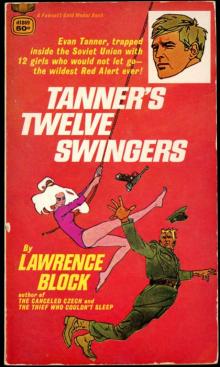
That phase ended when I began writing about Tanner. Because his first appearance was a novel only I could have written, from the point of view of a character no one else could have created, an imaginary chap who told his story in a voice that was uniquely mine.
I don’t want to overstate this. I’m reluctant to denigrate the body of work that preceded Thief as derivative and meretricious; some of my ten-day wonders for Bill Hamling were both those things to one degree or another, but a number of those early books and stories did a good enough job of being what they’d set out to be.
There are in fact readers today who would contend that some of my earliest crime novels—Grifter’s Game and Borderline, for instance—have a drive and an energy and a verbal economy that make them more satisfying than the more ambitious novels that have followed them. I don’t agree, not at all, but I’m able to see their point. And who’s to say my judgment of the work is any more valid than anyone else’s?
Never mind. The point is that my earlier work, whatever its strengths and weaknesses, was at bottom derivative and generic; it was the work of an imaginative and talented young man determined to make his mark as a writer.
By the time I’d written that first book about Tanner, that mark, let us be clear, was still unmade.
But I had found my voice and was on my way. Writing Tanner was an exhilarating experience, and it spoiled me. I’d written a book I was born to write, and that’s how I wanted to spend the rest of my life.
26
December 1, 2020
New York City
So I think it’s time to bring this book to a close. It’s early 1966 in the narrative, and I’m almost twenty-eight years old, with a wife and two daughters and enough published books and stories to fill a shelf. I’ve written a novel I can regard as the end of my apprenticeship, and not coincidentally I’ve wrapped up a successful experiment with corporate life and will return to freelance writing in and around New York City.
A Writer Prepares. Indeed—and I’ve spewed out an abundance of words chronicling that preparation, and I can’t be alone in thinking what I’ve written is more than enough.
And yet there’s a sense in which my apprenticeship has never ended, for how could it? A Trawl Among the Shelves, Terry Zobeck’s comprehensive bibliography of my work, begins with a section of books published as individual volumes. The Thief Who Couldn’t Sleep is A71; the most recent, Dead Girl Blues, is A209. Once Tanner helped me find my voice, I’ve apparently found it impossible to shut up.
That’s 128 books since the putative end of my apprenticeship, and not a few of them were written with no higher goal than to keep the pot boiling. But the humblest of them were the work of a writer who was at least maturing if not altogether mature. One could question the worth of John Warren Wells’s books, but they were a healthy cut above those of Benjamin Morse, MD. Jill Emerson’s three paperback originals for Berkley—Thirty, Threesome, and A Madwoman’s Diary—were as erotically purposed as any of the Lord/Shaw titles, but they played the game at a much higher level.
• • •
And here I am, so many years later, sitting in front of a computer and trying to come up with the requisite words. I don’t know how much time I have left, but I have that in common with the rest of the human race. I’m grateful for the time I’ve had, and that I’ve been privileged to spend it making things out of words.
I think I’ve written my last work of fiction, but I would have told you as much several books ago. Like Rick Blaine, who came to Casablanca for the waters, I was misinformed.
A few years ago my friend Oto Penzler, a bookseller and independent publisher, told me a story. Some years earlier he’d had dinner with Leon Uris, whose bestselling novels Battle Cry and Exodus he’d much admired. Uris confided that he’d recently completed a new novel and hadn’t found a publisher for it. His regular house had passed on it, and no one else who’d seen it had leapt at the opportunity to take it on. Otto expressed interest and Uris promised to send it over.
Otto was elated—until he read the book. He found a way to return the manuscript diplomatically, and walked away shaking his head.
I found the story chilling. I felt for Otto and the awkwardness of the position in which he’d found himself, and I also felt for Leon Uris, whose work I too had enjoyed and admired. I envisioned myself in his position, an old man who’d rounded out a distinguished career by writing a genuinely bad book.
It’s way too easy to stay too long at the fair.
• • •
Uris did eventually find someone to publish his book, and while it wasn’t well received, I don’t suppose it did his reputation any great harm.
And I don’t worry too much about my own reputation; if I did, I’d probably retire many of those early pseudonymous works I’ve been so pleased to republish. Those chips can fall where they may.
None of the work’s going to last very long, anyway. A writer sounds even sillier than a politician when he goes on and on about his legacy. Some of the books will be around longer than I, but only by a few years, and why should that matter to me? If there is indeed life after life, I doubt I’ll squander much of it caring whether somebody’s having a good time reading Ronald Rabbit is a Dirty Old Man.
A Last Word
January 24, 2021
New York City
And that’s that.
In the past month, I’ve come to the conclusion that I’ll be happiest self-publishing this memoir. I’ve explored some other possibilities and am grateful to several publishers who’ve expressed varying degrees of interest. But publishing A Writer Prepares myself has two undeniable advantages.
The first is that the text won’t be filtered by any editorial sensibilities other than my own. This, I hasten to admit, is not always a Good Thing. A more objective eye than the author’s can lead to a considerably improved book.
And that might well be the case here. But this is such a thoroughly personal book that I’d really prefer to dispense its content directly from my lips to your ears. Nor do I have either the energy or the patience for the to-and-fro process of working with an editor, toward what always is but rarely appears to be a common goal.
Or the time.
And time, let me say, is the second advantage of self-publication. It’s my intention to bring out this volume just five months from now as I write these lines. June 24, 2021, will be my 83rd birthday, and it will also be publication day for A Writer Prepares, even as that date in 2020 was pub day for my novel, Dead Girl Blues.
I like the synchronicity. Even more, I like the fact that the book will be published sooner rather than later—indeed, a good deal sooner rather than a whole lot later.
That’s always been my inclination.
Don Westlake told me of an acquaintance with an unqualified passion for fast driving; the fellow’s ideal, Don said, would be to have a car that would get from Point A to Point B in zero seconds. (In various guises, the chap found his way into Don’s fiction, not least of all in the person of Stan Murch, designated driver for the Dortmunder Gang. Of course there was also a lot of Don himself in Murch, as far as that goes, but never mind.)
I’ve been that way about publication. When I finish a book, I want things to happen ASAP. Once I’d skipped two spaces and typed “THE END” I wanted nothing so much as to get up from my desk, go outside, walk around the corner, and see that very book on a bookstore shelf.
Point A to Point B.
Zero seconds.
• • •
Over the years, of course, I’ve learned patience. Time takes time.
Even as it flies.
And, as it does that, it teaches impatience.
Sometimes by example. It was around the start of 2020 that I decided to return to work on this book, and since that date I’ve marked the passing of the following writer friends and acquaintances:
Mary Higgins Clark.
Clive Cussler.
Jerrold Mundis.
Patrick Trese.
Patricia Bosworth.
Bruce Jay Friedman.
Pete Hamill.
Parnell Hall.
John Lutz.
And Walter Bernstein. I didn’t know him well, but relished his company the handful of times our paths crossed. I really thought Walter might live forever, but nobody lives forever, and just yesterday, at the age of 101, he too joined the majority.
• • •
Everybody Dies.
That’s the title of the fourteenth Matthew Scudder novel, and when it came out I was sometimes asked if it was intended to be philosophical or descriptive. Why, I wondered, couldn’t it be both?
And it was for the epigraph of A Long Line of Dead Men that I quoted a few quatrains of William Dunbar’s “Lament for the Makers,” a posthumous roll call of Scottish poets, each stanza ending with Timor mortis conturbat me.
“Fear of death disturbs me.”
That’s Google Translate’s helpful suggestion. But an online Latin-English dictionary declines to supply to disturb, offering instead “to confuse, to disquiet, to confound, to derange, to dismay, to upset, to mix up.”
Indeed. All those things.
• • •
A week ago, Lynne and I went over to a public high school on Stanton Street and received our first doses of Moderna’s vaccine. For close to a year I’ve been as socially distanced as Simeon Stylites, and all that time I’ve taken it for granted that somewhere along the way I’ll come down with the virus. And, with a medical history that includes atrial fibrillation and bypass surgery, I could realistically expect to die of it.
Well, maybe not. Perhaps the city will replenish its now-exhausted supply of vaccine, and perhaps we’ll get our second round of shots, and perhaps they’ll truly keep the virus at bay.
Perhaps the time remaining to me might be measured not in weeks or months but in actual years.
I certainly hope that’s the case. When I had my bypass just three years ago, it was almost exhilarating to realize just how much I wanted to live, not so much for fear of the darkness as out of a desire to remain a little longer in the light.
I had things I wanted to do—and, indeed, I’ve had the luck to do some of them. Even more than that, I wanted to know what would happen next.
See, I’ve always wanted to know what happens next.
• • •
Meanwhile, I’ll hurry this book into print. On my birthday, as I’ve proposed—and by that time I’ll have witnessed the publication of Afterthoughts: Version 2.0, a consideration of some of my backlist titles. And Collectibles, my latest effort to demonstrate that anthologism is the last refuge of the used-up writer.
And, God help me, there a story I sort of want to write, probably a novella. I’m not desperate to write it, and I certainly don’t feel that it needs to be written, but each time I push the idea aside it manages to come back. Even if I begin writing it, I may very well lose interest along the way, or find it impossible to summon up the energy to see it through.
Before it’s written, I may have added my own name to that list.
A Writer Prepares.
T H E • E N D
About the Author
LAWRENCE BLOCK is a Mystery Writers of America Grand Master. His work over the past half century has earned him multiple Edgar Allan Poe and Shamus awards, the U.K. Diamond Dagger for lifetime achievement, and recognition in Germany, France, Taiwan, and Japan. His latest novel is Dead Girl Blues; other recent fiction includes A Time to Scatter Stones, Keller’s Fedora, and The Burglar in Short Order. In addition to novels and short fiction, he has written episodic television (Tilt!) and the Wong Kar-wai film, My Blueberry Nights.
Block contributed a fiction column in Writer’s Digest for fourteen years, and has published several books for writers, including the classic Telling Lies for Fun & Profit and the updated and expanded Writing the Novel from Plot to Print to Pixel. His nonfiction has been collected in The Crime of Our Lives (about mystery fiction) and Hunting Buffalo with Bent Nails (about everything else). Most recently, his collection of columns about stamp collecting, Generally Speaking, has found a substantial audience throughout and far beyond the philatelic community.
Lawrence Block has lately found a new career as an anthologist (At Home in the Dark; From Sea to Stormy Sea) and holds the position of writer-in-residence at South Carolina’s Newberry College. He is a modest and humble fellow, although you would never guess as much from this biographical note.
Email: lawbloc@gmail.com
Twitter: @LawrenceBlock
Facebook: lawrence.block
Website: lawrenceblock.com
My Newsletter: I get out an email newsletter at unpredictable intervals, but rarely more often than every other week. I’ll be happy to add you to the distribution list. A blank email to lawbloc@gmail.com with “newsletter” in the subject line will get you on the list, and a click of the “Unsubscribe” link will get you off it, should you ultimately decide you’re happier without it.
Lawrence Block, A Writer Prepares