A Writer Prepares, page 2


Well, I’m older now.
• • •
And now what?
The simplest approach, and surely the easiest, would lie in publishing exactly what I wrote in 1994, neither more nor less. The problem is that there’s no resolution; the account of my early days simply stops on one of those days, for no apparent reason beyond the fact that my stay at Ragdale had run its course. It was time to go home, and I could stroll a bit further down Memory Lane once I got there.
Except, of course, that I didn’t.
One thinks of Samuel Taylor Coleridge, waking from an opium dream with a head full of poetry. He began writing and the words began to flow, and they went on flowing until he was famously interrupted by an otherwise unidentified person from Porlock.
And that was that. The words stopped their flow, and “Kubla Khan” never got any longer.
This is not to say that Ragdale was Xanadu, but there’s something to the analogy. Coleridge wrote the poem in 1797 and didn’t publish it until Byron talked him into it in 1816. That’s almost twenty years, but “Kubla Khan” did not spend all that time in a manila envelope in the hall closet. Its author would trot it out from time to time and read it to groups of friends.
Few of them, I would suppose, hailed from Porlock.
Did he make little changes here and there? And did he tart it up some when he sold it to publisher John Murray?
Beyond fixing typos and tweaking the occasional infelicitous phrase, I’ve fought the temptation to improve on my original draft—not because it couldn’t use it, but out of a disinclination to patch 1994’s holes with a miracle fiber from 2020.
If that smacks of artistic integrity, well, my apologies.
• • •
So what we have here, then, is a set of those Russian matryoshka dolls, each nesting within another. An 81-year-old man is groping for words, trying to introduce a man of 55, who’ll tell you what he remembers about a fellow in his teens and early twenties.
A troika of unreliable narrators?
Perhaps. Nevertheless, the next fifty thousand words are the ones I brought home from Illinois. After you’ve read them, we’ll see where we lead us.
Introduction
Spring 1994
New York City
I never expected to be writing this.
• • •
In November of 1992, a fellow named Jim Seels came up to me at a signing in southern California to propose that he publish a bibliography of my work. I promised my cooperation. When the project was underway, I got a call from him. “What I need now,” he said, “is a list of all your pen names, and the various books you wrote under them.”
I explained that that was out of the question. I was perfectly willing to acknowledge three books I had written as Paul Kavanagh and four as Chip Harrison, and indeed had had those books reprinted under my own name. But my earlier pseudonymous work was something I did not want to talk about, for any number of reasons.
“Your fans want to know about these books,” Seels said.
I quoted the Stones, something about not always getting what you want. That night I sat down and wrote a 1200-word essay on pen names, and why mine would remain unacknowledged. I explained how little I had thought of the books while I was writing them, how idiotic editing had made some of them even worse than they were when they left my typewriter, and how the publishers sometimes cavalierly placed my pen name on somebody else’s book, or somebody else’s pen name on mine. Furthermore, I had employed ghost writers over the years, so there were many books published under my pen names, and purposely crafted by their authors to resemble my work, which I had not written. Or even read.
I sent the essay to Seels. He liked it well enough, and agreed to run it in the bibliography. It was clear, though, that he’d have preferred my coming clean in print.
• • •
A few months later, Ernie Bulow came to town. Ernie, a writer, small publisher, and Indian trader based in Gallup, New Mexico, had done a fine book with Tony Hillerman called Talking Mysteries. He’d published a limited edition of the book, with University of New Mexico Press issuing a trade edition. The book sold well and got an Edgar nomination, and Ernie had agreed to do five similar volumes, one with me. We were to call it After Hours, and it would include several lengthy conversations of ours plus a couple of odd essays and my first published short story.
We sat down together and he set up the tape recorder. We weren’t far into the first day’s session when he brought up the subject of pseudonymous work. I gave him a short version of my essay for Seels, explaining why I didn’t want to get into all that.
“But people want to know about all that,” he said.
“People in hell want ice water,” I said, quoting my mother-in-law.
“Look,” he said, “there are a lot of people who already know the names you used. There’s been quite a bit of research done.” And he showed me an annotated list of my books from a paperback dealer named Lynn Munroe. It was over thirty pages long, and listed 200 items, some in a single line, some with lengthy paragraphs explaining why the author assumed the book in question was mine.
I explained my stance to Ernie. I refused to confirm or deny my authorship of pseudonymous books, would not sign them when they were presented to me, and certainly did not want to sit around and discuss them now. He did what he could to sway me from this position, failed, and gave in gracefully.
We talked widely on other topics for several hours. At the end I asked if I could borrow Lynn Munroe’s list. He said he had a copy, and I was welcome to it.
• • •
It kept me up all night. There were books listed which I hadn’t written, of course, but there were also books that I had written—but hadn’t thought of in years. The effort that had gone into figuring out what I had or hadn’t written was remarkable. Here’s the entry for a 1960 title called I Sell Love, by Liz Crowley: “Monarch MB508 . . . this Human Behavior Series entry purports to be the true account of one prostitute’s life. Actually it’s a Block fiction. When Victor Berch ran his excellent Monarch pseudonyms checklist, he mentioned that two of the authors had asked him not to reveal their pen names. From my own interviews I knew that the only two of that gang who don’t own up to their books are Block and Westlake. And Westlake’s Monarch pseudonym . . . is immediately transparent to anyone reading the author profile. That left Block . . . . And so I visited the Library of Congress during my last trip to Washington, DC. Unlike the Nightstands and Midwoods, the Monarchs are all copyrighted. That’s how we know that Lawrence Block wrote I Sell Love. By the way, Liz mentions the name of a movie she likes on p. 28: A Sound of Distant Drums. And on p. 46 she meets Honour Mercy, “Honey” from Kentucky, A Girl Called Honey from Lord & Marshall’s Midwood 41.”
Reading all of this stirred me up more than I ever would have imagined. I clucked at the flights of fancy some of these researchers were capable of, finding hidden meanings where none existed. I got a certain amount of satisfaction from the several pen names of mine that they’d missed. More than anything else, though, I simply felt overwhelmed by having been suddenly ambushed by my own past.
“Someday,” I told my wife, “I ought to write about those years.”
“You should,” she agreed.
“But not yet,” I said. “I’ll have to wait until the time comes when I’m still young enough to remember it all, but old enough so I don’t give a shit.”
• • •
That all happened in April of 1993. In October I attended Bouchercon in Omaha, where a fellow named Martin Hawk was offering for sale his voluminous guide to pseudonyms. He had me in there, of course, with most but not all of the names I’d used, and several I hadn’t. He told me he’d certainly appreciate it if I could help him make his list more accurate for the next edition. I told him it was already more accurate than I would have preferred.
“Someday I’ll write about those days,” I told a couple of people. “But not yet.”
• • •
In February of ’94 I went to Ragdale, a writers’ colony in Lake Forest, Illinois. I had a book to write and went to work on it, getting almost half of it completed in the first two weeks of my four-week stay. Then, as sometimes happens, I realized I’d taken a wrong turn in the book. The first third of what I’d written was sound, but I was going to have to scrap the rest, replot, and do it over. And it was going to have to wait, because I wasn’t ready to undertake that task yet.
So what would I do with the rest of my time there?
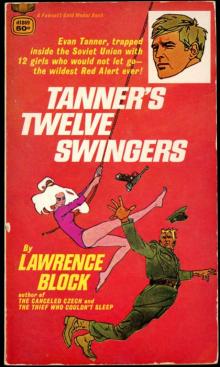
First thing I did was spend a couple of days writing a long short story (“Keller in Shining Armor”). Then, while contemplating my next move, I got a message from Otto Penzler; he would need an introduction for the hardcover edition he was going to publish of The Canceled Czech, a book I had written in 1966. There was no rush, he said, but I figured it was something I could get out of the way while I decided what to do next.
I had more trouble with it than I’d expected. I found myself reminiscing in the intro about what my life had been like when I wrote the early Tanner books, of which The Canceled Czech was the second. With the introduction about two-thirds completed, I realized that I was ready for a longer stroll down Memory Lane—that I was in fact ready to write that memoir about the early years.
I couldn’t get to sleep that night. My mind was racing all over the place. I woke up the next day and got to work as soon as I’d had my breakfast, and I literally could not stop working. I broke for meals, then kept going back to it. I didn’t stop until midnight, by which time I’d written 8000 words. Even then I couldn’t get my mind to quit, and I had a hell of a time getting to sleep.
The next morning I went right to it again. In a little more than a week, I would write 50,000 words.
• • •
Around the time I was getting ready to be a writer, Erskine Caldwell published Call It Experience. It was his autobiography, and he began by explaining that it concerned only his life as a writer. That was all he felt inclined to write about, he said, and probably all that anyone would be interested in reading about, anyway.
That made sense to me, and it still does. I’d rather not burden you with too much in the way of personal details. Nor am I inclined to let this book be an invasion of anyone’s privacy, least of all my own.
But writing, as I’ve remarked elsewhere, is a holistic pursuit; it is done with the entire self, not just the tips of the fingers. And so this book, too, inevitably reports on the whole self.
It is as honest and forthright as I am capable of being at the moment. I could not have written it a year ago. Had I postponed writing it another year, I might have been inclined to open myself up even more; on the other hand, I might have thought better about the whole enterprise.
[NB: This intro will be finished after the book itself has been completed, and will very likely be substantially rewritten at that time.]
1
February, 1994
Lake Forest, Illinois
In August of 1956 I got off a train at Grand Central Station. Seven hours earlier I had boarded that train in Buffalo, where I had lived all my life until I’d gone off to college the previous fall. The college was Antioch, in Yellow Springs, Ohio. Antioch had—and still has—as a distinguishing feature a program of cooperative education. The year was split into four semesters, two of them devoted to academic pursuits on the Yellow Springs campus, the other two spent at a job obtained through the school’s Co-op department. While some students did manage to save a portion of their earnings, that wasn’t the point; the jobs were supposed to provide real-world vocational experience, with the twin goals of enabling you to make an informed career choice and giving you a head start on other eager beavers.
The school encouraged freshman students to spend their whole first year on campus. I did so, and, when the academic year ended in June, I joined my parents and sister, Betsy, on a trip to Miami Beach. We drove down and back in my father’s ’56 Chevrolet. It was blue, and he had only recently traded in a brown ’54 Chevrolet for it. I think he may have regretted the move. “I never had a dime’s worth of trouble with that car,” he said more than once. The new car had its baptism of fire on the trip north. Somewhere in the Carolinas I threw a cigarette out the window, and it blew back in and wound up underneath the pillow I was sitting on. We kept smelling smoke, and scanned the horizon for signs of a forest fire. At last we pulled over and discovered that the fire was in our car, and that I was sitting on it.
My father, I must say, took this remarkably well, although I’m sure it must have deepened his regret at having parted with the other car.
• • •
Paul Grillo met me at Grand Central. He was several years older than I, and had been one of my hall advisors the previous year. Now we were going to room together for three months in New York. Paul was from Elkhart, Indiana, but he had lived in New York before as an Antioch co-op, and was reasonably familiar with the city. He had decided that we ought to live in Greenwich Village, and, arriving before me, had found us a large furnished room at 147 West 14th Street. He told me how to get there and pointed me toward the subway.
I had been in New York twice before, the first time in December of 1948, when I was ten and a half years old. My Dad had grown up in the city. He went to Cornell, where he met and married my mother, a Buffalo girl. They’d lived very briefly in New York after graduation, then moved to Buffalo and remained there ever after. He wanted to show me New York, and it seems to me that we went everywhere and did everything in what must have been a frenzied weekend. We stayed at the Commodore Hotel. We saw the Statue of Liberty on Bedloes Island, we went to the top of the Empire State Building, we rode the Third Avenue El, we saw Ray Bolger on Broadway in Where’s Charley? and were in the studio audience at Toast of the Town, the Ed Sullivan show. This last was a little hard for me to grasp, because I didn’t know what television was. I suppose they must have had TV in Buffalo by then, but I didn’t know anybody who had a set.
Several years later, we’d made another trip to the city. This time my mother and sister came as well. We stayed at the Commodore again and saw South Pacific and The King and I. I remember two things from that trip. At South Pacific, Betsy, five years younger than I, thought Bloody Mary was snarling “Stingy basket!” at Marines who aroused her displeasure. The rest of us found this amusing, and for a while the phrase became a family joke. And one afternoon my father and I went for a walk and, in a Times Square novelty shop, I came upon a group of mildly obscene photos. I can only recall one of them—I may very well have only seen one of them. It was a trick photo, and showed a woman with three breasts. The caption read, “Wanted—a man with three hands!”
• • •
I had a job waiting for me in New York. I was to be a mail boy at Pines Publications, at 110 East 40th Street. The company was owned by a man named Ned Pines, and was run, as far as I could tell, by another man named Frank Lualdi. Mr. Lualdi ordered his lunch every day, not from an ordinary coffee shop, but from an upscale place called the Brass Rail. For years afterward I would think of him whenever I walked past the Brass Rail—which, if I remember correctly, was on the east side of Fifth Avenue between 42nd and 43rd. I never went in, because I figured I didn’t belong there. It was for important people like Mr. Lualdi.
Pines was a diversified operation, publishing a movie fan magazine, a few die-hard pulps including Ranch Romances, a Readers Digest imitator, a handful of comic books, and a solid paperback line, Popular Library. My work consisted largely of distributing the mail and interoffice memoranda and running errands. For this I received $40 a week, of which I took home $34. (Toward the very end of my employment, I and the two non-Antioch mail boys received an unsolicited raise to $45.)
The job wasn’t much of a challenge, nor was there much you could learn there. I’d chosen it because it was in publishing, which seemed at least peripherally related to writing, and because it was in New York, which was where you went if you wanted to be a writer. I suppose I spent sixty or sixty-five days at Pines, but I don’t remember much of what I did there. Everyone, as I recall, was remarkably nice to me. And, although the position was not designed to be A Job With A Future, it became one, at least for a moment.
A little more than halfway through my term there, the head of the promotion department called me over as I was depositing his mail on his desk. I think his name was Victor Robinson, and he informed me that his assistant, whose name was Jules Shapiro, was going to be leaving at the end of the month. Would I be interested in the position?
I might be, I said, but I was an Antioch student on a co-op job, and I was sort of scheduled to go back to school the end of October, but—
“For God’s sake, go back to college,” he said. “You don’t want to drop out of school for something like this.”
That was the end of that. Looking back, I suppose he was right. But the fact of the matter was that I did want to drop out of school. I never seriously considered it, not after he’d made it so clear what he thought of the idea, but I’d have loved to do just that. It wasn’t that I didn’t like school. I felt entirely at home at Antioch, and, while I didn’t care much about studying, I liked the hanging out well enough. I didn’t want to drop out in order to get away from it all. I wanted to drop out in order to get on with it.
• • •
I probably learned more than I knew at Pines Publications. But the job there wasn’t the point.
New York was the point.