A Writer Prepares, page 16


The plot strikes me as preposterous now, but it didn’t seem that way when I wrote it, at least not to me. Henry thought it was promising enough to send around, and it kept getting the same reaction from just about everybody who saw it. They all really liked the way I wrote, and would be very interested in seeing my next book. But they would have to pass on this one.
I found this infuriating, of course, but now it makes perfect sense to me. They liked the way I wrote because I wrote well, with good sentences and good dialogue and interesting characters doing interesting things. They figured I’d eventually write a book that worked, but this wasn’t it.
In New York, I did write a publishable crime novel. It happened while I was trying to do something else.
What I was trying to do was write a sex novel for Harry Shorten. I’d done my book-of-the-month for Bill Hamling, so this would be an extra book. I wrote a couple of chapters about a con artist down on his luck. He skips a hotel bill, then steals a suitcase at a railroad station so he’ll be able to check in at another hotel. (This was before credit cards, and if you looked presentable and had decent luggage, hotels didn’t ask for money up front.) The suitcase turns out to be full of heroin, and belongs to a presumably respectable businessman who’s actually a drug trafficker, and who has a beautiful wife.
And away we go.
Two or three chapters in, it seemed to me that I was writing something with possibilities. Don Westlake came over and I asked him to read it. (He’d moved to Canarsie, at the very end of the 14th Street line, but we still saw each other a couple of times a week.) Don encouraged me to forget about Shorten and write the book as a Gold Medal-type suspense novel. The book I wrote probably owed a lot to James M. Cain, and to such literary heirs of his as Charles Williams and Gil Brewer. The narrator finally winds up with the woman, and to make sure he can keep her he addicts her to heroin. At the end he’s toying with the idea of trying it himself.
(After the book came out, I ran into Bob Aronson, who pointed out that I’d worked a variation on “Ride a White Horse,” a Manhunt story I’d written while we were roommates at the Alexandria. He was right, of course, but I hadn’t even realized it. I’d forgotten all about that story.)
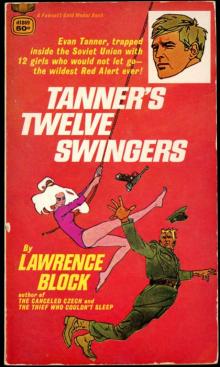
Henry sent the book to Knox Burger at Gold Medal, far and away the best market for this type of book. Knox bought it, and liked pretty much everything about it but the title. I’d called it The Girl on the Beach, and he wanted to change it to Grifter’s Game, which was fine with me.
When it came out, the title had become Mona. It seemed that Ralph Daigh, who ran the company for the Fawcett brothers, had bought a piece of art he wanted to use for the cover, a drawing of a woman’s face. The woman in the book was named Mona, so that’s what he decided to call it.
Jove reissued the book in the early eighties and called it Sweet Slow Death. Sounds like a bodice-ripper with a dark ending. I know where they got the phrase; it was part of the back-cover blurb on the original Gold Medal edition. As I write this, Paul Mikol at Dark Harvest is preparing to publish the book in hardcover for the first time, in both a limited and a trade edition. “Ride a White Horse,” which I’ve never collected in any of my short-story collections, will be included in the volume. It seems remarkable to me that the book should have had so many lives, and I’m by no means sure it deserves them. This time around I could call it Grifter’s Game, I suppose, or even The Girl on the Beach, but some people might think it was a new book, and they’d read the first chapter and figure I’d lost it. I’ll stick with Mona.
• • •
It was around this time that I became the notorious publisher of Confidential.
Well, the former publisher. His name was Bob Harrison, and he’d made a pile of dough with the scandal magazine during the fifties. It was the climax of a truly tawdry publishing career, which included a couple of girlie books called Wink and Titter. This was a class act.
Harrison had some sort of deal to do a book, which would be essentially a distillation of the best of Confidential. They could have called the book that, but it would have been too oxymoronic for words. Besides, no one wanted to tip the fact that the book had nothing new in it, that it was just old magazine garbage tucked between hard covers.
The book was going to be limited to material with some sort of connection to New York, and Harrison would have loved to call it New York Confidential, but unfortunately that title had been used by Jack Lait and Lee Mortimer, two journalists who were more respectable than Harrison, though less respectable than almost anyone else you could name. This really pissed Harrison off, as he figured he ought to have a proprietary interest in the C word, but he let it go.
He might have called it Inside New York, but then he’d have John Gunther mad at him. So he settled on Naked New York.
Now all he needed was somebody to write it for him.
That was where I came in. Harrison had called Scott, and Henry called me, and I went over to Harrison’s suite at the Hotel Madison, on Madison Avenue in the 30s. Harrison was a tall, well-built man in his sixties, always attired in a conservatively cut suit. He was accompanied by a woman of a certain age who was his assistant and, if I remember correctly, his sister. The two of them had a folder full of clippings of old stories from the magazine, and it would be my job to seek out the best of them and write them anew so that they would be fresh and timely.
Harrison couldn’t possibly do this himself. I’m not sure the son of a bitch could read.
I’ve thought about this, and my guess is he was dyslexic, or something like it. Whenever you wanted him to look at something, he would insist that you read it aloud. He had to hear it. It was easier for him to evaluate material that way.
“This is great,” he’d say, shuffling through the folder and pulling out some article about B-girls serving watered drinks in 1952. Then he’d hand it to me or his sister. “Here—read it to me.” And we’d read it and agree how great it was.
Many of the articles had nothing to do with New York—“But you could make it New York, couldn’t you?”—and managed to be tacky without being sensational. Anyone with an IQ higher than his birth weight could have told him he didn’t have the makings of a book. But he had something more important than that, he had a deal, and if you’ve got a deal you can always come up with a book, and it was my job to write it.
Somehow or other I did. I took the stories we selected back to my apartment and got the job done. I know it was one of those deals where they needed it yesterday, and I was certainly anxious to be done with it myself, so it didn’t take long.
Then the fucker welshed. He told Scott that the script I’d delivered wasn’t long enough, and that I hadn’t done it right, and he wasn’t going to pay the balance. He’d paid half, with the rest due on delivery. He was screwing me out of $750 or thereabouts. Scott said you had to stand in a long line to sue Harrison, so we let it go.
Naked New York. I don’t think I ever saw a copy. Was it ever published? Did Harrison ever get somebody to read it to him?
• • •
Around this time, I began writing for Charles Heckelmann.
Heckelmann was an editor at Popular Library while I was working as a mailboy at Pines Publications, but I never met him then. I never met him afterward, either, although I wound up writing upwards of a dozen books for the man.
As a matter of fact, I never met most of the people I wrote for, and it was a long time before I realized that this was unusual. There were two reasons for it. First and foremost, it was a policy of Scott Meredith’s to discourage any direct contact between the writers he represented and the editors and publishers with whom he placed their work. One might rub the other the wrong way and ruin what had been a perfectly satisfactory relationship. More to the point, the greater the distance between author and publisher, the more indispensable that made the agent.
In my particular case, Henry was especially disinclined to put me face to face with editors. He didn’t want them to realize how young I was.
There were times when Henry had to bite the bullet and let me meet somebody. He’d kept me away from Knox Burger with Mona, but would have to send me over to Fawcett’s 44th Street offices when Knox wanted to discuss changes in the second book I sold him. And, when Harry Shorten had insisted on meeting me, Henry grudgingly set up a date. I went to Shorten’s office, and he had two questions to ask, and I don’t think I answered either of them satisfactorily. First, he wanted to know how I intuitively knew just how hot to make a sex scene. Henry had told him that I was a professor of English (“Tell him you’re a professor of British,” Larry Harris counseled me. “It’ll impress him more.”) and I gave some artsy-fartsy answer, the equivalent of a starlet’s explanation that she’ll fellate an orangutan on camera but only if the integrity of the script demands it.
His other question? “That grease pit scene in Carla. Jesus, how’d you ever come up with that one?” I mumbled something vague. It was a pity the New Age hadn’t dawned yet. I could have said I channeled it.
• • •
In 1960, Heckelmann was editor-in-chief at a low-level paperback house called Monarch Books. Monarch wasn’t in a class with Nightstand and Midwood, but it was still pretty sleazy in its own right. Heckelmann had a penchant for quickie books produced to hitch a ride on the coattails of a popular success. He kept an eye on the headlines, too; when Elizabeth Taylor fell seriously ill, he commissioned Don Westlake to knock out a quick cut-and-paste biography of the actress. (When she pulled through he published it anyway, but I’m sure he wasn’t happy about it.)
The first thing I did for Heckelmann was a literal piece of ghostwriting. William Ard, a Scott Meredith client, had recently died young of cancer, and he’d stuck Heckelmann with a portion and outline of a mystery novel before bowing out. If I could complete the book from Ard’s outline, Heckelmann would have a book to publish, Ard’s widow would pick up a couple of bucks, and I’d make some money and have one more cover for the wall.
I’ll tell you about the wall in a minute.
William Ard was a pretty good writer, and got consistently good reviews from Anthony Boucher in the New York Times Book Review. Boucher was particularly pleased by Ard’s ability to get a story told economically. Brevity, I sometimes think, is especially endearing to reviewers, who have so damned much to wade through day in and day out that they’re grateful to anybody who gets them home early. Ard’s mysteries were on the short side, all right, most of them a scant 50,000 words if that.
I trust my contribution to Ard’s body of work was a slender volume. I certainly wanted to be done with it as soon as possible. All I recall of it was that there were twin sisters named LiLi and LoLa; putting those extra caps in their names was a real pain in the ass, and keeping them straight was out of the question. The opening chapters were not a terribly hard act to follow, but the outline, which I somehow thought I had to stick to slavishly, was awful. I’m sure if Ard had lived to finish the book himself he would have felt free to stray from the outline, and would have made the whole thing work. About all I managed was to get the thing written.
Besides, they needed it in a hurry.
I’ll tell you, I was a real sucker for that approach. All Henry had to do was tell me somebody was racing a deadline and needed something as fast as possible, and I’d have the sucker half written before he could hang up the phone. To meet Heckelmann’s ostensible deadline on the Ard project, I rented a room at the Spencer Arms, a hotel half a block away at the corner of 69th and Broadway. I pounded away at the typewriter and finished the book in three or four days, stupidly convinced that such a pace was essential. I’m sure it was a week before Heckelmann even looked at it, and another month before it went to typesetting.
I never looked at the manuscript after I wrote the last page, and never read it after it came out, but I’m sure it was terrible. Heckelmann must have thought so, because I wasn’t asked to be part of the team when they decided to keep poor Bill Ard dead and writing. Another of Scott’s faithful retainers got the job, and produced three or four more masterpieces under Ard’s name before the project was aborted.
What’s extraordinary about the whole affair is that anyone could have thought this deception was worth the trouble. Ard was a pretty decent writer, certainly, but it’s not as though he had a host of readers out there clamoring for more of his work. If he’d had any kind of a following, he wouldn’t have been writing for Monarch. One reason for continuing the series, of course, was so that the widow Ard wouldn’t have to take in washing. (I presume she got a quarter of the earnings on the posthumous books. That was the usual arrangement Scott worked out when he breathed fresh life into a writer’s corpse.) Somehow I can’t believe anybody at 580 Fifth wasted a lot of sleep over the state of Mrs. Ard’s finances. It was an easy sale, that’s all, and Scott never let one of those get away if he could help it.
But it wasn’t a good sale. It was John Jakes who ghosted those books for Ard, and in years to come he established himself as a writer of popular historical fiction and had a string of books on the bestseller list. His talent might have had a chance to develop far sooner than it did if his agent hadn’t handed him every piece of low-level hack work that came along.
I don’t know of a case where Scott helped a writer to improve, or even encouraged it. He never took the long view, never thought in terms of building a career. The point, as he saw it, was not to get his clients writing better books for better markets. The point was to keep everybody writing, so that they were all generating commissions.
• • •
I don’t know if I was called upon to make any changes in the Ard book. It seems to me there must have been a letter from Heckelmann, imploring me to flesh out a couple of scenes.
Everyone who wrote anything for Monarch was familiar with that phrase. It was a favorite of Heckelmann’s, and he rarely got through a letter without it. I used to have this mental picture of the Heckelmanns sitting down to dinner, all of them fleshed out like regular little porkers. “Have another helping!” he’d urge them. “I want you fleshed out!”
I don’t know how many books I wrote for him after that. Ten? Twelve? More?
I couldn’t say, but I can tell you this. He never knew it was me.
• • •
I promised to tell you about the wall.
It was Don Westlake who first took to mounting the covers of his published works on his office wall. He’d acquire a second copy of every book or magazine as it came out, cut off the cover, and affix it to the top of the wall where it met the ceiling. The parade of covers worked its way around the room, each specimen a proud proclamation of a burgeoning career. (Several of the covers were upside down, Don’s way of indicating that, while a publication had indeed used his story, they’d neglected to pay him; I remember three or four such covers from Mystery Digest, but there may have been others as well.)
My own first venture into the wallpaper business came in the first apartment Loretta and I shared, at 110 West 69th Street. Instead of circling the room with the covers, I started at eye level directly above my desk, and let the covers fan out in a sort of montage. Double-sided tape would have been ideal for my purpose, but I’m not sure it existed in 1960, and if it did I didn’t know about it. I made little circles of masking tape, and they worked well enough.
When we moved to 444 Central Park West, the wall montage made the trip with us, and was promptly installed over my desk in the dining room. It would move again, to Tonawanda and Racine and Lambertville, until one relocation proved to be A Move Too Far. The covers, dozens of them by then, came down from one wall but went not onto another but into a file folder.
Until then, the wall served a purpose. It furnished graphic evidence that I was turning out work and getting it published. While my books and stories put food on the table and kept a roof over our heads, they had little presence in the outside world; most of what I wrote was pseudonymous, and the rest might as well have been, for all the attention anyone paid to it.
The wall was evidence of accomplishment. Every time I wrote something, I covered some more square inches of wall space. And it was, to be sure, more satisfying to look upon than those rejection slips I’d mounted in my Antioch dormitory.
And, when Ted Hecht reprinted an article in another of his magazines, well, he might not pay me anything for running it a second or third time, and indeed I might have to buy my own copy at a newsstand, but that’s not to say I didn’t get anything out of it. It was, by God, one more cover for the wall.
• • •
One of the first books I did for Heckelmann—it may have preceded the Ard mystery—was the purported autobiography of a prostitute, I Sell Love, by Liz Crowley. That’s all I remember about it, that and the fact that I got $1250 for writing it. It was like writing a novel, except that it purported to be true. If anything, that made it a little easier to plot.
Then one day I got a call from Henry. Heckelmann had read a book called The Power of Sexual Surrender and wanted to knock it off. For this one, though, I would have to be a doctor, and the working title was Sexual Surrender in Women.
“That’s nice,” I said. “What does it mean?”
“It’s a way of overcoming frigidity by giving up control,” he said.
“Control of what?”
“I’m not sure,” Henry said. “You can read the book and then write your version. You just make up case histories to illustrate the points you’re trying to make.”
I looked through the book by Marie Robinson, then sat down and wrote Sexual Surrender in Women, by Benjamin Morse, M.D. Heckelmann knew this was a pen name, but he was given to understand that the real author was Morton A. Benjamin, a Chicago-area psychiatrist. If he’d found himself in Chicago in the middle of a psychotic break, he’d have had to seek out a couch to lie on other than Dr. Benjamin’s, who was as much a figment of my imagination as was Dr. Morse.