A Writer Prepares, page 24


And, of course, for most people it’s quite unattainable.
Sixty years ago, the American Dream was there for the taking. If you were white and native-born, if you were willing to work forty hours a week and stay out of trouble, you could hold a corporate job, buy a comfortable suburban home, drive a well-engineered American car, raise a family, put your kids through college . . .
And so on.
This had never been my particular dream, but I was not incapable of seeing its appeal. And as the months passed it became clear that it was mine for the dreaming.
I couldn’t expect much personal advancement within the coin supply division, as it was essentially a corporate backwater, turning a decent profit but with no real opportunity for growth and expansion. But my own future would lie outside the coin division. It became evident that another division of Whitman, the marketing department, had its corporate eye on me. That department had long been something of an afterthought, but now it was destined for growth, and I’d received hints that I was being groomed to grow along with it.
A Job With A Future. That’s not at all what I had expected to find in Racine, but there it was. I didn’t even have to reach out and take it. All I had to do was wait for it to come to me.
And that’s all it took, really, for me to realize that wasn’t what I wanted. Once I could see what was available to me, it was time to go back to New York.
Time to go back to being a writer.
• • •
But of course I had never stopped being a writer.
I hadn’t even considered stopping. One good thing about my low salary was that I knew from the beginning I would have to supplement it with writing income. Our duplex had three bedrooms on the second floor, and we let Amy and Jill share one and set up the smallest as a home office.
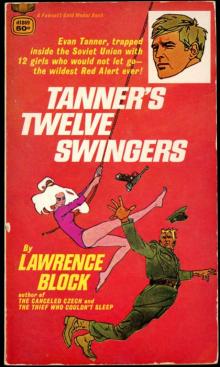
I arrived in Racine with a couple of works in progress. I’d been working on a novel about a couple of confidence men, and had even squeezed in a couple of trips to scout locations in Toronto and Olean. I finished it in Racine, and Knox Burger bought it for Gold Medal, and published it in 1965.
By then I had an agent, although I never met the fellow, and I can’t be sure what he did or didn’t handle for me. He was Gerald Kelly, a principal in the firm of Kelly, Bramhall & Ford, and he got in touch with me via Bill Coons, that friend of Don Westlake’s who’d been my original ghostwriter with Nightstand. When Scott Meredith dropped me from the client list, they dropped Bill as well, and he hooked up with Jerry Kelly, whom he’d either recently met or knew from school. All I know is that Bill called to tell me he had a new agent, and was I looking for an agent? Because if I was, his friend would like to represent me.
Well, no one else in the profession had expressed interest, and I was stuck in Buffalo with no idea how to go about finding an agent. So I agreed to be represented by KBF, but not exclusively; I’d continue to work directly with such markets as Midwood and Beacon and Lancer.
It seems to me I sent Kelly a couple of stories, and he sold at least one of them to Alfred Hitchcock’s Mystery Magazine. And I’m pretty sure it was he who handled the sale of The Girl With the Long Green Heart to Gold Medal.
But I never did meet Jerry Kelly, and we didn’t do a lot of business together. Thirty years later I found myself in a small English-language AA meeting in Madrid, and one of the attendees turned out to be Tom Ford, once the partner of Gerald Kelly and Dave Bramhall. That gave us something to talk about, but not for more than a paragraph or two.
And a paragraph or two is as much as my connection with KBF requires here. But if I’m going to digress, I think a more appropriate topic might be ghostwriters in general, and Bill Coons in particular.
• • •
Before I found myself in a room at Ragdale, with the original fifty thousand words of A Writer Prepares rushing out of me in a verbal flood, I was committed to keeping my beginnings in the world of erotica not merely at arm’s length, but out of sight altogether. When a collector turned up at a signing with something by Sheldon Lord or Andrew Shaw, I refused to sign it, or even to confirm or deny its authorship.
More than once, I remarked that the best thing about that early work was that it had not been printed on acid-free paper. “God speed the acid,” I would say.
Well, that’s changed, obviously. I’ve devoted no end of words to the subject in this present volume, and I’ve spent a good amount of time and energy in recent years resuscitating virtually all of my early titles, giving them a second life as ebooks and paperbacks.
But of all the reasons I gave myself for disavowing that early work, one argument still seems to make some sense.
Not all of it was mine.
I’ve always been grateful for my apprenticeship in the world of erotica. It served me well. But there’s a danger in settling too comfortably into an apprenticeship. Sometime in 1961, I felt it was time to stop writing a monthly Andrew Shaw novel for Bill Hamling’s operation.
But the deal was a difficult one to walk away from. I talked it over with Don Westlake, and together we hatched an idea. There was this fellow named Bill Coons he’d known for a few years, either in college or in the service; Bill had done some writing in college, and had always wanted to be a writer, but now he was married and living in Syracuse with a kid on the way and a minimum-wage job unloading trucks in a warehouse. It was hardly the life he’d dreamed of, but it seemed to be the one he was stuck with.
There’s this story about two wise guys with an interest in a young singer. They persuade an agent to catch the young man’s act, and he gives them the bad news—the fellow just doesn’t have what it takes. They’re disappointed, because they like the kid and they’ve invested a lot of money in him, paying his rent and springing for singing and dancing lessons and wardrobe and such. So where do they go from here?
Finally an inspiration. “Let’s see,” one of them says. “What’s the kid weigh? Maybe one-fifty-five, one-sixty?”
“So?”
“Well, fuck it. We’ll make a middleweight out of him.”
Don and I took Bill Coons and made a writer out of him.
I look back on it, and I realize how remarkable it is that it worked. I don’t know how much writing Bill had done, and there’s no one alive to ask, so it’s possible that he had once begun work on a novel, and possibly even completed a draft. But I don’t think he’d ever published a word of anything, and here we were bringing him to New York and offering him a job turning out a novel every thirty days.
The two of us sat down with Bill in my apartment in New York. We gave him books of mine to read, and pointed out ways he could mimic my style. And there were certain tells he could incorporate.
The name Schwerner, for example. Steve Schwerner, my freshman roommate at Antioch, had once mentioned that his surname was unique to members of his family; there were, he assured me, no other Schwerners in the world.
Well, it struck me that the least I could do was spread the name around, and for a couple of years I made a point of including one character named Schwerner in every book I wrote.
Similarly, Don and I had both taken to using A Sound of Distant Drums—or some word play derived from that phrase—whenever the title of a book or play was called for.
Bill accordingly was instructed to have some minor character named Schwerner in the books he ghosted, and to make similar use of those distant drums. I don’t know that anyone at Nightstand paid any attention to any of this, but it paid off in unexpected fashion decades later, when aficionados of the genre pored over the books looking for textual evidence of their actual authorship. “This must be Block’s,” one would write, “because there’s a character named Dave Schwerner, and a wino is described as being passed out in ‘a mound of wistful bums.’ ”
Right.
• • •
It didn’t take Don long to recruit ghosts of his own. He’d done a book or two for Hamling as Alan Marshall, the name he’d used for Midwood, and Hamling wanted a book a month from him, and Don agreed; almost all of the Alan Marshall books for Nightstand were the work of hands other than Don’s. Hal Dresner joined in, enlisting others to supply a monthly Don Holliday novel.
I don’t know what arrangements Don and Hal had with their various ghostwriters, but I know that mine with Bill and subsequent ghosts gave me an off-the-top payment of $200, with the remaining $1000 going to the writer. There were, alas, no royalties for either of us. The $1200 was a flat fee, irrespective of copies printed or copies sold.
Financially speaking, it wasn’t a bad deal for the ghosts. The $1000 was at least as much as a new writer could get selling books under his own name, and this way the sale was guaranteed. Bill Coons could walk into a sure income of $12,000 a year—well, $10,800 after Scott took his commission. He was learning a trade, and his was a well-paying apprenticeship.
Still, I’m not sure we did him a favor. Like everyone, he hoped his ghostwriting would lead to something better. It did for some; Dave Case, a friend of Bill’s who became Hal’s most spirited ghost, wound up making a name for himself as a horror writer, and there were others who went on to self-sustaining writing careers.
Bill died in 2001, and I’d lost track of him decades ago and don’t know what his last years were like. But I can’t imagine they were much fun. I’ll pass along two stories about the man, at the risk of speaking ill of the dead; they’re good stories, and I suspect I’m the only person around who can tell them.
The first would have taken place fairly early in Bill’s ghosting career, when he was living with his wife and daughter in Washington Heights—but not too early, because it was after Nightstand had upped their order to two Andrew Shaw titles a month. I’d let myself be lured back into the game. So we were each writing a monthly book, and you’d think one of Hamling’s editors would have to have suspected something, but if so he kept it to himself. Bill and I wrote our books and the checks kept coming.
And one day I gave him a call. “I wrote three chapters of a book,” I said, “and I just went dead on it, and I hate it, and I don’t want to write any more of it but I hate to let sixty pages go to waste. Why don’t you read what I’ve done, and if you can see a way to go on you can write the next three chapters, and then we’ll alternate until we’ve got a book. And Henry can submit it as our collaboration.”
“By Andrew Shaw and Dell Holland?”
Dell Holland was the pen name Bill had chosen for his own non-Shaw work.
“Sure,” I said. “And we’ll each write half the book and take half the money.”
That sounded fine to him, so I got on the A train and took the three chapters uptown. “A sow’s ear,” I said. “Make some kind of a purse out of it. It doesn’t have to be silk.”
Then the two of us went out for a beer. Maybe two beers, or even three, and then I got back on the subway and headed home.
And he returned to his apartment. His wife had come home in the interim, and saw the stack of sow’s-ear manuscript on the table where Bill had left it, and she was just finishing the last page when he walked in the door.
“This is really good,” she told him. “You’re really improving, honey. This is far and away the best thing you’ve ever written.”
• • •
One of the best things about the story—and one of the worst things as well—is that Bill chose to tell it on himself. The fellow was not without a sense of irony. And he did in fact write the next three chapters, and we shuttled the manuscript back and forth until it was done, and Henry sent it to Nightstand and in due course it was published. Not by Andrew Shaw & Dell Holland, Nightstand never used dual bylines, but as Man For Rent, by John Dexter. (That was a house name, fastened at the editor’s whim on odd books and extra books, and this was both.)
Bill did publish at least two titles as Dell Holland, Sin Town (Bedside Books) and Illusion of Lust (Playtime). But turning out the monthly Andrew Shaw title took up most of his time.
And in fact it was often a struggle for him to meet his deadlines, a frequent source of irritation to Henry. At some point prior to the birth of a second child, Bill and Cammy moved to Patchogue, a good ways out of town in Long Island’s Suffolk County. There were presumably fewer distractions out there, but Bill made do with what distractions the place offered, and timely delivery became increasingly problematic.
Eventually one book was close to two weeks late. He finally got it done and hopped into his car to deliver it, drove through the Queens-Midtown Tunnel, and managed to find a parking spot on West 47th Street not a block from the Scott Meredith offices.
Well, didn’t that call for a beer? He walked away from the car and ducked around the corner to a hospitable tavern on Sixth Avenue, and he had a beer, and, well, maybe he had a second beer.
Then he headed for his car, and wouldn’t you know it? Someone had broken into it, and stole whatever was loose, and that included a shopping bag with the overdue manuscript.
Of course he kept a carbon copy. And of course the copy was in the same shopping bag with the original, and both were gone, never to be seen again.
• • •
Or at least that’s the story he told.
Do you figure it’s true? For years on end, it never once occurred to me to wonder. Who would be fool enough to make up a story that reflected so poorly upon the teller? Yeah, I suppose I should have gone straight upstairs and turned the thing over to Henry, but, you know, it was a long dry drive and I’d feel a whole lot better with a beer in me. And yeah, I suppose I should have taken the manuscript with me, but why chance leaving it in some ginmill? And yeah, I guess it was a bonehead move to bring the carbon copy along, since I had no use for it in New York, but it was in the bag with the original, and I guess I wasn’t thinking . . .
When you make yourself the butt of such a buttheaded story, how could it be anything other than the truth?
But maybe he made it up. Maybe he never wrote that month’s book, or at least never got to the end of it, and he was way past deadline, so why not tell Henry that the dog ate his homework? The story made him look like an asshole, but he already looked like an asshole, so what difference did it make? And this way nobody could yell at him, because he was the victim here, his hard work stolen and never to be seen again.
And he could drive back to Patchogue and finish however much he’d actually already written, and turn it in as the following month’s book. He could even turn it in on time. Hell, he’d be back on schedule.
• • •
After I parted company with Scott Meredith, Bill’s ghosting gig vanished. A few years down the line he got a teaching position at Skidmore College, and I think that’s what he was doing when he got arrested for selling a couple of tabs of LSD to an undercover narcotics agent. With the outstanding luck and great talent for self-preservation he’d displayed all his life, the poor son of a bitch wound up in Attica Prison. After the Attica riot in 1971, he squeezed that particular lemon into a lead article for the New York Times Sunday Magazine, then expanded the narrative into a book, Attica Diary. As far as I can tell, that was the last thing he wrote.
I think it was Don who likened Bill to that character in Al Capp’s Lil Abner who went through life with a dark cloud forever suspended above his head. He had rotten luck all his life, and a generally frail constitution in the bargain. Someone speculated that, in spite of it all, Bill was destined to live an exceedingly long life.
“No,” Don said, “but it will seem exceedingly long.”
25
November 25, 2020
New York City
Well, that was an extended digression, wasn’t it? Bill Coons deserved inclusion here, I think, along with the whole phenomenon of new writers hitching a ride on the pen names of their more seasoned fellows, but it’s yanked me away from Racine and sent me down another tributary of Memory Lane.
I think it’s time to wrap this up.
The problem, of course, is determining a natural end point for this narrative. I’ve heard it remarked that God created orgasm so that people would know when to stop fucking, and a proper climax plays much the same role in a book.
But A Writer Prepares is meant to be my own imperfect recollection of my own early years in the profession, and who’s to say just how long those early years lasted?
In some respects I suppose they’re still going on. I’m still learning things, even if what I most often discover is the extent of my own ignorance.
A memory, if you will. I was fourteen years old, and this thought came to me: “Oh to be eleven again, knowing what I know now.”
Whatever did I think I knew?
Never mind. The words come back, over and over again, with only the numbers updated. And as long as I’m around I trust I’ll offer up a silent apology every year for the fool I was the year before.
• • •
There was this brilliantly talented albeit unpublished writer, I’d been given to understand, who would write one novel after another, each building up to the brink of a conclusion, and then ending abruptly with a one-sentence chapter: “And then the boiler blew up and killed them all.” They could be out in the middle of the desert, a hundred miles from the nearest boiler. It didn’t matter. That’s what he wrote, at least according to this tale told in publishing circles, and one can very likely infer what might have been the seminal event in his own unhappy life.
I seem to have told this story more than once. It’s to be found in the book description I supplied when I republished an old Andrew Shaw title as an entry in my Collection of Classic Erotica. (One with a real eye-roller of a title: High School Sex Club.) A Google search shows that I supplied a slightly different version for an Authors Guild Newsletter interview. I’m not sure who I heard it from—Don Westlake? Larry Janifer? Nor have I ever been entirely convinced that it’s other than apocryphal.