A Writer Prepares, page 10


There were some other students I’ve forgotten. And there were the ones who never brought in a thing, or at least never read what they’d written.
And there was me.
I didn’t attend every single week, though I certainly showed up more often than not. At a guess, I’d say I got to two classes out of three. And, when I did show up, I almost always brought in an article.
Where did I get them? That was easy. I handed in the ones I was writing for Ted Hecht.
• • •
Well, what the hell else was I supposed to do? I had to turn in something. I suppose I might have written something special for the class, something with an Asian slant to it, so to speak. “Yashimoto, Blond Beast of the Co-Prosperity Sphere.” That sort of thing.
Instead, I brought in carbons of my articles for Real Man and its fellows. I know I submitted my Morro Castle epic, and a few others I can’t remember. I left “She Doesn’t Want You” at home, but, I blush to admit, among the articles I brought in was the one about nasty old Reinhard Heydrich.
I wasn’t prepared for the reception I got.
I didn’t figure Loggins would like the stuff. I thought he might grudgingly acknowledge it as professional while lamenting the fact that I was wasting my talent on such swill. And I’d have had no quarrel with that.
Instead, he expressed great admiration for the pieces I submitted, but said he didn’t see how I could expect to sell them. While they were at once interesting and well-written, it didn’t seem to him as though they had much chance in the marketplace. They were excellent, he felt, but they weren’t commercial.
I knew better. They weren’t excellent—they weren’t even good—but you couldn’t tell me they weren’t commercial. Because I don’t think I ever showed him an article that I hadn’t already sold.
“This is fine work,” he would say. “But where could you possibly place it?” Perhaps one of the men’s magazines, I suggested. But would it really fit their requirements? I allowed as how I thought it might.
One time, unable to find my carbon of a particular article, I handed in tear sheets. He still worried that the piece, while praiseworthy, would very likely prove unpublishable.
• • •
Later, when I ultimately left Scott’s employ and returned to Antioch, I might have attempted to get academic credit for my time in Vernon Loggins’s classroom. I’d earned a B in the course, and I’m fairly sure the credits would have been transferable.
I never even considered trying. I was perfectly happy to pretend as though the whole semester had never happened, and to forget about that B, and the F and the Incomplete as well.
Why, I wonder? Perhaps because I felt less than proud of my performance. Perhaps my reason was the same unstated one that had kept me from going back to claim my day’s pay from Mildred’s Chowderhouse. Perhaps I felt the small gain wasn’t worth the embarrassment.
7
Just because I never went back to my Monday-night class, that didn’t mean I’d given up on the idea of writing a novel. I was quick to give up on The Diamond Whore, title and all, but I remained entirely certain that I wanted to sit down and turn out what Randall Jarrell defined as “a prose narrative of some length that has something wrong with it.” (I wish I’d been familiar with that definition at the time. It might have made the whole business a little less terrifying.)
Real writers, I knew, wrote novels. That was where the money was, and the glory, and the satisfaction. That’s what I most enjoyed reading, and that’s what I wanted to write.
I couldn’t figure out how to do it.
I was certainly reading my share of novels. Even as I filled my apartment with back copies of Manhunt and its fellows, I was buying up secondhand paperback crime novels at the same mad pace, and reading them as fast as I was buying them. When I liked a writer’s short stories, I went in search of his novels. A Manhunt short story by David Alexander led me to try one of his books, and before long I’d read his complete works. (Alexander, a writer for the Morning Telegraph, had as his series character a Broadway press agent named Bart Hardin, who lived on West 42nd Street upstairs of Hubert’s Flea Circus, wore brightly-colored vests, drank Irish whisky, and never took a drink before 4 pm or turned one down after that hour. I read somewhere that Alexander wrote each of his first drafts in the first person, then carefully rewrote them in the third person. Why, I have long wondered, would anyone do that more than once?)
I rushed headlong through the complete works of everybody I could find who wrote crime fiction that I admired. For a very small fee I joined the Mercantile Library, just a block from the office. They had a great selection of popular fiction and never got rid of a book, which made them a fine source of out-of-print work. I read Hammett and Chandler and Ross Macdonald, Fredric Brown and Ellery Queen, Rex Stout and Cornell Woolrich. I read everybody.
I should stress that I didn’t do this out of sheer professional dedication. I read the stuff because I enjoyed it. And I’ve always believed that it helped me internalize a sense of what a novel was. But I couldn’t access the knowledge. I couldn’t even figure out how to begin.
John Dobbin, who’d been published by Avon, had written his novel with the guidance of a book on the subject by Manuel Komroff, and he made me a loan of it. I got about a third of the way into Komroff’s book and my head was spinning. According to him, the first thing you did when you wanted to write a novel was buy yourself stacks of three-by-five index cards in three colors. The white cards were your character cards and the blue cards were your incident cards, or maybe it was the other way around. I forget what the pink cards were. By the time you’d filled up all the cards and arranged them in the proper order, you were ready to write your book, and perfectly organized, too.
I was awash in despair. I was perfectly willing to believe that this was the way to do it, and I’m sure it worked superbly for Komroff, who wrote elaborately plotted historical novels that spanned generations and had hundreds of characters. But I knew I couldn’t write anything that way. I couldn’t even bring myself to buy the cards.
I read somewhere that Fredric Brown used to ride buses all night before he wrote a book. That was how he worked out his plots. It sounded better to me than index cards, so one night I decided to stay up and ride the subway until dawn. I got on the uptown IRT, rode it all the way to Riverdale, then stayed on it for its return run and rode clear out to New Lots Avenue in Brooklyn and back again. I didn’t think of a single plot. All I could think of was how tired I was, and when the train got back to 103rd Street I got off and went to bed.
• • •
Larry Harris helped me edge a little closer to writing a novel. He got me a gig writing The Strange Sisterhood of Madam Adista.
Larry was 26 at the time. He too had worked for Scott at a tender age, preceding Henry on the foreign rights desk. (How they hated each other. I was never sure exactly why. Maybe it was karmic. One time Larry said something nasty about Henry, and someone else offered that you had to understand Henry. “There is a time for understanding,” Larry said, “and there is a time for hate.”)
I thought Larry was remarkably exotic. He was Jewish, and married a Jewish girl named Sylvia. The two of them converted to Catholicism together. They lived out in Brooklyn. Larry wrote various stuff, crime fiction, science fiction, and had once been called upon to complete a magazine serial for Craig Rice, who’d gone on a drunk and never delivered the last installment. Rice had since died, and Larry had a profitable sideline turning out “recently discovered stories by the late Craig Rice.” Scott had done well representing Craig Rice during her lifetime, and saw no reason why the woman had to stop writing just because she was dead. (Evan Hunter completed a novel Craig had left unfinished at her death, and it was published as The April Robin Murders, with a joint byline, Craig Rice and Ed McBain. And Larry later wrote The Pickled Poodles; originally conceived of as another recent discovery, it was instead presented as a novel by Larry M. Harris, based on characters created by Craig Rice.)
Larry was intimately acquainted with the Times Square porno scene, and wrote an article about it. At his request, Henry sent it to Playboy; when they passed, it was immediately submitted to Ted Hecht, who snapped it up for a hot fifty bucks. (Boy, did those two hate each other.)
One day Larry showed me a booklet. I don’t remember the title, but it was a cheaply printed affair, maybe 48 pages long, staple bound, with a cover showing a woman in what I would later learn was dominatrix drag—high heels, domino mask, long gloves, etc. He explained that it was an example of over-the-counter flag porn. (Flag, short for flagellation, was a generic label for any sort of S&M pornography.)
The boys on 42nd Street, Larry explained, had done very well with this little number, and, since the author was unavailable, one of them had commissioned him to produce a sequel. “But I can’t,” he said. “You do it.”
I asked him why he didn’t want to do it himself.
“I told you,” he said. “I can’t. But you could. Ten thousand words, and they’ll pay a hundred dollars.”
Not a fortune, but not bad for a guaranteed sale. I agreed to read it, and after I did I got in touch with him. “I thought it would be dirty,” I said.
“No,” he said. “It can’t be dirty. They sell this out in the open, not under the counter. If it was dirty, they could get arrested.”
“Nothing happens,” I said.
“No,” he agreed. “Nothing happens. Nothing has to happen in the sequel, either. They want to call it The Strange Sisterhood of Madam Adista. And the name to put on it is Larry G. Streater.”
Who, I wondered, was Larry G. Streater?
“I guess they think that’s my name,” he said. “I guess I told them it was.”
“Ah,” I said. “What happens in the book?”
“Madam Adista returns,” he said, “and has a strange sisterhood, and initiates some sweet young thing into it.” Was there a lesbian element? “There’s the implication of lesbianism,” he said. “There’s a lesbian aura. If there were actual lesbianism, they could get arrested.” And what about punishment and torture? Was there any of that? “There’s the threat of punishment,” he said. “Maybe she takes her down to a dungeon and shows her whips and chains and instruments of torture, and the sweet young thing is horrified. But there’s no actual torture, because—” They could get arrested? Right, he said.
I said I figured I could probably do it. I could use the $100, and this would be the longest piece of writing I’d done. Maybe it would be a good warm-up exercise for the novel. And, I said, I wouldn’t have to pay Scott a commission on this, would I?
“You won’t have to pay Scott a commission,” he said.
At the time there was something on Broadway north of 42nd Street called Ripley’s Believe It or Not Odditorium, with a museum full of the kind of oddities you might expect on the first floor. Down a flight, they had their Chamber of Horrors, filled with replicas of devices to gladden the heart of Torquemada. There was an iron maiden, there was a rack, there was a broad axe and a chopping block, and some of the scariest-looking people on the planet used to spend hours down there, just staring at all of this weird shit. I based Madam Adista’s dungeon on what I’d seen down there, and it was a great success. I wrote the book over the weekend, and Larry took it to 42nd Street and brought back $90 for me.
The Strange Sisterhood of Madam Adista was a hot ticket on Times Square for years. All the bookshops carried it, openly displayed but wrapped in cellophane to discourage browsers. The book bore the pen name “Rodney Canewell” as a clue to its contents. They charged ten bucks for it on 42nd Street, and must have reprinted it many times.
They wanted more of the same, too, and somewhere along the way I wrote The Wrath of Aunt Lorna, which Larry dutifully agented for me. I don’t remember what that was about, and I can’t recall ever seeing it offered for sale. Maybe they called it something else. I remember that I wrote it, and I remember that I got paid.
Were these books good warm-up exercises for my first novel? I suppose they must have been. The simple feat of sustaining the flow of a fictional narrative for 10,000 words was an accomplishment. I was going to have to string 60,000 words together in order to write a novel, and the task seemed less Herculean with Madam Adista safely behind me.
And, of course, it prepared me in ways I never would have anticipated. A year later, when I was the toast of 42nd Street, I could look back on Madam Adista as having launched me on my career as a pornographer.
• • •
If I’d had even a short-range crystal ball, I’d have been a lot more sanguine about the prospect of writing a novel. In the spring of ’58 I saw the whole business as unimaginably difficult. Within a year, I’d have written and sold four of them, and shortly thereafter I was turning out one a month.
Lacking this certainty, I looked around for something to write about. I read something, I don’t know what, about the 1916 Easter Rising in Ireland and the Troubles that followed over the next decade, and I thought that would be a wonderful subject for a novel. Unfortunately I didn’t know anything about it, and I felt I ought to do the necessary research. I hit the bookstores on Fourth Avenue—it was still Bookseller’s Row, though the rise of the paperback was beginning to have an impact. I bought everything I could find in the way of Irish history, and did a little reading at odd moments. I hadn’t read much before it struck me that I ought to know something about English history in order to understand Irish history, and so I began assembling a library on the subject. One of the first things I bought was Sir Charles Oman’s six-volume history of England before the Norman Conquest.
Now that’s preparation. I wanted to write a thriller set in Ireland in the 1920s, and I started out by studying about pre-Roman Britain. Only a man who was utterly terrified of writing a novel would think that was a sensible approach.
I never wrote the first sentence of a novel of the Irish Troubles, and find it incomprehensible that I ever thought I ought to. But for a couple of years I continued to tell myself it was something I would get around to sooner or later, and I went on reading English and Irish history well into the early ’70s. I amassed quite a library on the subject. It all went in ’75, when I sold off most of my books after my marriage ended.
In the early ’80s I led a once-a-week Mystery Writers of America short-story workshop, and for the first time in ages I had occasion to think of my Irish novel and the research I’d undertaken on its behalf. There was a woman in the class, a pretty good writer, and she was planning to set a short story in Jerusalem. So she was studying guidebooks, and trying to get a good street map of the city, and otherwise preparing to research the thing to death. If she were setting the same story in New York, I said, would she bother to name the streets? She agreed that she probably would not, and was able to see that her research was a guilt-free form of procrastination, a way to avoid plunging in and writing a story that scared her.
• • •
The Irish novel, I soon saw, was something that would have to wait until I was ready. Anyway, it was far too ambitious for a first book.
So I decided to write a lesbian novel instead.
• • •
God knows I’d read enough of them.
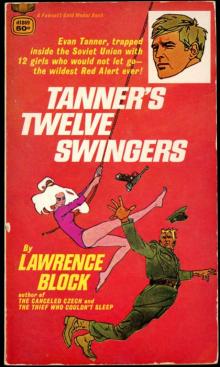
In the late fifties, lesbian fiction was an extremely popular paperback category. Two kinds of readers were drawn to the books—gay women who could identify with the characters, and men who were turned on by the idea of female homosexuality. Several publishers worked to meet the demand, most notably Crest. Fawcett originally established the Crest imprint as a reprint line, since Gold Medal published paperback originals exclusively. Crest added originals as well, especially lesbian novels.
I read them all, books by Ann Bannon and Valerie Taylor and everybody else who came down the pike. I read and reread Ann Aldrich’s lesbian nonfiction, with loads of detail on the lesbian psyche and lifestyle. (Years later I would learn that Ann Aldrich was one of the innumerable pen names of Marijane Meaker, who also wrote tough psychologically-oriented suspense novels for Gold Medal as Vin Packer and kid’s books as M. E. Kerr.) Some of these books were quite good and some of them were not so good and some of them were lousy. Didn’t matter. I read ’em all.
Why, I wonder? I found them arousing, but that seems insufficient explanation for the fascination. I was nineteen years old, for God’s sake. I found everything arousing. And the books themselves were a far cry from pornographic, and barely erotic. They never told you what the women were doing, let alone described it. (I knew what they were doing, as a matter of fact, but I understand that some men, equally devoted to lesbian fiction, didn’t have a clue. They read the books anyway.)
After years of thought, and after having heard and read all the usual explanations, I’ve concluded that I can’t explain why I felt such a strong identification with gay women. If I had to come up with an explanation, I suppose I’d have to attribute it to a carryover from a past life. I realize this will dumbfound those readers who are only willing to believe in one life at the most, but I can’t help that. There are other elements in my personality that only make sense to me in past-life terms, the most obvious being my similar (if utterly nonsexual) fascination with Ireland.
I was drawn to Ireland and things Irish long before I ever thought of setting a novel there. One of my earliest memories is of hearing someone sing “Toora Loora” on a Sunday morning radio program for kids. I must have been four or five. I never got the song out of my head. When I was nine years old I learned other Irish songs from the Book of Knowledge, and I still remember all the words to “The Wearin’ of the Green.” (It wasn’t until years later that I found out the tune. I’d made up my own tune for it, something reminiscent of “McNamara’s Band.”) And when I finally got off the plane at Shannon in 1965, I felt immediately at home. It seems undeniable to me that I lived several past lives there.