A Writer Prepares, page 25


Really, though, what difference does it make? Whether or not it ever happened, the lesson is there for all time. Sick of what you’re writing? Itching to be done with it?
Take a breath. Skip a space:
“And then the boiler blew up and killed them all.”
• • •
I’m tempted. But there’s a better note to end on, to wrap up my stint in Racine and, arguably, mark the end of my apprenticeship. And it started well before we made the move to Tonawanda.
At about the same time, two otherwise unrelated facts came to my notice. The first was tucked almost invisibly into an extended Time Magazine feature article on the phenomenon of sleep. I don’t remember the points covered, but the material must have been interesting enough to keep me reading. Eventually the author, who’d made the point that scientists differed on the precise function of sleep and how it achieved its ends, allowed almost as an aside that there were a handful of cases of individuals who lived their lives without sleeping at all.
I thought that was pretty interesting. What could a person do with an extra eight hours in every day? All those things you told yourself you wanted to do if only you had the time—well, you’d have that time, wouldn’t you? You want to learn Portuguese? Want to play the bassoon? Dude, you’ve been sleeping away close to 3000 hours a year. That’s all the time in the world. Why stop at Portuguese? Why limit yourself to a single woodwind? Before you know it, you could be a one-man band and an interpreter at the UN.
You get the point. My imagination latched on to the notion of a protagonist who’d lost the ability to sleep. Someone in the Time article had posited the existence of a sleep center in the brain, possibly hidden away in the hypothalamus, so why couldn’t my hero have had his sleep center destroyed? He could have served in Korea, he could have been wounded by a shard of shrapnel, and who was to say it might not have left him in a state of permanent insomnia?
So that was one fact, and where it led.
The other turned up in an encyclopedia, the 1948 edition of the Britannica some enterprising salesmen had palmed off on my parents. Something, very possibly a numismatic matter, had led me to look up the royal House of Stuart. I already knew that James I was the first Stuart on the English throne, and that Anne was the last, and I was dimly aware of the Old Pretender—James III, in the eyes of his supporters—and the Young Pretender, whom we know as Bonnie Prince Charlie. I read how a British force under the Duke of Cumberland routed the Jacobite army at Culloden in 1745, and put paid to Charlie’s efforts for all time.
That was, at the very least, interesting. But what I never expected and found truly remarkable was the fact that the House of Stuart had not disappeared, and that there was in fact still a Stuart Pretender to the English throne. He was, you’ll be pleased to know, one Albrecht Luitpold Ferdinand Michael, Duke of Bavaria; his eldest son Franz, born in 1933, is his heir and the current Pretender, and if the House of Stuart were to be restored, he and his wife and kids would have Buckingham Palace all to themselves.
Gosh.
Now that issue of Time must have had extensive readership, and I couldn’t begin to guess how many readers had access to the Britannica. But both factoids—about sleep, about the Stuarts—came to me one upon the heels of the other. And all at once I combined them, and now my Sleepless Knight had something to do with all those extra hours. He could hatch a plot to depose that usurper, Elizabeth Battenberg, and restore the House of Stuart to the British throne.
That would have been in 1962 or 1963, while I was still a Scott Meredith client, because I remember telling Henry my idea. He was encouraging, but I needed more than encouragement. I needed a story, and all I had were a hero and a quest. I thought about it some, and it didn’t go anywhere, and I put it aside and forgot about it.
Sometime in 1965, when I was a year or so into my sojourn in Racine, a fellow I knew by reputation turned up at the office. His name was Lincoln W. Higgie III, but my colleagues in the coin division knew him as Bill; in 1962, Whitman had published his book, The Colonial Coinage of the U.S. Virgin Islands. He was back in the States after a few years in Istanbul, where he’d risked life and liberty spiriting ancient coins and antiquities out of the country.
We hit it off, Bill and I, and I invited him home for dinner. He showed up at the appointed hour with a bottle of Bushmill’s Irish whiskey. Loretta put dinner on the table, and Bill and I wound up in the living room, draining the bottle and talking the night away.
He did most of the talking, because he had far more interesting stories to recount. What he’d spent his time doing had been a violation of Turkish law, and to commit such a violation was to take one’s life in one’s hands, and Bill had had a few close shaves and talked eloquently about them. Once, he recalled, he’d boarded a plane bound from Istanbul to Zurich, and his carry-on bag held a package of ancient artifacts to which he held no clear title and the export of which was strictly forbidden.
He found himself seated alongside a grandmotherly Englishwoman with a pleasant if distant manner. Some impulse led him to take his package from his carry-on and ask her if she could perhaps tuck it into her purse. She did so, and stowed her purse in the overhead compartment.
The plane closed its doors in preparation for takeoff. But it didn’t go anywhere, and after a few minutes the doors opened and some uniformed officers boarded and walked directly to Bill Higgie. They hauled him off the plane, they strip-searched him, they went through his carry-on bag as if sifting a haystack for needles, and at length they returned him to the plane with an apology that by no means struck him as heartfelt.
When they landed in Zurich, Bill’s seatmate retrieved her purse and handed over the small package. “I don’t know what you have in here,” she said, “and believe me, young man, I don’t want to know. But what a marvelous adventure!”
I’m sure I enjoyed hearing that story as much as the English lady enjoyed playing a part in it, and there were others equally compelling. But the one that had the most impact was long and rambling, with an inconclusive ending. I’m a little vague on its details, the bottle of Bushmill’s was mostly empty by then, but it concerned a group of men, several of them employees of the Arabian-American Oil Company, who’d learned that the Armenian community of what was then Smyrna and has since become Izmir, preparing to flee what would become the 1915 Genocide, gathered together all the gold in their possession and interred the hoard in the concrete porch of a house in Balikesir.
Against all odds, they managed to identify the house in question, and locate it. They went there and broke into the porch, only to find that someone had got there before them. Evidence indicated that the Armenian gold had been there once, but it was there no longer.
Oh well. We finished the whiskey. Bill went home. I went to bed.
I woke up the next morning in time to shower and shave and get to my desk on time. And, wonder of wonders, I had something to keep my hangover company; I remembered the conversation. Most of it, anyway—including the story of the Armenian gold in Balikesir.
And I remembered as well the hero I’d caught a glimpse of a couple of years before, the fellow with a shard of shrapnel in his hypothalamus, the permanently wide-eyed chap with plenty of time to learn languages and scratch out a living writing term papers and theses for college students.
You remember him, don’t you? That wide-awake fellow who dreamed of restoring the House of Stuart? I may have already come up with a name for him back in Tonawanda, before I had a tale for him to tell. In any event, I certainly knew his name now. It was Evan Michael Tanner, and I was now able to see him as a devotee of not a single lost cause but a few dozen of them. He’d be a diehard Jacobite, to be sure, but he’d also be a fellow of the Flat Earth Society and an officer in the Latvian Army in Exile—and, by God, a devoted member of the League for the Restoration of Cilician Armenia.
And that’s how he’d learn about that house in Balikesir. And, calling for support upon all the nuts and cranks who were his boon companions in various far-flung fringe groups and irredentist movements, he’d find that house and break into the vault where the treasure of Smyrna had spent the past half century. And, unlike those hapless schlubs from Aramco, he’d damn well find it.
• • •
And so he did. In the early weeks of 1966, I told that story in some fifty-five thousand words. I sent it off to Henry Morrison, and he sold it to Knox Burger at Gold Medal.
Yes, Henry Morrison. A year or two previously, Henry had left Scott Meredith (of his own volition or not, depending whose version you believe) and set up on his own as a literary agent. Some months earlier, while Henry was still Scott’s henchman, Don Westlake had gone through an acrimonious and indeed litigious break with the agency, and to the surprise of all parties, not least of all himself, he became the first client of the new Henry Morrison agency.
Henry reached out to ask if I’d done anything with Deadly Honeymoon, which he’d returned to me back when the shit hit the fan. Because, he said, he thought he might be able to sell it. I reclaimed it from Kelly, Bramhall & Ford, who’d been unable to do anything with it; then I sent it to Henry, and indeed some months later he went on to place it with Mary Heathcote at Macmillan, where it would become my first hardcover novel.
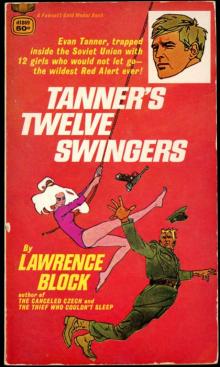
And so, when I’d finished my thriller about Evan Michael Tanner, I mailed it off to Henry. He sent it to Knox, and the next thing I knew I had a contract, and the book had a new title: The Thief Who Couldn’t Sleep. (I’d called it something else, but have no idea what that might have been.)
But even before I’d finished writing the book, I knew I wasn’t ready to say goodbye to its narrator. It was my first book about Evan Tanner.
There would be others.
• • •
Eight in all. Before The Thief Who Couldn’t Sleep was set in type, and probably before it got past the copy editor’s desk, I was busy writing The Canceled Czech, and for the next several years the series grew as I managed to keep Tanner busy with two or three adventures a year. The first six books appeared as paperback originals from Gold Medal, the seventh (Me Tanner, You Jane) as a Macmillan hardcover.
I’d managed to become the author of a series, and that had been a goal of mine almost from the beginning. As a reader, I’d always particularly enjoyed renewing my acquaintance with a character I’d already found appealing; if Nero Wolfe or Miss Jane Marple or Lew Archer or Ed and Am Hunter had charmed me once, why wouldn’t I want to spend another couple of hundred pages in their company?
If this was true for a reader, wouldn’t it be that much more the case for a writer? On the creative side, you didn’t have to reinvent the wheel every time you sat down in front of a blank page. Your character and his world were already there, waiting for you to come with things for him to do. And, from a commercial standpoint, the readers of one book were a natural core audience for the next. As the series grew, you’d be building a following.
None of this would seem to need saying now, with the publishing industry so committed to the idea of series in genre fiction that the decision to accept or reject a first novel often hinges upon whether the writer plans more books about the character. You’d need a memory almost as long as my own to know that such was not always the case.
Series characters have always been popular with readers—generations of children grew up with an unquenchable thirst for more stories about Nancy Drew and the Bobbsey Twins and the Hardy Boys, along with Tarzan and the Lone Ranger and all those oddballs in the Land of Oz. And one need only recall that Shakespeare wrote The Merry Wives of Windsor because Queen Elizabeth wanted to see another play about Falstaff.
At the same time, a book in a series was tacitly regarded as limited, both artistically and commercially. A successful novel, one was given to understand, ought to use up its lead character, leaving him changed at the end of it and hardly a good choice for further installments. To go on writing book after book about an unchanging protagonist was to spend one’s life repeating oneself, putting in endless hours on a literary assembly line.
And, while your core readership might stay with you over the course of a series, the whole enterprise had a ceiling as well as a floor. A series, you see, was undeniably genre fiction. A recurring detective made it very clear that what you had written was a mystery, and the publishing industry of the day knew how to define a mystery. It was a book-length work of fiction in which a crime was central to the plot, and one with a maximum sale of six thousand hardcover copies.
There were exceptions, of course. Once in a blue moon a work of crime fiction hit the bestseller lists, in which case it was recognized by all concerned to be something else. It brought off its escape from the ghetto by somehow transcending the genre.
What changed this? I’d point first to Agatha Christie, who wrote two novels to be published after her death. In 1975 Curtain constituted the final appearance of Hercule Poirot, and Miss Marple took her own last bow a year later in Sleeping Murder.
Both were bestsellers. Both were undeniably mysteries, and in fact entries in longstanding series.
The industry raised a collective eyebrow. And adjusted to a new reality.
• • •
For my part, I’d always wanted to write a series. Coward’s Kiss, my first private eye novel, had starred one Ed London, who struck me even then as a fairly colorless chap.
The book was my second sale to Gold Medal, and I’m sure it’s not coincidental that, like Grifter’s Game, I wrote it with lower expectations. I’d received an assignment to write a TV tie-in novel based on Markham, a weekly series which starred Ray Milland as one Roy Markham. Belmont Books, a third-tier paperback house, had acquired the rights, and I’d get $1000 for a novel in which Mr. Markham would set about solving a case of my own devising.
By the time I was halfway through the book, I decided it might have greater possibilities. I finished it and gave it to Henry, who agreed, and he sent it to Knox, who liked it enough to buy it. He had a couple of editorial suggestions; the one I recall was that I change not only the protagonist’s surname but his first name as well; Roy, Knox said, had been the name of his sergeant in basic training, and it wasn’t a name he wanted to encounter attached to a Gold Medal hero.
So I changed his name to Ed London. And I traded in the less than heroic Renault Dauphine I’d had him driving, a requirement I’d been lumbered with as that French automaker had been one of the show’s sponsors.
Knox took the book, and I then had to return to Roy Markham and wrap up the assignment for Belmont. Meanwhile the series got canceled, and Ray Milland went on to other things, but his picture graced the cover of Markham: The Case of the Pornographic Photos, which is a notably clunky title and subtitle.
Ed London’s title wasn’t a whole lot better. I’d called it Coward’s Kiss, a reference to the quatrain from Oscar Wilde’s Ballad of Reading Gaol about each man killing the thing he loves: “The coward does it with a kiss / The brave man with a sword.” It appeared as Death Pulls a Doublecross.
I never liked that title, and Ed London had struck me even then as a fairly colorless chap. Still, he was a private eye, and he’d emerged alive at the end of a published novel, so another book about him seemed the natural next step. But I couldn’t get it written. (I did turn out a trio of lackluster novellas about him, all published in 1962–3 in Man’s Magazine and subsequently appearing as The Lost Cases of Ed London; you can find them now in a collection of my earliest crime fiction, One Night Stands and Lost Weekends. And you can find both novels available, one as Coward’s Kiss, the other as You Could Call It Murder.)
And there were other occasions when, as I wrapped up a novel, I found myself laying the groundwork for a sequel. I did so in The Girl with the Long Green Heart; the two con men, having betrayed one another over the titular Jezebel, follow a knock-down drag-out fistfight with the grudging admission that they had indeed worked well together. Would they resume their partnership in some future caper?
They never did, nor did I spend much time contemplating the possibility. But I’d clearly left the door open, and I’ve had a few correspondents over the years wondering if there might be more in store for John Hayden and Doug Rance.
That could have made sense, if I’d put my mind to it and found the right sort of story for them. What made less sense was the wrap-up of Deadly Honeymoon, which found the bride and groom, having exacted their revenge and at long last consummated their marriage, musing that their successful joint quest might have spoiled them for the white-picket-fence existence they’d been headed for. But what other career might they consider?
Don Westlake saw right away where I was going. “By God,” he said, “you’ve set it up for a sequel. The two of them would constitute the least likely detective partnership since Bertha Cool and Donald Lam.”
Well, of course I never gave a moment’s real thought to the Deadly Honeymoon Detective Agency (although it does have a ring to it, doesn’t it?) Nor did the green-hearted girl ever develop any other colorful body parts. (I did, half a century later, echo that title with The Girl With the Deep Blue Eyes, but the two books had nothing in common but their titles.)
Tanner was different. He changed my life.
• • •
But not dramatically. The Thief Who Couldn’t Sleep didn’t get me out of Racine; I’d already left my job and set in motion a return to the New York area before I wrote a single word in Tanner’s voice. Nor did he make me rich and famous. Gold Medal took on those first six books and seemed happy enough to publish them, but none went back for a second printing. It was their flat sales that led me to move Me Tanner, You Jane to Macmillan, where its hardcover edition got a little more critical attention than its predecessors while reaching fewer readers. (It wasn’t reprinted in paperback. In those days, hardcover publishers sold reprint rights to paperback houses. Or, as in the case of MTYJ, didn’t.)
So how did Tanner change my life?
I think I can credit him with marking the end of my apprenticeship. While I’d made my career choice in Miss Jepson’s eleventh-grade English class, and while I’d been quick to mail poems and stories to otherwise blameless magazines and tape their rejection slips to my wall, I became an apprentice writer the moment I walked off the job at Mildred’s Chowderhouse and set about writing a daily short story upstairs of that barbershop in Hyannis.