

Planetary: Mercury, page 1
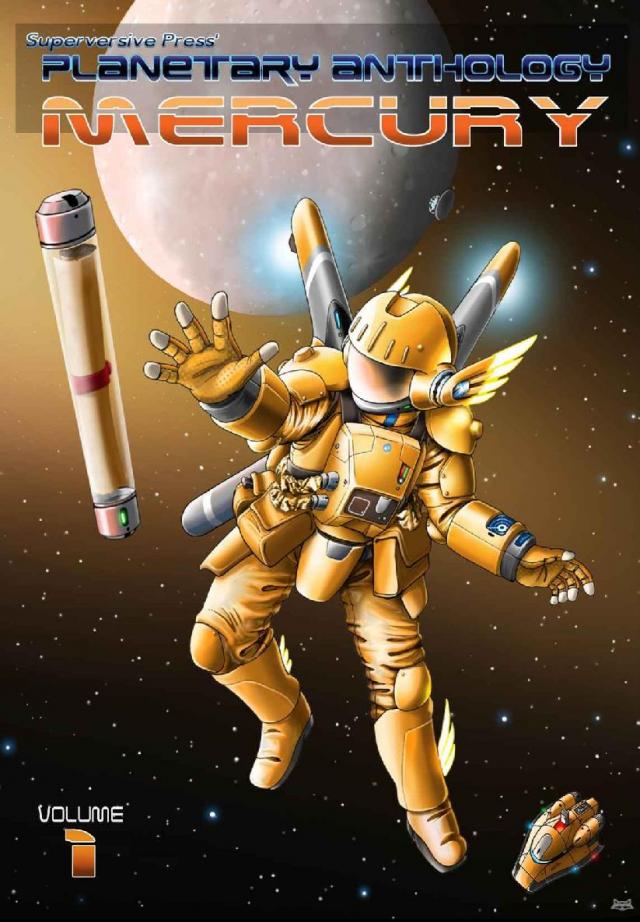


Table of Contents
Front Matter
Copyright Notices
Introduction
In the Palace of Promised Immortality by John C. Wright
Schubert to Rachmaninoff by Benjamin Wheeler
The Element of Transformation by L. Jagi Lamplighter
In Tower of the Luminious Sages by Corey McCleery
The Haunted Mines of Mercury by Joshua M. Young
Quicksilver by J.D. Beckwith
Ancestors Answer by Bokerah Brumley
Last Call by Lou Antonelli
Deceptive Appearances by Declan Finn
mDNA by Misha Burnett
The Star of Mercury by A.M. Freeman
Cucurbita Mercurias by Dawn Witzke
The Wanderer by David Hallquist
The Planetary Series
About Superversive Press
PLANETARY: MERCURY
© 2018 Superversive Press
All rights reserved. No part of the content of this book may be reproduced, distributed, or transmitted in any form or by any means, or stored in a database retrieval system, or copied by any technology yet to be developed without the prior written permission of the author. You may not circulate this book in any format.
Editors: David Hallquist & Ben Zwycky
Cover Art: Lee Madison
ISBN: 978-1-925645-12-5
First Edition: 2018
COPYRIGHT NOTICES
“In the Palace of Promised Immortality” by John C. Wright © 2018 John C. Wright
“Schubert to Rachmaninoff” by Benjamin Wheeler © 2018 Benjamin Wheeler
“The Element of Transformation” by L. Jagi Lamplighter © 2018 L. Jagi Lamplighter
“In Tower of the Luminious Sages” by Corey McCleery © 2018 Corey McCleery
“The Haunted Mines of Mercury” by Joshua M. Young © 2018 Joshua M. Young
“Quicksilver” by J.D. Beckwith © 2018 J.D. Beckwith
“Ancestor’s Answer” by Bekerah Brumley © 2018 Bekerah Brumley
“Last Call” by Lou Antonelli © 2018 Lou Antonelli
“Deceptive Appearances” by Declan Finn © 2018 Declan Finn
“mDNA” by Misha Burnett © 2018 Misha Burnett
“The Star of Mercury” by A.M. Freeman © 2018 A.M. Freeman
“Cucurbita Mercurias” by Dawn Witzke © 2018 Dawn Witzke
“The Wanderer” by David Hallquist © 2018 David Hallquist
INTRODUCTION
David Hallquist
Why Mercury? Why tales of a small, barren rock circling the Sun, almost invisible in its glare?
The question might be: why not Mercury?
This oddball world races about in a highly eccentric ellipse, instead of the more proper, nearly circular orbits of other planets. It is tidally locked in a 3:2 resonance with the Sun, with one Mercury day for every two Mercury years. This cratered little world is far more dense than it would seem, and is believed to have a proportionally larger iron core than other worlds. Then there is the odd phenomenon of a powerful magnetic field on a world that is barely rotating at all. Truly, a strange little planet.
Mythic Mercury, or Hermes was the swift messenger of the gods, and famous for his brilliance and trickery. The wand of Hermes, the Caduceus, is still the symbol for medical learning around the world. Speed, brilliance and knowledge are all associated with the messenger.
Mercury the metal, is known as ″quicksilver″ and has been associated with transmutation and arcane processes since the time of the earliest alchemists. Chinese Emperors believed that an amalgam of mercury would bestow immortality. Useful in early photography, industry and scientific studies, the deadly poisonous nature of the metal quickly limited the usefulness of quicksilver.
For all of that, Mercury has been a bit overlooked in Science Fiction. There are notable great stories: Arthur C. Clark’s ″Runaround″, Larry Niven’s ″The Coldest Place″, Ben Bova’s ″Mercury″, are all great examples of science fiction about Mercury, and there are many mentions of Mercury in many other works. Overall, though the tiny world is often overlooked for the glories of Mars, the majesty of Jupiter or the splendor of Saturn.
These then, are the tales of Mercury: messages about the Messenger and the Traveler.
In The Palace of Promised Immortality, by John C. Wright, takes place on Mercury itself, yet is also the tale of a traveler not only in time, but alternate worlds.
Schubert to Rachmaninoff, by Ben Wheeler, deals with a messenger braving hazards while traveling across the barren wastes of Mercury.
The Element of Transmutation, by Jagi L. Lamplighter, brings us the mythic character Mercury himself, and the element’s fascination with early alchemists.
The Haunted Mines of Mercury, by Joshua M. Young, brings a man into confrontation with the past while exploring the subterranean tunnels of Mercury.
The Tower of the Luminous Sages, by Corey McCleery, is a tale of fantasy and fantastic travel though strange realms.
Quicksilver, by J.D. Beckwith, is the tale of a crisis on a ship traveling near Mercury.
Ancestors Answer, by Bokerah Brumley, is a tale of a different type of travel: time, in a matter of family honor.
Last Call, by Lou Antonelli, brings us a Mercury of the far future, mined out of its precious minerals and all but forgotten.
Deceptive Appearances, by Declan Finn, brings a tale of rogues and schemes under the domes of Mercury.
mDNA, by Misha Burnett, is a tale of a different kind of messenger: a genetic courier in a desolate wasteland.
The Star of Mercury, by A.M. Freeman, involves bitter rivalry and high technology on Mercury, but most of all, the importance of a child’s life.
Cucurbita Mercurias, by Dawn Witzke, brings us a murder mystery during a crucial phase of the colonization of Mercury.
The Wanderer, by David Hallquist, is a tale of two explorers, one an alien probe, and the other a man researching the interior of Mercury.
IN THE PALACE OF PROMISED IMMORTALITY
John C. Wright
Lights of infinite pity star the gray dusk of our days:
Surely here is soul; with it we have eternal breath:
In the fire of love we live or pass by many ways,
By unnumbered ways of dream to death.
George William (“A.E.”) Russell (1867–1935)
Circe
She could not remember where she had put her memory eraser helmet.
Circe cupped the liquid of her pool in both her hands, and doused her face. She made her lips larger, redder, and her eyebrows darker, to allow her to pout and scowl more vividly. She focused two mirrors on her face, seconds before and after the change, and inspected the results critically.
Circe was half submerged amid the scented lilies and floating candles of the warm pool that served as her throne, wardrobe, and vanity. The bathing chamber was in her apartments that crowned the shining and soaring main tower of the Palace of Promised Immortality.
Naked, embraced by silky biomolecular-engineering fluid, floating beneath the dome of time glasses focused on the immediate past and future, she could make adjustments to her body, to hue of hair or feature of face, to foot or hand, or any measure of inseam, hips, waist, bust, height.
Discontent burned in her. Where was the helmet? What had been buried? She remembered the locket, and the face within, and remembered holding the locket in her hand. It was of utmost importance. It was precious beyond words.
Where was the locket now? Whose was that face?
The helmet had the power to call up buried memories as well as to bury them. Never had she needed it so badly. But why now, of all times, was it not to be found?
She had certainly had the helmet twenty-four hours ago. She had been assigned to babysit a bored and sulking little ghost. They had been playing hide and seek in the garden of forking paths surrounding the monument to Ts’ui Pen. Circe had been carrying the helmet then, just in case some memorable but deviant event might happen, an event that could not plausibly be reconciled with her own memories from ten years past, when she first lived through the scene.
The chance of a deviation was small. Circe but dimly remembered the sharp-tongued and impatient babysitter who used to take her into the park for outings. To her young eyes, the teenaged sibyl had seemed very grown up. She had indeed shown up once with a book, a bottle, and the cylindrical amnesia helm. Where had the helm gone? What had the babysitter done with it? Circe strained, but the memory from when she was six would not come to the fore.
It was not impossible that memories a decade old would fade. But twenty-four hours old? She remembered waking up at the start of this watch; but not retiring to sleep at the end of the last watch. That was sixteen hours ago.
Circe could tell something was afoot. Soon after breakfast, the time mirrors began to grow sullen and stubborn when asked to show certain scenes. And before lunch, during her history lessons, the golems were unaccountably slow in answering certain questions. (Of course she studied history. What else was there to study?)
After lunch, a middle-aged sibyl, with her dark hair pinned up in a tight bun and crow’s-feet gathered at the corners of he r eyes, had visited to tutor her in chronopathy. Circe stepped across a thousand years, futureward and back, across intervals large enough to be safe. These were lessons no golem could teach.
The matron seemed particularly curt, closed-mouthed, and cold. She frequently consulted her notes, as if to confirm that not a word of her dialog would differ from her recalled version. Circe, seeing this, resolved to write out her next diary entry with the wording changed.
Then a gray haired sibyl from near the end of her life, bent-backed and wrinkled like a prune, and leaning heavily on the middle-aged one, came to lecture her fiercely about the duties all time travelers owed their own future.
“Any act of disobedience, slouching, or sloth in performance, and you will erase yourself and die!” hissed the crone. “We who are downstream of you will not perish, however, as a slight adjustment to your past will prune you before you can act, and set the timestream right again before it goes awry.”
“You would kill me for slouching?” Circe had asked with sneer, rolling her eyes. “I make a terrible Mom. What if I decide never to have kids?”
The matronly, middle-aged sibyl grabbed Circe’s ear and twisted it painfully, making the girl bow and yelp. “Today of all days, will you give us cheek? Use your ear or I will rip it off.”
“It comes off you if it comes off me!” Circe snarled, “You are not my real mother, anyway! Where is she?”
The crone laid her withered hand on the wrist of the matron. “This does not sound quite right to me.” She whispered. But the younger sibyl said softly, “This is the way I remember it. Let us depart before any changes are introduced.”
Without any ado, the two vanished through their different mirrors.
That confirmed Circe’s suspicions. Changing insignificant events she had seen sibyls do thoughtlessly, or out of a sense of wicked pleasure. Her older shadows grew cautious only when massive happenings were afoot.
That had been an hour ago. Circe did not usually bathe before dressing for dinner, but she wanted to soothe her bruised ear. She ignored the dinner bell when it rang. Let Cook and the serving maidens keep her supper warm for her.
Circe touched one of the waterlilies with her finger, and told it expand to giant size, and fold its petals just so, to allow her to sit on it as it floated in the water. The biomolecular fluid penetrated into the lily and worked the alterations. Circe climbed into it. Perfume escaped the petals where her weight bruised them.
Springtide
Windows circled the walls of the bathing chamber. These were made of space glass rather than time glass. These panes could bring into clear view any object within the circle of the horizon, or bring physical objects.
The horizon displeased her: it was too close, too narrow. The horizon of Earth would have been three times further away, and the sun would have been three times smaller.
In the view, underfoot and close at hand, were the wings of the Palace of Promised Immortality, including the museum holding the artifacts, archives, and prophecies taken from all periods of future history from the current epoch to the Final Extinction in A.D. Three Billion, when the sun was destined to overwhelm the inner planets, and all life die.
The shining towers, sheathed in silent energy-auras, rose sheer from the waters of a central lake in the middle of a vast impact basin called Caloris Planitia. This basin formed the floor of a crater of the same name. It was wider than Texas. At noon, each second perihelion, this crater was in the closest spot to the sun of any bit of ground in the solar system. It was an act of overweening engineering to build an oasis of earthlife here.
Arbors, gardens, vineyards and crop fields ran from lakeshore to the horizon in orderly rows and rectangles; it was a pleasant patchwork of emerald hews. The channels and cracks of the Pantheon Fosse radiating outward from the lake were river canyons filled with streams, fishponds, and rice paddies. Fountainworks fed tiny, bright streamlets running to and over the canyon walls in the musical silvery threads of countless waterfalls.
Over the horizon and beyond her current view, four hundred miles of dark forest grew wild across the plains and up the knolls and bluffs to the continuous mountain-walls circling the crater. This unbroken forest was void of animal life, silent and without birdsong. No goats skipped amid the foothills, no sheep grazed in the meadows. Only the droning of bees was here.
The miniature planet was equal in surface area to Asia and Africa combined, and it was all her own private estate, or so she had been told. For a girl living in solitude, it was appallingly huge and bare, and lonely.
Shadows visited her, of course, sometimes in throngs: ghosts from her past and sibyls from her future. But, technically speaking, she was still alone.
Golems did not count. They were furniture.
Circe scowled at the swollen, slow, and sluggard sun. It was low in the east, but neither reddened nor oblate, since there was no atmosphere to distort it. Dawn had been two earth days ago; noon would not come for another forty-two.
The sight of young buds and green branches, and the scent on the warm breezes entering the space mirrors displayed the springtide. The axial tilt of Mercury too slight to contribute any seasonal variation, but so eccentric was the orbit that the difference in distance from the sun between perihelion and aphelion ushered in globe-wide seasonal variations.
Sunrise to sunset was eighty-eight days, one year, while the full day-night cycle was twice as long. Odd numbered years held four seasons of light: the buds of spring came at dawn; the warmth of summer burned the noon; the harvests of many-colored autumn came to full fruit in the afternoon; and the frosts and snows of winter turned the dusk white. Even numbered years held four seasons of darkness: the scented night-breeze of the springtide evening led to the showers of summery midnight; then a season of mists and fogs when the golems trudged through moonless darkness to reap a second harvest of the night crops; then came the clear cold night winds of winter before dawn.
The world should have been a molten hell by day, a frozen hell by night. The energy dome shielding the vast Caloris Basin did not seem like technology to her. It seemed like magic. The sibyls told her this art had originally come from twenty centuries in the future, from the cruel days of the Glorious World Empire of Tsan-Chan of A.D. 5000.
The biotic engineering that had created perfect replicas of earthlike plants yet able to sprout and ripen and fade in twelve weeks, to her was also magic, as were the strange fruits and nocturnal flowers designed to live and bloom without light. This art came from A.D. Five Hundred Million, when the highly-modified Biomancers of the supercontinent of Pannotia ruled a single landmass supporting a single interconnected treemass that filled the hemisphere.
The psychomechanical engineering that had created unfree yet living human-shaped artifacts to act as the serfs and gardeners, tinkers and tillers of the Palace of Promised Immortality came from the time when the Great Brains ruled the Vendian supercontinent. These were a race of immobile supermen whose nervous systems were forty-yard-wide masses floating in lakes of buoyant nutriment, from which their shriveled bodies hung like the stems of mushrooms. Their cold, intellectual empire arose a hundred million years after the Biomancers, for the Great Brains had exterminated their creators.
To create the golems, make them able to think, but not able to form desires nor act on them, that was something Circe did not think was magic. She thought it was black magic. She thought it was witchcraft.
From here, she could see the golems toiling, stooping in rhythm amid the rice paddies. They wore masks of white, with only the narrowest slits for mouth and eyes, to display their lack of humanity. All had female bodies, including the serfs tending the rice paddies and harvesting crops. No servant shaped like a man was permitted.
The science behind the time mirrors came from various eras, for it was easily discovered, and yet it even more easily eliminated itself and its discoverer. Circe had never been told the name or native year of the first time traveler, nor did any sibyl know.
Physical motion of the body through time was possible on Earth and Venus, but more deceptively fatal than quicksand. This was amply shown by the catastrophic paradoxes that haunted the Imperial Princess Shammuramat of Tsan-Chan when she attempted to use time travel as a weapon against the insubordinate yet all-powerful Gunsmith Guild of the Fifty-First Century.


