

Planetary: Mercury, page 16
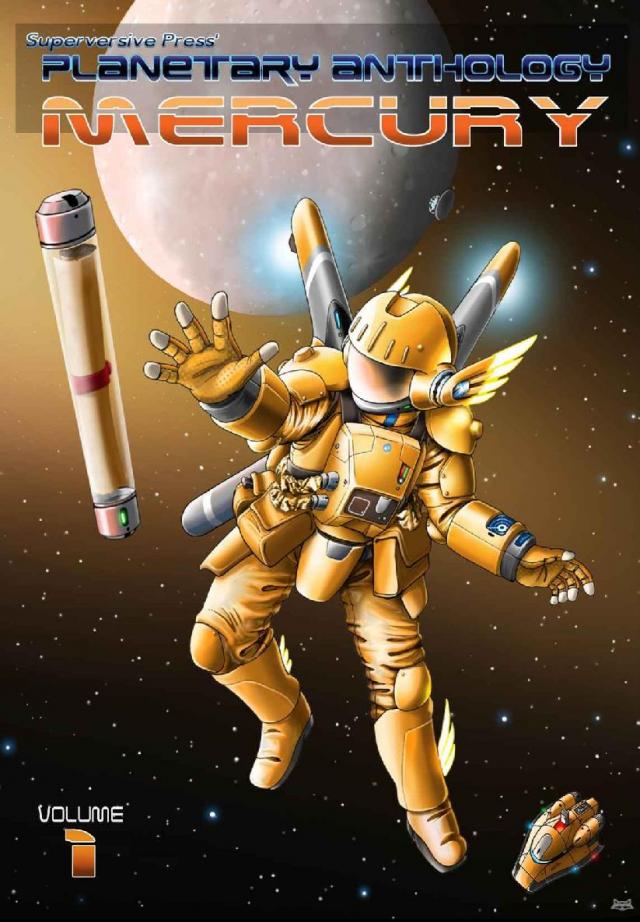


“Why what, your Highness?” Wei asked.
“Why did the dragon choose you?”
There were many things she could have said. She could have lied, played it safe, said that she didn’t know. But instead, quietly, she spoke. “He claimed he was my father.”
“I see,” the Emperor nodded. “As I thought.”
“What?” Wei asked.
“The Sage had a few theories why you survived looking at the Pearl of Shar Lung. One of them, the one I feel has the most evidence behind it, is that you have divine blood in you.” He sighed. “It poses a few problems.”
Her heart skipped a beat. “Problems?”
“People with divine blood challenge our… legitimacy.” He sighed. “The priests say that they are gifts from Heaven, talented men and women who are meant to expand the Imperial Family’s hoard of knowledge, and enrich their lives. But, many times they try and proclaim themselves emperors, and challenge my family.” He sighed. “And, in this case, there’s only one thing to do.”
Wei was going to be executed after all.
“We’d have to start it out slow. Give you honor in the court. Then, we’ll give you a position, and land to manage.” Wei blinked. The hopelessness of her imminent death gave way to confusion. What was he talking about? “And, say, six months after that, we can announce the betrothal.”
“Betrothal?” Wei asked. “What? I’m getting married? I thought you were about to execute me!”
The Emperor laughed. “No, no. An older dynasty used to do that. They spilled the blood of the children of Heaven, potential challengers to their rule. They found out that was the quickest way to anger the gods, killing their children. No,” the Emperor said, “it’s easier to just marry them into the family. But, since I have five daughters and only one son… the choice is quite obvious.”
Wei blinked. “You’re marrying me to your son?”
“You object?” The Emperor frowned. “I don’t remember any of my advisers saying he was too odious. Actually said he was pleasant to be around.”
“No, it’s… you’re offering to make me a princess.” Wei shook her head. “After I told you that your friend betrayed you.”
“Hamadau betrayed me. But you didn’t make him.” He sighed. “I already ordered some of my troops to take him captive. He will pay for his treachery against me. And you.”
“What?”
“The Sage told me about what happened to the Kueh. And, since you’re one of them, I thought it would be something else he should pay for.” The Emperor sighed. “I brushed that out of my mind because we had been friends… but now, that has been lifted.” He studied Wei for a moment. “You seem distracted.”
“I’m still trying to wrap my mind around becoming a princess,” Wei said, “even one by marriage, not birth.”
“You don’t understand. He is my firstborn son.” The Emperor paused. “When I join my ancestors… you will be Empress.”
Wei blinked. “And you trust me?”
“You could have killed him,” the Emperor said. “You could have slain him, gutted him in his sleep like a pig. I know he never keeps his sword far from him, and to steal all of what you took… he had to have been sleeping. You could have avenged your people.
“But you didn’t. Instead, you came to the Imperial courts. You did not slake your thirst for revenge with murder and bloodshed, but you sought justice.” He paused. “That is the character of an Empress.” He looked at her. “Go. I wish to be alone.” He paused. “What is done is done, and the man who was my friend, clearly, is no more. Hamadau has changed.” The Emperor seemed… weak. “I wish to grieve for him.”
“I understand, your Highness.” Wei rose, and began to walk away.
“Wei.” She turned. “I expect you to be kind to my son. He has… expressed interest in you prior to us knowing of your parentage.”
Wei nodded. She kind of liked the man herself. “I will leave you alone, sir.” With that, she left.
She had broken into the tower, to steal treasure. And somehow, Wei had topped it off. She had stolen a prince’s heart. And with that, an empire.
About the Author
Corey McCleery is a writer, artist, and general fantasy enthusiast. Much to the delight of his English teachers, he fell in love with the written word at an early age. Much to their chagrin, he fell in with the more disreputable genres of science fiction and fantasy. His epic science fantasy novel, Daughter of Sol, was serialized in Astounding Frontiers and presently will be published by Superversive Press. His fantasy novel Fever Blood, a rough draft of which is online on Wattpad, will also be published by Superversive Press. Corey occasionally writes for his website coreymccleery.com on writing, amateur forays into philosophy, Christianity, and the philosophy of fiction and fantasy. His art and doggerel can be found at panhead13.deviantart.com where posts his baby steps as he learns digital painting. He can be found on Wattpad as user Halcyon15 and on Twitter @halkyov15.
THE HAUNTED MINES OF MERCURY
Joshua M. Young
It was a mistake, Cincinnatus Sherman reflected later, to assume that preaching couldn’t be threatening. Mom’s uncle Boyd had been a preacher of one stripe or another, all fire and brimstone. Threatening enough, all things considered; maybe more so if uncle Boyd had been a ghost at the bottom of a mineshaft. But the foreman had said that their voice had been gentle rather than threatening, and somehow, that made it worse.
The cage grumbled to a halt, not quite level with the ground. The floor of the shaft was another three feet or so down, an easy hop in Mercury’s gravity. Cincinnatus double-checked his gear—the seals on his helmet, the atomic blaster holstered at his thigh, the life-blade gifted by the Virgin Queen of Venus on his left hip, the death-blade stolen from Harvesters in the Oort Cloud sheathed on his right—and made the hop. He landed with a spaceman’s easy grace and took stock of his surroundings. Behind him, the mineshaft and the level foreman’s pressurized office, dark and empty behind its window; ahead, the emptiness of the bottom level of the Rachmaninoff shaft, spreading out to the left, right, and dead ahead. The only working lights were in the immediate area surrounding the shaft; those farther out had been spotty at best on this level and had, of late, given up the ghost entirely.
In spite of himself, Cincinnatus chuckled at the pun.
Stereotypes painted manual laborers as rough and uneducated men, superstitious. Cincinnatus knew better. Mining was a finicky job at best and ignorance would lead to death. Shamanism might be fine for Venusian spear-fishers and Martian reed-farmers, but a miner trusting to the spirits to hold up the roof of his mine would be a flattened miner in short order. As for Cincinnatus himself, while he had no explanation for the strange lethality of his death-blade or the life-blade’s own bizarre properties, a veteran spacer had to trust to science as surely as any miner. Great Klono would not make a bad orbital insertion work, and the spirits of the stars would not plot the course of his ship.
The central section of this level had been thoroughly mined: stone, minerals, valuable metals. The support pillars here were more spindly and the roof higher than either would be on Venus or Earth, and his suit lights cast strange, shifting shadows that seemed to skitter away as soon as they entered the edge of his vision.
Maybe they were indeed skittering, but none of them in his direction.
He realized after a moment that his hand was clenched down on the grip of his blaster. He pried the fingers loose and rested them on the hilt of his death-blade instead. Foul though that weapon was, it would do less damage if he got jumpy. The blaster’s atomic energies were likely to bring down the roof if he started taking potshots at shadows.
The central cavern broke into three smaller passages, each carefully machined and supported; beyond that, Cincinnatus knew, beyond the reach of his suit lights, they became smaller, winding, more cave-like, following the valuable veins of ore here in the Rachmaninoff crater. He set off down the southern tunnel, where most of the events had been reported.
There was something about the tunnels, he had to admit. The way the shadows seemed to flee unnaturally; the way the roof pressed down on him, even in the low gravity, when he entered the less refined exploratory passages; the way his suit lights flickered uneasily. Something in him wanted to give up, but Cincinnatus Sherman was a man known for getting things done. He tightened his grip on the hilt of his death-blade and made sure he kept the comms and power lines always on his right and made sure one step was always followed by the next.
Several exploratory branches ended prematurely in cave-ins. Most such passages, Cincinnatus could stand in the main tunnel and play his lights across the stones. Neither the foreman nor the company brass had mentioned anything about cave-ins, and that troubled Cincinnatus. That meant that someone, at some level in the company, was hiding something, or it meant that something had caused multiple cave-ins in the few weeks since work had stopped. He was not sure which troubled him more.
…through one man entered death; a lie, a cosmic deceit upon your race…
Cincinnatus froze mid-stride, and slowly put his foot down. He forced tense muscles to loosen, and turned about in a circle to examine his surroundings. The mine walls were close, and while rough-hewn, not so rough that anything could have hidden in them. The nearest exploratory spur was a hundred feet or so back, and as far as his lights could reach, the tunnel both before and behind him was empty. The air in Cincinnatus’ suit seemed thick and stale, even though the filters and reserve tanks should provide him at least a day’s worth of oxygen; his suit lights seemed to dim perceptibly, even though there was a week’s worth of charge in his batteries. He wondered, for a few moments, if he was having an attack of previously unknown claustrophobia, but brushed away the possibility. He had been trapped in the Elder’s city with the Virgin Queen of Venus for nearly a month, and the tunnels of the Harvesters were almost designed to induce claustrophobia—to say nothing of the months spent on board his ship between planets. Never before had he heard voices in the dark. Something else was at work here; perhaps another dark god, like the one to which the cultists had tried to sacrifice the Virgin Queen. Perhaps a plot or machination of the Harvesters, though they seldom ventured past the asteroid belt, let alone this close to the sun.
And maybe it was something else altogether. The words had not come in over radio; there was no wireless contact with the surface this far down. They had been whispered, it seemed, in his ear, and even as he pondered that, they came again: Alone, all alone, because of death. Caesura. Never before any loneliness, not in all the vasty deeps….
And then they were gone, and Cincinnatus was alone with his thoughts once more. The Virgin Queen loomed large in his mind. With effort, he shook the memory off, but not without a sigh escaping traitorous lips.
The miner had been buried underneath a collapsed wall, and, with his thoughts on the ethereal messages drifting in from the dark, Cincinnatus nearly missed him as he skirted the pile of debris. It was only the straightness of the miner’s boot that caught his attention in the shifting, lumpy shadows of fallen talus.
He knelt near the boot and began shifting debris from form. A leg emerged, followed by another. A hip, a torso, two arms, suit miraculously intact. A helmet, one of the sturdy mining sorts, face just visible behind the glass. He pried open the access panel on the suit’s chest controls and examined the biomonitors. Dead as a doornail, needles resting at zero and status lights dark as the night. He connected his own data line to the panel and frowned. No data came forth from the suit at all. If the man had been down here for long enough, his suit would be out of power; but that brought Cincinnatus back to the troubling question of a cover-up. Neither the foreman nor company brass had mentioned a missing miner. But if the brass was involved in a cover-up, why call in an investigator? Just to calm the workers?
The workers, then? The blue-collar spacemen who worked the mine? Maybe; a coworker who was poorly liked, ill natured, or a layabout, meeting with disaster, either artificial or natural, and subsequently ignored and unreported? Suggestions to the mine bosses that he had caught a ship for Earth or Venus or Mars in search of an easier life? The oppressive atmosphere of the mine and the guilt over their dead coworker leading to hallucinations?
That did not explain the homily he himself had heard. Or, perhaps, it did; the oppressive atmosphere, the suggestion of a ghost, of messages in the dark, could have led his own imagination into overdrive. He rocked back on his haunches and nodded. It wasn’t perfect, as theories went, but it gave him something to work with if nothing surprising happened.
Cincinnatus stood, and brushed the stone and dirt from the knees of his suit. He found a communications port a few dozen feet back, in a section of intact wall, and plugged his suit’s comm umbilical in.
“Sherman to surface,” he said, but knew, even as he said it, that the line was dead. Like the crushed miner’s biomonitors, his suit was not receiving any data. Even the background static that accompanied an open channel was absent.
The suit lights flickered, dimmed. Maybe. Cincinnatus squinted into the darkness, sure something had moved. The ground rumbled, and small flakes of rock and dust fell sluggishly from the ceiling; but what he had seen had moved wrong for something falling. It had moved horizontally, not vertically.
Overactive imagination striking again. Nothing to be concerned about. The tremble in the ground, though. That concerned him; this particular area of Mercury was not known as a hotspot of tectonic activity, but there were the cave-ins, after all. The mines were maybe more dangerous than he had expected, preachy ghosts or no.
The death-blade twitched in its sheath, hilt trembling underneath Cincinnatus’ fingertips. It had done that before, in the presence of Harvesters and Venusian Elders, and it sent prickles down his spine. Cincinnatus was increasingly less certain that the issue of the mines could be dealt with in one visit. He had a reputation, certainly, as a man who got things done, but an intelligent man knew that there was no shame in pausing to regroup and reconsider gathered intelligence. He unplugged from the dead communications line and turned to look one last time at the tunnel behind him.
The dead miner was sitting up, cradling his helmeted head in his hands.
….all die now. All weep. Lonely, all….
The miner’s radio was dead, or maybe Cincinnatus’ own was down, although he heard the telltale pops and whistles of an open channel now that he switched to radio. He was at least receiving. He knelt next to the man once again, ready to plug his communications line into the man’s suit.
The man yanked on Cincinnatus’ collar ring, thunking their helmets together. “No time for that,” the miner said, voice made tinny and distant through the touching helmets, “This whole place is unstable. We have to go!”
Cincinnatus frowned. The man’s expression was mostly hidden behind his faceplate, but his eyes were wild, darting back and forth. Cincinnatus heard labored, rapid breathing through their helmets.
On his hip, the death-blade lurched.
“It’s not that unstable,” Cincinnatus said slowly, even as flakes of material fell in his suit lights. “The mines have held up this long. They’ll hold up long enough for to give your suit a once over and make sure we can move you without injuring you or damaging your suit.”
The man’s shoulders heaved, and Cincinnatus suspected the man was beginning to hyperventilate. He put a hand on the man’s shoulder and gently—but firmly—pushed the man back down even as he probed in a chest pocket for a sedative capsule. He found the capsule he wanted, adjusted the dose, and plugged it into the first aid port on the underside of the man’s helmet.
The miner relaxed visibly as the suit dumped the sedative into the man’s air supply. Cincinnatus did not; he checked the suit over with a practiced, professional hand, fighting desperately to not think about what the activity of his death-blade meant. He found an incipient crack in the man’s faceplate and a threadbare section near to rupture at the man’s wrist and applied a sealant to both. Nothing he did brought life to the biomonitors, and likewise, nothing but touching their helmets together enabled communication. The man’s suit refused to transmit anything even after Cincinnatus ran a communications cable to it.
“Your biomonitors are down,” Cincinnatus said through the helmets. “Can’t get anything out of them. How are you feeling in there?”
The miner’s eyes were distant and unfocused, and he thought perhaps the man’s mouth hung a little slack, but there was a clear nod behind the faceplate. “Fine. Feel fine. Hurt before. Feel stiff now. Been down here a while.”
“Think you can walk?” He had dialed the dose back to almost nothing, just enough to take the edge out of the man’s panic. Walking should have been within the realm of possibility, but the man frowned.
“Don’t know you,” he said simply, and Cincinnatus cursed himself. Had he fumbled the dose?
“Cincinnatus. Cincinnatus Sherman. Not that you really need to know me for me to get you out of here.”
“Out?” The man’s eyes sharpened. “Yeah. Out. ’Fore the spiders come.”
Spiders? He frowned, but the death-blade was growing icy-cold and stirring again in its sheath, as if to remind Cincinnatus that something strange was still occurring in the mines. Time enough for all that later, once—
“Malachi,” the miner slurred. “Malachi Abrams.”
“Can you walk, Malachi?”
….Non serviam. Broke the contract. Betrayal; messenger, companion, friend, now gone.
“Yeah.” Malachi’s eyes were suddenly sharp and clear; there was no doubt that he’d heard the words, too. “Yeah. Help me up. Let’s get out of here.”
The damage to Malachi’s suit meant that they spoke little as they followed the bundled power, data, and communications cables back towards the central shaft. The meanest conversation meant stopping and touching helmets, and so few words were exchanged. That their pace quickened after a few minutes, was, then, the result of a mutual feeling of unease as it was anything else. Ever the shadows skittered; ever the mine bore down on them. Cincinnatus was sure that his suit lights were continually dimming, and just as sure that he was imagining it. His readouts continued to display reserve power at an acceptable level.


