

Planetary: Mercury, page 33
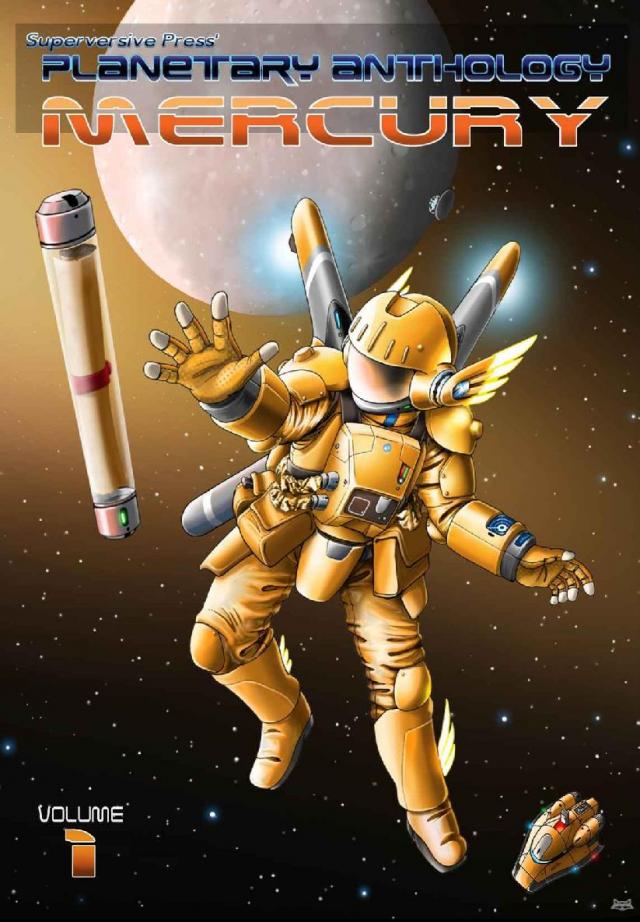


Gabriel turned on the virtual-reality displays in the helmet to look around. He could now see perfectly clearly in any direction, and even through the massive shoulder plates that would have blocked his side view. Readings and indicators of temperature, pressure and location floated in front of his vision.
The tunnels beyond were round bores, with cables and pipes that ran along the white insulation material covering the walls. The thick, heavy air slowly wavered with heat distortion, and the helium coolant systems gave a low rumble, like the breath of some massive creature. Low groans vibrated though the walls, and he tried not to think about the vast pressures pushing down on the core from above.
Gravity was noticeably lighter down here, at the solidified edge of Mercury’s core. The heavy armor stomped through the tunnels, barely clearing the arched ceiling. Along the tunnels there were branches off for power generators, sensory systems, and the giant coolers that lowered the temperatures from red-hot to merely boiling hot.
The other work shift, clad in similar golden juggernauts, trudged towards him from the other end of the tunnel. They gave him a thumbs-up on the way past, into the elevator he had come from. Even with the golden suits, no-one could stay down here for too long.
Soon, he came to his destination: a massive vault-door leading to the exposed section of core, a natural void formed in the cooling core. This too, was an airlock, and he ducked to enter the armored cylinder and seal the massive hatch behind him. He made sure he had plenty of reserves of coolant, and then equalized the heat and pressure for the cavern beyond.
The great door swung open into a cavern of wonders. Gleaming metallic crystals of a thousand shapes scintillated on the walls, floor, and ceiling of the arena-sized cavern. Cubes, rhomboids, tetrahedrons, and other polyhedrons all grew together in a myriad of shapes and sizes. Forms grew out of or through other crystals, or formed fractals of endless complexity. It did not appear to be a random jumble, but instead there was some sort of pattern, an alien order of some kind.
A lighted catwalk ran down the middle of the cavern, and wires led from consoles to sensors and the other devices drilled into the walls. Gabriel sealed the hatch behind him and advanced down the catwalk to the middle of the chamber where the central controls were.
Would this be first contact? Gabriel wondered. Would he be the one to first make contact with the relics of an alien intelligence? Gabriel wanted to wipe the sweat from his brow, but the visor of his suit stopped his hand.
Activating the terminal, he soon lost himself in the flow of information. Those who had come before had tried every known approach, so he had to try something new. Gabriel tried his latest ideas and theories; programs and possibilities that would grow as if they were alive, developing into ever-more complex forms. No computer before had been able to fully test his theory, but this amazing alien system could and did. An intermediary program was growing; one that could communicate with the alien machine, and with the human operator. A messenger between two different worlds had been created. Then, he downloaded a language and history database, to form a common foundation of communication. Could there ever be enough in common for communication? Would he be able to communicate with this relic of another world?
Now, to test it. He sent a basic query into the material. At first nothing happened. Then, the query was repeated by the surrounding matrix. Success! As he was writing his report for the surface, he noticed an increase in activity.
The crystal matrix began to furiously send communications though itself and to his computer. Activity grew at an ever increasing rate, and he had no way to keep track of it. Working eagerly to keep up, he didn’t notice the temperature until a warning alarm sounded.
Looking up, he saw the crystalline walls glow a deep maroon, and brighten to an angry red as he watched. Sparks of light flickered along the edges of the crystals and flashes of lightning burst from sharp points.
He turned to run towards the hatch when the magnetic locks sealed it with a low clang. Containment procedures were in place: it could only be opened from the other side now. Gabriel stared at the door in frustration, nothing short of a nuclear blast would get that hatch open now.
The chamber was brightening to a deep orange, and the temperature alarms in his armor began screaming at him. He closed his eyes. Laura, I love you, he thought. He knew the end was coming.
The Wanderer knew the end was coming. The damage from the star had been too extensive. Once it had regained consciousness, it found it was crippled. More than half of its outer mass had been blown away, and what remained of the surface was a cratered, scorched waste. The magnetic drive was a hopeless unrecoverable ruin, and now simply existed as a basic magnetic field around the wreck of the Wanderer. Worse, its very mind had been savaged by the massive current that had passed through it, and the steady stream of neutrinos from the raging star would slowly degrade what was left. Most of the nuclear fuel, carefully saved over the course of the long journey, had been used up. Eventually, its computing core would cool, and freeze into a static mass, with thought frozen into a few patterns. Death was not the worst of it, though, for it had failed in the very mission it had been constructed to do; its very reason for existence.
It would never form the basis of a new habitable world. With most of its mass blown away, and trapped in a close, tidally locked orbit about the star, it would forever be only a burnt cinder of a world. The time, expense and planning that went into its design and launch had been wasted. No civilization would take root in this star system, to make contact with the slowly growing web of intelligence and civilizations spreading though out the galaxy.
The Wander needed to be sure. Even though its outer senors had been scoured away, it could still sense the other worlds of the star-system though tidal interactions. It activated its gravity detectors: no anomalies. When it listened in on the quantum-field there was only silence. There might be life, but clearly no communicating intelligence. A dead system.
Finally, all hope of finding intelligence exhausted, the wander sent its report. The original parts of its systems that remained were quantum-entangled with the World-Foundry of its home. The message was instantaneous, and brief: this system is dead. There would be no further reason for communication, nor any reason for any traveler to spend the time and expense to come. Prospective young star-systems and advanced inhabited systems filled the galaxy. Why build in an old, dead system, after all?
Still, as all life wished to persist, the Wanderer did not simply die. External and non-vital systems were shut down entirely, and core systems went on stand-by. The core was allowed to cool slowly, preserving what nuclear fuel remained, in the event it needed to awaken again. As its core mind cooled and crystallized, it formed into thought-routines to watch for signs of communication with the World-Foundry, or any intelligence that might happen by.
Asleep one more, the Wanderer had no sense of time, until it was awoken, one more by a signal. The battered world-ship began to slowly awaken once more, and tried to communicate with the minute signal coming from within a cavern in its own mind. There was a reply!
There was a reply! Gabriel opened his eyes and looked at the data floating in his visual field. The alien machine was trying to communicate with him!
There was little time left. The room was filled with a blazing gold brilliance. Soon, either the armor’s outer coating would melt, or the cavern would melt and cover him in magma.
″It’s too hot; you’re killing me!″ he sent.
Seconds passed. The air in the cavern roared, and coolant pipes burst, venting helium. Then, slowly, the blinding golden light dimmed to orange, then red, then back out of the visual range.
″Who are you?″ appeared in his vision. It had decoded the language and database he had sent to it!
″I am Gabriel Marius. Who am I speaking with?″ he entered.
″My designation would mean nothing in your language. Your people call me Mercury.″
Any question of whether to establish first contact had passed, it had begun.
It had begun. Astonishingly, life had not only gained intelligence on one of the worlds of this system, but had even developed rudimentary technology… all on their own. The Wanderer once again had a purpose, a reason to live. It could never be the basis of a new civilization on its surface, but it could assist these primitive beings in building their own.
As time passed, the Wanderer gained more of an understanding of these people. The one called ″Gabriel Marius″ was fragile, and needed to return to the habitat on the northern pole. Large amounts of data was exchanged about both of their respective civilizations.
What new future might come of this? The Wanderer had failed in its original purpose in life and had been left crippled and alone, as one dead. Now a new possibility had dawned. Rather than create a new world of life, it might help the current life that had come to pass in this star system. The Wanderer might finally achieve its purpose: parenthood.
About the Author
David Hallquist has had a long history of customer service positions including banking, call center service and sales, all of which have served as a fascinating study of the human species. His short stories can be found in Sci Phi Journal, Astounding Frontiers and other works. He lives in Rockville, Maryland, and is still waiting for the flying cars.
This volume you are holding is part of the larger Planetary Anthology series that has one volume for each planet in the solar system, plus Lunar and Sol. If you enjoyed this ride leave a review and check out the rest at
http://www.superversivepress.com/our-books/planetary-fiction-series/
Superversive Press is a small press that specializes in heroic and uplifting fiction. To find out more visit out website
http://superversivepress.com
Also check out our Superversive News site
http://superversivesf.com
Don’t forget to sign up for our mailing list while your there
If you enjoyed this book please leave a review
John C. Wright, Planetary: Mercury


