

Planetary: Mercury, page 32
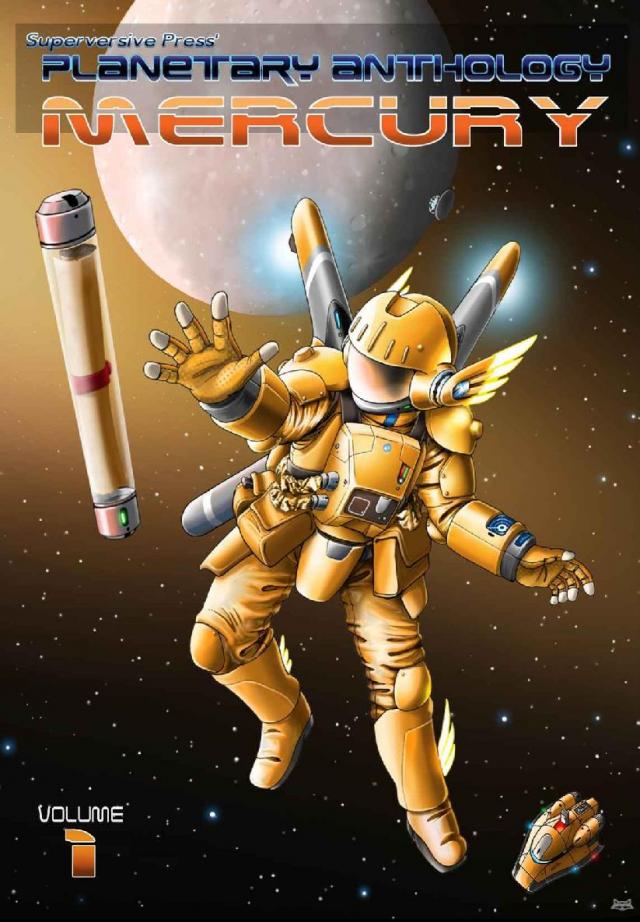


The space suit was light enough in the low gravity, but stiff so that he had to lean back to look up. The high crater rim at the north pole cut off the Sun’s fierce light. Overhead were the sharp points of star light and a faint, ethereal glow from the the Sun’s corona, raging eternally below the horizon. This frozen crater never saw the Sun’s light, and this was the only location with the ice required for sustaining Hermes Base.
The silver domes of Hermes Base seemed to huddle together for protection and warmth on the icy black plain of the crater’s floor. Its lights cast hard, sharp shadows from the surrounding outcroppings, pointing back at the base like ebony needles. Lights from the landing pad around Gabriel showed on the blueish-black rock beyond, and off of the mirrored silver domes, yet they could only drive back the darkness a short distance, and the surrounding blackness of the ancient crater seemed to hide endless secrets.
The three men made their way towards the distant base. Gabriel wished they had built a tram-line from the landing field to the domes, walking out on the surface of Mercury was… otherworldly. He had always thought the word simply meant strange; now here, millions of kilometers from home on a cinder orbiting the Sun, it had new meaning.
As the team from the lander made their way from the landing capsule and the melted rock of the landing fields, shadows seemed to shift and jump with every slow step. With his field of vision limited by his helmet, Gabriel kept trying to peer into the darkness, unable to shake the uncanny sense that something was alive out there… watching them.
So, he did what everyone does when walking past a graveyard, or a haunted house; he made conversation to break the watchful silence. ″Do we know anything new about the crystals recovered from the Caloris Basin?″
″Individually, each is a powerful nano-tech computer.″ his radio replied. ″The nano-tech in each is able to function, or be re-programmed in an almost infinite variety of ways, and with great efficiency. Quantum effects allow a massive amount of parallel processing, and each crystal is able to network with a theoretically infinite number of other units. You can see why we wanted a man of your expertise on site before we proceeded further.″
Gabriel’s heart raced at the prospect. To actually work on an extra-terrestrial computer! The haunted hills around him were forgotten as he considered the implications. ″But how could such systems retain their integrity? The crash, or the heat inside Mercury, should have destroyed it to the last component.″
″That’s one of the questions we hope to answer, Dr. Marius. We speculate that most of the original system was vaporized upon impact, leaving only a few, scattered components, driven deep into magma. These components can survive, even thrive in conditions of molten metal, and we suspect that these crystals reproduced for a while, attempting to repair something long gone. Think of it as how a man’s hair and fingernails would continue to grow after he dies.″
The unearthly chill of the surrounding darkness was back. These relics were the last remnants of whoever had traveled so far. ″Over a billion years…″ he whispered.
″Sorry, Doctor?″
″Sorry. I was just pondering the scope of time. Mercury would have been young and volcanicly active then; this might have even been before life on Earth. All this time, waiting to be discovered…″
″Quite right. We expect this discovery to revolutionize computer science.″
It would change everything. Gabriel paused, staring up at the stars. The Solar System visited by intelligence. Weather it had taken a year, or a million years, the trip had been made. There must have been other interstellar voyages too. Slowly perhaps, but inexorably, life would have crawled from one world to another. Even if only a small handful of ships had survived, over the lifetimes of stars all of the galaxy should be inhabited. Yet this was the only evidence they had found, so far. Why?
″Is everything all right, Doctor?″
″Yes.″ He began walking again. ″Why do we have this such a secret? Alien artifacts on Mercury can’t remain secret forever, certainly…″
″Two reasons: security and methodology. As to security, whomever first masters this new technology will have an extraordinary edge in computing. Then, there are the dangers of a unstable individual or regime with self-replicating quantum nano-tech.″
The airlock doors opened in the dome, and they stepped into the lit metal cube. Finally, something human in scope and scale. ″You mentioned methodology?″
The outer doors closed and air began to hiss into the room. ″Right. Before we release anything this world-shattering, we need to be certain we have our facts right. Remember how long we waited to reveal life on Europa? We had to be certain before we released the data. Remember how people reacted to that? This will make that look like a byline in a news-feed…″
The inner doors opened into the dome and Gabriel took off his helmet as he stepped though. ″We’ll see. I expect people will be able to deal with it. Frankly, the whole thing is so grand, and so abstract, that most won’t even consider the bigger implications.″ An entire galaxy of life and civilization… life everywhere… ″Most will just be shocked for a few days, and then go about their daily lives. It’s not like any starships will be coming or going anytime sooner than in a century or so.″ But they are going to be coming and going, Gabriel thought. If they came once, they can come again. Because of this, soon mankind will also be going to the stars.
The brightly-lit colorful walls inside glowed with images of life and Earth: forests, waterfalls, a sunny beach and other scenes from home. All of it driving away the outside with its impossible heat and cold; its total light and absolute darkness. ″There is also the matter of safety.″ the other man said taking off his helmet to reveal his closely cropped black hair and beard. ″The nano-tech particles must remain here on Mercury until we know how to control them. We also have to sequester all of our computer systems that interface with them, considering that we are talking about alien software from a more advanced civilization. This is the real reason why communications from Mercury are so closely controlled. Finally, we will all be looking at a long quarantine process once we finally return to Luna. Sorry.″
″Sensible″ Gabriel said as they walked down the corridor. Inwardly he groaned, more time away from his family, and no way to explain it to them. ″I presume most of my work will be examining the samples from Caloris Basin?″
″Actually, no. While we retrieved our first samples from the Caloris Basin, and we believe that that is the original site of impact, most of our samples, the active samples anyway, are retrieved from much deeper into the interior of Mercury. We believe that the particles that were able to survive and propagate found the once-liquid core of Mercury to be a more hospitable region. Thus, all of our active samples came from there.″
″Wait…″ Gabriel paused as he considered the implications, an image of Mercury building in his head, and the structure of its magnetic field lines. The planet barely rotates, and the core had frozen solid. Mercury’s powerful magnetic field had been a mystery for years. What could be happening in the core of a dead world to generate such a powerful field? ″You think there’s a giant alien machine down there? That that’s what is making Mercury’s magnetic field? That those alien things grew out of control, and transformed the interior of an entire planet?!″
″We’ll need to investigate closer to find out. The interior core of Mercury is fully crystallized with this machinery, but we cannot tell what it is doing… yet.″
The image in Gabriel’s head changed, the dense iron-nickel core became a massive lattice of metallic crystals; a great computer running unknown code from distant, alien minds. ″That’s what I’m for then? Not to examine this little sample of crystals you’ve been studying for years, but to examine the core, and see if it’s a functioning computer?″
″Quite. We’ve already drilled a shaft down… we went through three plasma drills to get there, actually. Physical examination of the… machine… down there is ongoing. What we need is a expert on artificial intelligence, quantum computing, and distributed systems with sufficient clearance. You.″
The corridor seemed to shift and swim. The implications, the dangers. Of all of the people on Earth, he would be responsible for dealing with the alien computer… or mind. ″I assume then that you have a high-speed, high-density communications conduit to the core? Delays in messaging will cause some issues in this work, but it can’t be helped…″
″Actually, no, Doctor…″ They came to a room in the center of the dome. A round pit down into darkness was in the dead center, with a reflective elevator cylinder hung above it on a cable. ″We simply cannot chance any computer contamination with our systems up here. You will be descending to interface with the alien machine—personally.″
He looked into the pit, and the mirror-smooth walls that disappeared into endless darkness: down, down, down…
Down, down, ever downward the Wanderer fell. The star had swollen to a raging disc of radiation and heat. The last of the ice and gas had long been scoured from the surface of the Wanderer, and now searing light and radiation hammered the silicates on it’s hull, heating and cracking the exterior. Occasional flashes of light marked impacts that left glowing craters. Whether the Wander would survive would be decided soon.
It’s interior had completely melted by this point, and the flowing computer network churned the charged liquid metal forming the great dynamo in its heart. Powerful magnetic fields sprang into life once more, as it spread its wings of magnetic force. It had been ages since it last used its fields to correct its course and fly; could it still do so?
The hard magnetic fields bit deep into the proton flux of the young star’s raging ion winds. Streams of gold and white plasma parted around the Wanderer, and concentrated into bands of pale light. The Wanderer began to shift in position, slowly altering its course to enter orbit around the star. Everything would have to work perfectly; an error could send it on a path out of the star system, plunge it into the star, or most likely, force it into any number of useless orbits.
The stellar winds were too thin this far away. The Wanderer corrected course and dived deeper towards the hungry fires of the star.
The star’s disc slowly swelled into a horizon of blazing light, with streams of luminous plasma arcing up and about the falling Wanderer. Eruptions of ionized gas streamed over the vessel, unable to be completely diverted by the magnetic fields. The silicate surface boiled in the raw plasma fury, and streamed behind the Wanderer, turning it into a comet once more.
Still, the ancient ship dived deeper towards the star, as its great magnetic wings bit deep into the stellar winds and began to slowly shift the course of the battered vessel. Everything depended upon this moment, where it would finally be able to shed much of the velocity of its interstellar voyage, using the remainder to enter a stable orbit.
Unexpectedly, a massive eruption from the surface of the star blasted into space directly ahead of the Wanderer. The vast curtain of raging plasma was larger than worlds, and filled the space ahead with deadly heat and radiation. While it could see it coming, there was no possibility of dodging such a blast, as the magnetic fields could only slowly shift the vessel.
It calculated its possibilities with lightning speed. If it drew in its magnetic fields tightly, it should be able to survive the blast, but would lose the ability to correct its course at the crucial moment, and be unable to enter a useful orbit. If, instead, it attempted to use the powerful stellar winds of the stellar eruption, then it could make its orbit with certainty.
The Wanderer readied to enter the raging stellar winds and use them. There was no other choice: to fail to enter a proper orbit meant to fail in the task for which it was created. It was worth any risk for the future.
The blazing ions streamed around the Wanderer, and the magnetic field of its drive glowed visibly, appearing like the layers of an onion with a long trail stretched behind. Blue fire flared at the poles of the field, as tremendous energies began to overwhelm the magnetic drive. The Wanderer shook in the energies, its surface scoured away by the raging stellar storm while a hail of neutrinos from the flare began to interfere with the delicate quantum computing systems deep within the hull. Still, its course was slowly correcting. It had already gone from a parabolic path to an elliptical orbit, with a little more time…
But there was no more time. A tight magnetic loop of plasma burst next to the Wanderer, hitting it with immense magnetic fields and electric charges, along with incredible heat and radiation. The Wanderer’s magnetic drive collapsed in a series of internal explosions, and its drive field collapsed, bringing the raging stellar storm in contact with its hull. The outer silicon surface cracked and boiled away in the raging plasma, while massive currents surged though the Wanderer’s core and the computer networks within. The Wanderer experienced a sensation like a brilliant flash of light as its computers were overloaded, then it descended helplessly into darkness and heat.
Gabriel descended helplessly into darkness and heat. It wasn’t any warmer in the suit than before, but he turned on a cool breeze to blow across the cold sweat on his skin, and took a drink of water from the suit’s internal stores, fighting off the heat and fatigue
He had slept poorly last night. He’d known he would have to be at his best, but how could he sleep knowing he was going into the searing core of a planet the next day? His dreams had been filled with endless caverns and fire.
When he was a young boy he had dreamed about wearing power armor on an alien world. Now he was, but would have far preferred to be home. The armor was based on the kind the mantle miners wore, with thousands of insulating layers and liquid nitrogen coolant systems. The whole thing was so massive, that without the motors to move it, he would be immobile even in Mercury’s minor gravity. The outer surface gleamed with mirror-bright gold: to reflect heat and light for anyone working on the surface of Mercury.
He wasn’t on the surface of Mercury, though, but someplace far more dangerous. The mirrored capsule around him was barely large enough to contain his massive armor. It descended into the depths of Mercury in a mirror-smooth elevator shaft impregnated with millions of dust-sized magnetic devices. Once it had been lowered into the shaft by the cable, the capsule would engage its magnetic field, and raise or lower itself as the field interacted with the particles embedded into the shaft walls. It was the only way to have elevators work in deep mining shafts where no cable could bear its own weight. It was tested, and used in mines all around the world, Gabriel told himself. Accidents and failures were rare, he told himself, very few people actually fell several kilometers to their death…
There was a brief moment of weightlessness as the cable broke away and the capsule fell. Before he was done swearing, gravity returned as the magnetic fields gripped the walls and the capsule began to descend more slowly.
″Doctor, we are registering elevated heart-rate and breathing. Is everything all right?″ came a voice in his ear.
Yeah, I’m only being lowered into the core of an alien world, he thought. ″I’m fine.″ he gasped ″All systems appear nominal.″
″Very good, Doctor. We’ll be out of contact after you pass the first barrier. Communications must be limited in order to prevent potential contamination. Do you have any final questions?″
Any last words, the thought. ″Actually, I do have a question. If these breaks are to prevent malign code from infecting the systems of Hermes Base, what about me? What happens if my suit is infected with alien code, or nano-tech infiltrates my suit or body?″
″Don’t worry, Doctor. We have established protocols in place in that case.″
How reassuring, he thought. He knew this would be dangerous, and it was too late to back out now. If he didn’t go then someone else, less qualified, would have to go down instead. ″I’m approaching the first barrier.″ Each barrier formed a separate airlock in the shaft. The segments below would be filled not with air, but a variety of coolant gasses of increasing density. The pressure at the bottom would be about that of the ocean floor.
″Godspeed, Dr. Marius.″ The hatch closed over the capsule, cutting off any further transmission. High pressure gas filled the airlock and the outside temperature rose. The capsule’s cooling systems hummed as they turned on, fighting off the increasing heat. Then, the lower hatch opened, and the capsule resumed the long descent into the depths below.
He tried to look straight ahead, but there was almost nothing to see. The visor was a narrow slit of crystal, several centimeters thick and mirror-coated with a golden surface. He was looking at the reflective inner surface of the capsule, directly in front of his face. He could make out the reflection of a hulking form in absurdly heavy golden armor, like a fantasy figure about to challenge a dragon in its lair. He ordered the visor to close, and heavy armor plating slid over the only remaining weakness in the armor. Instead, Gabriel looked at the displays inside the helmet, and the diagrams showing his descent towards the heart of the world.
There was an unearthly sensation around him, hovering at the edge of his consciousness. It was like the uncanny feeling he had when he first stepped out on this alien world, and it only seemed to grow as he descended. He shook his head and focused on the diagrams of data in his helmet as he descended into the heart of the dead world.
It took hours to descend, and the capsule groaned as the pressure increased at each airlock, and hummed as additional coolant systems engaged to deal with the increase. Gabriel grew stiff and restless, unable to move or shift in the confines of the capsule, bumping into the wall with a clang when he tried.
Eventually, the capsule arrived at the bottom. The capsule and the airlock began to fill with the monstrous heat and pressure beyond. Coolant systems in his armor engaged, the armor creaked under the pressure. Pressure and temperature equalized, the capsule and airlock doors slid open, exposing him to the tunnels in the heart of Mercury.


