

Planetary: Mercury, page 18
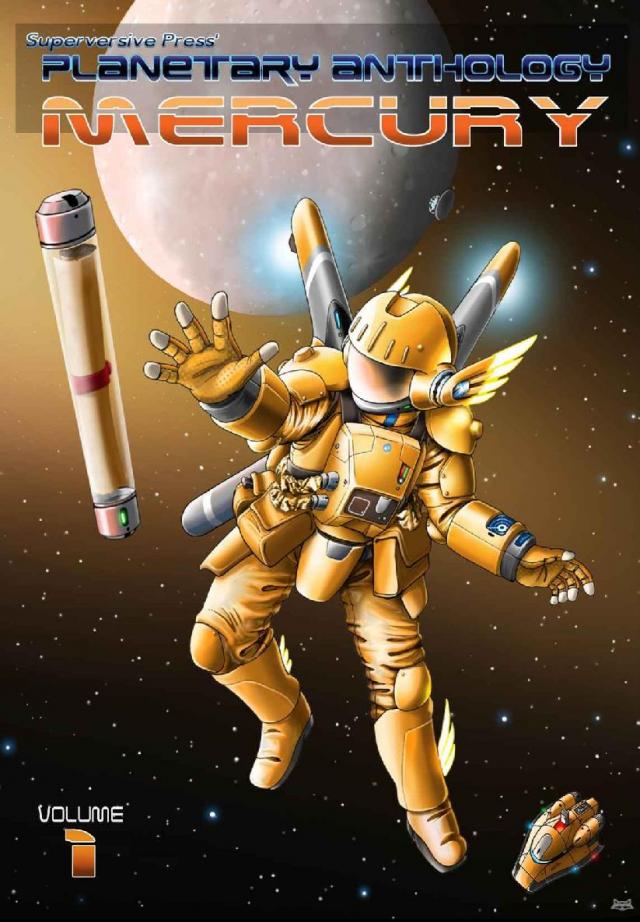


QUICKSILVER
J.D. Beckwith
“Emergency Alert. Flight crew report to Operations immediately.” The klaxon and strobes flashed red again. “Emergency Alert. Flight crew report to Operations immediately”, the central E.I. repeated in its accent-less masculine voice. Sighing and taking one last drink from his morning coffee flask, Captain Ozi Zanwe stood from his customary spot in the commissary. He took the extra three seconds needed to close the container and turn on the mag-seal that locked it to the tabletop before following his executive officer. It was still technically her watch, so she was already out of sight before he even reached the top of the ladder and stepped into the corridor. He retracted his flimsy reader into its slot on his uniform sleeve below his wrist, and then reversed his arm with a ninety-degree twist to look at the status readout on the top side. It seemed that his shift would start a bit earlier than planned today.
Quickly assessing the source of the ‘emergency’, he mumbled to himself. “Great. Can we not have even a cycle without some new bug to work out?” He pressed a contact link and waited for the expected response as he continued to walk toward Main Operations Quad 2.
“Corrington here, sir,” the speaker in his wrist comm announced. “The answer is ‘I don’t know, yet’. I’m heading to OQ3 from my cabin. ETA one.”
“That’s fine, Richard,” Zanwe replied, “Sarah and I are headed to OQ2. Did you get any sleep?”
“Only about three hours, sir. I’m going to need your permission for a stim if this takes very long.”
“All right, but I’m ordering you to take twelve down after this. And ten of those will be for sleep. Understood?” Zanwe’s slight West African accent slipped out a bit more than usual when he emphasized a word.
“Yes, sir. And I’ll be quite glad for it.” The tiredness of the chief engineer’s tone backed up the sentiment.
As the conversation paused, Zanwe saw the access tube of the command pod rise into view. He approached the rounded phone-booth sized tube in the center of the curved aisle-way and grabbed onto the ladder inside. Once both feet were firmly planted on a rung, he quickly swung both of them to the outside edge and slid downward into the pod. Once at the bottom, he exited the tube and turned, speaking to his second in command, XO Commander Sarah Fairbanks. “What do we have, Sarah?”
“That damned ‘upgrade’ has been nothing but bugs,” she complained. “This time it’s the frequency modulation in the propulsion system’s shielding. Something is oscillating out of phase and we’re getting radiation spikes from the plasma stream. I’m looking for the source, but diagnostics is still running.” Her pony-tailed head whipped back and forth over several monitors, while her hands manipulated a three-dimensional model of the propulsion system. “Rick, you linked in yet?” she asked aloud.
A phantom image of a much bedraggled Rick Corrington materialized in front of her. “Yes, I’m here.” He also began to poke and prod at the same model. Together, they separated components and attached scrolling readouts in mid-air for each of them. They spoke only in a clipped shorthand techno-speak as they dissected the problem component by component.
Zanwe did them all a favor by overriding the still repeating emergency notification, thus restoring silence and calmer lighting conditions. He followed their efforts as best he could, but he didn’t interrupt with questions. His team would tell him what he needed to know as soon as they could. The one thing he refused to be was a micro-manager.
The holographic representation of the ship hovered in one corner, sans the central propulsion module the team had swiped to the side to examine. Ozi still felt a like a schoolboy with a crush every time he saw ‘his’ ship. The main drive was housed in a squat central cylinder with a large rotating reception dish atop it. Eight ovoid girder-like trusses dropped downward at a sharp angle to connect to the large diameter inner toroid like a hanging skirt. Outward from that, eight more spokes connected a narrower diameter outer ring toroid to the first. And finally, sixteen dangling spherical pods hung from the outer ring, reminiscent of the old carnival swing-carousel rides. They spun with the two rings in a steady circle around the central drive housing. At the moment, the pods themselves were canted slightly thrust-ward to account for the ship’s ongoing acceleration. This kept ‘down’ always in the same direction, which meant the crew could utilize their full gravity workspaces, quarters, and other living spaces freely, instead of being strapped in during the mission’s thrust intervals.
The inner ring housed the ships supply of bio-matter – cryogenically frozen embryos, plant seed, and bacterial stocks - all the living components needed to set up a self-sustaining outpost once they reached their destination orbit. My ship and my mission, Ozi thought, first of its kind in human history. And I get to lead it. It’s like a dream.
Once in place, the ship would become the platform for an expanded human crew that would oversee the construction of one of mankind’s biggest space-based endeavors to date – the Helios Array. The first permanent extra-planetary space station, Ozi thought with pride, and this crew, my crew, will be the ones to make it happen!
At a point just beyond Mercury’s orbit, the ship would become the focal point of a massive array of solar power collectors. The purpose of which would be to help fill the Earth’s clamorous demands for the huge amounts of power needed by the ever-expanding use of matter-energy conversion technology. With almost seven times more solar energy per square foot that close to the sun—plus the added benefit of not causing any further albedo change for the Earth’s rapidly cooling climate—the location was an ideal place to set up shop. Mercury’s planetary shadow would help block and deflect solar radiation harmful to crew and biome while the array was fabricated using the same matt-beam that now supplied the ships propulsion.
It would only take a few months of work before the new artificial solar satellite would be self-sufficient, able to expand without further energy input from Earth. In the meantime though, feeding the crew members that would be joining them for those few months would be the main challenge.
Since the matter transfer of proteins was still a very flawed and dangerous—now internationally illegal—process, the choices were limited. Technically, they could ignore international law—being in space as well as a private corporate venture—but no one would. No paycheck was worth dying from some randomly generated plague, or ingesting potentially carcinogenic food. This meant that there were really only two options: anything biological had to be brought along or grown. So, growing it on site was the cheapest, most viable option. But getting it there and set up was still not an easy task.
“Well, bollocks. That’s not good at all, now is it?” Rick’s projection intoned, snapping Zanwe from his reverie.
“Oh, crap! No, it isn’t,” Sarah agreed. “Ozi, this is pretty serious. Take a look here.” She motioned him closer. She pointed at a graph that represented the containment field for the propulsion system. “These oscillation spikes are increasing. At this rate, we don’t have the time to figure out where the code is screwed up before this gets critical.”
“Meaning?” Zanwe prodded.
“Meaning, we’re going to have to initiate propulsion shutdown until we can.”
“What? Are you being serious?” he growled. She nodded. He sighed deeply then closed his eyes and began massaging his temples with his thumb and middle finger. “OK, you know I don’t want to second guess either of you, but is this the only way? You know disrupting the particle feed from Earth is going to cause Control to shit a baby rhino. Not to mention what this will do to our trajectory.”
Rick’s ephemeral form responded without looking up from his tasks. “Ozi, our trajectory and a bit of control booth ire is about to be the least of our problems. Let me describe a parallel situation for you. I’m sure you’ve heard of the Tacoma Narrows bridge incident, right?” Ozi grunted an affirmative. Almost anyone who’d taken any physics knew of that particular disaster. “Well, that containment field protecting us from all that deadly plasma energy coming from our engines is starting to get really ‘twisty’, just like that old bridge.”
“The difference in this case,” Sarah interjected, “is that if we don’t stop pumping plasma through before it snaps, our ship goes boom.” She looked him directly in the eye to emphasize her seriousness.
Sighing heavily, Ozi bowed to the inevitable with a heart-felt curse of “Well, isn’t that just crap-freaking-tastic!” He threw his hands high. “How long do we have until we need to shutdown the feed?”
“The sooner the better,” Sara responded. “We’re getting radiation bleeds at random locations already. Too high a spike in the wrong place and we could end up with contaminated cargo, dead embryos in cold storage, or we could lose parts of the greensward.” She tapped and expanded the central toroid ring of the ship showing it overlaid with phantom radiation spikes, some reaching uncomfortably close to the walls before bending away in the direction of the ships thrust.
“If that happens,” she continued, “we’d have to purge the soil and restart the plants. We can re-convert or just beam new dirt from Earth, but our supply of seeds isn’t big enough to do that and meet the expansion schedule. And the microbes would have to be reapplied from the bio-rec system. I, for one, do not want to go playing in the poop-tank again. We’re potentially talking months of work out the window. Not to mention, we’d be wasting even more joules and losing more thrust if we had to re-beam the dirt.”
“Damn and double damn,” the captain swore. He wanted to pace, but there was just not enough room with two people in the Operations pod. “We would have to be in the worst possible position for our transmissions, too. Do I at least have time to warm Earth so they can stop the feeder beam?”
“Actually…” Sarah narrowed her eyes in thought, glanced back at some numbers on her display, and then slowly started shaking her head. “Not and get an acknowledgment. Twenty-five minutes is too long. I can give you ten so that your warning gets to them and they have about two minutes to react, but after that, we have to cut it.” She shrugged. “Best I can do, Cap.” She started a countdown timer and threw it to hover above their heads.
“Alright, I’ll go send Earth Con-Cent the news. Keep working at this,” he points to the hovering image of the drive. “I want us back up and running as soon as possible. Rick, have your stim if you need it, but once we’re shut down, take that rest period.”
“Aye, Captain,” the duo chorused as Zanwe grabbed the ladder rungs and began quickly ascending the module’s access tube. His head was already spinning with numbers by the time he stepped into the curved corridor of the outer ring. Orbital mechanics calculations fought for priority over cost overrun figures in his mind. He tried to estimate the cost of a delay to their arrival at Mercury versus the extra energy expenditure required for the thrust they would need to push them back onto a proper schedule. He quickly stopped that fruitless train of thought though, realizing that he didn’t know how long they would be without propulsion.
At that point his mind jumped to the crew’s bonus reduction for the wasted petawatts of beamed energy that would soon be wafting into space uncollected. He would have to negotiate that down. The source was obviously not his people. The programmers Earth-side had screwed the proverbial pooch on this last upgrade. Sure, his crew had not found these bugs either, before giving the go-ahead to implement, but Earth Control Central had more computing power, and a fully working model of this ship to check things out. The fact that they were still experiencing so many problems had to mean a piss-poor quality checkout by the systems engineers at a minimum.
Zanwe jogged toward Comm Pod Alpha as quickly as the ring’s lighter gravity field would let him without bouncing too high and slowing his progress. He maneuvered down the ladder into the pod with practiced ease and immediately sat himself in front of the main communications screen. He set it to live transmit and began speaking immediately. “Earth Con-Cent, this is Chariot of Helios, sending unscheduled emergency communiqué. Be advised that we will be forced to shut down our propulsion containment system due to impending failure caused by frequency oscillations. Beam receipt will be lost at that time. Cause of the malfunction is yet to be determined. Time of discontinuation will be…” he looked at his arm chrono display and read off the time plus the remainder of the countdown Sarah had set. “Recalculations for Mercury orbital entry are pending determination of restart time. Further communications to follow. Message repeats. Zanwe, Captain, out.”
He shut off the transmission, and repositioned himself to a secondary console in the circular room, stepping onto the disc in front of the imager. He pulled on a thin wire from his uniform collar, looped it over his ear and pressed it to the side of his jaw. Activating the holocomm with one hand, he used the other to bring a projection online in front of himself. An image of both Sarah and Rick materialized in front of him.
“Sarah, Richard, the message is sent. I’m initiating de-acceleration protocols.” He set another holographic timer labeled ‘Decel Init’ above Sarah’s earlier shutdown. His preceded hers by two minutes and thirty seconds. “Let me know when you have your visual inspections for your quadrants completed. Sarah, you take up-spin of Zone Four also. I’ll get the downspin and Med Bay.”
“Aye, Cap. Tell Marsh to hang tight for me.” Sarah replied without looking away from her holos.
Ozi stepped down from the holo-disk and took a sliding stool to his right. His image copied his movements, but remained in position. He glided his seat along its rail in the floor until he was in front of a bank of six small fixed screens arranged in a two row by three column pattern that filled the curvature of the wall. He initialized a pre-programmed set of commands on the console and began scanning the screens. Each row of screens showed the interior of a curved room from three angles, each with a label in the corner. The labels read Zone 1 with a dash 1b or 3c, as he scanned through them. He carefully scanned each before proceeding to the next, looking for loose objects that might be thrown or scattered during de-acceleration. Satisfied, he reset the views to rooms labeled Zone 4. Likewise, he seemed fine with his checks until he came to the last room.
What he saw on the camera there made his heart skip a beat. He sprang from his seat and virtually leapt up the ladder to the curved corridor above him. The screen, labeled Zone 4-1c: Med Bay showed the shirtless figure of a man lying crumpled on the floor. A bandage was wrapped around his torso, slightly bloodstained. His sandy shoulder-length hair was draped over his face, hiding his features. About him was a scattering of bedclothes and a tray of medical items, possibly collateral damage from the apparent collapse. A shirt was clutched in his hands.
Zanwe barely heard both Rick and Sarah report their zones’ visual checks complete. He quickly glanced at his timer and saw it tick down to less than four minutes before he jump-slid down the ladder to the medical bay. He hit the floor already twisting to inspect his crewmate. He brushed his hair aside and quickly felt for a pulse on his neck. Finding one, he sighed with relief, then he cradled the man’s head and gently rolled him over, keeping his bloodied bandage off the floor. As he did, the man moved and gave a groan.
“Marshall, can you hear me?” Zanwe asked.
“Mmmm…nngggg”, Marshall roused with a painful wince, automatically reaching a hand for his side. The captain caught it and held it away from the wound.
“Easy, Marshall. Let’s not make it worse. We need to get you back in the bed. We are about to stop thrust and the ring is going to re-orient. We need to be strapped in.” He said this as he began to carefully set his patient up. “Did you fall out of bed?”
Marshall, still wincing, finally focused on Zanwe’s face. “No,” he grunted as he began to get to his feet. “I heard the alert, and was coming to help…ghnnn,” he grit his teeth as he was jostled when they set him back against the nearby bed.
“You are not supposed to respond to alerts when you are on bed rest, Doctor.” Zanwe scolded. “You of all people know this.” He helped Marshall to lie back on the bed, and assisted him with getting his legs onto it. His arm beeped at him with a one minute warning as he reached over to pull on the strapping across Marshall’s waist. “One minute. Can you finish while I pick this stuff up?”
Marshall just nodded and began using one arm to pull a brace cage that was angled above the head of his bed up and over his chest. Zanwe quickly began to collect the loose items - gauze, scissors, bandage tape, etc. and stashed them unceremoniously into a nearby drawer. He tossed the last item, a pillow, to his friend. He then rushed to the corner and folded out a trundle seat for himself, and strapped in, snapping the belt in place.
Overhead, the lighting strips in the ceiling began to blink with a slow blue, blue, yellow repeating pattern that indicated impending rotational change. The voice of the ships Electronic Intelligence spoke once again in its flat monotone. “All personnel prepare for ring orientation shift.” The warning repeated three more times and then the room began its first jerking sideways motion. Simultaneously, the subtle feeling of the subsonic rumble that accompanied the ship’s main plasma drive began to lessen.
Zanwe watched on his arm flimsy as the main boom recon camera showed him the slow changes to the ship’s configuration. The hoop-skirt-like dual wheel-in-a-wheel mid-ship sections continued their steady spin about the drive module while the individual pods that had been hanging at a forty-five degree angle to the rotation slowly swung outward to a straight radial configuration. He skimmed through a few camera links of the interior of the greensward as well, watching the internal cylinders of plants and grow lights rotate along their built-in railings within the hull. Simultaneously, another view showed the swirling glow of plasma fire from the drive fade away to nothing.


