

Planetary: Mercury, page 12
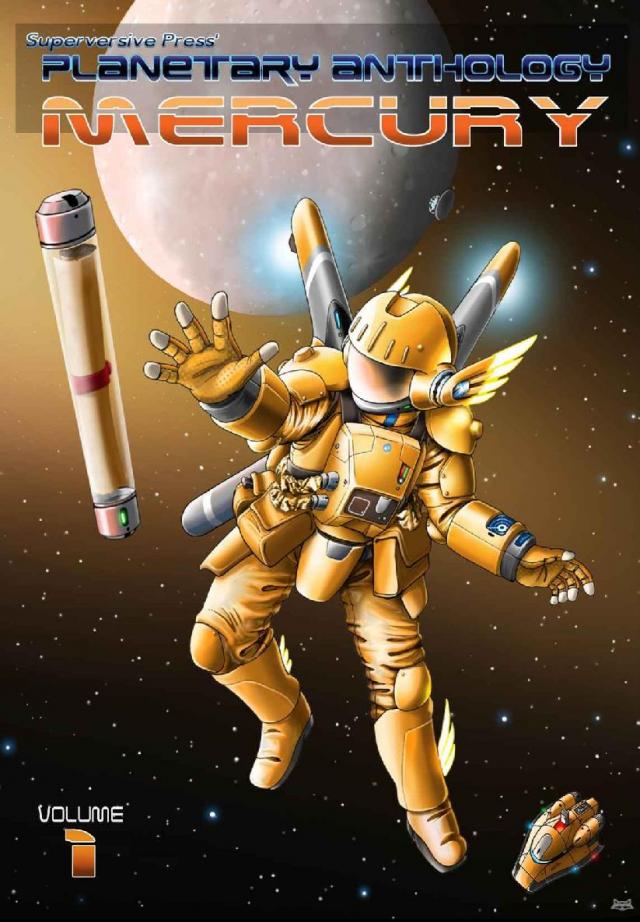


“Then it is yours! As much as you can carry! After all. I can always make more.”
“M-my… mine?” Erasmus gasped. “For me? I…”
Words did fail him.
Presently, he cleared his throat and asked, “What do you desire in return?”
“Nothing really, a mere token, as easy as waving your hand.” The Conde gave a small shrug. “Actually, exactly as easy as waving your hand.”
Cold fingers crept up Erasmus’s spine. “How so?”
“I have great riches, Dr. Prospero. Wealth, women, song. All that a man could desire. There is only one things that eludes me,” said the Conde. “My health is going. I no longer have the strength that was once mine. I want the one thing that you and you alone can bestow.”
“And, what is that?”
“Youth.”
“Ah.” Erasmus leaned back.
“Is it not true?”
“It is,” Erasmus said slowly. “The Staff of Withering can be used to make things younger as well as to age them.”
“Then there is no problem!” The Conde gave a great grin. “I shall regain my youth, and you shall have all the mercury you desire!”
“Actually, there is.” Erasmus winced. “A problem, I mean.”
“How so?”
“I did not bring it with me. My staff is back in my family’s mansion in Scotland.”
The Conde’s brow grew dark with annoyance. “Then go get it!”
“I… can’t.”
“Why not?” The storm over the Conde’s brow grew.
Erasmus told the truth, though it shamed him. “My father, the Dread Magician Prospero, controls the staffs. He only gives them out when he approves our purposes.”
“Will he not approve of this?” The Conde spread his arms indicating his riches. “To gain a treasure for a moment’s work?”
“No.” Erasmus said grimly. “He objects to magic being used on mort… anyone outside the family.”
“Why so niggardly?”
“He says that magic inhibits a man’s ability to reach Heaven.”
“That matters little if I do not perish!”
“It is precisely that sort of thinking of which my father most disapproves.”
“What!” the Conde cried, red face. “Unacceptable! After the extreme generosity of my offer! And you will not even plead with this hard-hearted father of yours?”
“I—”
Guards! Seize him!” cried the overwrought Conde. “We will see if this father of his will change his tune!”
Half a dozen burly guards rushed forward to grab the Conde’s guest, but Erasmus was far stronger than an ordinary man. He lifted the table upon which he and Conde had been feasting and threw it. Crockery rained down, smashing underfoot. The table knocking over two of the guards. The rest lunged, Erasmus grabbed a tapestry—one which portrayed the Conde as a young man winning a military victory upon horseback—and swung away, over the heads of the men-at-arms. The cloth ripped. Erasmus landed on his feet. He wrapped the torn cloth around the head of the next guard to rush him and used it to spin the brawny youth into a corner. Then, he picked up the next guard to come at him and threw him, toppling two others.
Before any of the guards could regain their feet, Erasmus dashed across the room, dodging screaming ladies. More men-at-arms came from the other direction. Light of foot, Erasmus leaped into the basin of mercury and kicked the dangerous silver-white liquid into the faces of the approaching guards. Mercury was difficult to kick, but if he flexed his foot, he could catch some in the crook of his ankle. Two young men shouted and slid to a stop, brushing the silver droplets from their faces.
Erasmus kicked again, but he had forgotten that the basin had been built to swing freely. As it moved under his weight, he lost his footing. The last thing he remembered was the sensation of back of his head striking the rim of the basin.
When he had next woke up, he lay on his back in the barred cell as guards stripped him of his knife and belt.
Erasmus shook off his revere about the previous day and looked down. Slight ripples spread through the quicksilver beneath him, ripples that appeared to start right where he thought himself to be. Erasmus stared, alarmed. If he could affect the mercury, could it affect him?
A strange dizziness assailed him Surely the mercury could not poison his soul? Could it? He reeled back.
Without his body, he moved much more easily than a fleshly being. The slightest desire to move whisked him across the floor. A feminine voice sounded in his thoughts.
“Woe is me. Oh, Lord, why did you make me barren, when all that I wanted in the world was to be a mother?”
Puzzled, Erasmus spun around and discovered that he seemed to be occupying the same area of space as the little dancing girl who again knelt in an attempt to gather more droplets of quicksilver from the floor. Erasmus moved away from her slightly, but he could still hear her thoughts.
“Now that my husband is dead, what is there left for me?” the plaintive thoughts mused sadly. “ The Conde knows that I am barren. He will not find me a good husband. I will be sent to the mines.”
There was a pause, and then, even more plaintive and sad came, “I try and I try to please the visitors, hoping one will take a fancy to me and take me away from here, as happened to Luisa, but I know now how to be pleasing. All I do is dismay them.”
Erasmus moved away, but he felt less annoyed with the little dancer. Cinnabar was poisonous. Miners often had short lives. No wonder she had tried to catch his fancy.
Now that he knew that, in this bodyless form, he could hear the thoughts of another, he deliberately moved to just beside the Conde. The Spanish lord’s thoughts were filled with the image of a cowering old man. As he listened to the man’s blustery thoughts, Erasmus realized that this old man was the Conde’s mental image of Lucretius Prospero, coming in search of his missing son.
Erasmus laughed long and hard as he contrasted this with his own image of his hearty and hale father arriving in splendor, perhaps surrounded by his sons and daughters, each brandishing their own magical staff. He imagined his brothers destroying the chamber, while his younger sister Logistilla turned men into toads.
The old chancellor passed near enough to his master, that Erasmus suddenly picked up his thoughts as well. The old servant carried a picture in his mind of the Conde as a child of no more than four. The chancellor as a younger man doted on the little boy. Erasmus perceived the happiness that the old man had derived from doing things that made the charming, fatherless boy happy.
When did it go wrong? The old man thought sadly. When did my master go from such a good child to a spoiled monster? How did I fail to see what he had become?“So this is all your fault then, Fernando?” asked Erasmus, though he knew the chancellor. could not hear him. With a derisive snort, he moved away from the selfish lord and his overly-indulgent servant.
The sky above the palace was a perfect blue. The sun beat down on the scrub-covered hills. Perhaps it was hot, but Erasmus could not tell. He felt no sensation of heat or cold.
He was not sure how he had moved, but he now stood on an upper balcony. The coppery length of his enchanted telescope stood beside him on a tripod. Erasmus peered through the eyepiece. The enchantment allowed one to see the stars, even during the day. Through it, he could see the planet Mercury winking back at him, perfectly framed in the lens.
“Is this all your fault?” he mused, gazing at the tiny light. “Or rather, I guess it’s his fault.” He pointed down below, towards where he guessed the barred cell might be.
Watching the planet twinkle, Erasmus recalled the many nights he had lain on the roof of his house in Milan, gazing up at the stars. Occasionally, after the children were asleep, Maria would sneak up onto the roof beside him. She would snuggle against his shoulder while he pointed out the constellations. He had been so happy then.
“If only I could show you the stars again, my love.”
“You can show them to me any time, my dear one,” said the voice he loved most of all. “I can still look down and see you, you know.”
Erasmus started and looked around wildly. There, on the balcony beside him, stood Maria. She smiled sweetly, her hair falling over her eyes, as it so often had done life. She looked even more beautiful than the cameo in his locket, even more beautiful than she had in life, for she lacked little idiosyncrasies that had marred her fleshly form, such as the tiny scar beside her left ear.
“Maria? I-is it you? H-how could it be?”
Maria reached forward and took his hands in hers. He could feel the warmth and softness of her fingers. To Erasmus’s surprise, he realized that he had hands. He could now see himself. He looked the same as when he was in his physical form, except that there were actual chains of lead constricting his chest.
“The psychopomp left the door open,” Maria pointed up toward the Swift One’s planet.
“A-are you sure? I’m not just suffering from spiritual Mercury poisoning?”
“I am sure.” Her dark eyes shone with love. “I am here.”
“But… I…” Erasmus stuttered.
“My love. Where is your noble heart? Do you really want all the people in this palace to die? Even innocent children?”
“But…” he sputtered. “An ounce! My darling, a whole ounce! One drop could have saved you. One drop can save the children of our children. I still watch after our family, you know. We have many descendants.”
“I know.” Maria’s eyelashes did that fluttery thing that they had done in life whenever she had been amused at her husband but had been too kindhearted to laugh at him openly. “Did I not just say that I look down upon you?”
“I…” Erasmus balked. The idea that Maria had been watching, while he wasted his talents, wallowing in self-pity and turning his back to the world was… even more painful than watching gold dissolve.
Maria reached up and brushed her hand across his cheek, cupping it against her warm palm. “Shh, my dear one. I have only a moment. Please, you must let go of your grief and anger. You must forgive your sister.”
“Never!” shouted Erasmus. “She killed you! Or, she might as well have!”
“The circumstances of my death are not quite as you believe them,” Maria said sadly. “You will learn this someday. I cannot stay, but before I go… I can help a little.”
His sweet, beautiful wife reached upwards and tapped her finger on the planet Mercury. Erasmus blinked. What his eyes showed him made no sense. Maria touched this same finger to her lips, giving it a tiny kiss. Then she reached toward Erasmus.
A tiny silvery-white droplet glistened on the pad of her finger. She touched the quicksilver to one of the half dozen lead bands constricting his chest, the one covering the lower part of his heart. The silvery drop sank into the chain and began to spread.
The lead turned to gold.
It transformed from a shackle that bound him into a strip of golden breastplate that protected his heart. Erasmus could not make sense of how the piece of breastplate stayed on his chest without any straps to hold it in place, but it did.
Peace swept over him, as if a chink had opened in the terrible darkness that had been smothering him for the last century. He felt joy.
Erasmus woke up with straw in his mouth. He lay on his back in the cell, groggy but at peace. Beside him, Hermes sat against a wall examining his sandals. One wing had unfolded from his left shoe and was flapping aimlessly. When Erasmus stirred, he looked up.
“Change your mind?” asked the youth.
Pulling the crystal vial from his boot, Erasmus tossed it to the swift god.
Six months later:
The great doors of the entertainment chamber of the Conde de Cordoba silently turned to dust and rained down, suddenly admitting the bright sunlight of the Andelusian sky. Dancing girls scattered, screaming. Tapestries became threadbare and dreary, their once bright colors dimmed. Men-at-arms in red tunics ran forward, only to stumble, falling to the ground as wrinkled and decrepit as a man of a hundred years.
Through the door came a figure in green armor wielding a staff that hummed as it spun in the pitted white gauntlet that covered his right hand. As he strode forward, withering all that lay in his path, the words of William Dunbar’s Lament for the Makers tripped from his lips.
”He takes the champion in the stour,
The captain closed in the tower,
The lady in bower full of beauty;
Timor Mortis conturbat me.
He spares no lord for his puissance,
No clerk for his intelligence,
His awful stroke may no man flee;
Timor Mortis conturbat me.”
The green figure approached the Conde, who had jumped up from his dinner and stood shaking with terror. The Conde’s chancellor, already old and decrepit, tried to toddle forward to protect him. The hum of the staff stopped, and the green figure pushed him roughly aside.
“What… do you want?” croaked the Conde.
Erasmus pushed up his helmet. “I have come for my revenge. You should not have mistreated a guest.”
“No! Please! Spare me! I will give you everything!” cried the Conde.
Erasmus shrugged. “What is that to me? I can take it anyway, as soon as I kill you. You should be grateful that I am sparing these your people. Doing so cost me dearly.”
He lifted his staff, which began to spin again, a slight red glow about the length.
From behind a yet-unwithered tapestry came a small, sad squeak. The little dancing girl cowered there. She was a pretty thing with Spanish coloring, and yet, at that moment, something about her dark eyes reminded Erasmus of Maria.
He paused, pressing his hand against the one place on his chest where his armor of callousness no longer protected him.
“I’ve changed my mind,” he announced suddenly to the Conde. “I am going to give you what you most desire after all.”
“You will restore my youth?” cried the Conde.
“Yes,” Erasmus showed perfect white teeth. “All of it!”
The Staff of Withering began to spin in Erasmus’s gauntlet, but this time, it spun in the other direction. The glow about it changed to blue. He moved it toward the other man.
The Conde grew younger. He flexed his hand and arm, which were now strong and fit again. He shouted with joy. Only the whir of the staff did not stopped. The Conde grew younger still and younger.
“What? No! Stop! I am… Noooo!”
The Conde grew smaller and smaller, until he disappeared among the folds of his garments. From beneath the vermilion silks came a tiny wail. Erasmus leaned over and scooped up the baby beneath the silks.
Crossing the room, he placed the infant into the arms of the little dancing girl. “It seems you are destined to be a mother after all. See that you are a good one.”
The girl’s eyes filled with tears of gratitude. She hugged the child to her, gazing at its tiny round face with wonder.
Erasmus turned to the chancellor Fernando, who had been close enough to his lord to be affected by the effect of the staff. The eighty year old man was now a vigorous man of forty.
“Don’t spoil him this time.”
Fernando’s head nodded up and down repeatedly. “Yes, milord. I give my word!”
Turning away, Erasmus stalked toward the door. As he moved forward, he returned the youth of the Conde’s men-at-arms. Then he paused and looked back.
In the center of the chamber, glistening in the sunlight, was the pool of quicksilver. Erasmus eyed it thoughtfully. Had not the Conde offered it to him, if he would but make the man younger? Had not he, Erasmus, fulfilled his side of the bargain? Could not the young Conde’s men make plenty more from their supply of cinnabar?
And besides, wasn’t an open pool of mercury a danger to an infant?
“Pack that up.” He addressed the men-at-arms cheerfully, gesturing at the king’s ransom of mercury. “I’ll be taking it with me.” With a wry smile, he added under his breath, “Seems my luck has finally changed.”
Turning, he bowed slightly in the direction of the unseen planet Mercury, “Thank you, Trist.”
About the Author
L. Jagi Lamplighter is the author of the YA fantasy series: The Books of Unexpected Enlightenment. She is also the author of the Prospero’s Daughter series: Prospero Lost, Prospero IHelln , and Prospero Regained. She has published numerous articles on Japanese animation and appears in several short story anthologies, including Best Of Dreams Of Decadence, No Longer Dreams, Coliseum Morpheuon, Bad-Ass Faeries Anthologies (where she is also an assistant editor) and the Science Fiction Book Club’s Don’t Open This Book. She also has an anthology of her own works: In the Lamplight
When not writing, she switches to her secret identity as wife and stay-home mom in Centreville, VA, where she lives with her dashing husband, author John C. Wright, and their four darling children, Orville, Ping-Ping Eve, Roland Wilbur, and Justinian Oberon.
THE TOWER OF THE LUMINOUS SAGES
Corey McCleery
Chapter 1: A Melody Sung in Light
Wei’s hands, her mother had told her, were a gift from the gods. Whether they were plucking the strings of a harp, or delicately holding a horse-hide calligraphy brush, they were teasing beauty into the world. Her hands were not mere tools to make art, her mother had promised, but they were vessels of the creative lin of the gods, works of divine art themselves. They were the hands of an artist.
They were also the hands of a thief.
She delicately twisted the lockpick in her hands, slowly feeling out the positions of the tumblers. Granted, this lock was tougher to pick, seeing as it was situated in the throat of a dragon statue, sculpted of gold. Chips of rubies made up its mane, which made Wei wonder what treasures lay behind the door, if rubies could be spent on a security measure. “Are you almost there?” Pao asked.
“This is my art,” Wei said through gritted teeth. “Don’t rush my art.”


