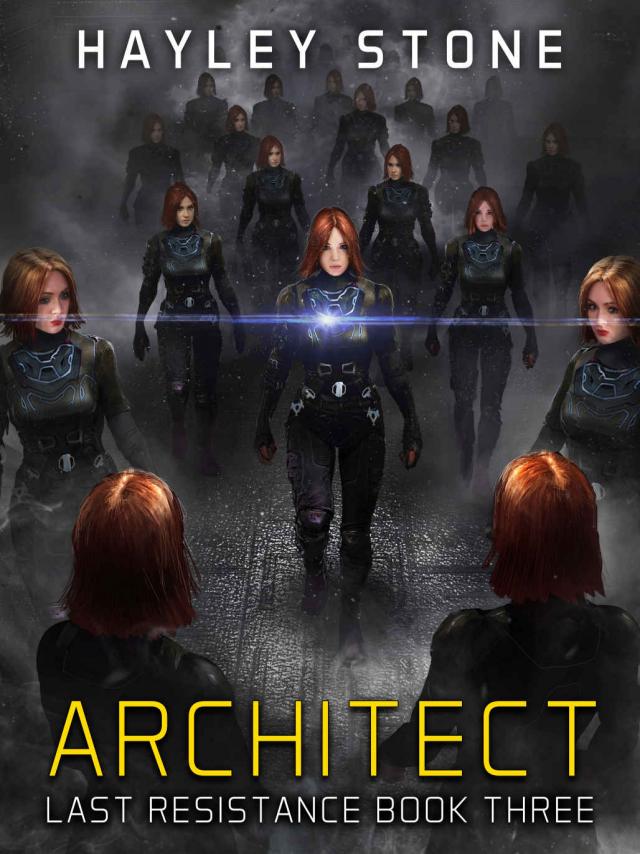
Architect (Last Resistance Book 3), page 9


Black water closes over my helmet, and I find myself holding my breath despite the oxygen still pumping in through my mask. I have enough presence of mind to reach for the knife strapped to my thigh, knowing I may have to cut myself free of my reserve, but I don’t have enough strength to keep hold of it after the current bounces me against the riverbed.
I connect hard enough to rattle my teeth. Thankfully my helmet does its job, protecting me from a fatal head injury. I can’t be far from the shore if I’m already hitting rock—
A crack appears across my facemask. A moment later, my HUD goes completely dark. The voices of my friends yelling to me over comms cuts out, and I can’t respond to them.
“Not good,” I hear myself say. My body feels far away, and I know that’s me starting to disassociate, my brain running in the opposite direction of my panic. It started happening after the attack on McKinley, after Rankin died. But I can’t let it happen right now. If I let myself fade out of the moment, I won’t just sink. I’ll drown.
I need to move before my oxygen fails or my cracked helmet bursts. I set about disentangling myself from the lines of my reserve and start to kick toward the surface. My muscles burn, already tiring. My chute gathers around my limbs, clinging like a wad of wet tissue paper, and I don’t know if adrenaline is going to be enough to overcome the dead weight of so much equipment.
The crack grows. In the pitch black I can’t see it, but I hear it, fissuring across the face of my helmet. A sound like someone slowly lowering their entire body onto a piece of glass. Somehow it’s still holding out the water, but I don’t have a choice. I have to cut my losses. Now.
I rush the normally painstaking process of freeing myself from the equipment, feeling for each buckle and strap. As pieces fall away, I feel a little lighter. But it isn’t enough. I’m still weighed down, caught in the chute, my lines wrapped around each arm of my hard-shell suit. I’m exhausted, and I’m not sure which way is up anymore. It’s getting harder to breathe. I think my oxygen has stopped recirculating.
Kkk-kkkkkk.
My mask is about go. I take down one last breath—the largest my lungs can manage—before the face plate explodes inward, opening me to the river.
I shut my eyes against the blast of intense cold. It feels like a bomb’s just gone off: sudden pressurization followed by intense pain. Pieces of what was supposed to be shatterproof glass embed into my cheeks and chin like shrapnel. I lose a little air to a groan before clamping my lips shut to preserve the rest. I wrestle the helmet off and do the same with my hard-shell flight suit, hoping I can escape the tangle of lines that way.
I keep a death grip on my EMP-G—not the rifle strapped to the back of my pack, which is a lost cause, but the handgun model—passing it carefully between my hands as I struggle out of each sleeve of the suit. I’m terrified of losing it to the murky depths of the river. Unzipping by feel rather than sight, I shimmy completely free, letting the chute drag the suit and my remaining equipment to the bottom.
I release a tiny bit of air to identify which way the surface lies, then begin pumping my arms and legs, using my last reserves of strength. There is no bed to kick off, nothing to give me a head start, only a long slow ascent. My lungs burn for air, and good god, I did not think I was this deep underwater. I guess I should be grateful for the river’s depth and the fact I didn’t smash into the river bottom going Mach-whatever, but I’ll save such gratitude for when I can breathe again.
Almost, I tell myself, even though I don’t know if that’s true. Almost there…
My lips are already coming unglued as I break the surface, my body desperate for air. I cough and sputter, spitting up acidic-tasting water. I struggle to turn over onto my back and float, the effort of doing anything more beyond what I can manage.
Above, the night sky lights up every few seconds inside large plumes of smoke, like lightning inside a thunder cloud, illuminating a swarm of shapes: planes, drones, and more helicopters. The battle’s intensifying, though I have no way to know who’s winning. Down here it’s almost peaceful, quiet except for the sounds of the river sloshing against concrete debris along the shore and the occasional rumble of distant ordnance.
A loud splash turns me over from my back as something comes down like a missile into the river several yards away from me.
I’ve barely managed to catch my breath, but when I notice the mushroom shape of a parachute deflating into the dark waters I push through the wall of exhaustion with a small primal cry, swimming over as quickly as I’m able to, desperate to reach my comrade before they go completely under.
I push aside the parachute. Thankfully, whoever this is was able to release it after they hit the water, unlike me. It slides away into the current as I reach toward the dark figure rapidly sinking. I have every intention of keeping them afloat, but the weight of their gear pulls me under just as mine had when I was wearing it.
Sucking down a deep breath, I dunk my head and dive below, never releasing my grip on their arm, afraid that if I do they’ll be lost to the under dark of the river. I can’t see through the murky darkness, but I can feel their desperate movements. Limbs bump as we both fight to free them from their gear. I hope their helmet is doing a better job than mine did. Whoever it is must be strong, because as soon as we remove their pack from around their arms they’re free enough to propel us both to the surface with a few powerful kicks.
I break the surface with a gasp but immediately go under again, too fatigued to keep afloat. It’s like buoyancy is no longer a thing, like I’m pedaling in mid-air, falling again, the current pushing against me like a strong wind. I panic momentarily under the weight of my own limbs, and it’s a long, scary moment before I’m able to breach both the surface and my own terrified mind.
“Rhona!”
Elle’s voice reaches me moments before her hands do, gripping my shoulders. She leans me against her, helping me float until I’m able to catch my breath again. Her oxygen mask floats beside us, miraculously still attached to her helmet by a strong cable. I can’t see her face, but just hearing her voice fills me with relief. I won’t be alone after all.
“Hey, Elle,” I pant. “Nice of you… to drop in.”
“Don’t talk,” she tells me, not unkindly. “Just breathe.”
After a few minutes of rest, Elle swimming nearby, I claw my way toward the nearest bank, slapping the water in such embarrassing form as to make a professional swimmer wince. It’s all I’ve got left in me. I’m so focused on each sloppy stroke that before I know it, I’m dragging in handfuls of grass and soil. I heave myself onto the shore like a beached whale, breathing so hard I gag a couple times, and then let myself lay there for a moment, not a person but a collection of aches and pains, held together by habit.
Elle lays beside me, helmet momentarily discarded, her short dark hair splayed against the sand. The harsh cut of her bangs makes her look severe even as she smiles up at the sky, clearly grateful to be alive. She touches her pink bracelet to her lips. Her teeth chatter, adding a touch of fragility to her smile.
At least it’s late February and not, say, mid-December. It’s still freezing out though, enough that if we’d stayed much longer in the river we certainly could’ve risked hypothermia.
I sit up and wring out my hair. The simple clothing I had underneath my flight suit has been soaked through, which adds a unique layer of misery to this whole affair. Nothing like riding to the rescue in wet socks and underwear. So glamorous.
“Are you hurt?” I ask, turning to look at Elle.
“I don’t think so,” Elle says, “but my backup insulin was in my pack.” She doesn’t have to explain beyond that. Elle’s a Type 1 diabetic. I was skeptical about her joining us on this particular mission, but I trust her to know her limits. Although if she’s anything like me, maybe that was a mistake.
“Okay,” I say, “Okay, so what do we do?”
Elle gives me a long-suffering look. “You can relax, for a start. I’m not going to slip into a coma in the next few minutes or anything. I don’t spend all my time inside the warm, snuggly nest of Vancouver.”
“Right. Sorry.” I’m too cold to flush or I would. I guess she does need to explain. “What’s your timeline look like? Is there a point when I should start to worry?”
“I still have basal in me from this morning, so even if I lose my pump I’m good for at least another fourteen hours or so. I just changed the injector set so that gives me a cushion of a couple days as well, provided my pump continues to work.” She opens a zipper on the side of her hard-shell suit, confirming the condition of the tubeless insulin pump before zipping back up. It doesn’t look damaged, which is a relief. I can’t imagine working pumps are easy to find, and I’ve seen the time and effort it takes for Elle to synthesize her own insulin protein from yeast. “After that it’ll start to get ugly, but presumably we’ll be done here by then.”
“That’s the goal.”
I climb to my feet and help Elle to hers. It takes us time to get our bearings, but soon we realize we’re on the wrong side of the river. Providence Park lies on the other side in the middle of downtown. There’s a bridge nearby if we want to risk traveling in the open. I don’t see another option. Not unless we want to attempt to swim back across the river—also in the open—and then climb the stone levee. Which, hah. Not a chance.
“Providence Park is only a few blocks after that bridge,” I say. “If we take Southwest Alder Street, it should get us there.” Good thing each of us memorized the geography of this city ahead of time, or we’d be completely lost. This portion of Portland is in surprisingly good shape, except for what looks like concrete chunks of a collapsed bridge and some rebar that have washed up against the shoreline, which gives me hope that some of the street signs will still be intact. People learned from the early attacks that a city was a bad place to be. Enough must have gotten out in time that the higher echelon didn’t feel the need to carpet the downtown area in fire.
“Lead the way,” Elle says.
I stagger up the embankment, Elle right behind me, only stumbling a couple times when my legs suddenly forget how to be legs, all the muscles sore from hitting the water at a weird angle. But hey, they’re not broken. The bar for a win is, admittedly, quite low at the moment.
“Wait. Do you hear that?” Elle has stopped.
I’m almost to the bridge, but now that the last bit of water has drained from my ears I hear it too.
Battle. Machines. Both coming our way.
I quickly duck underneath the bridge and pull Elle with me, squeezing us both into the sloped crawl space between the on-ramp and the earth where the grass has grown long and thick with no one providing maintenance to the area.
Almost a full minute passes before I spot the first machine on the street above, followed by a second and third. Always three. Like some unholy trinity. At the sight of them, nausea swoops through me and for a moment I close my eyes, waiting as a hard memory passes. The trio consists of three predator-class models that look no different from the machines who attacked McKinley, cornering Zelda, myself, and a few others while we were attempting to rescue our friends trapped behind a crashed elevator. The same machines who killed me once and have almost managed it many other times too.
Run, primal instinct tells me. Runrunrun.
Even if I weren’t wiped out, there’s nowhere I or Elle could retreat to without being spotted, and it doesn’t seem wise to fight when we’re severely outgunned. EMP-Gs are created to be waterproof—all that snow in Alaska would cause a problem otherwise—but I don’t want to test that durability with three fully-armed machines ready to fill me and Elle with holes.
I lock eyes with Elle who mouths just breathe at me again, doubtless seeing my stiff, frozen expression. I hate that she has to remind me. I hate that my body still responds like this, keeping score of all the horror. It feels like all I can do to follow Elle’s suggestion, easing my breath in to a count of seven and out to a count of four while the whirring only intensifies. It sounds like an oncoming train. The machines stampede across the bridge in one long, unending growl until I’m so lightheaded with fear I feel I could float right out of myself altogether.
It's my sinking heart that anchors me to earth. Reinforcements, I assume. Not dozens, either. Hundreds. They must have been summoned to defend the city.
The machines are so numerous that from our hiding spot they blend like a colony of ants. Only their beady red optics distinguish one body from the next. They’re heading in the same direction Elle and I need to go too, into downtown Portland, which means either they’ve been tipped off to our plan to meet Glasgow at Providence Park, or else they’re falling back. As much as I’d like to believe the machine lines around Hayden Island and Vanport have collapsed, that seems unlikely. The I-5 bridge is too effective as a chokepoint for any ground teams to have made that much forward progress. I’m surprised the machines haven’t just blown the bridge entirely, but the higher echelon has always been reluctant to destroy good infrastructure. They need bridges to move their own forces, too.
I’ve never known the higher echelon to pull away from a potential victory unless the cost was greater than the prize. Still, a nervous voice at the back of my mind warns me that I don’t really know the higher echelon, especially now. We’ve seen plenty of erratic behavior from our malevolent AI overlord in the past, but nothing like the weirdness these days. Reports of infrared launch signatures detected on the coasts originating from known machine havens, but no targets struck. No bases destroyed, no death from above. If they’re launching missiles like the ones we detonated in Calgary, Detroit, and Palo Alto—where are they all going?
A lifetime passes until the last of the machines totters off, following its brethren into the deep city.
“Well, that was fun,” Elle says once they’re out of sight. She emerges from the bridge first, hoisting herself free and then dusting her hands. “Hey,” she adds when I don’t immediately crawl out from our hiding spot. “You okay?”
My hands are tensed into fists, my body still fighting with my mind. I tell myself, move, you have to move, but my heart stomps against my chest like a child throwing a tantrum. Blood pounds in my ears. It sounds like the rushing river as it tried to carry me away.
“Dumb question,” Elle concludes, leaning down to offer me a gloved hand. “The machines are gone. It’s safe.”
It isn’t safe. It’s never safe.
I will never be safe.
But I nod and force myself to take Elle’s hand. I can manage that much, and hopefully the rest of my courage will follow.
The machines diverge from our planned route down Alder thankfully, heading up Southwest Washington. The two streets run parallel to one another, less than a block between them. We remain on guard as we finish crossing the bridge, darting across each side street one at a time when the coast appears clear. I expected there to be cars, but the streets are weirdly, uncomfortably blank, like every vehicle just up and drove off.
The street might be empty, but the skies certainly aren’t. I’m not sure what triggers me to look up, but I do in time to watch a bright cylinder of flame rise into the night. This missile or rocket is followed by a second, then a third and fourth.
Elle’s hand grips my arm, following my gaze. I brace too, sure the missiles are about to arc back toward the city, but they don’t. They continue upwards, clawing open bright tears in the night. Minutes later the sky is dark again, closed over in clouds, and I’m left standing in the dimming glow, wondering who or what I’ll lose when those missiles come back down.
ZELDA
McKINLEY BASE, ALASKA
Hanna’s late.
Zelda’s been waiting for fifteen minutes and Hanna hasn’t shown and maybe she’s not going to show and maybe this whole thing is a stupid waste of time. An overreaction. Or maybe it’s not and maybe that’s worse.
She hasn’t felt this wired since grad school, her anxieties compounded by lack of sleep. It doesn’t help that even at this hour Military level is crowded, every hallway jammed with personnel, most of them strangers—so many faces she doesn’t know in a place where she used to know everyone. But that’s not what bothers her.
In the months since the New Soviets took control, McKinley base has become a hub for the conquest of North America. Zelda has made herself indispensable by providing upkeep to the machines in the training rooms as more and more people pass through the base needing rudimentary training. Refugees picking up a gun for the first time, children now old enough—or, hell, tall enough—to fight. Countless bodies to feed the war. They look scared, every single one.
That’s what bothers her.
She wants to believe time with her machines is helping them stay alive longer out in the field, but so few have come back. At this point it feels delusional to think she’s making any sort of difference here.
Which is why she’s leaving.
One reason, anyway.
“Are we winning the game?” Dopey asks. The machine’s artificial limbs are dressed in stiff khaki borrowed from one of the laundry bins down here, as well as Lefevre’s old college sweatshirt—the only thing she could find baggy enough to hide Dopey’s long, inhuman torso. That gnarly hoodie survived the destruction of their home and their dangerous pilgrimage to Denali, and now it’s being worn by a machine who believes she’s a person. A very irritating, know-it-all child. If Zelda thinks about it for too long, it starts to fuck with her head. Items like the sweatshirt take on almost religious significance when you’ve had them for so long, and she’s sure Lefevre wouldn’t be thrilled by the new wearer. But her brother doesn’t exactly have a say, seeing as he’s dead. Technically missing, which is basically dead. That fucks with her head, too.