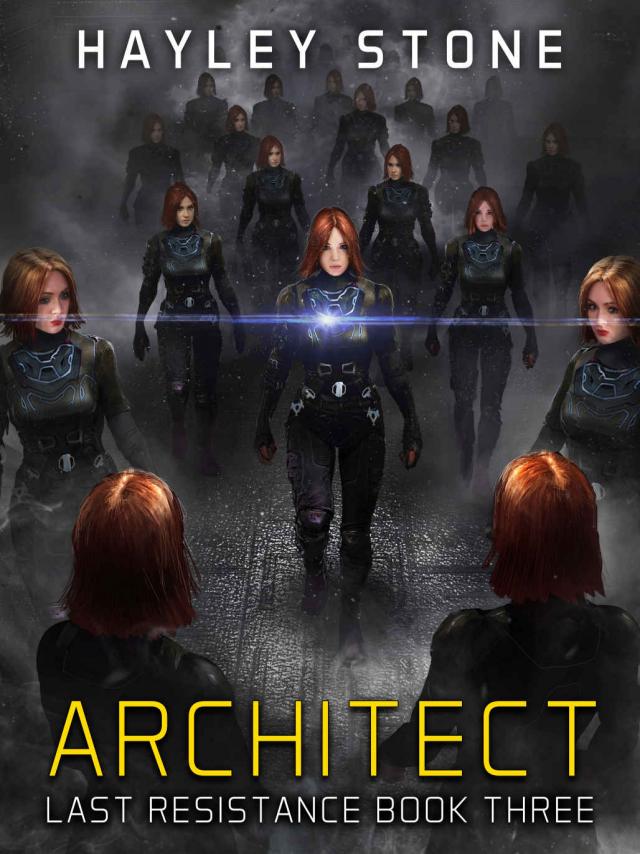
Architect (Last Resistance Book 3), page 11


I set the small box of lancets down and raid the concessions area near the front of the store while waiting for Elle to emerge from the bathroom. I’m starving—nerves kept my appetite low for the past twelve or so hours, and I avoided eating anything right before the jump for obvious reasons—but a quick search around the display case doesn’t turn up much. At least nothing I’m willing to chance with expired food old enough to hold a conversation.
Spotting movement outside the store’s broken automatic doors, I draw my EMP-G in a smooth, practiced motion. “Elle?” I whisper. Maybe she decided to wait outside?
It sounds stupid as soon as I think it.
I back toward the bathroom, easing the door open with my foot. “Elle.”
The bathroom is pitch-black. There’s no sign of Elle’s flashlight or Elle herself. I check the men’s bathroom to be on the safe side, but she’s not there either.
Seconds tick by. I back into an alcove housing a high-low water fountain. All this sneaking around and hiding doesn’t make me feel especially brave, but it’s become second nature over the months I’ve worked with Liz’s crew, running scavenging missions in derelict towns and cities. Better to be a living mouse than a dead wannabe Rambo.
My stomach chooses that moment to growl loudly, and I quickly slap a hand on it as if that will shut it up. A quick, panicked scan of the store shows nothing seems to have heard me, but I continue to train my gun on the entrance, waiting for a machine to step into sight, drawn to the noise.
In the tender silence, Our Lady of Tough Love, Zelda Lefevre, comes to me:
Pull it together, Long. You’re jumping at shadows.
She’s right. Or would be if she weren’t just a voice inside my broken head.
I retrace my steps through the store, calling for Elle, thinking maybe she had the same idea to look for supplies and we just missed each other. No answer.
My skin prickles with worry. Where could she have gone? The store is hollow and quiet, churchlike. I should have heard a struggle if one took place.
I grab the box of lancets and exit the store cautiously, inching around rows of bright red carts, careful not to bump any. I tell myself Elle is just outside, because that is what I have to believe to make myself feel good about leaving the store without her.
As it turns out, Elle is outside.
She’s on the ground. Just lying there, in the middle of the street. A little girl with dark brown hair stands over her with a studying gaze. The girl could be Elle, a much younger version anyway. They look a lot alike. She gives Elle a cautious nudge with her foot.
I barely have time to process any of this, because behind them both a machine is slowly making its lethal approach.
“Behind you!” I shout, instinct overriding the good sense to be quiet in a city where everything wants me dead.
The girl turns. She’s holding something. I can’t tell what. A weapon? She’s dressed in sterile colors—white long-sleeved shirt, white pants, white shoes. Only the whites of her eyes are hidden, covered by a head-mounted display that looks a few generations removed from regular glasses, full of technology that would no doubt have spawned countless debates over privacy. Her entire appearance strikes me as totally out of place against the jungle weeds and browning concrete of the city, like a tourist visiting the slums. But perhaps the strangest part of all: she looks maybe nine, if that. I haven’t seen any children this young outside McKinley since Juneau, and before that? Not since the start of the war.
What’s she doing here? But that’s a question for after.
I drop the box of lancets and raise my EMP-G, praying the gun still works after being submerged in the icy depths of the Willamette. The trouble with electromagnetic weapons is that you have no way of judging your aim; it’s obvious when you land a hit, but if you’re off there’s no bullet hole to tell you by how much. I squeeze the trigger and—
Nothing happens.
I check the gun, but the machine’s still advancing on the girl and Elle, not leaving me a lot of time to troubleshoot. It’s a miracle it hasn’t opened fire yet. Operating on the assumption that it’s my aim that’s bad, and not my gun malfunctioning, I fire again. Three successive shots.
At least one hits, blowing the machine’s processors, which protest in a loud flash of blue-white light—but it’s the girl who collapses. She drops beside the machine and begins screaming.
I didn’t hear a gunshot. I don’t see any blood. Maybe it’s terror that’s brought her to her knees. I hope that same terror can also motivate her to run.
“Move!” I gesture her frantically away from the downed machine as I race towards them. Even now I can’t help checking both ways as I shoot across the lanes, the instinct to look for cars now merged with the instinct to watch out for more machines. As I run, I fumble for the hammer inside my backpack, counting off the seconds in my head.
Ten, nine, eight…
I don’t know how quickly it will reboot, whether in the traditional ten-second interval or less, but it’ll be a close thing either way.
Seven, six, five…
I’m close enough to see the machine’s darkened stare, my own face reflected like in a blank monitor. But a tiny pinprick of light at the center tells me something is still alive inside the mesh of wires. And in mere moments it will be back online, ready to kill.
Four, three, two…
My hand closes on the handle of the hammer, and I’m partway through my swing just as the girl holds out a hand. “Stop!” she screeches, but it’s too late.
I follow through with the force and fury of a Norse god. The metal gives beneath my first and second blows, and by my third I’ve punched a significant hole through its chest plate, exposing the core processor as it hums back to life, all the instruments inside the machine beginning to whir. One limb jerks toward me in spasmodic panic between the third and fourth blows, as if can swat me away like an insect. I’m faster, firing another electronic pulse while simultaneously dodging underneath its arm. I’m nearly flesh with the machine as I slot the head of the hammer into its vulnerable heart, relishing the satisfying crunch the processor makes as it caves in.
It feels good to hit something. I’m so damned tired of holding things together that I bring the hammer down twice more for good measure, defying the angry shocks that sing up the steel handle and into my bare hand. The hair on my arms stands upright like a startled cat, and I wouldn’t be surprised if the hair on my head is pulling an Einstein as well. My fingers come away singed at the tips, nails dark. It’s a real look.
But the machine is dead. The girl is safe. That’s what matters.
“It’s all right,” I say, turning to the girl who is still screaming, “You’re safe n—”
The girl throws a small fist at me, which glances off my hip with just enough force to hurt before she takes off. “Hey!” I cry. I’m slowed by the bizarreness of the exchange. “Wait!”
She’s out of my reach by the time I think to grab her. At first I think she’s headed straight for the river, which would be bad enough, but then she hooks a sharp left down a side street, back toward the other machines. Shit.
I rush back to Elle—she’s breathing, her pulse steady—and drag her out of the street, leaving her just inside the store before going after the girl. I don’t like leaving Elle alone, but if I don’t act quickly, that little girl is dead.
“I’ll be right back,” I promise Elle.
I hope it’s the truth.
Nine
The girl is fast. She’s cooking down the street like the devil’s on her heels. I keep replaying her frightened expression when I came toward her. The small step she took away from me. How she tried stopping me before I brought the hammer down on the machine.
It’s almost like she was trying to protect it.
For the first time in my life my legs are the longer ones in this race, and I’ve nearly closed the distance when she turns a sharp corner. I follow, emerging from the protective barrier of the buildings, and that’s when I hear it: the harsh, grating sound of something heavy—multiple somethings—traveling in my direction. I skid to a stop, trying to grab for the edge of a dumpster to stop myself in time, but end up out in the open ahead of a line of machines.
Not the small-time predators from before. These are the higher echelon’s big boys: siege-class models. They look like the result of a howitzer and a tractor having a good time together. Most siegers feature a dozer blade in front and two telescopic arms mounted on top, capable of removing almost any obstacle in their way, from excavating earth to tearing apart a building. Each also comes equipped with a railway gun and light machine gun. Some employ grenade launchers and electromagnetic weapons of their own, but that’s rarer. All are operated remotely, frequently under the higher echelon’s direct control. They’re essentially weapon stations, miniature Death Stars on wheels—er, treads. Are they bulky and impractical? The argument’s been made. Slow as hell? Sure, but once they’re in position, watch out.
I jump back in time to narrowly avoid becoming a smoldering crater as the lead sieger takes aim. Chunks of the building rain down on me in a solid spray as the structure comes under fire. My ears are ringing even before the smoke clears, and as I clamber backwards into the alley I run my hands over my arms, chest, and legs to make sure everything is still attached.
From cover, I watch in horror as the girl races out in front of the siegers. My entire body clenches, anticipating the crunch of bone as the sieger steamrolls her. I want to close my eyes, turn away, but if I can do nothing else in this moment, I can still witness the little girl’s sheer fearlessness.
Except it soon becomes apparent that she has nothing to fear at all, as the sieger comes to a slow, grinding halt. So does the one behind it, and every machine that follows. The entire column stops long enough to let the little girl aboard the first sieger. She clambers up the massive treads with familiarity and ease before silently dropping down into the open hatch. It seals behind her, and the column proceeds.
What the hell?
I’m not given time to process this bizarre development, as two siegers break off toward me, lining up for another shot.
I’m quickly on my feet again, but my first few steps see the ground sliding away from me, off-balance from my ringing ears. The concrete and building blur as if the world is all running together, and I reach out to catch myself on the dumpster as another high-artillery round fires my way. Glass shrieks, and I cover my head as the shards fly at me like fanged bats—yet nothing bites. The shards never reach me, and when I look up, I discover a metal ceiling has developed above me.
At first, I think I’ve somehow ended up beneath the dumpster or been buried by rubble from a collapsing building. But I’m not that lucky.
I’m staring up at the belly of a machine. It absorbs the impact of the debris without flinching, its metal skin impervious to the damage or at least the sensation of pain. I don’t recognize this model. It looks like a cross between a predator and something more. Bipedal, but far less Jurassic, more sapien. I would almost call it ape-like, if not for the flat blank face which looks down toward me with unblinking optics. Green, instead of red.
To protect me, the machine has lowered itself from its hind legs onto large forearms that look as strong as steel girders.
I’m already fumbling for my gun—which would have been useless against the large siegers, which are built to resist electromagnetic attacks—ready to defend myself against this mystifying would-be ally. For all I know the machine didn’t even realize I was here at all, and it’s just an unhappy coincidence for us both.
Stupid, instinctive gratitude causes me to hesitate a second too long, enough time for the flat-faced machine to move off and away from me, heading toward the siegers in the street. Once it clears my view other machines follow behind it, identical to the predators I saw earlier but moving in strange tandem with the flat-faced machine.
Are they… with this machine? The predators don’t appear to be part of the sieger unit, and they’re inexplicably grouped in a unit of five, as opposed to the two trios of six I’d normally expect.
The siegers hold their fire, perhaps confused by having lost sight of me. Being slow, siegers are not ordinarily programmed to pursue or fire on small targets. They move from one location to another for specific tasks. Them turning their guns on me was an attack of opportunity more than anything else. I have to assume the higher echelon isn’t directly controlling them at present—mostly because the AI has never been able to resist taunting me when we’ve encountered one another. For an entity that seems determined to wipe out mankind, the higher echelon is quite the chatterbox.
I don’t wait for the other machines to turn on me, as machines always do. I begin firing on them, disabling the ones closest as I back out of the alley, catching each with ease as they remain stationary, waiting.
The flat-faced machine finally turns back to me, likely sensing its brethren’s distress.
I have it in my sights when its face suddenly activates like a projector screen, shocking me with the image of someone I know.
My heart launches into my throat. I feel my mouth form around his name, even though no sound makes it past my lips.
Camus.
In that split second of surprise something slams into me, plastering me against the wall. The collision forces the air from my lungs so that for a moment I can’t speak, only gape, trying and failing to pull in a breath. As my attacker closes in an old instinct kicks in, and I throw him off me by raising my knee swiftly to his groin.
The man lets out a whoof, backing off. “Sorry!” he blurts. He doesn’t look much older than me and not much taller either. “Didn’t mean to knock the wind from you. Although maybe you should be apologizing to me. Shit.” He holds himself gingerly, eyes clenched in pain as he bounces in place.
“Who—are you?” I wheeze. Somehow I managed to keep hold of my hammer throughout the assault, and I raise it menacingly.
“A friend. Promise.” He takes another awkward step back, waddling a little as he shakes off the pain. “Christ. Is your knee made of titanium?”
“Friends don’t usually greet each other with body slams.” I massage my back. My eyes are still on the machine wearing Camus’s face, its expression uncannily blank.
“You looked like you were about to pull the trigger.”
“I was.”
“Right. Which is why I stopped you. Cause and effect. Good, now we’re all caught up. Would’ve been a big mistake, you know. Fatal, most likely.” I fail to see how, but before I can ask, he says, “Come on. We shouldn’t stay here. It’s not safe.”
“What about those machines?”
“What? Those guys?” He glances back at the flat-faced machine and the others coming back online. “Don’t worry about them. They’ll do their thing. We’ll do ours.”
“And what exactly is that? Where are we going?”
“Are you from Portland?” I shake my head, indicating no. “Then you wouldn’t know it.”
I’m too exhausted to argue with that logic, but as he starts forward another thought catches me. “Wait. My friend—” I glance back like I might be able to see Elle through the buildings, still lying prone in the store. I can’t get the image of her still body out of my mind and feel a sharp pang of guilt for having left her.
“A woman, right?” the stranger replies, moving ahead without me. I reluctantly trudge after him. Suspect or not, he’s my only human connection in this machine-cursed city. Maybe I can get answers out of him about what’s happening here. “We met. Well, sort of. She’s safe. Glas is looking after her.”
“Glas?” I nearly stop short, but then hurry to get ahead of the man. My thoughts are sluggish, mired in disbelief from the pair of unnatural collaborations that just happened—the little girl and the siegers, myself and the machine who saved me. This day is running me ragged, and I feel myself nearing my limit, a finish line I do not want to cross. “Do you mean Glasgow? Is that how you found me? Glasgow sent you?”
He laughs. “Uh, no. Glas isn’t a mind-reader. I was doing a final perimeter check when I saw you lose your mind on that kid and her escort.”
“Do you mean the little girl? The one traveling with a machine?”
“More accurate to say the machine was traveling with her, but yeah. Surprising, isn’t it?” He gives a happy shrug. “The first time, anyway. You get used to it.”
“She was afraid of me.”
It sounds ludicrous aloud, almost insulting. Yet isn’t that what I joked to Samuel I was? A bogeyman used to scare little toasters at night? I still remember his reply: Oh no. You’re much worse. You’ve become a rallying point.
I don’t feel like much of a rallying point these days. The flag I planted still waves with every action the resistance takes, but it might as well be waving at me from the moon. I can’t get back to that place, and most days I’m not even sure I’d want to return to life in the spotlight. It’s people I long to get back to, not some glorified position.
“You killed her friend,” my companion says casually. He rolls a marble grey beanie a little farther down over his ears, his breath smoking in the cold. “If you killed my friend, I’d be scared of you too.”
“Her friend, the machine?” I clarify.
“Friend is maybe the wrong word.”
“What would be the right one? Escort? What does that even mean?”
“I know. I’ve never liked it either. Always sounded too sexual to me. Kinda weird, you know? Cause they’re always with kids. But I got outvoted. I wanted to call them daemons.” I don’t immediately realize he’s waiting for me to say something until the silence stretches, and I look over to see him staring expectantly. “You know,” he finally adds, “Golden Compass?”
I’ve perfected a look of fake understanding when it comes to references I don’t know, but I don’t bother hiding my blank expression from him. I’m too tired to play pretend.