Architect (Last Resistance Book 3), page 23
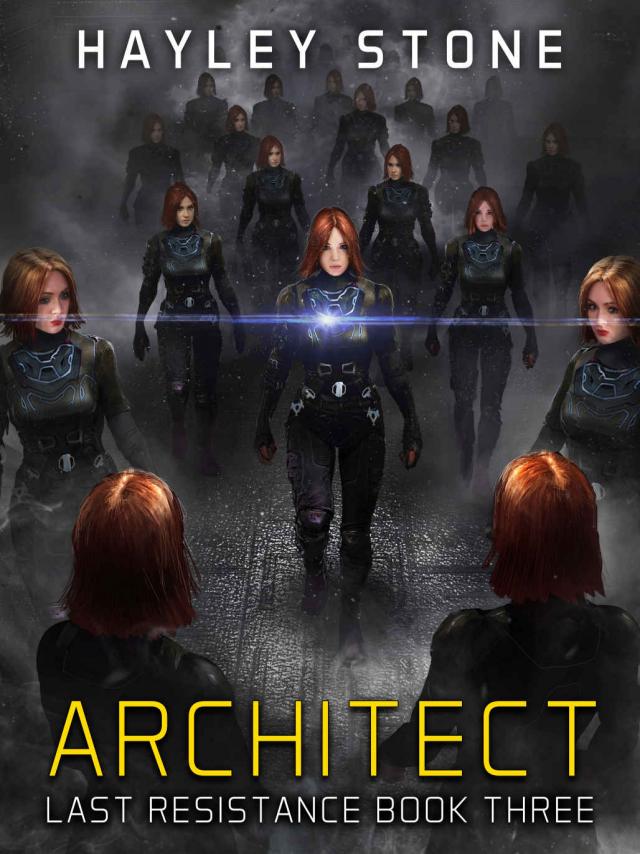


The worst part is the fact it uses my face to participate in this mockery. I glance back at Zelda and Hanna as Hanna finally coughs, taking down large gulps of air. Her fingers reach out to Zelda’s face gratefully, and Zelda lowers her head to Hanna’s, showing more affection than I’ve ever seen Zelda show anyone, save Ulrich and her brother.
This is it. My last chance to help them in any meaningful way. To save them from this machine they think is their friend. I know what the higher echelon is planning, and although I don’t know exactly how this particular model fits into its vision of a new world, I can hazard a guess.
The higher echelon doesn’t just want to destroy us after all. It wants to replace us.
I jerk up from my knees and launch myself at the machine, sending us both sprawling against a stuffed bison that has been toppled from its display by the cavalcade of snow.
I don’t need an EMP-G for this. It’s not fighting back. With enough force I should be able to crush in its chest cavity, grab its central processor and—
Hands grab roughly at my shoulders, pulling me backwards. My head connects with hard-packed snow, jostling my vision. For a moment I blink out of myself again, watching my body from the perspective of this stupid machine doppelganger. I see Zelda attempting to wrangle me even as I flail. I see my nose begin to bleed. My head pounds like it’s a bell, and someone is ringing it with a tiny hammer.
“You don’t understand,” I shout, hearing my voice through two sets of ears.
“It’s okay,” Hanna says, her own voice scratchy. She’s sitting up now, her face marked with small cuts. “It’s okay, Rhona.”
I know she’s only using my name as a distraction, as a way to soothe and calm me. But damn it if it doesn’t work. No one’s called me by that name in so long.
“You’ll have to kill me,” I say with savagery. “I won’t stop trying to destroy that machine and every other one. You’ll have to kill me. Please. Just kill me.”
Hanna embraces me unexpectedly, and I begin to sob in earnest, snapping back into myself completely. Whatever the higher echelon planted in my head must be malfunctioning, because these little vision quests never last long, and they’ve grown increasingly unpredictable. Days have passed without one vision, sometimes even weeks, though more rarely. I thought if I could just get back to McKinley, they could help me…
“McKinley,” I wheeze.
The others reach the same realization within moments, but Zelda is the only one to rise. Hanna continues to hold me close, and I start to wonder if it’s for my benefit, or hers.
“Well?” I ask Zelda, who’s climbed the snowbank high enough to see over it and outside. “How bad is it?”
She’s silent for a long moment, her shoulders a tense line.
“There’s nothing,” she finally whispers.
“No damage?”
“No—there’s no mountain at all. I can’t see Denali.”
“What’s going on?” Hanna asks.
Zelda turns onto her back, collapsing against the snow drift. Her face is blank.
“I was right,” she says.
Now Hanna seems to understand. “No.” She shakes her head. “Look again.”
“I thought there’d be more time,” Zelda says. “I thought—Renee was going to—”
“What about the base?” I say dumbly, reality not quite sinking in.
Zelda just shakes her head and punches the snowpack over and over until drops of blood fly off her knuckles. She screams a curse, but I know it isn’t because of the pain. I know what she’s feeling. I felt it when the higher echelon lied and told me Samuel was dead. Physical pain would be welcome right now, anything to distract from the internal breaking.
Hanna doesn’t resist when I pull out of her embrace. I don’t try for the machine again, though everything tells me to go for its throat, some part of my mind still mistaking it for a living thing. That’s how the higher echelon gets into your head. It makes you believe it shares your humanity.
I clamber up the slope beside Zelda, enough to poke my head outside. The land is rock and white smoke, the trees buried beneath ice so that only the tips show, breaking out like new shoots. The range in the distance looks like someone scooped Denali out of it, the upper portion of the mountain now a deep, craterous caldera. Chunks of rock have fallen to its base, while the immense heat from the attack must have melted the ice so now there’s a steaming lake in place of the peak. This has to be the work of the kinetic weapons I saw in my visions. The ones that drove me north, back to McKinley. If only I’d had the courage to put myself in harm’s way, face the Russians, warn the base…
I was still hoping I was wrong. Just messed up in the head.
I was scared, and now people are dead.
It’s been years since the machines dropped bunker busters on this range. They tested them against Denali a couple times, but never because they knew we were there. Now I wonder if those tests weren’t for those bombs, but for this one.
I shield my eyes against the sun still determined to rise. The loss of McKinley is so large I can barely wrap my mind around it. All those lives.
“We need to check for survivors,” I say.
“What survivors?” Zelda says, red-eyed. “They blew up the whole goddamned mountain.”
Already there are helicopters circling, drawing in like carrion birds. These few must have been far enough away when the bombardment happened. Anything else in the sky would have been brought down by the energy from the blast and then buried. Good thing we were far enough outside the range, close enough only to suffer the loss of our small shelter. If not for the Visitor Center, I’m not sure we would have survived at all.
“We should still look,” Hanna says.
Zelda hesitates but ultimately shakes her head. “No. The mission hasn’t changed. We need to get far away from here. The base is gone, but the Sovies still have plenty of personnel in the area.”
“All those people,” Hanna whispers.
Rankin, I think suddenly. Hanna’s boyfriend. Was he back at base? Why didn’t he come with her?
“I’m sure Rankin’s all right,” I say, even though I know it’s a hollow offering.
Hanna stares at me, but Zelda beats her to an answer, saying, “Rankin died last year. There was an attack on the base from the inside, orchestrated by one of Rhona’s clones.” She stands and moves toward me threateningly. “And now you show up and there’s another attack.”
I scoff. “Seriously? You can’t think I had anything to do with this.”
She takes another step toward me, and as I move away my foot slips out from beneath me. I fall backwards into something solid. It’s that damn machine. How is it still standing after taking a bullet and being buried?
“Grab her, Dopey,” Zelda instructs.
“Okay,” Dopey says in a garbled voice that sounds like me but also not me. A young me. “Did she do something bad?”
“Are you kidding me with this? Zelda, come on. I was standing right here. I could have died, same as you.”
“And how long have you been lurking here in the Visitor Center? Spying on McKinley?” Zelda says. Hanna tries to intervene by putting herself between us but Zelda, with surprising gentleness given her anger, moves her out of the way. “Why should we believe a word that comes out of your mouth?”
“Oh, but you’ll trust this machine?” I spit back.
“Stop this,” Hanna says, “the both of you. We need to work together.”
“I just wanted to go home,” I say, and the words loosen something inside me, a hard tangle I’ve avoided pulling at. Camus. The realization hits me like a train. Camus was in McKinley. He had to be. There’s nowhere else for him to go.
My legs go out from underneath me, and only the machine’s hands on my arms keep me mildly upright. “Camus,” I murmur. “I’m so sorry.”
“Sounds like an admission,” Zelda says, but Hanna grabs me by the shoulder. “No,” she says. “Rhona, no. Camus wasn’t in the base. He left for Oregon months ago.”
I start to repeat her words, unable to make sense of them. “Camus wasn’t there?”
It doesn’t erase the loss of everyone else but it’s something, and I feel the thin threads of hope holding me together strengthen. Part of me wants to immediately strike out for Oregon, but that’s a long and perilous journey. I’d be more use here. I find my feet again, rising slowly. The machine continues to keep its hold on me. “We should still search for survivors,” I say. “It’s possible they had advanced warning that we didn’t. People could be trapped on the lower levels, or in the evacuation tunnels…”
“If she’s bad, she should be punished,” the machine says from behind me.
“Yeah, maybe,” Zelda agrees. I can tell from her tone it’s a throwaway comment, but the machine takes it as permission to shove me to the ground. Its metal foot holds me there. Air whuffs from my lungs, and for a moment I can’t breathe.
“Enough!” Hanna snaps. “Let Rhona go.”
“But I’m Rhona,” the machine says. It sounds confused. Malfunctioning. “I’m… Rhona. I’m Rhona. I’m bad?”
“Shit,” says Zelda.
“What am I? Where am I?” the machine says, and it sounds older now, more like me. “What did you do to me?”
“I didn’t do anything to you,” I manage to get out.
“Don’t say anything,” Zelda instructs me, and then to the machine, “Calm down.”
I watch her feet shuffle toward me, my face still pressed against the cold, rocky ground.
“Let me help you,” Zelda says, and I don’t think she means me.
I expect the machine to resist, lowering its full weight onto my back, snapping my spine, paralyzing me. I expect Zelda to use force or threats to get her point across or for Hanna to sweetly persuade the machine into dropping its guard. But none of that happens.
“How can you help me?” the machine asks in a voice so quiet and so afraid and so mine.
In that moment I return to Calgary, where I was bound and tortured and made to become the higher echelon’s voice. The electric burns have healed from my fingers, but the ghost of that pain still wakes me up at night, my dreams providing unnecessary reminders of what I went through. Now, hearing the machine answer with an echo of that desperate desire to be made whole again…
“We’re the same,” I answer before Zelda.
“The same?” the machine asks. “Bad?”
“Not bad.” I force a smile. “Hurt. Lost. Mistaken… about a lot of things. But bad? No. Now, would you mind letting me up?”
I have no idea if this simple plea will work. A moment later the pressure eases off my back and I roll free, gaining my feet quickly. In that moment, Zelda dashes forward, finding a place on the neck of the machine that immediately shuts it down. Its knees lock, keeping it upright, but the face flickers and then goes out, replaced by faceless metal. I reach out a hand to the machine’s equivalent of a cheek, still warm and full of enough leftover electricity to give me a faint shock.
“What now?” Hanna asks. I’m not sure if the question is directed at me, Zelda, or some imaginary force in the universe, but either way Hanna looks exhausted, her entire being sagging. “Should we look for survivors?”
Zelda crosses her arms. “We have to keep moving. Dopey’s still our best bet when it comes to predicting what the higher echelon will do next. If nothing else, its technology we might be able to reverse-engineer and use against the machines. We have to protect it.”
Hanna seems to consider this a moment, then she asks me, “If you survived… is our Rhona alive, too?”
I give a stiff nod. I don’t really want to talk about Bossy right now. Or ever again.
“Do you know where she is?”
There was a moment earlier, before I encountered Zelda and Hanna, that I thought I was seeing through Rhona’s eyes. Or seeing her through machines’ eyes. It was like one of the visions I’d had before, but different. This one came with a strong command; I almost lifted my gun to my head, as if compelled by a stronger presence. Thankfully I think whatever device inside me is malfunctioning, because I was able to fight back long enough for the vision to fade, as they always do.
“Portland,” I say. “I mean, I think it was Portland.”
“What do you mean, you think?” Zelda asks. “We can’t travel hundreds of miles on a feeling and a prayer.”
“Why not?” I almost laugh. “We’ve gotten this far on less. Okay, look. There was talk that the Oregonians were preparing to stage an assault on Portland. If our plans up here failed, it makes sense that’s where Rhona and the others would go.” I don’t tell them about my weird visions. It’s nobody’s business but my own, and moreover, I worry Zelda would want to take a crack at opening my head and peeking inside for the technology that makes it possible. “Trust me. If your goal is reaching Boss—Rhona, Portland is your best chance.”
“You talk like you’re not coming,” Hanna says and signs.
I shake my head. “No. I’m not. I didn’t come all this way to turn around.”
“What are you going to do?”
Hanna’s expression is soft and melancholy as she extends her hand to me. I accept it, even though I know I won’t be able to hold onto her for much longer. “I’m going to look for survivors,” I say. “I’m going to go home.”
Part Three
Backdoor
RHONA
Before
The machines in the maternity ward aren’t like those outside McKinley, all that metal fashioned for killing. These bring new life into the world. I can only imagine the extraordinary lengths someone endured to acquire this equipment, especially the photo-therapy lights and respiratory monitors. There’s even a machine whose sole job is warming blankets for newborn skin.
I like coming here when I’m restless or need to be alone. Nights like tonight, when I can’t sleep, even pressed into the comfort of Camus’s slender body. The lantern glow from the shaded lamps and soft blue walls champion a sense of calm that’s missing elsewhere in the base with all its unfeeling concrete and harsh overhead lighting.
At this late hour the ward is all but abandoned, full of expectant quiet and the pleasant gurgling of a few tabletop fountains. There are no mothers in residence today, as there rarely are. McKinley doesn’t have a lot of babies, for obvious reasons, but it has a lot of hope.
“I thought I’d find you here.”
Camus stands in the doorway behind me. I didn’t even hear the door slide open. His short, black hair is still posed in awkward curls from sleep, and he’s wearing dark jeans and a turtleneck. He looks more like a moral philosophy professor than a resistance leader. Handsome and sophisticated, full of easy intuition. He certainly makes me feel underdressed in my lumpy jacket and sweats. The base always feels too cold to me. I have to keep moving in order to stay warm.
The door shuts soundlessly behind him as he enters the room. Even with the ward’s large, open floor plan, space between us feels tight. “Third night in a row you’ve been up before dawn.”
“You noticed,” I say, quitting my relentless pacing and dumping myself into a sofa instead. The cushions feel stiff and unused, and I can’t get comfortable.
“You’re not as stealthy as you think,” says Camus, coming to join me. The sofa I’ve chosen is for support personnel. Not many people here have actual families, but we try to make sure there’s always a friend or someone familiar present during labor in lieu of a blood relation. Some experiences shouldn’t be endured alone. “Are you ready to tell me what’s been bothering you, or should I make a guess based upon where we are?”
I’d been quiet getting up from the bed, but maybe I was thrashing again in my sleep, begging to be released from my dreams. They’re more nightmares, really. I’m wandering a place I know—usually my childhood home in New Mexico or the house of some family friend, sometimes even my student flat in London—and everyone’s talking to me as though I’m not present, as if I’m not me. Not the me who matters, anyway. Samuel’s there, and Camus; Hanna with her boyfriend, Rankin; sometimes Matt; my mother, miraculously alive again. It’s a stilted kind of horror, like those dreams of arriving to take an important test in a class you’ve somehow neglected to attend all semester. And you’re left wondering, how did I let this happen?
One by one I watch all my friends, everyone I’ve ever loved, depart with some other woman who looks and sounds like me while I’m expected to stay behind. It feels like a funeral, only I’m left carrying my rotting heart aboveground.
But I can’t tell Camus any of this. It’s too close to the kernel of truth at the dark heart of my fears.
I spring up from the sofa, fighting a shiver. “You know, there’s been talk of putting an aquarium in here.”
The non-sequitur seems to throw him. “An aquarium.”
“I thought it sounded nice. Better than whatever this is supposed to be.” I gesture to an impressionist painting hanging over the blanket-warming machine in perfect view of the bed. Because nothing says “hey, take your mind off the excruciating pain of childbirth” like a bunch of yellow and navy slashes barely resembling a beach. “I mean, I’ve had the past three nights to consider this painting, so I’m kind of an expert on impressionism now.”
Camus shakes his head with a small, critical smile. “Where would we even get fish?”
“We’re in Alaska. You can’t go two feet outside McKinley without kicking a fish or moose. Mooses. Meese?”
“Rhona.” The humor has gone from his voice. He knows I’m stalling. “What’s wrong?”
I’ve put off telling him about my secret project for too long, afraid of this moment. Judgment day.
I know Camus. He’s not going to take the truth well, given the rough philosophical and ethical edges to cloning. But Samuel says my neural implant is working even better than expected and we’re close to having a viable substitute—he avoids using the word ‘clone’ like that’s the most problematic part of this whole business, the terminology—which means Camus is going to find out sooner or later anyway. I’d rather he hears the full explanation from me. The version of me he knows and loves, who might be capable of persuading him to listen before making up his mind.