Architect (Last Resistance Book 3), page 14


I don’t have a better answer, but I also know the higher echelon wouldn’t waste resources constructing rockets and satellites without damn good reason. If Liz was right about us winning the war via attrition, and the higher echelon can’t replace its machines faster than we destroy them, why sacrifice more material for mere surveillance? Assuming the satellites aren’t for something else entirely.
Everything about this war seemed so neat and clear-cut back in McKinley. I knew who the bad guys were, what they were up to. I had my hands full controlling all the levers of power, sure, but at least nothing happened without me knowing about it first. Out here, that’s far from assured. I’m not sure who I can trust, and all the mechanisms continue turning whether my eyes are on them or not. If I’m not careful, not quick enough, I’m worried I’ll be ground up, too slow to keep up.
“Oh. Hey.” Benji steps toward me, invading my personal space to such a degree that I jerk back, holding up my hands to keep him at bay. He takes the rebuke in stride, perhaps used to being warned away. “You’re bleeding.”
“Probably from earlier,” I say. “I went into the river. I was wearing a crash helmet but…”
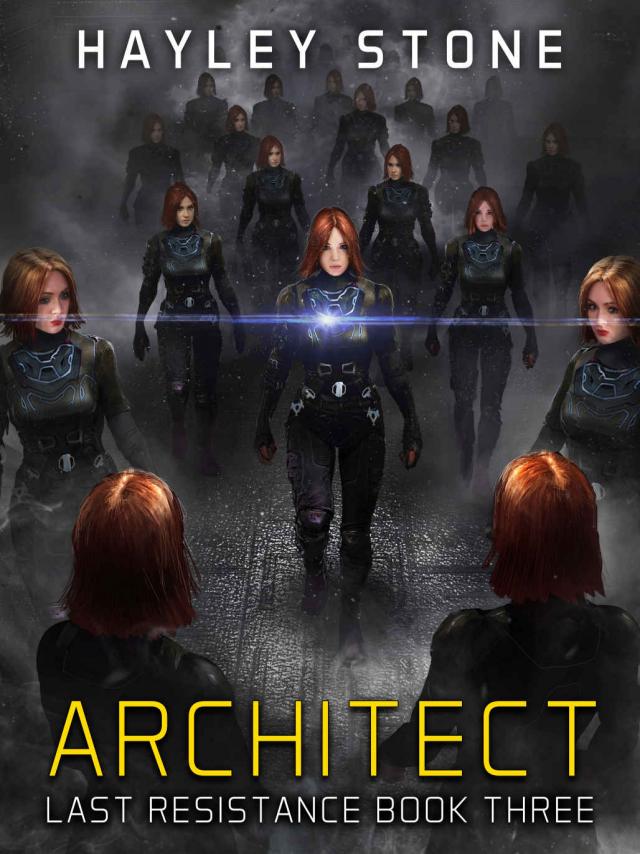
I trail off, plunging my fingers into my hair and feeling for a wound. At least blood won’t make much of a difference to the color now. I couldn’t ask the clones to do anything I wasn’t willing to do myself, so a few months ago when I proposed changing our appearances to hide our identities I went first, shortening my hair to an above-the-shoulder crop and dulling the red to a soft brown. I’ve cut my hair plenty of times before, but it surprised me how much it hurt losing the color. Like I was giving up a piece of my borrowed soul.
“It’s more—this area.” Benji gestures to his nose.
I assume he’s referring to one of a dozen cuts on my face where the tempered glass blew inwards when my flight mask broke and dab at where it hurts the most.
“No—here.” Benji steps close again but hesitates with his arm held out. “Okay?” he asks. I nod dumbly, not stubborn enough to deny his help. He uses his sleeve to wipe beneath my nose. Oh no. “My dad used to do this for me.” I’m startled by how gentle he’s being, given our rough introduction and the way he’s avoided touching me since. “I got nosebleeds all the time as a kid. Mom said it was all the thinking I did. I was… a lot, for them. But they never complained. God, I miss them.” His smile is painful, edged with grief. “Anyway, pinch and hold there. The pressure should make it stop in a few minutes.”
“Thanks,” I mumble.
“First hallucinations, then a nosebleed. I’d be worried. Are you worried?”
As irritatingly invasive as his question is, the answer is worse. I am worried. In the past month I’ve had several nosebleeds and felt more tired than ever before. Thanks to a solid rotation when it comes to shifts I sleep plenty, like the dead, but somehow it’s never enough to fully remove the lethargy. A permanent sluggishness hangs on my limbs, making every day feel longer than it is, and when not focused on a task I’ve noticed my mind drifting, visiting the same blank space where no thoughts live. And now this.
I don’t think Samuel’s noticed the changes, or he would have said something. Then again, if there’s anything I’ve mastered, it’s the art of pretending everything’s okay when it very clearly isn’t.
“I told you, I took a hard hit earlier,” I say, pulling away. Could all that static noise have screwed with my brain and caused the nosebleeds? “Come on. Let’s go.”
Benji was kind to clean me off, but I still feel weird seeing my blood on the corner of his jacket sleeve. Serves as a decent reminder that more could end up on him if I’m not careful. Because while Benji may come across as an open book, and I may feel as though I know him, the truth is that I don’t. He’s been living out here for years. That requires a sturdy constitution. A complete lack of squeamishness when it comes to doing whatever it takes to survive.
“You don’t trust me, do you?” Benji asks after we’ve walked a little way, reading my mind.
Although he sounds unoffended, I remain wary. My back still aches where he shoved me up against a wall. He’s strong, even if he doesn’t look or act it. “Trust is earned.”
“Hey, I’m helping you,” he grouses. “Even though your plan is stupid.”
“Story of my life.” I shoot him a smile, hoping to defuse his petulant annoyance. “But I brought my friends into this situation, and I’m going to see them safely out of it.” I’d do it without Benji’s help too, though I’d rather not have to, so I don’t say that part aloud.
“Well, you’re going the wrong way.” He temporarily uncrosses his arms to hook a thumb over his shoulder. “Park’s that way.”
“I know. I’m making a slight detour.”
Benji’s head swings between the direction of the park and where we’re headed, clearly trying to make sense of my navigation. “Didn’t you come from the river?”
“Just get your comm ready.”
“For what?” he asks. “You’ve completely lost me. And trust me, that is difficult to do.”
“On second thought, maybe it would be best if you just let me hold it for a while.” He seems reluctant, which is why I add, “You want me to trust you? Let’s start with this.”
Benji resists for another few seconds before finally relinquishing the device to me. “It’s basically a paper weight at this point anyway. You’re not planning on bludgeoning another machine, are you?”
But I’m already halfway down the street and too far away to provide an answer without shouting.
Eleven
I move quickly, comm in one hand, EMP-G in the other, occasionally activating the former for insight into the machines’ positioning. It’s frightening how easily I’ve already adapted to this new reality. None of this should be possible, but it’s happening. To deny it would mean sticking my head in the sand, and that strategy rarely works out. If the beginning of the Machinations taught us anything, it should have been this: There’s no such thing as overreacting when underreacting means death. Inaction isn’t neutral. It’s a choice.
With the help of the signal, it doesn’t take long to locate Charlene’s team. They aren’t very far away.
“Charlene!” I call out to her, causing those with her to also turn. Am I imagining things, or are there a lot more people than there should be?
“Wow! What are the odds?” Benji exclaims, but I’m too distracted to parse meaning from his delighted remark.
I hasten forward, my head on a constant pivot, comm switched on, trying to make my two separate realities align by singling out the machines stalking Charlene’s team.
There. Near the buildings. My breath catches in my throat as my gaze meets red both ways: their optics, my heat. It’s like staring into a funhouse mirror; I jerk to an abrupt stop, stepping to one side, then the other. The machines imitate the movement. But I can feel that command slipping inside me again, the call to kill, and I know the machines are receiving it too.
“Rhona?” a man says.
But his voice is lost amidst the noise of my own heart, now interred behind ribs of metal—instead of pounding my blood whirs.
“Ambush!” I shout, sprinting toward the group in bursts of silence as I close the channel long enough to see a clear path forward. When my allies don’t immediately respond, I begin gesturing frantically toward the alley I just emerged from. “Get to cover!”
I open the channel again long enough to glimpse the machines coming toward me with equal speed. I target them across the unsteady distance and pull the trigger without hesitation.
An electric shudder travels through my arm as multiple guns fire in place of one.
Blood sprays across the front of my suit as one Canadian slumps forward, her back riddled with bullets. From the many corners of my many eyes come frantic blurs as several people duck for cover. Gunfire catches those who aren’t fast enough. Legs jerk out from beneath running torsos, and I can barely watch in either perspective as the team who put their trust in me learns the hard lesson not to.
My EMP-G is still raised, poised to shoot. All the muscles of my arm tighten, instinct screaming for me to do something, dammit—but I stall, afraid of what might happen. Was it just coincidence that the machines fired at the same time I did? Am I crazy for imagining that I was responsible for it?
I hear someone calling out for Rhona, and for one brief moment I wonder, do they mean me? The spasmodic rate of automatic fire sounds like metal shutters opening and closing, and the cross-play of electromagnetic pulses with traditional muzzle flashes lights up the night in alternating shots of blue and white. Voices call to each other from across the dark street, human voices, and when I hear my name again this time I recognize it as mine.
One of the soldiers rushes me, taking me off my feet. It takes my brain a moment to recognize I’m not being attacked as we tumble backwards through an open door and into cover. I feel my comm slip from my hand, and the noisy clatter of it landing nearby. The signal is still playing screaming static, and I can’t see through my own eyes clearly. I can only watch from outside my body as those I came to save perish under a storm of bullets.
No. Not again. I won’t let this be another Anchorage.
I roll over onto to my stomach and begin crawling back toward the door, hands outstretched, searching. I’m no use to anyone in this state, least of all myself. I need to find the comm and shut it off; cut the signal. Dirt has broken through the floor in chunks of swollen earth, and the smell of it clears my senses like smelling salts. I try focusing on other concrete details—the sting of air moving over my cuts, the closeness of my breath—to ground myself. I don’t know how else to evict the machines from my mind except by reminding myself of the flesh I’m actually in.
A blizzard of images flash across my mind’s eye, buffeting me with memories that aren’t mine and aren’t the Rhona’s before me either.
At least, not from our perspective.
The dirt between my fingers turns inexplicably to snow, my hands transformed into icy prongs of metal. I can’t feel the cold, but instead register it as an afterthought, a notation.
Code scrolls through me. The code that’s always there:
identify target;
if(unknown) {
eliminate;
}
As I’m lost inside myself and struggling to make sense of the code, a pair of warm hands closes on my own.
“Rhona?” I hear the soldier whisper, half in question. My heart shudders at that slightly accented voice, and even if I can’t see his face clearly through the kaleidoscope of alternate perspectives, I know whose hands these belong to. Even if it feels impossible that he could be here with me in this terrible moment.
“Camus.”
I take my hands back only to throw them around where I expect his neck to be. I glance off his shoulders first, but eventually find my way and feel arms wrap around me in return.
“Are you hurt?” Camus asks. My body is clenched so tightly around a spear of fear, I can barely speak.
“I can’t see.”
His hands shift to my face, and I flinch at the unexpected contact. I feel his gaze on me as he turns my head back and forth, full of gentle care, assessing the damage. “I don’t see anything,” he says.
“Me neither.”
He gives a short, startled laugh.
In the next moment I find myself rising to my feet, returning to the world that matters, the one that’s happening right now. My mind flickers between past and present even as I’m helped up. I lock eyes with myself across multiple backdrops: a stretch of snowy tundra; a ruined city block; a dark forest. The only way out is through. That’s the best truth I know.
Camus pushes me backwards a moment before I hear shattering and watch from outside as the storefront window flies apart under the bullet storm. As my back collides with a wall I expect to feel the sharp spray of glass against my face again, but it doesn’t come. Camus grunts, pressing himself against me protectively.
“Just like old times,” I say. It’s absurd, but I want to hear him laugh again. Hear him say something, anything and know he’s okay too. If I can’t be in his world, I must pull him into mine somehow.
His answer surprises me. “Yes, and I’d like to stop meeting this way if at all possible.”
“I’ll talk to my people. See what I can do.”
Camus yanks me unceremoniously to the floor. I offer no resistance, trusting him to keep us both safe in this moment. Plaster dusts my head and shoulders mere seconds later, and I think I feel a spent bullet casing bounce off my shoulder. I’m not in love with these near misses.
“We need to get out of here,” I say.
“They have us pinned down. Even if we wanted to run, you can’t see. We wouldn’t get far.”
I cover my ears but the comm is still too close, the signal too strong for me to block out.
“Be realistic,” Camus says, exasperation in his voice, like I’m being childish. It must look that way from an outsider’s perspective.
“My comm,” I say, because it’ll take too long to explain everything. “Can you hear it? That static?”
“Yes.”
“Find it for me. Turn it off.”
“Is that truly the priority here?”
“I don’t have time to explain. Just—please. Do this for me. I promise I’ll make it make sense later.”
He lingers, and loathe as I am to lose the comforting pressure of his arms around me, I know it needs to happen if any of us are going to survive the next five minutes. While he’s hunting for the comm I let myself fully invade the machines’ mental circuits, unsure whether I’m controlling them or being controlled alongside them. I stumble toward the door, tripping over unseen obstacles. I jam my hip against a counter and catch my foot on a chair before watching myself finally come into view. Fully exposed.
Behind me Camus cries out to stop, and I can see the dark shape of him staggering toward the door as well, reaching to drag me back into safety.
I don’t hesitate, facing the street with gun raised.
If I target the machines again they’ll likely return fire, same as before. But maybe I can punish them for copying my actions another way.
In a single fluid gesture I turn the muzzle away from the machines, flattening it against my head, and suck in a breath before firing. The electromagnetism won’t harm me at point-blank range—I don’t think—but the machines aren’t equipped with EMP-Gs.
They shift as one, unloading bullets at themselves without hesitation. I half-expect some programming to kick in, preventing them from damaging themselves or each other, but either I’ve overridden their friendly fire settings or the higher echelon removed that protection to avoid us using it against them. Confusing them with old parts, like holding up a picture of another person’s face to unlock a phone.
“Go!” I shout, hoping the others will have been paying enough attention to seize on this opportunity. I almost say, I have them, but I’m not sure that’s true. Not anymore.
Because something else happens when I pull the trigger: everything stops. All those viewpoints cluttering my vision disappear like I’ve just exited a dozen browsers at once. I’m alone again inside myself—whatever that means. It feels weird to think of my body in the same terms as a machine, as housing, separate from the soul inside. I spent a year convincing myself and everyone around me that I was the same inside as out. But after what just happened, I don’t think my software is the only locus of aberration. My hardware might be different too.
Blue flashes across my vision as electromagnetic weapons discharge at the machines. I’m able to count as each of them drops. Half a dozen. Two groups of three that must have become separated from the rest of the herd. I wonder how that could be with the higher echelon guiding them away from the main action. Could my initial—I don’t know what else to call them but ‘connections’—have interfered with their orders?
My surviving allies make short work of the machines, ensuring they don’t rise again by destroying their central processors.
“Wait!” Benji blurts, frantically waving his arms as he rushes out of cover to stop Charlene from gutting the last surviving machine. She has a blade readied like she’s about to skin a carcass. A bullet would be faster, but after this firefight she’s no doubt trying to conserve ammunition. “Don’t destroy it!”
I lose sight of Benji as Camus reaches me, drawing me swiftly out of the doorway like there’s danger still present. “What just happened?” he demands, and my gut clenches at his rock-hard expression. I made the machines fire on us, I think. That’s what happened.
But already I’m beginning to doubt that’s true, second-guessing the nightmare as reality and reason take over. Could I have been misinterpreting what happened? Is this all part of some complex psychosis, another form of psychogenic attack? Once again, I can’t help imagining what Zelda would say if she were here. She’s always enjoyed arguing logic in the face of my irrationality. Machines fired on you because of course they did, she’d say. That’s what they do, Long. Get out of your own damn head.
But how does a person escape their own mind?
“That was stupid and reckless…” Camus’s hands are shaking as he pulls me into his arms, closing his face in my neck. His breath is warm and fast. I let myself sink into the embrace, shutting my eyes to allow each of my senses equal opportunity to absorb the feel of him, solid and real and safe. “But it also worked,” he adds. The words themselves aren’t tantalizing, but the way his unshaven mouth moves against my skin is. There is so much I want from him in this moment that will have to wait. “Please, help me to understand how.”
I start to reply but raised voices cut me off. Everyone is shouting, and when I turn to see why I spot Benji standing in front of a predator, blocking half the team from putting it down. The team with Camus has their weapons drawn as well, but they’re not aiming at the machine—they’re aiming at my people.
What the hell?