Architect (Last Resistance Book 3), page 18


It's not that she wants to forget the good along with the bad, but when it comes to remembering, she wants the choice of when. That’s harder to manage when every hallway and room serves up painful reminders of her loss.
Maybe it’s these thoughts of her past that make her see Rhona through one of the center’s windows. Their eyes lock through the webbing of frost and the absence of Hanna’s breath.
She watches Rhona’s mouth shape her name before she disappears from view, perhaps searching for a door, a way inside.
Hanna doesn’t believe in ghosts. If ghosts were real, Rankin would have visited. He would have found a way back to her, even if only to shuffle objects around in their quarters and make a small but determined nuisance of himself. Only living people need doors.
“Zelda,” she calls out, but doesn’t wait for the other woman to join her. She hurries in the same direction Rhona went, trying to find a place they can meet. In the dark she uses her hands to trace the wall, hovering in case she trips over something she can’t see.
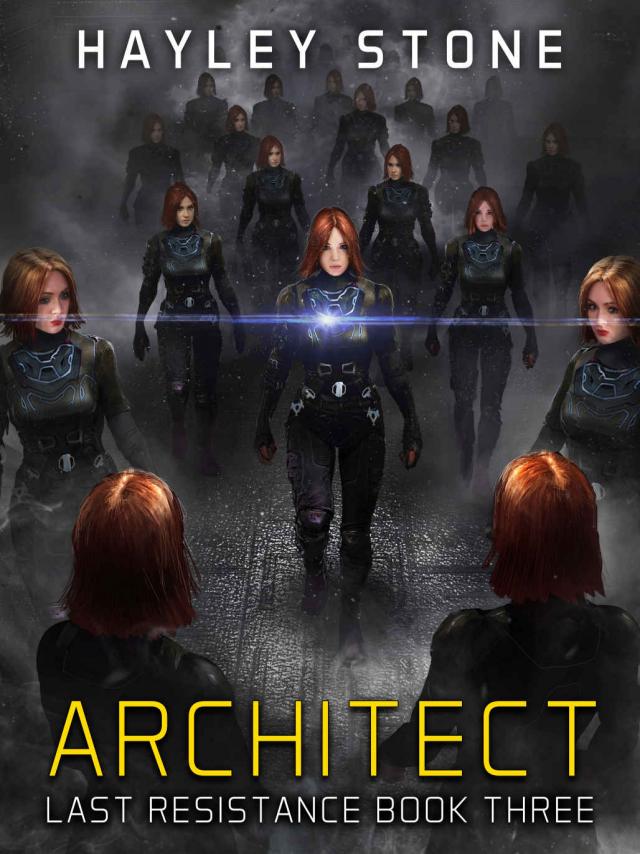
Cold bursts across her face a moment before she is overpowered by an embrace. Red hair fills her vision, colored in by the brighter dark of outside coming through the flung-open door. She feels a staccato rhythm of breath against her cheek and movement against her chest, all those subtle patterns of speech that she can’t hear and doesn’t need to right then to understand what she already knows. Her friend is here. She is, against the odds, once more alive.
Zelda appears as Hanna’s pulling back from Rhona, and she watches the pair exchange words. It’s too dark for her to lipread, and they’re speaking so rapidly that she’d probably catch even fewer words than she ordinarily would anyway, so she focuses on what she can observe: Zelda’s ruler-stiff posture, Rhona’s gloved hands in two fisted snowballs at her sides. This no longer feels like a reunion but an interrogation.
And there’s something else. It takes her a moment to realize what feels off about her friend, leaving aside Rhona miraculously appearing here at all.
While Zelda and Rhona continue to argue, Hanna reaches out to Rhona’s cheek with two fingers, swiping down too quickly for Rhona to pull away. Her fingers come away clean. No powder or hard foundation, nothing that would conceal Rhona’s splotchy freckles. Yet they aren’t there. Even in the grim light Hanna can see the canvas of Rhona’s face, spackled only with the small smattering of original freckles.
“Who are you?” she says, taking a step away.
Any warmth in this false Rhona’s eyes drains. You know me, she signs.
Hanna shakes her head. “I don’t know you.” Another step back. All she can do is put distance and shadows between them. She has a gun, but she doesn’t think she can use it. Not on Rhona. “But I knew someone like you. She’s gone—so how are you here?”
Instead of answering false Rhona’s gaze moves past her, and then she takes a step back. “What’s that thing doing here?”
Dopey is standing behind Hanna, head cocked. Its face is still glitched, showing a partial expression of curiosity between blacked-out pixels.
“Have we met?” Dopey asks, signing the words at the same time for Hanna’s benefit. In that respect, the machine shows more consideration toward Hanna than most do. It seems like an innocent question, but false Rhona blanches as if the machine had struck her.
“Don’t pretend you don’t know me,” she says, and then to Hanna, “You can’t trust it.”
Zelda says something as she moves forward, nudging Hanna aside, but Hanna misses what.
Then there’s a flash.
The entire room lights up, and her brain reaches for the first explanation it can think of: Sunrise. No. Darkness closes back in around them immediately after. The light does not linger. Camera? But why would Rhona have a camera? And why would Hanna have felt the rhythm of the flash in her chest, like clouds breaking during a storm? She cannot hear, but she can sometimes feel noise when it’s nearby and loud enough.
Sparks fly onto Hanna’s arm, sizzling through her coat. She smacks them out and then stares at the source: a hole in Dopey’s chest.
Rhona is holding a gun.
Zelda catches Dopey as the machine staggers backward, and the flash happens again, except this time Hanna knows exactly what it is. And what she must do to stop it from happening a third time.
She runs at the clone, connecting with enough force to send the gun flying. “Why are you doing this?” she asks, holding Rhona down with both hands. The other woman doesn’t fight back. Her eyes are glazed over in surprise. Hanna can feel how skinny she is beneath the downy insulation of her jacket, like a store mannequin. Her chest rises and falls in the short, fluttery breaths of a panicked bird, and Hanna adjusts her grip, fearful of accidentally snapping a bone. How long has she been out here on her own? Weeks? Months? How has she survived?
Hanna misreads Rhona’s initial answer as Zelda’s shadow falls over them both. “What?”
“To stop that,” Rhona repeats, her gaze on Dopey, “from replacing us.”
Thirteen
Rhona
Darkness slouches off the city in chunks of shadow as the sun begins to rise. Coal-colored smoke continues to drift above the buildings to the northeast, stark against the red wound of the horizon. The ground forces must be making progress. They sound closer, even though we’re farther from the river now, following the path of the park evacuees. Glasgow is providing Camus directions through a pager that looks older than I am, but it must be the only way to maintain communication while the higher echelon is still projecting that bizarre signal over all channels. I wonder why, if the signal is the cause of my connection, why it doesn’t seem to affect Glasgow. Maybe I can ask Jo about it later.
Camus still hasn’t brought up what happened with the machines earlier. Maybe he’s forgotten, or more likely he’s trying to spare my feelings while we’re already in the midst of a high-anxiety mission. I'm not going to be the one to remind him, either way. I’m still not sure of myself or of what happened, but if I stay clear of that signal I believe I’m safe.
Relatively speaking.
“What’s the plan once we catch up?” I ask. Even though I’m not speaking loudly, the haunting stillness in the air carries my voice like a shout. “I don’t have a gun, remember? And it doesn’t look like you do either, unless you’ve been working on your sleight of hand as well as that beard.”
Camus rubs a hand across his chin. “You don’t like it?”
“That's your takeaway?” I fight back a laugh and the desire to show him exactly what I think of his rugged scruff by peppering his mouth with kisses. “I like it, though I’ll admit, it does make you look like your own evil twin a little. And believe me, I’m aware of the irony of that statement coming from me.”
“Maybe you’re right,” he says with faux seriousness. “Maybe I killed the real Camus and replaced him.”
I walked right into that, but even though I know he means nothing by it I’m suddenly caught in a dangerous thought spiral, thinking of the Rhona who attacked me in my quarters back at McKinley. She was driven by desperation, manipulated into believing the higher echelon’s lies. I still remember her wig coming free in my hands, her bruised scalp showing all the cloning sickness I never experienced and the cruelty in the wet shine of her eyes (my eyes) as she came for me. I’ve tried to forget the feeling of her nose shattering beneath my elbow and later the ease of driving my knife into her neck. The way she died choking on herself.
Self-defense. It was self-defense. But each day the armor of that lie fails a little more, the truth ugly and skeletal beneath.
Maybe that’s why my mind can so readily accept Camus locked in a fatal embrace with himself, knife between them. Every killer must see the same violent potential in those around them. No one wants to believe themselves truly singular. Alone. Evil.
Camus stops so abruptly I nearly run into him. I hadn’t realized I was lagging behind. His face has collapsed into an apologetic look. “I’m sorry, that was a horrible joke. I wasn’t thinking… Are you all right?”
My mind reaches for a lie, but instead I surprise myself by answering with the truth. “No, actually. I don’t think I am.”
“Maybe we should go to the boat,” he offers, but I shake my head. “If you don’t feel up to—”
“I didn’t say that. Let’s just get through this.”
I turn my face away as he takes my hand. I don’t know why, but holding his gaze physically hurts. All that targeted concern feels like an accusation. “Did something happen?” His quiet voice beckons like a priest toward confession. “These months you were away.”
Even with hundreds of days spanning between now and then, I feel a collar of ghostly fingers around my neck, squeezing. More images splatter against my mind like hot oil.
Rhona the White’s red eyes staring down at me.
Rhona the Intruder’s lifelessly staring up.
After everything that’s happened today, I don’t know why this—a single offhand remark from someone I love—is enough to trigger my panic, but it does. The buildings feel closer even as Samuel feels farther away than ever.
“Why did I think that I could do this?” I murmur, my breath coming fast and short as I pull out of Camus’s grasp. He lets me go. He’s never had the power to make me stay.
“Do what?” Camus asks.
Come back. “Come to this city. I thought this was the right thing to do, but now look at where we are. Look at what’s happened. I’m just making everything worse.”
“That isn’t true. Earlier, you saved your team—”
“Only after putting them in danger by bringing them here.”
His expression softens to something worse than sympathy. Pity. “You can’t control for everything. You aren’t the higher echelon.”
“You’re right,” I snap. “I have to be better. Smarter.”
“That’s not—” He cuts off with a sigh and takes a break from looking at me to scan the street. Freed from his scrutiny, my muscles unclench and I begin to breathe easier, no longer the center of attention. No longer playing the part of a brave, unflappable leader. I let myself slouch, exhausted, and straighten only when he looks back. “Perhaps we should table this conversation. You’re tired, you’ve been through a lot today, and it’s only going to get more difficult from here if we catch up with the Providence group. Be honest with me,” he pleads. “Can you do this?”
What he’s really asking is the same thing he and everyone else has been asking me for the past three years. Can I rely on you?
I know the real answer, but I don’t speak it aloud.
“Yes. Of course.”
Camus looks like he’s about to say more but instead responds to an alert from his pager. “We’re almost there. Glasgow thinks they’re heading up into the hills. There’s a shortcut we can take that will save us a few city blocks.”
“Why?”
“What, are you trying to get more steps in today?” he responds, a little peevish. I miss being the only snarky one.
“Not about the shortcut. Why would the higher echelon be leading them to higher ground instead of straight out of the city?” I’d noticed the river overflowing its banks, but not to a significant degree. Winters have been too warm for there to be much snowmelt leftover.
“Who knows,” Camus replies. “The machines have been behaving unpredictably these last few weeks. I’d almost call them withdrawn. They pulled back from the city limits even before the ground forces arrived.”
“That makes sense if the higher echelon planned this to be a trap. Taking its sweet time springing it, though,” I add in a grumble. At this point the anticipation of dealing with the unknown feels worse than anything it could throw at us.
“I’m sorry,” Camus says a moment later. The non-sequitur catches me off guard. “I didn’t mean to be short with you.”
“The steps thing, right?” He nods guiltily. “Already forgotten. I’m good at that, you know.”
He doesn’t take the bait. “I’m just worried about you.”
His concern warms me, but we don’t have time for it. “Sure I’m not having a great day, but I’ve survived worse. In terms of bad days today’s not even top three, honestly. Maybe top five, if we’re limiting it to the last two years. I’d have to give it some consideration.” Camus stares at me with a mixture of baffled horror. “What?”
“You do understand how that’s not a good thing, right? Life isn’t a scout group where you get merit badges for pain.”
“Okay, but if it were, I’d be Eagle by now for sure.”
“Rhona.”
“Camus,” I repeat his name in the same deep timbre. “Like you said, let’s leave it for another time. Hey, I just had a thought. What if the machines recognize me? Maybe I should have grabbed a mask while we were back at base.”
From his tight-lipped frown, I know Camus isn’t distracted or fooled by my gish-galloping in the slightest—his eyes say, we will be discussing this later—but I’ll take any stay at this point. “That isn’t going to be the problem you think it is,” he answers, and I release a small breath, grateful he’s moving on.
“Oh, really? Why’s that?”
“I’d hoped Jo would have mentioned this. The higher echelon has been performing human experiments using Samuel’s research. We assume it developed the technology based upon the cloning capsules it retrieved from Brooks facility, but it’s not entirely clear. It’s also discovered a way to accelerate the growth rate to a handful of months as opposed to years.”
“The higher echelon is creating more clones,” I conclude. The blow of this news doesn’t hit as hard as it might have a year ago. Maybe because I’ve already dealt with a handful of my genetic sisters so I know what to expect. Or maybe it’s because the events of the past day have so thoroughly hollowed me out that I can’t feel much of anything right now, just the slow coughing smoke left behind the flames of my fear.
“Unfortunately, yes,” Camus says. “But not just clones of you, though you do appear to be its favorite template.”
Benji’s response makes far more sense now. Maybe he thought I’d escaped the park, broken free of my programming. “Are they being tortured?” I think of Princess Rhona’s electrical burns, the way she flinched whenever anyone came close enough to touch her. She let Samuel hold her our first night together, but in the months after, before she ran away, I sometimes heard crying from her room in whatever house or building we hunkered down in. I thought about knocking on those closed doors. Going in and taking her into my own arms and telling her everything was going to be okay, the same way I wished someone would do for me back when I first returned to McKinley. But it would have been lies. For her, nothing will ever be okay, because the ones she loves belong to someone else now.
Me.
“Not to our knowledge.” Camus frowns. “What would make you go straight to torture?”
“We ran into evidence of it elsewhere. Long story. But hey, this could be a good thing then.” My relief must show on my face, because Camus gives me a funny look. “Samuel’s research was incomplete. He destroyed a lot of it when we fled Brooks. The higher echelon might want to keep him alive to pick his brain.”
“If that’s the case, it may be more difficult to separate him from the rest of the group. He’ll be protected.”
I’m not going to let myself get discouraged by thinking about those “what if’s” just yet. “Maybe we’ll get lucky,” I say. Commissar Kozlov and many of the New Soviet refugees that came with him believed I was supernaturally fortunate. It’s hard to imagine that being true, but if it is, I hope I didn’t spend my daily quota simply surviving a blown chute.
A short time later, we finally catch up to the Providence refugees. Most are on foot save those riding on the siegers I saw earlier, and a few drive what I assume are electric cars at the front and backs of the caravan. We make our approach by way of a side street perpendicular to the train and wait until there’s an easy opening before sliding into the crowd. From what Camus told me I expect these people to be zombified, but they seem… normal. If anything, the higher echelon’s prisoners look too well-rested, like they haven’t been struggling through an apocalypse. Like they’ve been taken care of, all of their needs readily met.
Maybe not prisoners after all.
Camus pops his collar to obscure his face, but it’s quickly apparent that I don’t need to do the same. Amidst the various adults and children I count at least seven other Rhonas in our immediate vicinity monitoring the perimeter like sheep dogs on the edge of a herd. Their faces are stony, eyes vacant. I almost breathe a sigh of relief because they are nothing like the Longs— absent my personality.
I try not to dwell on the more disturbing implications of that fact.
Some members of the crowd are talking low to one another, so I figure it’s safe if Camus and I do the same. “What’s with the Terminator attitudes?” I nod toward the nearest Rhona, whose hair has been sheared to a bootcamp pixie cut, looking as if she just entered Basic. It’s a little unnerving how much she resembles the image I have of my father with his close, military-style buzz.
“It’s unclear. But we suspect it’s because the higher echelon is using them as… I’m sorry, love, I don’t have a better term, but as vessels.”
“They’re hardware.” At least with these clones, I won’t be competing for the award of Most Rhona. If they lack the soul of my predecessor, her thoughts and memories, then we’re not truly cut from the same cloth after all. There’s some weird comfort in that.
“That’s one way of putting it. We aren’t clear how, but it seems the higher echelon controls them using some kind of neural implant.” That doesn’t sound dissimilar to what Samuel used to map Rhona’s memories onto me, and I feel suddenly foolish for never pressing him on whether that device is still inside me or not. “Which,” Camus continues, “is why you need to keep your expression as blank as you can. And why we should probably end this conversation.” His eyes slide sharply away as a few folks nearby glance over.