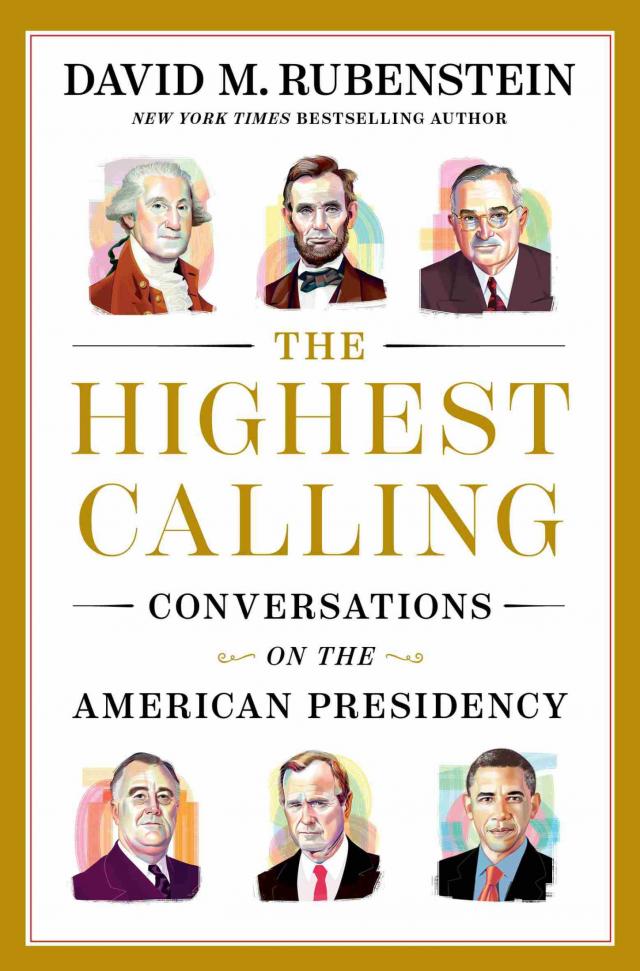
The Highest Calling, page 49


And the night we’re walking out, we are about to be announced, my mother saw the look on his face and she grabs his hands and says, “Come on, honey, it’s going to be okay.”
DR: What did she call you—Joe? Or Joey?
JB: Joey. My father called me Joe or Joey.
DR: Do you like to make decisions based on reading materials that your staff gives you or in oral meetings? I know some presidents only like to do oral meetings. Some like written things. Barack Obama liked to read a lot. Jimmy Carter liked to read a lot. What’s your style—to get meetings with people, or to read, or both?
JB: I think it’s fair to say both. I am at home with a book like that every night, for real. But I also very much like to look people in the eye. It surprised me, the response to checking with the staff. I’m looking for detail. I don’t want generic assertions. I want someone to tell me in detail why you think such and such. For example, I just had a meeting on the whole issue of what’s going on in Israel and what I should be doing, and what’s going on in Iran. I want to know the details before I make a decision.
I used to kid Barack. I’d sit in that chair, and he’d sit in this one in front of the fireplace, and the deal he and I made was that I literally got to be the last person that he worked with, the last person in the room, before he made his decision. I’d give him my advice, my opinion in detail why I thought he should do A,B, C, or D. He probably only disagreed 30 percent of the time, but he always said thank you. I said, don’t thank me. I get to give you the advice, and I get to leave. You’ve got to make the decision. That’s the biggest difference.
You know that Harry Truman deal about if you want a friend in Washington, get a dog? Well, it’s not that so much, it’s that it’s very different when you know no one else is you.
DR: One of the most emotional things I’ve ever seen you be involved with was when Barack Obama surprised you by giving you the Presidential Medal of Freedom with Distinction. You were choked up, and you turned around to kind of get your emotions under control, and you came back and faced the crowd? You were truly surprised.
JB: I was. I was totally surprised. There are things you never think of. I never thought I could qualify for that.
DR: When I worked here, I was 27 years old. I was the youngest person in the White House. Now, in many cases, I am in rooms where I’m the oldest person. I’m now 74 years old. I say I’m too young to be president. I couldn’t be president, I’m only 74. But you were nearly the youngest person ever elected to the Senate. You were elected when you were not even 30.
JB: There was one younger.
DR: All right. So now people say you’re old. How do you deal with that? Because I deal with it all the time. People look at me, like, “You’re kind of old to be doing this. Why are you still working?” And I say, “I feel young, and I’m still happy doing this.” And if I’m happy, why do anything else? So how do you address that question that people ask you—are you too old to do this job or not?
JB: I don’t think that. For the longest time I was too young for the job. The guard used to stop me getting on Senate elevators.
DR: They thought you were a staffer?
JB: They thought I was a staffer. Yeah. “No, this is for senators only.”
DR: You have a trainer that helps you?
JB: Yes, I have a trainer.
DR: Does a trainer say to the president of the United States, you’ve got to work harder? Or they don’t tell the president of the United States, you’ve got to work harder?
JB: Actually, they work me pretty hard. He works me pretty hard. I don’t feel anything less in my stamina, or my intellectual curiosity, or in my ability. I’m going to say something about you. You have enormous experience. It’s not like you were just doing business for all these years and decided you want to be engaged in the larger issues.
DR: I’m trying to give back to the country in some way.
JB: Bingo. Bingo, bingo, bingo.
DR: That’s what life is about, right?
JB: I think it is. You think it is. But how many people want to give back or take? I think there are too many people today—maybe it’s always been this way—who look at it in terms of how it can enhance or better their financial or physical circumstances.
DR: Some people measure their self-worth as a person by their net worth. I don’t do that.
JB: Because you and I come from a similar background.
DR: I have a blue-collar background. My father worked in a post office. I’ve given away a good deal of money for various things in Washington, and we’re going to redo the Lincoln Memorial, we’re redoing the Jefferson Memorial, and hopefully you’ll come there when we’ll dedicate them.
JB: My dad used to have an expression on repeat—he repeated it a million times—Joey, a job is about a lot more than a paycheck. It’s about your dignity. It’s about respect. It’s about being able to look your kid in the eye and say, “Honey, it’s going to be okay.”
DR: I agree.
JB: But how many people in your circumstances or in my circumstances think that way?
DR: To me, the greatest thrill is making your parents proud.
JB: Bingo.
DR: My parents are no longer alive, but they lived to see a lot of what I did. They always said to me, David, you’re doing something good for the country, and that’s what made them proud.
JB: Same. My mother used to say, as long as you’re alive, you have an obligation to strive. You’re not dead and you’ve not seen the face of God. And she meant it. My mother was a five-foot-one little Irish woman who had a backbone like a ramrod. But it was about principle.
DR: She lived to be 90?
JB: She was 92. She was born in 1917.
DR: 92. You’ve got a ways to go to catch up there.
JB: Yes.
DR: I appreciate your giving me this time. The book is coming out in September and it’s about the presidency. I’ve interviewed a lot of great presidential scholars, and former presidents. President Clinton I’ve interviewed, and I’ve interviewed President George W. Bush. He’s got a quite a sense of humor, as you probably know.
JB: He does. He’s a decent guy.
When I said “Restore the soul of America,” I was talking about decency. I have great faith in American people. American people are decent. They’re decent. We’re on the verge, God willing, of making enormous progress in this country.
DR: What keeps people young is a sense that they have an obligation to do something. They feel like they’re doing something that makes their life worth living.
JB: Bingo.
DR: And that’s what makes it possible for people to keep living.
JB: I couldn’t agree more.
23 FRANKLIN FOER
on President Joseph R. Biden Jr.
* * *
DAVID M. RUBENSTEIN (DR): Why did you pick Joe Biden as a subject for a book?
FRANKLIN FOER (FF): My publisher came to me and asked me to do a book about the first 100 days of the administration. I was reluctant because I was never really connected with Joe Biden as a political figure. The first time I spoke to him was when I was a 24-year-old reporter and I got him on the phone. I was really excited to get Joe Biden on the phone, and five minutes into the conversation, it was clear to me that I was not going to be able to get him off the phone.
DR: Biden was elected to the United States Senate when he was 29. He couldn’t take the job until he was 30. How did he get elected to the Senate at such an early age? He had only been a county councilman or something like that. Was he a great politician at the age of 29?
FF: He was a charismatic guy. He was riding on the coattails of the Kennedys. His family campaigned as an Irish Catholic clan in Delaware. They held coffee klatches in the style of the Kennedys. And he was a good public speaker, which is an interesting fact about him, because he’d had this stutter that was a defining fact about his childhood. His eloquence on the stump was something that he was quite enamored with because it showed how he’d overcome his fundamental disability.
DR: When his wife and young daughter were killed in a tragic car accident, he thought about not taking up the Senate seat. Senators came to him and persuaded him to take the seat. Whose idea was it to commute every night back from Washington to Delaware, which he did for thirty-some years?
FF: He was despondent at that moment. He lost his faith in God. He describes walking the streets of Wilmington spoiling for a brawl. And the Senate really gathered around him. Mike Mansfield, Hubert Humphrey, all of these names from another generation of American politics got together, and they told him that he had to do this. That’s why he’s always considered himself a Senate man. He’s fetishized the institution because, in a way, it saved him from the depths of despair.
DR: From the time he got elected at the age of 29, people were saying he should be president. He’s spent 48 years of his life, the longest period of time of any American in our country’s history, trying to become president. Why did he want to be president?
FF: He thought of himself as a great man. One of the defining features of his personality is that there’s this sizable chip on his shoulder. He was a guy who came from Scranton, Pennsylvania, who identifies with the blue-collar working class but grows up within a party that sociologically becomes something different. It’s run by Ivy League meritocrats, so he feels somewhat out of place. He grew up being bullied for his stutter. He was always trying to prove himself. And what’s the best way to prove yourself to the world but to become president of the United States?
DR: He’s elected to the Senate in 1972. In 1988, he starts running for president, and then all of a sudden pulls out. Why?
FF: He was accused of plagiarizing a speech given by Neil Kinnock, a British Labour politician. It was one of the great humiliations of Biden’s life. For a guy defined by his eloquence, the notion that it was inauthentic—and because oratory was a way of proving himself and overcoming his stutter—it really cut to the core of him. It was another moment of darkness where he fell into a pit of despair.
DR: I always wondered about that, because he didn’t write the speech. Most politicians don’t write their speeches. He had an advisor, Pat Caddell, a pollster and friend, who was the one who thought of the speech. Why didn’t Biden just say, “I didn’t write the speech”?
FF: I think in the moment he just got carried away. The speech nominally acknowledged Neil Kinnock, but he just took on this other guy’s biography in the course of delivering this oratory.
DR: At the time, he said he was pulling out not so much because of the alleged plagiarism but because he wanted to concentrate on the Senate confirmation of Robert Bork. He was then the chair of the Senate Judiciary Committee. Did he lead the effort to kill Bork’s nomination?
FF: In Washington, there are show horses and there are workhorses. Biden went from trying to be a show horse, who gave electrifying speeches, to becoming a workhorse. One way of proving he was able to do this was to throw himself into the stuff that the Senate did.
DR: He became famous for blocking Bork from becoming a Supreme Court justice. Later, he had another nominee sent up to him when he was chairman of the committee. That was Clarence Thomas. In hindsight, does he regret the way he handled that?
FF: No. Joe Biden is somebody who doesn’t experience many regrets. What he experiences are grievances. He’s still very angry at a lot of the women’s groups who he felt characterized his performance in those hearings unfairly.
DR: Later he becomes chairman of the Senate Foreign Relations Committee and makes himself into a bit of a foreign policy expert. Did he enjoy that even more than being the head of the Judiciary Committee, because he’s running around the world and gets to talk to heads of state?
FF: He enjoys them both considerably. He thinks of himself as the world’s leading constitutional scholar. He also really does love foreign policy, more than almost anything in life. Speaking with foreign leaders on the phone is his happy place. And if his staff doesn’t manage his schedule in the right way, it expands to blow up the entirety of his day.
DR: He decides to run for president again. This is the year that Hillary Clinton and Barack Obama are running. We don’t talk much about the Biden campaign for that year. Why?
FF: Because it was a pretty stunted venture that went almost nowhere.
DR: Did he even get to Iowa or New Hampshire?
FF: It was such a footnote to the rest of his career. I think he made it through Iowa, but I don’t think he made it to New Hampshire.
DR: Obama becomes the Democratic nominee for president that year, and he picks Joe Biden as vice president. Why did Obama pick him when he didn’t know him that well?
FF: Obama sent some aide a note while Biden was speaking in the Senate Foreign Relations Committee, complaining about this blowhard who was going on forever. But what Obama needed was that weight, that resume. Joe Biden had the foreign policy experience. He had these relationships on the Hill. It was proof to the world of Obama’s seriousness about governance.
DR: They were partners for eight years. How did they get along?
FF: There’s an arc to the relationship. When Biden comes in, Obama needs him, and he gives him important tasks to perform, but at the same time, there is this cultural temperamental disconnect between the two of them. Joe Biden’s tendency to go on to, to engage in these soliloquies where he references all of these characters from his past and from Scranton, annoyed Obama, who would roll his eyes at him. That essentially gave the green light to the rest of Obama’s staff to turn Joe Biden into the punch line. And you know who knew that he was the punch line of all those jokes? Joe Biden, which only made him want to speak even more to win over the audience.
DR: When Obama runs for reelection, did he ever consider replacing Biden?
FF: No. Over the course of his presidency, Obama, who had campaigned against Washington politics and against politicians, came to have greater respect for the likes of Harry Reid, Nancy Pelosi, and Joe Biden. These tasks that Obama treated with such disdain, like negotiating with Mitch McConnell, he came to respect Biden for performing adequately.
DR: He gives Joe Biden a Presidential Medal of Freedom with Distinction, the highest honor a civilian can get, and kind of says, “You’ve done a great job as vice president, but Hillary’s going to be a stronger candidate, and Beau Biden’s death gives you a very good reason why you shouldn’t be running.” Is that essentially right?
FF: That’s right. He doesn’t say to Biden, “You’re my anointed successor,” but tells him that they need to clear the field for Hillary Clinton. Part of this has to do with Beau Biden’s death and the trauma and grief and mourning that Joe Biden was experiencing, but it was also that Barack Obama clearly thought that Hillary Clinton was the better candidate. There’s also an interesting counterfactual: if we went back to 2016, if Joe Biden had been the candidate then, in my opinion, he would have stood a much better chance of beating Donald Trump, because he neutralized a lot of the attacks that Trump would ultimately lob against Hillary Clinton.
DR: Trump is elected president. Biden is out of office, and for the first time since he was 29 or 30 years old he is out of government. What does he do?
FF: He sets up the Biden Institute. He takes a gig at the University of Pennsylvania. It’s a period where he is a bit at loose ends, because he’s a professional politician. It’s the thing he’s done for the entirety of his life.
DR: He leaves the vice presidency when he’s roughly 73 years old. For those four years, for the first time in his life, he’s making some money speaking, consulting, writing books, and so forth. Does he think that he should run for president again or his time is over?
FF: Very soon into the Trump presidency, Biden begins to think about running. The Charlottesville “Unite the Right” moment in 2017 is something that has a profound effect on his thinking about his political prospects and that maybe he’s the one to stop Donald Trump.
DR: Was there a groundswell of support in the Democratic Party for Biden or not?
FF: I would say no.
DR: He has a shoestring campaign. He doesn’t raise that much money. He comes in fourth in Iowa. But that’s better than New Hampshire, where he comes in fifth. Why did he think he should continue? Did he have enough money to continue?
FF: One of the more admirable qualities Biden possesses is this incredible resilience that goes back to his stutter, continues through the tragedy that he suffers with his family in the car crash, continues through the collapse of his 1988 and 2008 campaigns. He has this ultimate faith in himself, in his ability, and he could see toward the South Carolina primary, where there was a different demographic and a chance to rebound.
DR: He wins the South Carolina primary, and then the people he’s running against suddenly say, “We’re giving up now.” Why did they leave the field so quickly?
FF: The two other leading candidates came from much further to the left and were potentially riskier general election candidates. The pandemic was crashing. So the idea of having somebody who was a safe bet, a sober person who had governing experience, seemed like the wise political strategy.
DR: Biden gets the nomination. Why did he pick Kamala Harris as vice president?
FF: He promised to pick a woman as his vice president. He was never enamored with Kamala Harris as his leading choice for number two. Biden varies from being somebody who is extremely decisive, who has strong gut instincts, to somebody who struggles to make a decision. And this was a decision he struggled to make.