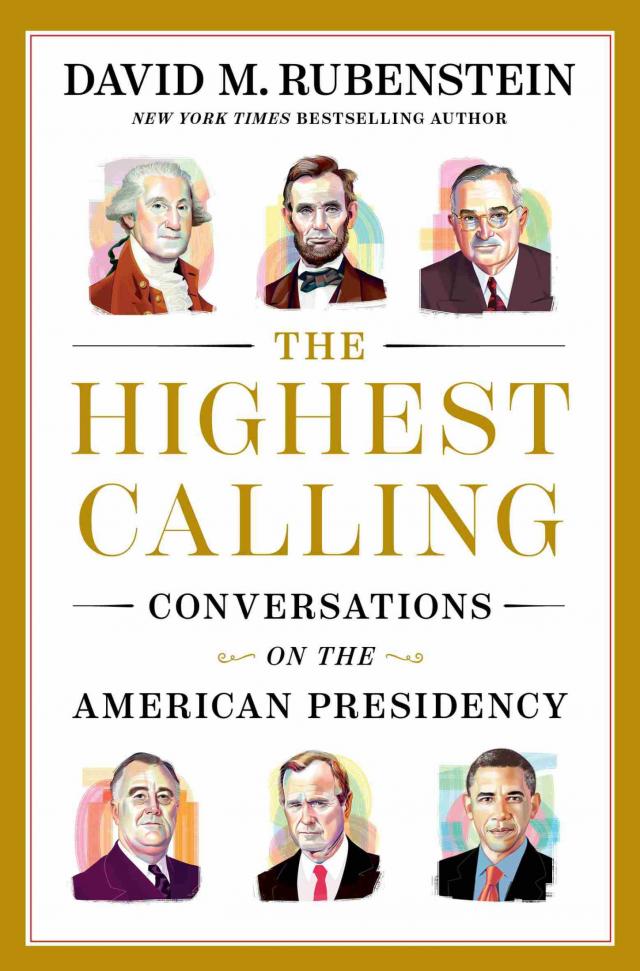
The Highest Calling, page 39


HRC: There are so many in every category. I, to this day, am hugely grateful to and admiring of Nelson Mandela and what he did under such difficult circumstances. Knowing what he was going through and how he was able to maneuver, I’m incredibly grateful to him.
I’m a big fan of Ellen Johnson-Sirleaf of Liberia, the first woman elected a president of any African country. She was elected not once but twice. I went as secretary of state to her second inauguration. I really admired her and think she set an amazing example.
I also, as you might expect, enjoyed working with Angela Merkel. I had known Angela going back to the’90s, and I remember—I think it was like 1994 when we were in Germany—when Helmut Kohl said, “I want you to meet this young woman.” She was the minister for children or sports or family, something like that. I watched her being a masterful politician, the way that she was able to maneuver and try to keep Germany together and focused.
DR: The health care system that you were trying to promote when you were First Lady is largely what we have now. I don’t know if other people thank you for it. Do you think that at the time having a First Lady so involved in policy was upsetting to some male members of Congress?
HRC: I think so. I would have been shocked to think so when Bill asked me if I wanted to work on health care, because I had, at his request, worked on reforming public education in Arkansas. And one thinks of Arkansas at that time as being much more conservative than Washington, D.C. But maybe it was because I knew people on a first-name basis there and I had worked with them, and he’d been governor for a long time. We had a very respectful relationship with the legislature.
It was, I think, somewhat of a shock to the system for a First Lady to take a public role on a major initiative of her husband’s. It’s not that other First Ladies had not been very influential, had even testified, on a few occasions, on things that mattered to them and mattered to the administration, but my role in the health care reform effort was a bit of a shock to the system.
BC: I was at a cabinet meeting one day with congressional leadership, and Bob Dole was the Republican leader. We then had about a 55-to-45 advantage in the Senate, but the filibuster was alive and well. We knew we had to get 60 votes to pass health care.
I talked to Dole, whom I liked, and said, “Look, I know you care about health care.” He had an aide, Sheila Burke, who was a nurse, who really cared about it. I said, “Why don’t we just write a bill together? Because if you don’t like it, you can hold 41 of your senators till hell freezes over, and we’ll never get anything done. So let’s just do a bill together.” And he said no. He said, “You put in a bill, and I’ll put in a bill to show our differences, and then we’ll get together and work it out.” But it never happened. Dole was generally good about keeping his word. It’s the only time that didn’t happen. He got a letter from a prominent Republican maven, who said, “If you let President Clinton sign any kind of health care bill, you can’t be elected president in 1996. And they’ll have the Congress for a generation. Convince people that it’s the worst thing since the Titanic sank, and we’ll win the Congress. And then you can win in’96.” And he was halfway right.
But we tried. We tried everything we knew to do.
HRC: I’ll tell you a little funny story about that too, because Bill is absolutely right. We worked on a bill that was going to require individuals to have health insurance and employers to pay. The Republicans worked on a bill that was going to lessen the employer mandate but have individuals carry the responsibility.
I met with then-senator John Chafee from Rhode Island, another honorable person. He and Dole were working on the bill. I went up to the Republican Senate caucus to present the bill at Dole’s request, the bill that we were working on. At that point, Strom Thurmond was still in the Senate. He’d been there since the Civil War. He was sitting front and center in the meeting where I was telling them what we were going to put in the bill. Strom Thurmond kept saying, “That sounds really good. I like that.” And all the other Republicans are saying, “Shut up, shut up, Strom. Don’t say anything.” That’s when I went back to Bill and I said, “I think there’s something at work here, because they were trying to prevent Strom Thurmond, of all people, from endorsing our bill.” So, yes, there was a lot of backroom maneuvering.
But you’re right, we eventually got the Affordable Care Act. We’ve gotten close to insuring everybody. I wish we could keep going and make sure we don’t drop people from Medicaid and all the other stuff that the Republicans are doing across the states, because health care is a basic human right, and it should be delivered to everybody on an affordable, quality basis.
DR: Speaking of health, how is your health, President Clinton? You look pretty good to me.
BC: I feel good. I’m the oldest man in my family for three generations, and I’m still kicking around.
DR: When there was a tsunami in Southeast Asia, President Bush 43 asked you to do something with Bush 41. The two of you had been bitter rivals in the’92 election, yet you seem to have bonded with him. How did you get to be so close to the man you bitterly fought in the election?
BC: I think he deserves more credit than I do, because it’s a lot easier to be friends with somebody you defeated than somebody who defeated you, right? It just is. But I always liked him. Hillary and I, in 1983—when he was President Reagan’s vice president—went to Maine to a governors’ conference, and Vice President Bush hosted all the governors and their families at his home in Kennebunkport and introduced us to his mother. She was 90-something, I think.
Hillary and I were standing there, and George came up. I took Chelsea by the hand, and I said, “Chelsea, this is Vice President Bush.” He said, “How are you, Chelsea?” And she said, “Where’s the bathroom?” She was three. And he took her by the hand and took her to the bathroom.
He was a very good guy, and I always liked him, even though they tried to play me pretty hard in 1992. It doesn’t bother me, what other politicians do. People do what they think they can make work in a campaign.
After the election, I invited him back to the White House several times, when we announced the Middle East peace signing and when we kicked off NAFTA and other times. Then, when his son asked us to work on the tsunami together, I was thrilled. After that, we worked on Hurricane Katrina together. I also did some work with George W. Bush after he left office.
I felt close to President Bush 41. I got pretty close to Barbara too, who was a tougher nut to crack and was very shrewd. I miss him. I miss the summers when I used to go visit him every year.
DR: Final question for both of you. Secretary Clinton, in your long, distinguished career, what would you say you’re most proud of having accomplished?
HRC: Taking the personal out of it—because obviously, as Bill said, we’re very proud of our daughter and grateful for our family—in terms of the political and public, there are three things that really stay with me.
I’d been senator from New York for about eight months when 9/11 happened, and it was the most devastating, horrible experience for our city and our country. But it was also an absolute mandate to act to help people who’d been directly affected, to help victims’ families, to help rebuild New York. And it was so bipartisan.
I just want to tell a little story here. Chuck Schumer and I literally were in the only plane in the sky on September 12th, because we were flown to New York to meet with then-governor Pataki and Mayor Giuliani to survey what had happened. It was overwhelming to have seen it firsthand like that. The television could not capture it. We spent the day in meetings talking about what we were going to do. That night, around eight, nine o’clock, Chuck and I were in a meeting with all these state, local, and federal officials, and we were each handed a note from our staffs who were with us that said, “The White House has just sent a budget request to deal with 9/11 for $20 billion and there’s not a penny for New York in it.” Our mouths dropped.
We got up and left the room. Chuck hadn’t seen his family yet. He had a daughter who’d been at Stuyvesant High School and had been evacuated across the river, and he had another daughter who was in school at the time, so he needed to go home and see his family.
I took the last train out of Grand Central back to Washington, and I literally showed up at the door of the office of Robert Byrd, who at that time was the chair of the Appropriations Committee, at six o’clock in the morning. I said, “Senator, we need your help. The White House has sent this bill and it has not a penny for New York.” This was now Thursday. And I said, “You just have to imagine what has happened. You haven’t been there, but you should go. We should take a delegation. But we need money, and we need support right now.”
He said, “Well, what do you need?” I said, “We need $20 billion.” He said, “On top of the $20 billion?” I said, “Yes, on top of the $20 billion.” And he goes, “All right, if that’s what you need.” By this time, Chuck was back and I go to the floor of the Senate and say, “We need $20 billion. Senator Byrd has said he would support that.”
Then that afternoon, we go to the White House. It’s the two senators from Virginia, Senator Allen and Senator John Warner. Chuck and I were in with the president. I could see on his face this was a devastating crisis, obviously, that had to be dealt with. And he says to us, “I’m with you. What do you need?” And I said, “We need $20 billion, Mr. President.” And he said, “You got it.” His staff nearly fell off their chairs.
We were going to the Cabinet Room, which is next to the Oval Office, and we got up to leave. John Warner, one of my favorite colleagues of all time, stopped me and said, “Hillary, have him make that commitment in public in this meeting.” We go in. It’s members of Congress from New York, Connecticut, New Jersey, but mostly New York and Virginia. The president’s talking about how we’re going to protect the country, and we’re going to do this, and all that. He finishes talking and then I say, “And I just want to thank you, Mr. President, for committing $20 billion to New York.”
And literally, by the time Chuck and I got back to the Senate, his staff was trying to undo that and telling the Republican leaders, “Don’t put it in the appropriations bill.” We just kept calling the White House. Bush said, “I gave my word and I’m going to follow through.” That was an amazing moment for me.
DR: President Clinton, when you look back on your distinguished and long service to our country, what are you most proud of having achieved?
BC: Can I just add one thing to what Hillary said? One thing I like about George W. Bush. We have fought. We have disagreed. He started out more conservative than his father. We do speeches together that are funny because we bad-mouth each other in a funny way, but he will listen. And if he thinks you’re right, he’ll switch. If he thinks you’re wrong, he’ll argue. That’s all you can ever ask.
When he passed this PEPFAR bill—the president’s emergency plan for AIDS—it was more money than I could get through because he got the Christian evangelicals to support him. The Republicans were reflexively against anything I wanted to do. He got this big AIDS program, and I was, meanwhile, working as a former president with Mandela to get AIDS medication to people and get the prices down.
He invited me in 2005, a couple of years after, to Pope John Paul’s funeral. I flew with his dad and him to the pope’s funeral. He calls me up to his cabin and he says, “Tell me about what you’re doing with AIDS.” I explained what we were doing: “We’re getting the medicine out there. We’re getting the supply chains worked out. We’re doing all these things we’re supposed to be doing to fix the system. And we’re working with your people” in the seven countries I think they were working in then. I said, “I’m very grateful to you, Mr. President, but you could save six times as many lives if you would just let your people in these countries use the generic drugs” that were made in India, primarily, rather than Big Pharma drugs, which they were requiring.
He said, “The pharmaceutical companies tell me they’re not as good,” and this is a big deal because they were big supporters of his. Al Gore had said in the 2020 election—and they all went nuts—that he thought these AIDS-ridden countries should be able to use generic drugs, and it shouldn’t have anything to do with the patent rights. That was agreed in an international treaty.
I said, “I’ll tell you what. What if I submitted every drug we use anywhere in the world to the FDA in America? If they approve the drug, would you then tell these countries it was okay with you if they got the generic drugs?” And Bush didn’t blink. He said, “Yes.”
Before you knew it, the FDA approved 22 of the 24 drugs. Instead of seven countries, PEPFAR was in 15 countries. With that one little decision to go against the polarizing grain that dominates American politics, millions of people’s lives were saved. And I think that’s what you should remember.
When you asked me in the beginning and I said that polarization was partly because the right had been rewarded, but it is also true that the left too easily gives up on people. We shouldn’t talk down to people. The one thing I loved about Elijah Cummings and John Lewis was they treated people respectfully, and they just kept trying. They kept knocking on the door.
And so I guess one of the things I’m proudest of is that in the face of the torrent of almost life-threatening opposition I received, I just kept knocking on the door, and the results were pretty good. Specifically, we had the broadest, most widely shared prosperity that our country has had in more than 50 years. And it mattered to me that those in the bottom of 20 percent of income increased their income in percentage terms more than the top 20 percent.
I’m proud of that, and I’m proud of the fact that we basically kept marching toward peace in a world that was full of potential conflicts. And I’m sad that in the twenty-first century, a lot of the people who once thought cooperation was better than conflict have apparently gone to the other side, but they can be brought back.
18 PRESIDENT GEORGE W. BUSH
(b. 1946; president from 2001 to 2009)
It did not seem likely that lightning would strike twice for the Bush family, and that George W. would also become president.
But it did, probably aided by former secretary of state James A. Baker III (who was then a partner at Carlyle). After the dispute on the Florida vote total in the 2000 election, Secretary Baker was asked by then-governor Bush to represent him in the recount effort. And that effort ultimately resulted in the Bush v. Gore decision, which led to George W. Bush becoming president. (I once asked President George H. W. Bush why he did not give his son George the same middle initials and have him be a junior. He told me that when he was growing up in Greenwich, Connecticut, his friends made fun of him for having two middle names, and he did not want to subject his son to the same taunting. So it was just W.)
Although George W. might have been expected to know a fair bit about the White House and governing because his father had been president, he did not spend much time in Washington during his father’s time in office, and was not all that interested in the intricacies of policy at the time. He did come to the White House from time to time to see how his parents were doing and to serve as “eyes and ears” for his father and sometimes as an “enforcer.” (He was the one who told President Bush’s first chief of staff, former New Hampshire governor John Sununu, that he had to leave that position.)
At the time of his election to the presidency, Governor Bush was really not steeped in the intricacies of U.S. foreign policy or the workings of Washington, D.C. That was, presumably, one of the reasons he chose his father’s former secretary of defense, Dick Cheney, as his vice president. Cheney knew Washington inside and out, having been President Ford’s chief of staff and a six-term member of the House of Representatives, and could be president if need be.
As president, George W. dealt with two extraordinary challenges that largely defined his presidency. The first was the 9/11 hijacked plane crashes in New York, Washington, D.C., and Pennsylvania. The second was the Great Recession, the greatest economic calamity faced by the country since the Great Depression.
His initial response to 9/11—to send troops to Afghanistan to capture Osama bin Laden (and others involved in the attack)—was not controversial in the United States. President Bush, once he got his bearings after the first few days, was widely seen as a decisive leader, with sky-high approval ratings.
But the subsequent response split the country (and the world) down the middle when he decided to invade Iraq, which had no direct 9/11 connection, to destroy its presumed “weapons of mass destruction.” In one of our country’s greatest intelligence failures, there were no such weapons, and Iraq descended into chaos, with many thousands of Iraqis and American soldiers losing their lives until President Bush ordered what became known as “The Surge” in 2007.
That war began in the latter part of the first Bush administration, and Bush’s popularity, which had soared after 9/11, descended rapidly as the war went poorly. Nonetheless he was reelected, narrowly defeating Senator John Kerry. To compound the war’s challenges, during Bush’s second term the U.S. financial system essentially collapsed, due initially to the failure of the home mortgage market. Only with the most extraordinary and unprecedented of measures by the Bush administration, Congress, and the Federal Reserve did the economy stabilize and start to recover.
Although I came to know his father, George H. W. Bush, reasonably well after his presidency, I did not know George W. even though our paths briefly overlapped earlier at my company. Before running for governor, when he was a private citizen, George W. served on a Carlyle portfolio company board, though I was not on that board and had essentially no interaction with George W. After he became president, I saw George W. Bush on a few occasions at the White House at various Kennedy Center Honors (I was appointed to the Kennedy Center Board by him) and other social events at the White House. When President Bush left office, I interviewed him on several occasions, and saw up close his self-deprecating sense of humor (not seen quite as much in public while he was president); his close affinity for the veterans who had returned from the Iraq War with serious injuries; his great pride in the PEPFAR program he developed to provide medicine to Africa (and other emerging markets) to reduce the spread of AIDS and save tens of thousands of lives; and his newfound passion for painting, which surprised many of his friends and relatives.