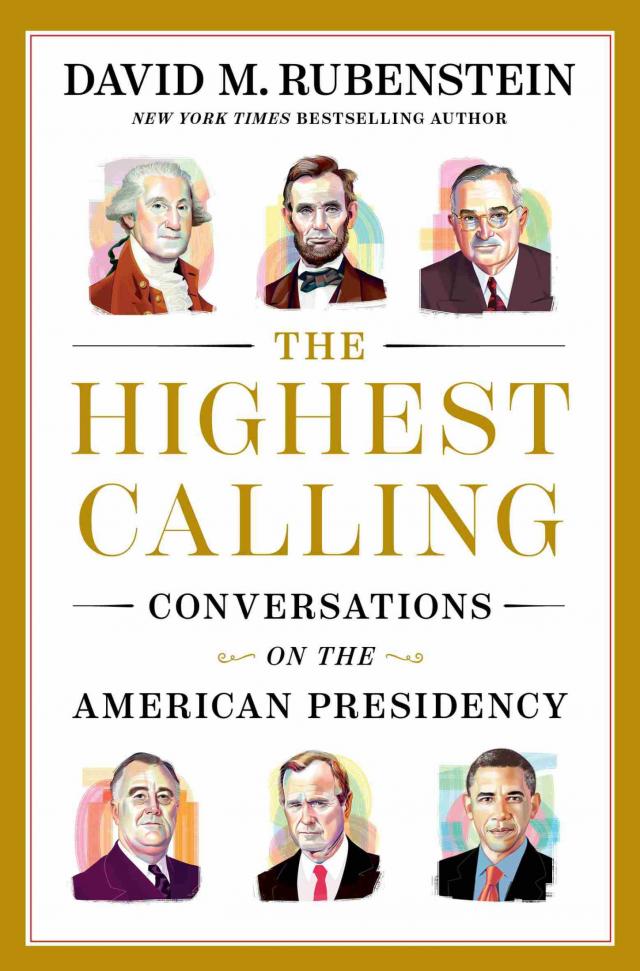
The Highest Calling, page 40


What follows is the edited transcript of an interview I conducted on stage with President Bush in Washington, D.C., at a Carlyle Group event on September 19, 2023.
* * *
DAVID M. RUBENSTEIN (DR): What’s more fun, being president or a former president?
PRESIDENT GEORGE W. BUSH (GWB): They’re both delightful. I really don’t miss being president. I enjoyed it when I was there, but I don’t miss the power; I don’t miss the fame; and I don’t miss Washington, D.C. I live in the “promised land,” as you know. Laura and I are Texans, proud Texans, and we like living in Texas. So, I’m having a good life. I enjoy it. I really don’t miss power.
DR: Since you left the presidency, you’ve taken up painting. Why?
GWB: Because I was bored. (Laughter.) Yes, it surprised me. I read Winston Churchill’s essay “Painting as a Pastime.” I’m a big Churchill admirer. It kind of harkens to today. We’re becoming isolationist as a nation, and it requires certain courage in order to fight off tyrants, like Ukrainian president Volodymyr Zelenskyy is doing.
I always admired Churchill’s leadership, so when I read his essay, I went home and told Laura, “If Churchill can paint, I can paint.” I know it sounds cocky, but you’ve got to be pretty cocky to run for president in the first place, right?
DR: How many paintings have you done?
GWB: A lot. That’s like asking a rancher, “How many cows you got?” (Laughter.)
DR: But you don’t sell them, right?
GWB: I don’t sell them, no. But it’s changed my life. Every brushstroke is a learning experience. As a result of my desire to raise money for invisible wounds of war, I painted 98 veterans who got hurt. My favorite story about that is I painted a guy named Todd Domerese, who wrote me a compelling letter about the horrors of war. He also told me he had night sweats. And so I’m thinking about a guy having night sweats, and I painted a very dark painting. I was selling the book in Tampa, Florida, and I was a little worried about him seeing his portrait. But I said, “You want to see the portrait I painted?” And he looked at it and went, “That’s how I used to feel.” And that is the whole purpose of the book.
Then I painted immigrants. That’s how I weighed into the immigration debate, trying to remind the country of the importance of immigration, not only for the present but for the future of our country.
DR: Do you think if you had taken up painting when you were in college and been a painter instead of president, you’d be happier or not?
GWB: Well, I’d have been better than a C student, that’s for sure. (Laughter.) Did you ever hear about the time I gave the Yale graduation speech? Yale doesn’t have graduation speakers unless you’re president. My buddy, the head of the board of trustees, convinced me to go down there, and I got up and said, “To you parents of students who got honors, congratulations. To you summa cum laude students, congratulations. And to you C students: you, too, can be president.” (Laughter.)
DR: Did you think at the time you were going to get into politics?
GWB: No, I wasn’t very political.
DR: You grew up in Texas. Your father grew up in Connecticut. You were much more Texan than he was, right?
GWB: Yes. The best inheritance I had was being raised in West Texas and not in Greenwich, Connecticut—with all due respect to Greenwich. I was raised in the desert, basically. You get to know independent-thinking, free-enterprise-thinking people.
DR: And you went to Andover.
GWB: I didn’t volunteer to go to Andover, I got shipped to Andover. (Laughter.) As a matter of fact, that’s the kind of school that people where I was raised say, What did you do wrong?
DR: Well, you went to Yale, so you must have done reasonably well at Andover. Then you went to Harvard Business School?
GWB: I did that as well, yes. Went into the military in the meantime. You know what I learned at Harvard Business School? Not to trust Wall Street. (Laughter.)
DR: So you weren’t trying to be a Baker Scholar (the top 5 percent of HBS students)?
GWB: No, no, I wasn’t.
DR: You were going to be in the energy business, right?
GWB: I had been helping run a poverty program in Houston and realized that there’s no money in poverty. (Laughter.) So I decided that I wanted to redirect my thinking, and Harvard Business School helped.
DR: After Harvard Business School and some work in the energy industry, you had an opportunity to buy a baseball team. Why did you want to be an owner of a baseball team?
GWB: Because I love baseball. My uncle Herbie owned 13 percent of the Mets. Joan Payson was a majority owner; I remember going up to Maine, and he had a dog named Go Go and a dog named Metsy. He would listen to the games, and he really seemed to love it. An opportunity presented itself, and I put together a group along with Richard Rainwater and Rusty Rose, and we bought the Texas Rangers.
DR: And the team did reasonably well and you sold it for a profit?
GWB: Sold it for a profit. Selling a team is the only way you make a profit in baseball. (Laughter.)
DR: After you sold it, you decided to run for governor.
GWB: Not true. I decided to run for governor before we sold it. The reason why is that the public schools in Texas were lousy. I thought, frankly, it was a civil rights issue, to challenge what I call the soft bigotry of low expectations. In other words, if you’re a Black kid in a big urban school district, it’s almost like, You can’t learn, let’s just move you through. I ran on a campaign to put accountability in the public school system. And I won.
DR: What did your mother and father say when you told them you were going to run for governor?
GWB: My mother said, “You won’t beat her.” I was running against Anne Richards, a seemingly unbeatable woman. But I had a reason to run, and I explained the reason to run. I treated her with respect. I didn’t fall prey to all this kind of name-calling and stuff, and Texans bought it.
Plus, we’re the tort reform state. The largest growth industry in Texas at the time was trial lawyers. I thought that was not very conducive to accumulation of capital, and so we got tort reform through.
DR: The night of the election, your brother was also running for governor in Florida. Your parents chartered a plane to fly to Florida for his victory celebration. Did you ask them about planning for your victory?
GWB: No, I didn’t. But unfortunately they made a bad bet. I won, and he lost. (Laughter.)
DR: You’re governor of Texas for four years and you get reelected. And then all of a sudden, people think you should be the Republican nominee. Did you want to run for president?
GWB: You know, I wasn’t sure at the time. I didn’t run for governor to become president. By the way, being governor of Texas is an awesome job. Our legislature meets four months out of every two years—seriously—and the governor decides if they meet more than that. And so it’s a hell of a job and I really enjoyed it.
The party was looking for a new leader, and I kind of got swept up in it, and I knew exactly what I was getting into. I watched a good man become president, get beat, get pilloried in the press, but it didn’t diminish my appetite for serving the country.
DR: When you ran for president, that famous election night, it came down to Florida. Al Gore called you and said, “I’m conceding the election.” Then he called you back and said, “I’m not conceding anymore.” Did you think that you would win at that point? And were you preparing for a transition?
GWB: We were preparing for a transition. But my attitude was that I’d run the race as hard as I could. I gave it my absolute best shot. If it turned out that I won, I was ready. And if not, that’s life. And so we were preparing a transition, but I was uncertain as to what was going to happen. I knew this: if it was a legal matter, I put the best lawyers in place starting with Jim Baker.
DR: How did you pick Dick Cheney to be your vice president?
GWB: I realized he’d be the best selection. Here’s the thing about selecting a vice president. Some candidates have done a lousy job. Some have done a decent job. Ronald Reagan did a really good job. (Laughter.) I think I did a good job. It’s a deliberative process where you go through a lot of iterations before you pick someone to be your vice presidential nominee. The person you pick has to be able to be president. It also sent a signal that I was comfortable in my own skin, that I knew where I was weak and where my strengths were. I was pretty weak in terms of Washington, D.C., politics. Cheney had been around Washington a long time and that was comforting, I think, to some people.
DR: On your first year in office, the 9/11 terror attacks happened. You were reading books to schoolchildren at that time. What did you think was happening? Did you know immediately it was an attack?
GWB: Right before I went in the classroom in Sarasota, Florida, I saw the first plane hit the tower, and I thought it was an accident. I just couldn’t believe that anything other than an accident had taken place. Then Andy Card whispered in my ear, “A second plane has hit the second tower. We’re under attack.” And I wasn’t sure what it meant, but I knew this: that I needed to project a sense of calm, because the eyes of the nation were focused on me. And it was obvious, because there were probably 20 TV cameras in this classroom. So I waited for the appropriate moment to leave and hurriedly wrote up a statement, and I went in front of a group of parents and children who had not yet heard the news. I basically said, “We’re under attack and we’re going deal with it.” I had no idea what “it” meant, but I knew we were going to deal with it. And from that point forward, I got whisked around the country until I finally made it back to D.C.
DR: A lot of your advisors said not to go back to Washington, D.C. Why did you want to come back?
GWB: First, because I was the commander in chief in a time of war, and I needed to be in the White House. Second, I was in a bunker in Omaha, Nebraska, and they said, “You need to give a speech to the nation.” And I said, “You’re right. I need to, but I’m damn sure not going to give it from a bunker. I’m going to give it from the Oval Office.”
DR: So you came back to D.C., you made the speech, and then you sent troops over to Afghanistan to capture Osama bin Laden.
GWB: Well, no, I said to the Taliban, “Cough up Al Qaeda or you’re going to face serious consequences.” So the choice was theirs, not ours. I said, “These bastards came and killed people on our soil and we want them.” The Taliban were providing safe haven for them in Afghanistan, and refused to comply. And I meant what I said. We put together a good plan and in we went.
DR: Do you think if you had sent more troops over, you would have captured Osama bin Laden at that time?
GWB: We got him eventually.
DR: Did President Obama call you right before the actual killing of bin Laden?
GWB: Yes, I was eating a souffle. (Laughter.) It’s kind of out of character, I know, but there’s a restaurant in Dallas called Rise. Get it? I got a call and skipped the dessert and went home, and he called and told me.
DR: During your presidency, we went through what’s called the Great Recession.
GWB: Yes, we did. Wall Street got drunk.
DR: Did the secretary of the Treasury and the chairman of the Federal Reserve come to you and say, “Look, the economy is collapsing because of mortgage defaults” and so forth? Did they say, “We have to do something or the entire economy will collapse”?
GWB: Yes, that is exactly what they said. And this is after the financial markets were kind of pitching and bailing for maybe five weeks. The short sellers were just bombing weak stocks, and these stocks started collapsing right and left. And eventually they said, “Look, if you don’t do something big, we’re going to have a Great Depression.” Which is a seminal moment, because you basically say, “Do I trust my advisors and do something about it, or do I adhere to my principle, which is let the market sort it out?” I couldn’t think of anything worse than bailing out Wall Street. But these guys were saying, “You’ve got to bail out Wall Street or we’re going to have a depression.” So I listened to Paulson and Bernanke and spent your money to bail out the guys who created the instruments in the first place, which is an absolute political disaster.
You wonder why populism is on the rise. It starts with taking taxpayers’ money and giving it to the powerful. It really irritated a lot of Americans, and they haven’t gotten over it yet. That’s just part of it; there’s a lot of other reasons why. But we’ve had candidates say, “You’re mad, I’m going to make you madder.” As opposed to, “You’re mad, I have some solutions to make you less mad.” We’re kind of in the madder stage, where people are exploiting the anger as opposed to dealing with it like leaders should.
DR: The legislation proposed at the time, known as TARP (Troubled Asset Relief Program), failed in the House on the first vote.
GWB: Yes, then the market corrected by losing $1.4 trillion in value—kind of the ultimate focus group. We ran TARP back up on Capitol Hill, and it passed. But the interesting thing is after it passed, Paulson said, “What we proposed and passed is not going work.” I said, “You’ve got to be kidding me.” He said, “It’s not going work. We don’t have enough time, because we weren’t sure how to auction off troubled assets.” And that’s when he decided to dole out the money to companies like Goldman Sachs, where Paulson used to work. But you know what? It worked. We didn’t have a Great Depression. The problem is, you can’t prove a negative. Anyway, it was a tough moment.
DR: During your presidency, you decided to invade Iraq because it had weapons of mass destruction, we believed.
GWB: Actually, Saddam Hussein made that decision.
DR: What do you mean?
GWB: Well, I went to the UN and said, “Disclose, disarm, or face serious consequences,” and he refused to disclose, which led the world to believe he wouldn’t disarm—otherwise, why not disclose? It was his choice to make, and he made a fateful choice.
DR: In hindsight, if you had known there were no weapons of mass destruction, would you have still invaded?
GWB: Probably not, but you don’t get the luxury of that when you’re president. You’ve got to make the decisions that you have at hand. And remember—I don’t want to sound defensive, but I will—Congress overwhelmingly gave me the authority to take any measures necessary. That includes the current president (Joe Biden), Hillary Clinton, John Kerry—on and on with these fiery speeches from the Senate floor. That’s not why I did what I did. I’m just telling you there was a major consensus that Saddam Hussein had to go since he would not disclose whether or not he had weapons of mass destruction. And I can’t think of anything worse than for a president to say “Disclose” and not mean it. It sends signals to the enemy that we’re weak and it sends signals to our allies that you can’t trust America. I was the kind of guy who, when I said something, I meant it.
DR: During your administration, you started the President’s Emergency Plan for AIDS Relief (PEPFAR), which was designed to eliminate AIDS, to the extent possible, in Africa and other parts of the emerging world. Is that one of your proudest accomplishments?
GWB: It’s a big accomplishment. My proudest accomplishment is that I didn’t lie, cheat, or steal, and my kids love me. The American people ought to be proud of this, but nobody has any clue what I’m talking about when I say PEPFAR—they think it’s deodorant or something. (Laughter.) I told the American people that a principle I believe in is that all life is precious and we’re all God’s children. And Condoleezza Rice tells me there’s a pandemic destroying an entire generation of people on the continent of Africa.
I also believe that to whom much is given, much is required. I know this has a little religious connotation to it, but I happen to think it’s important. I believe we’re a blessed nation, and to sit down and do nothing when a pandemic was destroying an entire generation of people was unconscionable in my mind.
So we put together a business plan with clear goals, aligned authority and responsibility, and meaningful objectives, and we went after it. And 25 million people are alive now who would have died, thanks to the generosity of the American people. The question is: Is this in our national interest? I think a lot of Americans would say, “Not really,” in this day and age. Or “Who cares about African women and children? Let somebody else worry about it.”
I think it is in our interest. I think it’s what great nations do. And the problem is we can’t now get the reauthorization through Congress. It’s so divided and so bitter that they can’t pass a reauthorization on a government program that clearly works. Most government programs don’t work. This one measurably works: 25 million people living who would have died. The American people ought to be very proud of that.
DR: When you were president, the first time you met Vladimir Putin, you said you looked into his eyes and you saw his soul. What did you mean?
GWB: Do you want to know why I said that? It was in Slovenia. He was nervous, and I was trying to befriend the guy. He just had gotten into office and so had I, and he wanted to talk about Soviet-era debt saddling the Russian Federation. I wasn’t interested in that. I was interested in getting to know the guy.