The Pope Who Would Be King, page 1


Copyright © 2018 by David I. Kertzer
Maps copyright © 2018 by Laura Hartman Maestro
All rights reserved.
Published in the United States by Random House, an imprint and division of Penguin Random House LLC, New York.
RANDOM HOUSE and the HOUSE colophon are registered trademarks of Penguin Random House LLC.
LIBRARY OF CONGRESS CATALOGING-IN-PUBLICATION DATA
NAMES: Kertzer, David I., author.
TITLE: The pope who would be king : the exile of Pius IX and the emergence of modern Europe / David I. Kertzer.
DESCRIPTION: New York : Random House, 2018. | Includes bibliographical references and index.
IDENTIFIERS: LCCN 2017038825 | ISBN 9780812989915 | ISBN 9780812989922 (ebook)
SUBJECTS: LCSH: Pius IX, Pope, 1792–1878. | Europe—Church history—19th century. | Europe—Politics and government—1848–1871.
CLASSIFICATION: LCC BX1373 .K47 2018 | DDC 282.092—dc23 LC record available at https://lccn.loc.gov/2017038825
Ebook ISBN 9780812989922
randomhousebooks.com
Book design by Barbara M. Bachman, adapted for ebook
Cover design: Joe Montgomery
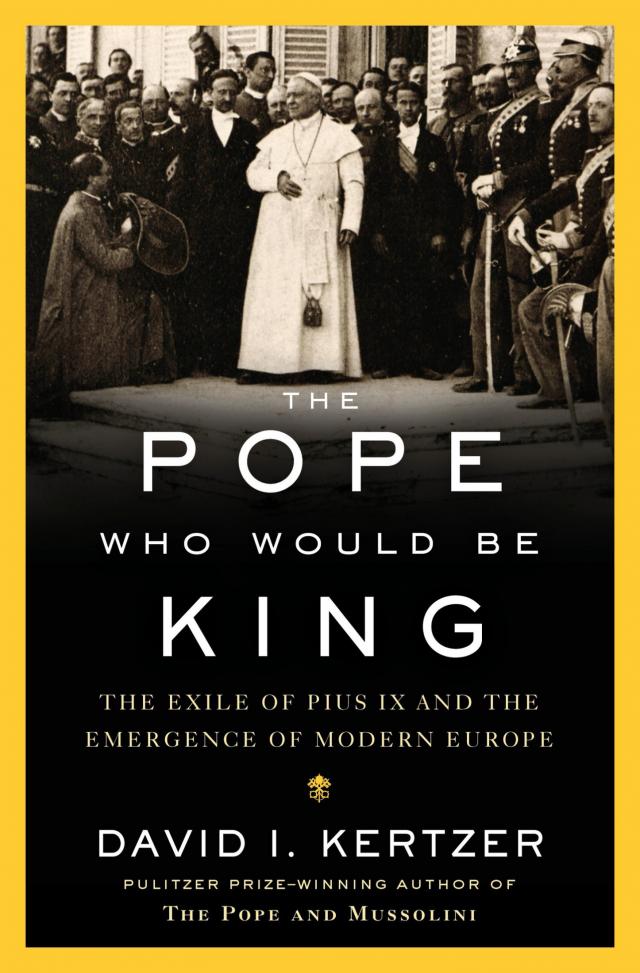
Cover photograph: Antonio D’Alessandri (1818–93), akg-images/Fototeca Gilardi
v5.2
ep
Contents
Cover
Title Page
Copyright
Epigraph
List of Illustrations
Maps
Cast of Characters
Prologue
Part One: The Beloved
Chapter 1: The Conclave
Chapter 2: The Fox and the Crow
Chapter 3: An Impossible Dilemma
Chapter 4: Papal Magic
Chapter 5: The Tide Turns
Chapter 6: Fending Off Disaster
Chapter 7: The Assassination
Chapter 8: The Escape
Part Two: The Reviled
Chapter 9: The Reactionary Turn
Chapter 10: Revolution
Chapter 11: Pressuring the Pope
Chapter 12: The Friendly Army
Chapter 13: The French Attack
Chapter 14: Negotiating in Bad Faith
Chapter 15: Battling for Rome
Chapter 16: The Conquest
Chapter 17: The Occupation
Part Three: The Feared
Chapter 18: Applying the Brakes
Chapter 19: Louis Napoleon and the Pope
Chapter 20: The Unpopular Pope
Chapter 21: “Those Wicked Enemies of God”
Chapter 22: Returning to Rome
Epilogue
Dedication
Acknowledgments
List of Abbreviations
Notes
References
Illustration Credits
By David I. Kertzer
About the Author
Let lips of iron and tongues of slaves
Fit welcome give thee; for her part,
Rome, frowning o’er her new-made graves,
Shall curse thee from her heart!
—EXCERPTED FROM JOHN GREENLEAF WHITTIER, “TO PIUS IX,” 1849
1. Prince Klemens von Metternich
2. Pope Pius IX
3. Pellegrino Rossi
4. Giuseppe Mazzini
5. The popular hero Ciceruacchio
6. Charles Bonaparte
7. Giacomo Antonelli
8. Margaret Fuller
9. Pius IX
10. King Charles Albert of Sardinia
11. Terenzio Mamiani
12. Antonio Rosmini
13. The death of Pellegrino Rossi
14. Gaeta
15. Ferdinand II, King of the Two Sicilies
16. Louis Napoleon Bonaparte
17. Pietro Sterbini
18. Ciceruacchio speaks to the people
19. Felix Schwarzenberg
20. Moritz Esterházy
21. The abdication of King Charles Albert
22. Triumvirate of the Roman Republic: Carlo Armellini, Giuseppe Mazzini, and Aurelio Saffi
23. Édouard Drouyn de Lhuys, French foreign minister
24. Giuseppe Garibaldi
25. Garibaldi and his comrade-in-arms, Andrea Aguyar
26. General Charles Oudinot
27. Ferdinand de Lesseps
28. Pius IX blesses Spanish troops at Gaeta, May 26, 1849
29. Alexis de Tocqueville
30. The bombardment of Rome
31. French troops fire on Rome’s wall, June 20, 1849
32. French soldiers
33. Garibaldi with his dying wife, Anita
34. The arrest of the monk Ugo Bassi
35. General Achille Baraguey d’Hilliers
36. The patriot princess Cristina Belgiojoso
The Pope and the Church
ANTONELLI, GIACOMO (CARDINAL) Born in 1806 in Sonnino, in the southern part of the Papal States, he came from a family of peasant origins, his father having become a wealthy country merchant. Antonelli entered the prelature, but he was never ordained and could not say mass. As a young man, his administrative abilities and elegant manner brought him to the attention of higher prelates as he was called on to perform ever more responsible positions in the government of the Papal States. Pius IX, who made him a cardinal in 1847, at age forty-one, increasingly came to rely on Antonelli, his opposite in so many ways, and it would be Antonelli, as his secretary of state, who would mastermind the pope’s turn to Austria and reaction.
DELLA GENGA, GABRIELE (CARDINAL) Born in Assisi in 1801, nephew of Pope Leo XII, made cardinal at age thirty-four, Della Genga was one of the leaders of the reactionaries of the Sacred College and widely despised by the people of Rome. On the retaking of the city, in July 1849, Pius IX named Della Genga one of the three members of the governing commission to rule Rome until the pope’s return. His strong personality ensured that he would be its driving force.
LAMBRUSCHINI, LUIGI (CARDINAL) Born in 1776, he was a Barnabite monk who became archbishop of Genoa and then nuncio to Paris. Lambruschini was closely identified with Pope Gregory XVI, serving as his secretary of state from 1836 until the pope’s death a decade later. Reviled by the Romans, he ended up hiding under a pile of hay in a horse stall before fleeing the city in November 1848. A man of the old school, an inflexible champion of theocracy, despotic by nature, he nursed a deep hatred for modern ideas of freedom.
PIUS IX (GIOVANNI MASTAI FERRETTI) Born in 1792 to local nobility in Senigallia, in the middle of the Papal States, Giovanni Maria Mastai Ferretti suffered from epilepsy as a youth and had a limited seminary education before being ordained a priest in 1819. Eight years later he was made archbishop of Spoleto and then Imola, both in the Papal States. In 1840 he became a cardinal, and in June 1846, on the death of Gregory XVI, he was elected to the papacy, taking the name Pius IX. Initially feeding popular hopes that he would not only be the champion of reform and modernization in the Papal States but also help lead the battle for Italian independence, he would soon find himself in an impossible position, caught between his desire to be loved by his subjects and his fears that he was betraying the trust placed in him by the cardinals and by God.
ROSMINI, ANTONIO (ABBOT) Born in 1797 to a noble family in Rovereto, then part of Austrian-ruled northeastern Italy, Rosmini studied law and theology at the University of Padua and was ordained a priest in 1821. A prolific author and well-regarded philosopher and theologian, Rosmini urged the church to adapt to modern times and called on the pope to embrace the cause of Italian independence. Pius IX thought highly of Rosmini and initially valued his advice. Serving briefly as King Charles Albert’s envoy to the pope in the summer of 1848, Rosmini later joined the pontiff in exile. He had a formidable adversary in Cardinal Antonelli.
The Romans and the Roman Republic
BELGIOJOSO, CRISTINA (PRINCESS) Born in 1808 as Cristina Trivulzio to one of Milan’s wealthiest families, she married Prince Emilio Barbiano di Belgiojoso at age sixteen. They separated four years later. A great patron of the Italian national cause, she hurried to Rome with the proclamation of the Roman Republic and was placed in charge of the medical services for the injured. She would not take well to being called a “prostitute” by the pope.
BONAPARTE, CHARLES (PRINCE) Born in Paris in 1803, the son of Lucien, Napoleon Bonaparte’s younger brother, Charles grew up on his father’s feudal holding north of Rome, developing an interest in the natural sciences. Said to resemble his famous uncle, he combined his devotion to science with a strong interest in politics. He first urged greater reforms on Pius IX, and then championed the Roman Republic, serving as vice president of its Constituent Assembly. He would be accused of masterminding the assassination of Pellegrino Rossi.
CICERUACCHIO (ANGELO BRUNETTI) Born to a poor Roman family in 1800, Angelo Brunetti had an easy eloquence and a personality that inspired
GARIBALDI, GIUSEPPE Born in 1807 in Nice, then part of the Savoyard kingdom, Garibaldi began adult life as a mariner. A follower of Mazzini’s Young Italy movement, he took part in the Italian revolts in 1831, leading to a long period (1835–48) of exile in South America, where he joined a series of rebellions. Returning to Italy following the upheavals of 1848, initially taking part in the battle against the Austrians in Lombardy, he was elected to the Constituent Assembly of the Roman Republic and became the most important military leader in its defense. On his majestic white horse, with his long brown hair and full beard, wearing his distinctive South American poncho, leading his army of wild-looking legionnaires who had followed him across the ocean, he became the icon of Italian independence.
MAZZINI, GIUSEPPE Born in 1805 in Genoa, his father a professor of pathology, Mazzini got a degree in law while becoming a leader of the conspiratorial groups seeking to overthrow the homegrown autocracies and foreign-ruled regimes in Italy. He would spend most of his adult life in exile, in good part in London. Through his prodigious correspondence and organizational skills, he became the prophet of Italian independence and republican rule. He arrived in Rome in March 1849 to take his seat in the Constituent Assembly of the Roman Republic. Elected to the triumvirate to lead the republic, he became its guiding light as it faced what seemed certain destruction.
The Italian Kings
CHARLES ALBERT, KING OF SAVOY Born in 1798, he became monarch of the Kingdom of Sardinia, which encompassed northwestern Italy and the island of Sardinia, in 1831. In March 1848, casting himself as the champion of a greater Italy, he responded to the popular revolt in Austrian-controlled northeastern Italy—Lombardy and Veneto—by ordering his army into battle against the Austrians. His efforts to get Pius IX to join with him placed the pope in a terrible bind.
FERDINAND II, KING OF NAPLES Born in 1810 while the Bourbon royal family was in exile in Sicily, Ferdinand became king on his father’s death in 1830. Suspicious, superstitious, a faithful Catholic, reviled by his subjects, Ferdinand faced widespread revolt in his kingdom in 1848, quickly losing control of Sicily. The pope’s unexpected appearance in his kingdom later that year proved a godsend, allowing him to pose as the great defender of Christendom. He would not be eager to see the pope return to Rome.
The Austrians
ESTERHÁZY, MORITZ (COUNT) Born in Vienna in 1807, Austrian ambassador at The Hague from 1845 to 1848, Esterházy was named Austria’s ambassador to the Holy See in January 1849, following months in which Vienna had withdrawn its ambassador from Rome in protest of anti-Austrian activities. A tenacious conservative and fierce opponent of any compromise with the Roman Republic, Esterházy would come to have great influence with Cardinal Antonelli and the pope himself.
METTERNICH, KLEMENS VON (PRINCE) At his birth in 1773, Metternich’s family estate in the Rhineland encompassed seventy-five square miles of land. Made foreign minister by the Austrian emperor in 1809, he chaired the Congress of Vienna in 1815, and became chancellor of the Austrian Empire in 1821, a position he held until a revolt in Vienna sent him into exile in March 1848. Dismissing Italy as merely a “geographic expression,” Metternich sought to preserve stable conservative rule on the continent. He viewed Pius IX’s initial eagerness to win popular approval as a grave danger. A liberal pope, Metternich remarked, was an impossibility.
SCHWARZENBERG, FELIX (PRINCE) Born in 1800, the second son of an Austrian nobleman, he combined an early career in the military with a diplomatic career in several of Europe’s major cities, before serving in the Austrian army in northern Italy during the fighting in 1848. Appointed Austrian prime minister in November 1848, he oversaw the repression of the revolts that had broken out in various parts of the Austrian Empire. He would direct Austria’s efforts to retake the Papal States for the pope and to discourage any inclination Pius IX had to return to his reforming path.
The French
BARAGUEY D’HILLIERS, ACHILLE (GENERAL) In November 1849, eager to have all French affairs in Rome in the hands of a general, Louis Napoleon named the fifty-four-year-old Baraguey both ambassador to the Holy See and head of the French army in Rome. A veteran of the colonial war in Algeria, with little sympathy for republican principles, he was outraged by the pope’s treatment of France. He would remain in Rome until May 1850.
BONAPARTE, LOUIS NAPOLEON Born in 1808, he was the son of Louis Bonaparte, brother of Napoleon Bonaparte, and king of Holland. From the time of his youth, he spent winter and spring each year in Rome. He joined in the rebellion against the pope in 1831 before going into exile in Switzerland. Imprisoned from 1840 to 1846 in a French fortress following an abortive attempt at organizing a revolt, he escaped to London. Two years later, in 1848, following the revolution in Paris, Louis Napoleon was elected to the French Constituent Assembly. In December of that year he was elected president of France. Proud of his name—and without much else seemingly going for him—he was eager to portray himself as restoring France’s lost glory. Ironically, the former rebel against the Papal States had to decide whether to become the pope’s savior.
CORCELLE, FRANCISQUE DE Born in 1802, married to a granddaughter of General Lafayette, Corcelle was elected as a liberal deputy under the July Monarchy in France, serving from 1839 to the revolution in 1848. He served in the subsequent Constituent Assembly of the new French Republic. Initially sent by the government to Rome in November 1848 to rescue the pope and take him to France, he returned to Rome as the emissary of his good friend Alexis de Tocqueville to serve as special French envoy to the Holy See from June to November 1849. A committed Catholic, Corcelle grew increasingly angry with Tocqueville, convinced that he was overly critical of the pope.
DROUYN DE LHUYS, ÉDOUARD Born of a wealthy and aristocratic family in 1805, he served first as envoy to The Hague and then to Madrid. In December 1848, shortly after his election as president, Louis Napoleon named Drouyn, then a deputy in the Constituent Assembly, foreign minister. Although opposed to French military intervention in Rome, he was eventually overruled. He urged his envoys to persuade the pope to continue on his earlier reforming path, but his efforts would be in vain. Alexis de Tocqueville replaced him as foreign minister in early June 1849.
FALLOUX, ALFRED DE (COUNT) Born in 1811, Falloux began his career as a conservative Catholic journalist and was elected a deputy to the Constituent Assembly following the French Revolution of 1848. In December of that year, Louis Napoleon, seeking support from conservative Catholics, named him minister of public instruction and religion. Falloux did not let a session of the cabinet go by without pressing for French military intervention to restore the pope to power in Rome. In Tocqueville’s memoirs, he characterized Falloux in the cabinet as representing no one other than the church.
HARCOURT, FRANÇOIS (DUKE) Born of a prominent aristocratic family in 1786, serving as a military officer until 1820, he became French ambassador to Madrid in 1831 and then to Constantinople. With the advent of the French Republic, he was named ambassador to the Holy See, arriving in Rome in June 1848. Deceived into thinking that the pope intended to take refuge in France, Harcourt played a role in the pontiff’s escape in November of that year. Growing ever more critical of the pope’s embrace of Austria and reaction, Harcourt found himself increasingly isolated. He would be recalled from Rome in July 1849.
LESSEPS, FERDINAND DE Born in Versailles in 1805, he served in a variety of diplomatic posts, before being called upon by the French government in May 1849 to serve as special envoy to Rome, charged with negotiating an end to the conflict. Thanks to the duplicity of his own government, Lesseps found his efforts to reach a peaceful agreement with the leaders of the Roman Republic undermined.