The Pope Who Would Be King, page 17


The people, wrote the abbot in his draft, had wronged their pontiff, a man who had done so much in his two years on St. Peter’s throne to ensure their happiness. If they would simply recognize the wrong they had done, he would return to Rome, retain the constitutional guarantees he had granted the people, and all would be forgiven. Rosmini was not the only one who thought that such an approach had a good chance of success. The Sardinian envoy in the Eternal City reported that the Romans had had enough of turmoil and uncertainty. They feared that if the pope did not return peacefully, foreign armies would soon come to install him by force.
It was Antonelli, though, who lived with the pope and constantly had his ear, and Antonelli despised Rosmini, most of all because of the affection Pius clearly had for him. Although Pius did indeed like and respect Rosmini, a man of great intellectual stature, he depended on Antonelli. The descent from the splendor of papal Rome to the poverty of life in the fortress, the uncertainty of how or if he would ever return to the Eternal City, the nagging thought that he had failed in the awesome responsibility he had assumed in taking St. Peter’s throne, all led him to find comfort in Antonelli’s self-assurance. The abbot could not compete.
The cardinal persuaded Pius to jettison Rosmini’s text. In its place, he talked him into issuing a very different message, denouncing Rome’s new government as “a usurpation of Our sovereign powers.” The statement made no mention of retaining any of the reforms that had so endeared Pius to the people, but if the cardinal prevailed it was because the pontiff himself was of two minds. Antonelli needed only fan the embers of betrayal already smoldering in Pius’s heart.33
The London Times correspondent from Naples offered a bleak view. “In an ill-advised hour,” he reported, “Pio Nono abandoned Rome…and…I cannot see how he is to get back. The diplomatic corps that surround him are more engaged in watching each other than in devising means for his restoration, and all appear, like cads of rival omnibuses at Charing-cross, on the alert to carry him off, each in his own conveyance.”34
* * *
—
IN CITIES AND TOWNS throughout the Papal States, popular clubs clamored for a constituent assembly aimed at ending the pope’s temporal power. In the absence of political parties, the clubs were the only organized form of popular participation in political life. In Rome, the fiery Charles Bonaparte seemed to be everywhere, urging an end to priestly rule. Mazzini, the exiled prophet of Italian independence, urged his supporters on: “Pius IX has fled, his flight is an abdication….You are in fact now a republic.” Abandoned by the pontiff, the moderates who had previously advised him now felt helpless. With the pope refusing to talk to the representatives of the government in Rome, they had no credible plan to propose. As one wrote from Rome on December 20, “We are witnessing the most miserable political spectacle imaginable. A people has become fully in charge of its own fate, and does not know what to do….The fact is the manifestos of the Clubs are coming in from the provinces, calling for a Provisional Government and a Constitutional Assembly, and the same demands are being heard here as well, but no one really wants to proclaim either of them.”35
Despite pressure from its more radical wing, the Chamber of Deputies was reluctant to act. On December 26 one of the chamber’s moderates tried to make the case that it had no authority to create such a body. The angry crowd in the gallery shouted him down. Increasingly, even the moderates, forsaken by the pope and horrified by his embrace of King Ferdinand, felt no other path was open. “It was not the people who made the revolution,” observed Charles Bonaparte, “but the Sovereign.”36
No one better illustrates the radicalization of the moderates than Carlo Armellini. One of Rome’s most prominent lawyers, a man known for his sober judgment, Armellini had become an influential member of the Chamber of Deputies. Called upon to help guide Rome in the power vacuum left by the pope’s sudden departure, the seventy-one-year-old Armellini took the post of minister of internal affairs in a government still headed by Monsignor Carlo Muzzarelli.37
On December 28, it was Armellini who came to the podium and urged the Chamber of Deputies to authorize the convening of a constituent assembly. The man who had hailed Pius IX on his election, and upon whom the pope had relied in the first two years of his papacy, now turned against him. Those who sought to dethrone the pope were not, as some later defenders of the Papal States would suggest, troublemakers from outside the pope’s lands but men who, like Armellini, were Romans to their core. As he spoke, the excited applause and supportive shouts from the gallery, packed with both men and women, forced Armellini to pause now and then to let the noise to die down:
Can we or can we not continue at length in the current state of things, with a precarious Power, represented by a Sovereign who flees, who rejects every attempt to talk, and who, unwilling even to accept messages of peace, forces us to give up any hope of reconciliation?…Such a state of things cannot last; it must end. How however can one cope with it? Tell me what other means can be employed. Could there be anything more natural, surer, more legitimate, than a solemn call to the Nation? It must decide its own fate….Can there be some other Lord more legitimate than the People, the People themselves?38
The following day the decision was made. Pietro Sterbini himself raced through Rome’s streets in a carriage, directing the placement of the proclamation on the city’s walls. A vote for members of the Constituent Assembly would be held on January 21, its two hundred members to be elected by universal male suffrage—a first in Italy. A hundred and one cannon blasts sounded from Castel Sant’Angelo, and for the next hour bells rang throughout the city. In the evening, festive crowds marched up Capitoline Hill, plastering the iconic equestrian statue of Marcus Aurelius with the tricolored flags of Italy so that no sign of the Roman emperor below could be seen. Bands played, and fireworks lit the sky. A patriotic priest from Venice stood up on the Aurelius pedestal to pronounce the creation of a government of the people to be an act blessed by God.
Yet amid all the festivity, signs of uncertainty were not hard to find. Hearing the blasts of the cannon coming from so close to the Vatican, some Romans thought they were signaling the pope’s sudden return, and many rushed to the nearby city gate, eager to greet him.39
* * *
—
AMONG THE POPE’S LAST visitors in 1848 were two envoys sent by King Charles Albert, come to make one last attempt to persuade the pope to move to Piedmont. Their mission was destined to fail. Pius felt more secure where he was, and he was not well disposed to the Sardinian king. In recent months, the Sardinian government, now ruled by a constitution, had made efforts to limit the church’s influence, including its hold over public education, and had also tried to curtail some of the clergy’s privileges. It did not help that the newly appointed Sardinian prime minister was the patriotic priest Vincenzo Gioberti, scourge of the Jesuits. Nor was the pope pleased by the fact that the Sardinian government showed no interest in taking part in any military effort to restore him to Rome.40
In late December, Father Luigi Tosti, a Benedictine monk and old friend of the pope, came to visit him. Tosti was taken aback by the modesty of the pope’s room. “On seeing me,” recalled the monk, the pontiff “began to cry, something that had never happened before.” He seemed not angry but depressed. How, Pius asked his friend, could a few demagogues have led the people so far astray?41
It had not been so many months since Romans had paraded through Rome’s streets singing odes to the pope. The piazza beneath his window had filled with thousands of the faithful eager to glimpse his benevolent smile and to bask in the warmth of his blessing. Now Rome’s streets once again became scenes of jubilation, but it was not the pope whose praises they were singing.
On January 2, 1849, in the wake of the announced plans for a constituent assembly, former papal soldiers marched through the streets, their artillery in tow, followed by Civic Guardsmen clutching their rifles. They converged on Piazza del Popolo, where armed men set a pile of wood afire to the sound of bands playing patriotic melodies. As sparks fluttered into the dark sky, drifting up toward the crescent moon, the men surged on to the Campidoglio, Capitoline Hill. There tricolored fireworks burst in the sky, illuminating the Italian flags that covered the bronzed Marcus Aurelius.
Not everyone was celebrating. The livelihood of many Romans depended on the presence of the pope, the cardinals, and the aristocrats. They looked on as others paraded, anxious about what was to come.1
Nor did the rest of the Papal States see a great outpouring of popular enthusiasm at the time. The moderates felt paralyzed, unhappy with the radical direction being taken but repelled by the pope’s embrace of the reactionary king of Naples. “It is my firm conviction,” wrote Captain Key on January 3, “that there exists a nearly universal wish for the Pope’s return, and that a very slight conciliatory disposition on his part would be responded to, and meet with favourable terms of accommodation, by his subjects.”2
The pope, though, was in no mood for compromise. He used his New Year’s address to condemn the sacrileges, murders, and other outrages that, he said, had swept Rome. His words were harsh, as he dismissed the “sterile invitation to return to Our Capital, without any word of condemnation of the above-mentioned attacks and without the least guarantee that assures Us against the illegalities, and the violence of this same bunch of lunatics, who still today tyrannize Rome and the Papal States with their barbarous despotism.” He denounced the “detestable” decision to establish “a so-called National General Assembly of the Roman State” and warned the Romans that it would be a grave sin for anyone to support it.3
If the pope had any notion that this condemnation, widely viewed as a threat of excommunication, would help his cause, events would quickly prove him wrong. His vilification of those who favored change provoked widespread anger and, even worse, ridicule. Demonstrators broke into an ecclesiastical apparel store in Rome and made off with its stock of red cardinal hats along with a white papal skullcap. These they paraded through the streets to much hilarity before flinging them into the Tiber. Copies of the pope’s address were ripped from the doors of Rome’s basilicas and deposited in the city’s latrines. Some of the more mischievous dressed up as priests, giggling as they mumbled irreverent imitations of priestly chants. “Long live the Excommunicated! Bon voyage to the pope and the cardinals!” they shouted. Large protest marches followed, and the pope’s coat of arms was torn from government buildings and tossed from the Ponte Sisto into the Tiber.4
Rome’s newspapers were unsparing in their attacks on the pope. Extracts were plastered on the city’s walls and distributed as leaflets. Far from casting the new path as a rejection of religion, they portrayed it as following God’s will:
Mastai Ferretti has raised his hand only twice, once to bless, and then to curse. He blessed a man who bombed his own people, and the men who enforced his brutal tyranny. He cursed his own people. Neither the one, nor the other, was the word of God.
Courage, Roman People! Have true faith, true love of the fatherland, conscience, and determination, and God will be with you. One day the Pontiff, freed from his prison, will repent of his error, a child of his weakness and of the overwhelming desires of those who oppress and control him, and he will return to the love of his children and to the duties of his heavenly mission.5
The pope’s New Year’s denunciation triggered a violent reaction in other cities of the Papal States as well, prompting some bishops to judge it prudent not to make it public. An article from one of Rome’s major newspapers, copies pasted on the city’s walls, trumpeted the fact that Bologna’s archbishop had decided against promulgating “the act of excommunication.” After consulting a group of distinguished theologians, or so the article claimed, the archbishop had determined that the pope’s message was not in accord with Catholic doctrine.6
The American consul in Rome, Nicholas Brown, not averse to rhetorical flourishes, informed Washington that “in spite of the anile, tautologous prolixity of this extraordinary document,” he had decided to send the full text of the pope’s remarks. An abridgment, he explained, “could hardly do justice to its imbecility.”7
* * *
—
EUROPE’S POLITICAL SITUATION WAS far from stable. Less than a year earlier, a revolution in France had toppled the monarchy and ushered in a republic. In Naples, King Ferdinand had been forced to grant a constitution, Sicily was still in full revolt, and unrest continued to threaten the capital itself. In the wake of Charles Albert’s capitulation to the Austrian army, the king of Sardinia was himself “very shaky on his throne,” as Captain Key put it. “Do not be surprised,” the British naval officer added in a letter to England, “if you hear of Charles Albert taking refuge on board the Bulldog.”8
Austria had seen Prince Metternich driven into exile the previous year, and then at the close of that year, the feebleminded Ferdinand, emperor since 1835, had abdicated, elevating his nephew, the eighteen-year-old Franz Joseph, to the imperial throne. The new emperor—destined to reign for almost seven decades—was something of a mystery. “He is animated by good principles, the result of a Catholic education,” observed the papal nuncio in Vienna, but “it is difficult to judge his intelligence, for he speaks very little.”
Metternich’s place had been taken by the forty-eight-year-old Prince Felix Schwarzenberg, a soldier at heart, of distinguished appearance, proud of his military bearing and cool under fire. Self-assured, some would say arrogant, he would continue to wear his military uniform even as prime minister. “Prince Schwarzenberg,” recalled one of his friends, “had the greatest contempt for the human race, but he had not a profound knowledge of human nature.” A loyal Catholic, firmly committed to the old order, and convinced that the papal theocracy was key to European stability, Schwarzenberg quickly became the point of reference for those of the cardinals—Antonelli very much included—who dreamed of restoration.9
Since the previous spring, when Vienna had ordered its envoy to leave Rome, Austria had had no ambassador to the Holy See. Given the pope’s new circumstances, finding a replacement now became urgent. Count Moritz Esterházy seemed well suited to the job. He belonged to one of Hungary’s most devout Catholic families and as a youth had spent several years in Rome. His principles, the nuncio reported in informing Antonelli of the appointment, were very Catholic and very conservative. Although not yet forty years old, Esterházy had already served as Austria’s ambassador to the Netherlands.10
As the new ambassador prepared to set off for Gaeta, Schwarzenberg sent him instructions. Italians, complained the prime minister, thought Austria exercised undue influence in Italy. “Nothing,” he remarked, “is more absurd, yet nothing is more generally believed in Italy….The ignorance of the masses there and the bad faith of those who are educated…nourish a prejudice that, Monsieur*1 Count, you have been called upon to destroy wherever you encounter it.” What Italy needed, Schwarzenberg was convinced, was a well-ordered society, where people respected the authorities. He was open to the idea, proposed the previous month by Spain, of a congress of the Catholic powers to jointly plan the pope’s return to power. What could never be tolerated were French or British efforts to bring a peaceful end to the conflict by serving as mediators between the pope and his subjects. Pius, advised Schwarzenberg, must pay no attention to those who were trying to get him to leave Gaeta, nor to those urging him to negotiate with the men who had usurped his power.11
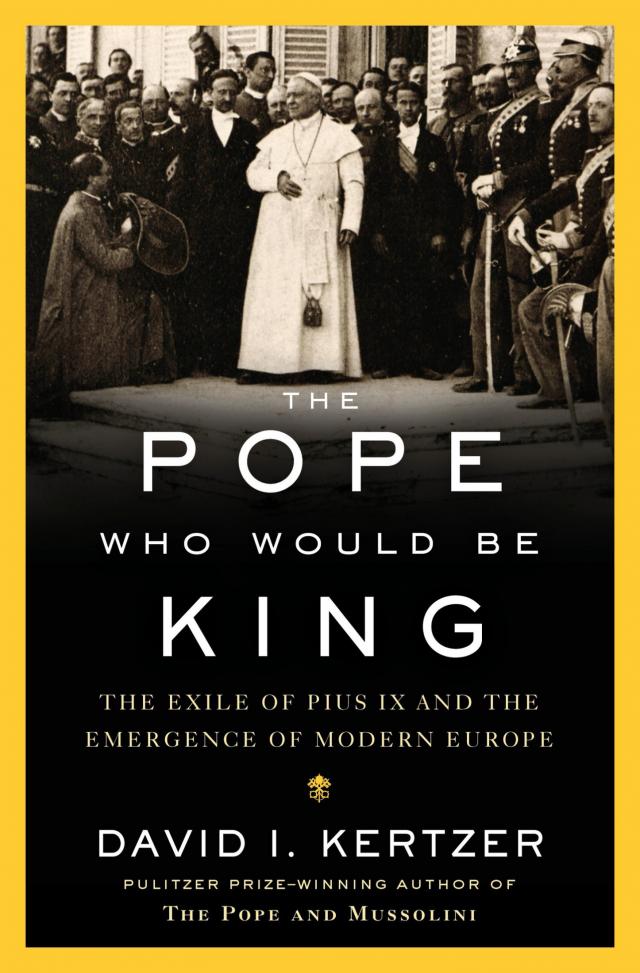
Felix Schwarzenberg
Distrustful of France and lacking confidence in the military abilities of the other Catholic states, Cardinal Antonelli hoped to persuade the Austrian government to take the lead in restoring the pope to Rome. Schwarzenberg opposed the idea, for he did not want to antagonize France, which had made its opposition to unilateral Austrian action clear. Austria’s hold on northeastern Italy remained tenuous, the intentions of Louis Napoleon and France’s republican government uncertain. The last thing Schwarzenberg wanted to do was push the new government in France to support King Charles Albert in an effort to drive the Austrians from the peninsula.12
While the Austrians’ goals were clear—restoration of the Papal States under the pope’s sole authority—the French government’s were not. Not long after his election, Louis Napoleon had sent the pope a letter that expressed concern for his well-being but, much to Pius’s dismay, said nothing about what aid France might offer to restore him to Rome. The new French prime minister, Odilon Barrot, a strong supporter of the popular uprising that had swept the Papal States in 1831, had no sympathy for the pope’s role as king. To further complicate matters, there was also a large and loud left wing in the French parliament. Fiercely anticlerical, it saw the revolt in Rome as a sister movement, aimed at bringing down the old autocratic order and ushering in a modern republic. In early January, Édouard Drouyn, the new French foreign minister and himself unsympathetic to the pope’s claims to temporal power, warned that any unilateral military action by the Austrian government in Rome risked provoking war with France.13
Pius briefly harbored the hope that he might avoid these foreign entanglements by relying on his own army to retake his states for him. In early January he sent word to General Zucchi, who had earlier helped quell unrest in the northern provinces of the Papal States, to come to Gaeta. But rather than agreeing to organize a military expedition on the pope’s behalf, as Pius had hoped, the general tried to convince him that his wisest course would be to keep his constitution and find a peaceful resolution to the conflict.14
While the French still held out hope that the liberal pontiff who had earlier endeared himself to his people could somehow be brought back to Rome, others recognized that the previous year’s traumas had left a permanent mark. “It is best not to have any more illusions about the pope,” observed Venice’s envoy to the Holy See. “He is a man with good intentions, but he sees himself solely as the representative and the guarantor of the Church. From such a man Italy can fear everything. And one must not kid oneself. The pope is powerful. In Rome he is all powerful.”15