The Pope Who Would Be King, page 37
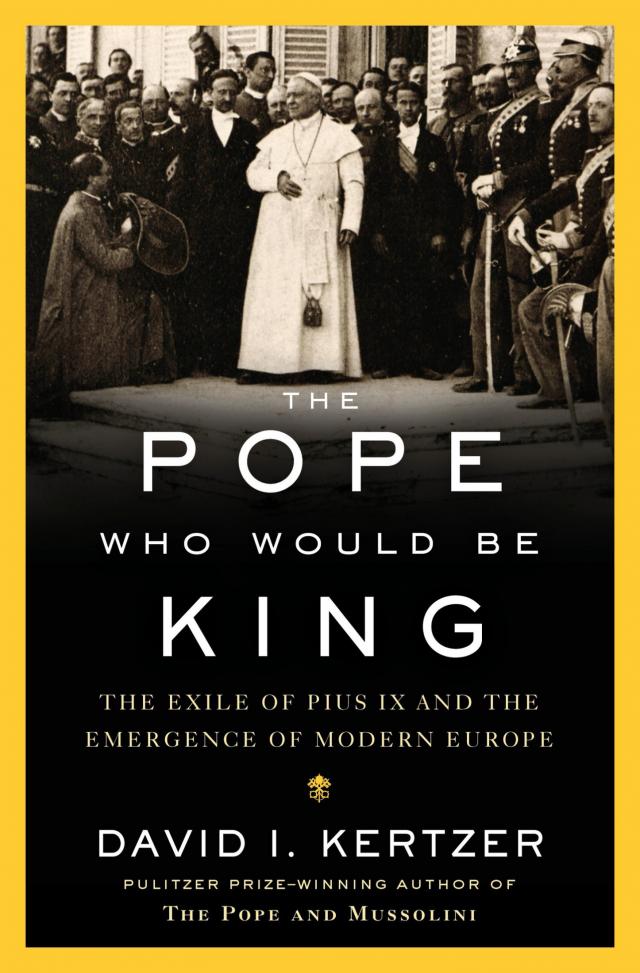


The popular excitement that had greeted the pope in the hill town of Velletri was not repeated in Rome, although bright banners waved overhead and flowers littered the pope’s path. Romans could not forget the recent bloodshed, and the sight of the pope, protected by the French army that had so recently conquered the city, produced mixed emotions. “Things went reasonably well,” remarked the Dutch ambassador, “but without any enthusiasm, above all on the part of the population….The Romans participated in this entry, or rather this return, as one takes part in a spectacle, guided by a simple instinct of curiosity, and the same as if tomorrow they were to take part in those that the Republic offered them, if it were to arise from its ashes.”13
The French had hoped that once the pope was free from King Ferdinand’s influence and firmly ensconced in his French-held capital, he would come around to their point of view. Although Louis Napoleon had reduced his pressure on the pope, the full-scale return of a medieval theocracy would still be a great embarrassment. But initial reports from Rome were not encouraging. Pius was showing no sign that the move to Rome had made him any more eager to follow French advice. “The conversations that I have had on this subject with the pope and Cardinal Antonelli,” reported the French ambassador in late April,
are scarcely more satisfying than the reality, and I greatly fear that the status quo will be embraced for a long time to come as far as reforms of any kind are concerned. Moreover, I cannot repeat too often, the Holy Father is personally sympathetic to France, but the milieu in which he lives is profoundly hostile. In this respect nothing has changed. The pope is no freer in Rome than he was in Gaeta or Portici. On the contrary, they are redoubling their efforts to diminish the influence that the Holy Father’s return to Rome ought naturally have given to France.
All this, Baraguey predicted, augured poorly for the future, for unless the pope made significant reforms, he would never be able to rule except by foreign arms.14
The London Times correspondent in Rome painted a similar picture. “I am sorry to commence by saying that hitherto the Holy Father has, since his return, disappointed all his friends, and that not a single step has been taken to inspire confidence or hope….The enthusiasm which the Pope’s presence inspired is fast wearing away….He is constantly in public, but the people scarcely notice his passing by.”15
Caught up in the daily struggle to feed their families, most Romans wished only for the returned pope to be the same benevolent pontiff they had known from the early days of his papacy. But the flame of Italian patriotism still burned in the hearts of many, and the occasional murder of a French soldier or of a particularly reviled clergyman—their bloated black-robed bodies periodically fished out of the Tiber—kept tensions alive.
On April 30, the first anniversary of their victory over the initial French assault, Romans awoke to see a message painted in large red letters on the walls of several churches: “Priests, the blood of the martyrs screams for revenge!” A new leaflet flooded the city, with an ironic ode to the pope-king:
Rejoice o Pope, you are in Rome, you are on the throne, you are king…your hands are soiled with blood….
So Rejoice o Pope, you are king. Like all the other Popes, you have betrayed the fatherland, handing it over to foreigners….
You have called for war and carnage….You have given your blessing to a massacre!…So rejoice, o Pope, you are king!16
Among those waiting in vain for signs of papal benevolence were the three thousand political prisoners languishing in the Papal States’ jails. Five or six prisoners lived in a dark cell intended for one, with no blanket to keep them warm at night, breathing air rancid with the stench that wafted from their lidless latrines. Living on a diet of stale bread and beans, they quickly fell prey to disease. Among them were fifteen priests, found guilty a few weeks earlier of lesa maestà—revolt against the monarch. Monsignor Carlo Gazzola, a prominent Catholic intellectual, was imprisoned in Castel Sant’Angel, having been given a life sentence for “injuries to the person of the pope,” inflicted through articles in a newspaper he edited. Hair-raising stories spread through Italy, such as the case of Giovanni Marchetti, director of a center for exercising horses, accused of having blackened the nose of a statue of Cardinal Lambruschini with the flame of a candle. Jailed in 1849, he was still awaiting trial two years later. Coughing up blood from the tuberculosis he had contracted in prison, he begged to be released to his family. His request was denied.17
On the pope’s return to Rome, the cardinals’ governing commission was disbanded. One man alone ran the papal government, the formidable Cardinal Antonelli. “Hated by many,” as church historian Giacomo Martina described him, he was “virtually omnipotent in economic-administrative matters and in the defense of temporal power.”18
While Antonelli grew in confidence, the pope himself also seemed changed. He was no longer so good-natured or eager to please. To the secretary of the city government who came humbly to beg for his old job back—having been dismissed for failing to abandon it when the pope had fled—Pius replied, “The time for mercy is over, it is now the time for justice.” Visibly aged, prone to bouts of melancholy, apt to be more cautious and suspicious, Pius, who celebrated his fifty-eighth birthday shortly after his return to Rome, was also more given to outbursts of temper.19
Antonelli moved quickly to consolidate his power. In late June he began talking about reinstating the long-abandoned practice of allowing cardinals to visit the pope only by previous appointment. As it was, any cardinal could come to the pope’s quarters and expect to see him. “The Sacred College, already not well disposed to Cardinal Antonelli,” observed the Neapolitan envoy to Rome, in reporting the plan, “would with this new measure be even less well disposed. However, this shows that he feels strong and secure in his Sovereign’s favor.”20
Feeling considerably less secure in the pope’s favor were the French. Rather than appreciate the protection that French troops now offered him, the pope made known how much he resented their embrace. “In short,” complained Pius to Esterházy in late May, “in whose hands am I? In the hands of the French!” Just as the pope had feared, the French ambassador kept pushing him to announce reforms, warning that popular unhappiness was growing ever greater.21
Pius pushed back. Despite what the ambassador kept telling him, the pope told Baraguey, the fact that he had not yet announced any reforms was not causing any problems. Said the pope,
I have now seen many delegations. Not one has uttered a word about it. When they have come to see me…it was to tell me: “in heaven’s name, Holy Father, don’t go and fall again into new dangers by establishing municipal elections on too broad a basis at a time when spirits are not yet sufficiently calmed down for general elections to lead to good results.”22
It was now summer, a time when Romans who were wealthy enough escaped malaria season by retreating to their country estates in the hills. By the end of August, twelve hundred of the ten thousand French soldiers who remained in Rome were bedridden, feverish with the disease. Meanwhile the relentless pace of the arrests continued. “They imprison many,” complained Rayneval, and “they only begin their interrogations months later.”23
The executions continued as well. Before the recent upheavals, capital punishment had been meted out in Rome by a guillotine placed in the middle of a large piazza, as a crowd of the curious and the horrified looked on. Pius IX had had his first experience with the guillotine when, as bishop of Imola, he gave last rites to two convicted murderers moments before their execution. “I have seen the guillotine for the first time,” he wrote a friend at the time. “The image is still with me, and I believe I will not forget the spectacle that I witnessed for many years.”24
Rome’s guillotine was among the casualties of the Roman Republic, demonstrators in those heady days having burned it in a celebratory blaze, retrieving the warm pieces of iron that remained from its ashes and throwing them into the Tiber. Forced as a result to rely on firing squads, papal officials discovered that their former method was much more reliable. One early October morning, in a particularly embarrassing episode, six men found guilty of committing a murder during the days of the republic were taken to the piazza facing the Church of Santa Maria in Cosmedin, famed for its Bocca della Verità, the Mouth of Truth. The pope had refused the men’s appeal for leniency. A crowd gathered to watch. The signal sent, the soldiers opened fire, but their aim was poor. One of the condemned men found to his surprise that he had been only lightly wounded in a rib. “Grazie,” he said, apparently thinking that he was now spared. The officer in charge then ordered a second round fired. Only after a third round ripped through the survivors were all the men dead.25
When the pope first returned to Rome, Lewis Cass, the American chargé d’affaires, expressed hope that things would soon improve. Cardinal Della Genga had told him that Pius was a great admirer of the United States and its institutions, a statement the American reported credulously to Washington, along with assurances from another cardinal that the pope was eager to adopt a liberal constitution. When, shortly after Pius’s return, Cass—who at that point had been in Rome for a year—finally got to meet him, the pope’s warmth won him over. “He took me by the hand,” recalled the ambassador:
He spoke of his late efforts to introduce liberal reforms to his States and of the difficulties which he had encountered, adding that he had learned by painful experience that it required much caution and prudence to prepare his people for an order of things to which they had not been accustomed. Far from being disheartened, however, by the late untoward result of his political experiments, he stated, with a firmness and consistency which does him no small honor, it to be his intention to pursue the same course in the future, and on all practicable occasions to introduce into his government salutary measures of reform, which he admitted to be much needed.26
Over the following months, as all signs pointed to the return to the old theocratic ways, the American ambassador’s optimism faded. What obedience to authority could be found in Rome, remarked Cass, was simply the result of coercion. The French troops had retreated from any involvement in public affairs, and, he reported, “the papal functionaries are no longer, in the slightest degree, restrained in the exercise of their accustomed duties.”27
* * *
—
NONE IN ROME FELT more fearful than the Jews. With the founding of the Roman Republic, all legal restrictions on the Jews had been lifted, but they had barely begun to enjoy their freedom when the French army brought the pope back to power. Now the Jews lived in great anxiety. Would the old, benevolent Pius IX be returning, or would the chastened pope embrace the repressive measures of the past?
With evidence quickly accumulating that it was to be the latter, Rome’s Jews turned once again to the Rothschilds. A week after the pope’s return to Rome, the officers of the Jewish community sent a letter to Baroness Rothschild in Vienna. “In this state of painful uncertainty about our affairs, alternating between resignation and hope,” they wrote, “we send you the present letter, praying that you will want to address a letter to Prince Schwarzenberg, minister of foreign affairs at the imperial court of Vienna, encouraging him to have the goodness to write an official note.” Schwarzenberg, they hoped, would urge the pope to reinstate the concessions he had previously granted Rome’s Jews.28
A few months later officers of the Jewish community prepared another long plea to the Rothschilds. After chronicling all the restrictions on the Jews that previous popes had imposed, they praised Pio Nono for having earlier had the goodness and the courage to abolish a number of them, “to the applause of all of civilized Europe.” Now, they lamented, these same restrictions were being brought back.
The Jews expressed the hope that they might keep the freedoms that they had enjoyed under the Roman Republic. They wanted again to be able to live and work outside the ghetto. They wanted to be free to practice a wide variety of occupations and to be able to own real property. They also wanted their children to be able to attend universities. They sought to end other humiliations they suffered, including the law forbidding Jews from giving testimony in civil trials and the requirement that they pay a large sum each year to support the House of the Catechumens, the church institution dedicated to their conversion. They did not ask to be allowed to have access to positions in the city administration, for this they thought would be too much, but they did ask that the menial jobs sponsored by the municipal government, available to the city’s poor, be opened to them.29
The Jews’ pleas did them little good. Pius IX had never been comfortable challenging the old orthodoxies and was certainly not about to do so now. He regretted that he had ever agreed to the requests that, in his first months as pope, had led him to grant the Jews so many freedoms. Over the next months, as reports of Jews remaining outside the ghetto’s walls streamed in to Rome’s cardinal vicar, Jewish stores were shuttered and Jewish families forced back into the ghetto.30
* * *
—
THE ARRESTS IN ROME continued at a brisk pace. Those known to be critical of the papal regime lived in fear of the hand on the shoulder, the manacles on the wrists, and the trip to the prison where beatings were common. Michelangelo Caetani, the duke of Sermoneta, a literary man from one of Rome’s preeminent noble families, explained to a British visitor in early 1851 what life was now like in the Eternal City. Ten people a day, he said, were arrested, “to be confined for a few weeks in a damp, filthy dungeon, among wretches swarming with vermin and allowed to perpetrate on a new comer any atrocities that they think fit.” It was a method, he said, the police used to make people think twice before criticizing the papal regime.
Pius, explained the duke, believed firmly in the right God had bestowed on him to wield absolute power. It was a trust that he was charged with transmitting intact to his successors, as his predecessor had to him.31
Marble genitalia offer a good barometer of the state of repression in Rome. Ever since Michelangelo painted a bevy of nude figures on the walls of the Sistine Chapel, covering up the naked human form had periodically become a papal crusade. Now Pius IX, bent on restoring morality in his capital, entered the fray. “At St. Peter’s,” reported one observer in April 1851,
they continue to put clothes on the angels, the genies. The Genies of the Monument to the Royal Stuarts by Canova have all received little tunics. On the pilaster to the left as you enter there is a large medallion of Saint Leo supported by angels, one of which has no pants. They have been busy covering it a bit. What they have done most dramatically is this: at the foot of the statue of a pope, there was a woman nursing a child. They have hidden the breast, but what to do about the child? They cut off his head and put it back on facing in the other direction.32
Around this time Nassau William Senior, a prominent British lawyer and economist, visited Rome. Eager for insight into the political situation, he went to see Alphonse de Rayneval, who months earlier had become the new French ambassador to Rome. The unflattering view of the Romans that Rayneval conveyed was equaled only by his dim view of the pope’s prospects. “If 500 foreign republicans were to come in, I do not think that they would find 500 Romans to join them,” said Rayneval, before adding, “but I do not think that they would find fifty to oppose them. The Romans would run into their houses, lock the doors, and peep through the keyholes to see what would happen.”
The next day Senior went to see the British consul, John Freeborn, who had been an enthusiastic supporter of the short-lived Roman Republic. Senior told him what the French ambassador had said. “Rayneval,” replied the disapproving consul, “is utterly mistaken. He does not know the feelings of the middle classes here; for he does not mix with them. I do; and I can assure you that in three hours after the French left us, there would be a sanguinary revolution.”33
This was the American chargé’s view as well. “The tendency now,” Lewis Cass reported to Washington in May, “is to return to the old system, with all its abuses….The feeling against the Vatican…is as strong as ever, and I have every reason to believe, that a great majority of the inhabitants of the Papal States are willing, in their desire for a change in the political economy, to encounter the horrors of a second revolution….Hatred to Church government and dread of despotic power appear to animate every breast.”34
Nor did Cardinal Antonelli himself have any illusions. “The Roman people,” he confided in a mid-1851 memo to his nuncio in Vienna, “is in general radically corrupted, or inept, and incapable of giving the government the least shadow of support.” The ideas spread during the revolution, and the propaganda sneaked into the city in the months since, had, he wrote, “perverted the ideas and the sentiments of this people to such a degree, that,” should the French troops leave Rome, “the government of His Holiness would find itself abandoned to passionate hatred in the womb of its own capital.”35
The pope sat uneasily on his throne. It was not only the Romans’ hopes that had been crushed in the time since those exhilarating days when festive crowds had marched through the city’s streets singing his praises. The pope’s dreams, too, had faded. Pio Nono had wanted to be a benevolent ruler and had delighted in his people’s praise. In those early, heady days of his papacy, the tears he shed were tears of joy at the outpourings of people’s love for him. What a contrast with the tears that had so often moistened his eyes during his humiliating exile, as he heard reports of the curses hurled at him in Rome and contemplated his return with the greatest trepidation. It was only by weaning himself from what he now recognized as his weakness, his great desire to be loved by his people, that he could face the future. He would need to develop a protective shield, to turn not to the people for approval but to God alone.