Dashboard Elvis is Dead, page 30
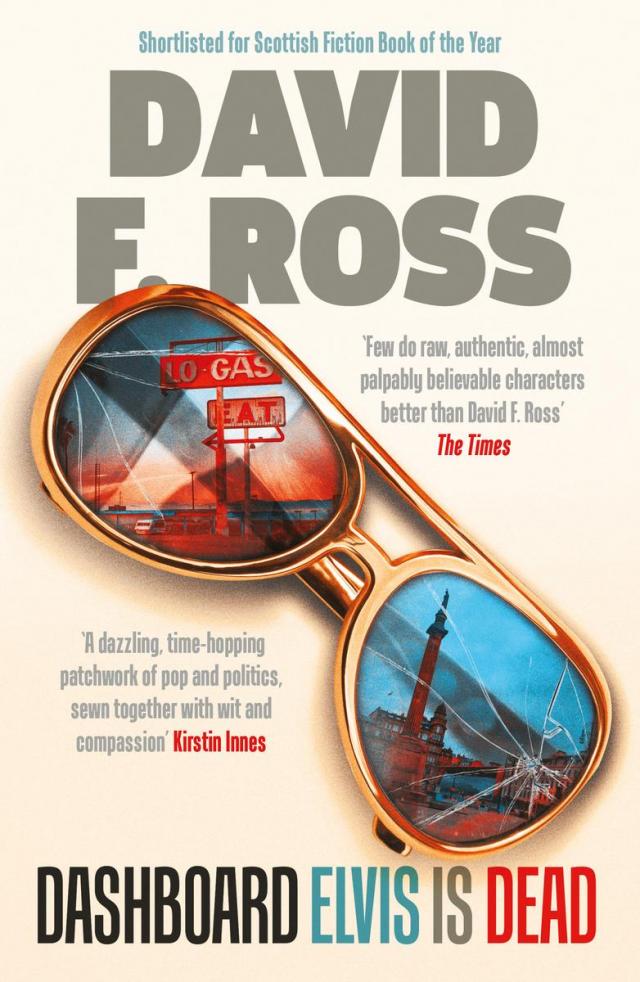


Jude moves past without acknowledging them. Avoids eye contact. She smells the beer breath and the pungent weed that recalls Hennessey. It helps to remind herself that she lived for years in the brutal urban projects of the New York boroughs. Young pack-males on the margins are the same the world over. Full of peer-pressurised, toxic bravado. At least Glaswegian ones don’t carry guns.
‘Gaun, ya fucken asylum seekin’ hoor, ye! Awa’ back tae yer ain bit.’ The last insult from the pack, irritated that Jude hasn’t responded to their baiting. They move on. The threat diminishes.
The doors at the base of Chic’s tower are broken, the electric cables that once secured entry ripped out and hanging lifeless from their box. The putrid stench of urine is unbelievable. Holes in the plastered concrete range in size from sledgehammer to bullet. On a wall, barely decipherable against the graffiti, Jude snaps an old sign. It reads:
Advice to new students:
Don’t use the ice-cream vans.
Don’t buy drugs from anyone in the area.
Don’t borrow money in the area.
Stay out of the pubs.
Stay out of the bookies.
KEEP TO YOURSELF.
Jude presses the lift button, fearing an encounter on the stairs more. The doors screech open, and once inside, she fears them not opening again. She distracts herself from what’s waiting above by thinking of Hennessey and of the time he headed into the depths of the Lower East Side looking for dime-bagged heroin. His lowest ebb, he’d said. He’d climbed a crumbling ten-storey slum to the ninth floor. The elevator was out. The staircase, dark and smelly, and littered with semi-conscious junkies. He held an old harmonica in his pocket like it was a gun and he was Sam Spade. He and Jude had laughed as he described reaching the dealer’s sliding hatch cut low down into a metal-plated door and handing over his ten bucks to an elderly Filipino dwarf in return for one bag of Colombian brown.
Thinking of Hennessey brings the faintest of nervous smiles. How he’d laugh if he could see her now. Shivering with anxiety inside a derelict Glaswegian tower block, fingering the plastic dashboard Elvis Presley figure in her pocket to make it look like a weapon. They’ve been through a lot together, Jude and Elvis. He’s been her guardian angel, and briefly, Hennessey’s. Tomorrow, Jude will present him to Rabbit. He’ll be a lasting connection between the two of them and Brandy.
The doors open. Jude shudders. The man’s there. Waiting for her. A dying fluorescent light flickers. It hurts her eyes. When on, it illuminates scores of discarded hypodermic needles on a shiny bed of burnt foils. When off, only the green of a fire-exit sign above a door with a smashed glass panel prevents total darkness. The green catches him. He looks ill. The fluorescent strobes and he looks worse.
‘Chic?’ Jude asks. She now wishes she’d walked back to the taxi after the encounter with the young team outside.
‘Got the money?’ Chic barks. He is wired, and aggressive with it.
‘Can I ask you a few questions first?’
‘Fucken money!’
Jude clutches her bag tightly under her arm.
‘That prick Ross said ye’d pay me!’
Jude has nothing to bargain with. The Buchanan Street busker got the last of the folding kind. Chic Chalmers doesn’t look like he’ll accept a bank transfer.
‘Yes, I will. But look, I just want to ask about Anna Mason. I think I saw you—’
‘Dinnae start wi’ that fucken devious cunt, right. Money. Now!’
This was a big mistake. Jude steps back and presses the lift button behind her. Chic Chalmers hears the gears ratcheting and leaps forwards. He grabs for Jude’s bag. Jude’s hand rises instinctively. No-one will hear her, but she summons all her rage and screams. She grips Elvis Presley tightly and drags him down Chic’s face. Elvis’s tiny pointing finger at the end of his extended right arm punctures the pallid skin. It draws blood. The flickering light catches Chic’s crumpled face. The fluid bag under his eye is ripped open. The blood runs freely. The crease of his eyelid is torn back. He yells in pain. Jude shrieks, preparing to redeploy the plastic king of rock an’ roll. Chic attempts a punch. His fist misses Jude’s cheek. She pushes him backwards onto the lift’s metal door frame. His back catches a projecting panel. The jagged edge cuts him through the shirt and she sees the fury. His hand reaches into a pocket. They are like dancers in a strobe-lit industrial nightclub. She advances. The green doesn’t catch the glint of the blade and she walks onto it, almost gracefully. There’s no pain. No panic. Not yet. By the time the light stutters on again, she’s down. A discarded syringe has jabbed her face but the warm wetness around her stomach is more worrying. Chic grabs for the bag. She has fallen on it, but her resistance is waning. He rolls her over. She hears him say, ‘Sorry. Ah’m fucken sorry, right!’ She screams again, this time, not because of the knife wound. But because the needle has gone right through her cheek.
The lift doors open. Chic stumbles inside. He holds her bag with one hand and his torn face with the other. Jude smells his stale sweat and retches.
‘Don’t leave me here,’ she yells. She throws out a foot. The only pain she feels is from the lift doors shutting on her ankle. They force her lower leg to form an odd angle. The metal releases her and Chic aims a kick. He connects at the second attempt. A jolt ratchets up her leg. A bone broken, most likely.
‘Fuck sake. This is your fucken fault!’ shouts Chic.
Jude lifts a hand, pleading. But the doors rattle shut, and he’s gone. She screams for help, but these towers are on the condemned list. Few residents remain, and those that do will be unlikely to venture out of boarded-up, locked doors to help a stranger. No-one is coming. Even the taxi driver will have given up and driven back to the city centre. She will probably die here. In this piss-stinking hellhole. With a migraine from that fucking light. And it might take hours for her to bleed out. But she can’t raise herself. Try as she might, she can’t move. Her leg has given out. She is weakening. Burning up one minute, freezing cold the next. The dark stains of her blood grow.
That’s a lot of blood, she thinks.
She wonders how little a person could survive on.
Time of death? Who knows? Her watch has stopped. Its face broke when she fell.
Rabbit will think Jude has let her down yet again. Andi will get the phone call. She’s her designated next-of-kin. There are contact details for Ben too. Rabbit will forgive her then, once the whole story is known.
She is struggling to keep her eyes open now. Her throat is dry. From a scream to a whisper. She holds the bloodied, broken figure close to her and mumbles:
‘Through all trials an’ tribulations, we will travel every nation … with our plastic Elvis we’ll go far.’ She coughs and winces.
If only she’d been a better person. If only she’d told those that mattered that she loved them. Then she might’ve been more loved in return.
Her eyes are closed. Lids heavier than stacked grocery bags from Edgar Vane’s store. She couldn’t open them if her life depended on it, ironically enough. She wonders how long she’s been here, in Purgatory. No matter now. This is it. The end. She thinks about what happens after death. About where she’ll go next. She hopes AJ Carter will be there.
She whispers, ‘Bloomingdales.’
And her heart stops beating.
‘Hey, is this real, or is this just a ride?’
—Bill Hicks
Postscript
I had two encounters with Jude Montgomery: one by transatlantic telephone call in 1997, and the other in person, in Glasgow in 2014. Both encounters, brief though they were, had dramatic and devastating outcomes. The writing of this book is my attempt to rationalise, explain and atone for my part in these events.
In early October of 2014, I received a call from Jude. Despite the uniqueness of her accent, I didn’t immediately recall her as the person who’d contacted me seventeen years earlier, looking for information about or contact details for The Hyptones, the Scottish band I had written articles about. When she reached me in 1997, I immediately assumed hers was merely another in a lengthening line of legal strong arms attempting to protect the interests of the ‘Material Girl’. But Jude quickly explained that her interest was in tracking down whoever held the media rights for the song ‘Independent State of Mind’. Her marketing agency was interested in using the song for a high-profile campaign, which, if sanctioned, would be very lucrative for the band and their management. I reached out to a company called AFB Management, after discovering it was run by Anna Mason (who featured briefly in my long-read feature, ‘Ballad of the Band’).
When the campaign was a worldwide success, I was genuinely delighted for Jamie Hewitt, feeling, perhaps undeservedly, that my writing had performed some beneficial part. I doubt he’d have acknowledged it, but that didn’t matter to me. The ends justified the means.
Perhaps inspired by the song’s renewed application in 2014 as the anthem of the YES vote for Scottish Independence, I signed up. I painted my face blue and white. I campaigned around the west of Scotland with the other recruits. And I was distraught when the vote was lost. So I was at a very low ebb when Jude Montgomery called me for a second time. She explained her background and her involvement in my article about the band. I was astonished. We agreed to meet. My memory of the conversation we shared as we walked around the upper inclines of the Necropolis won’t be exact, but what follows is the substance as I now recall it:
4th October 2014:
‘Hi there. Lovely to finally meet you,’ she says. She extends a gloved hand, backed up by a warm smile.
‘Yeah, you too. This your first time in Glasgow?’ I ask.
‘It is … first time in Scotland.’
‘You managed to see more than just the city?’
‘Well, not really,’ she says, and I detect the regret. ‘I managed Edin-boro but not the Highlands, which I’m sad about. Maybe next time.’
‘So, how can I help you, Jude?’ I ask.
‘I’m not entirely sure you can,’ she replies. ‘I flew over from the States a few months ago, a bit unsure about why. It wasn’t really a vacation, and I’m not workin’ on a commission. I guess I wanted to see someone who was once very close to me, and I figured that researchin’ The Hyptones’ song and its use in the independence referendum would provide the justification.’
‘Or a cover story?’ I suggest.
‘That’s very perceptive of you,’ she says, smiling.
‘And has it?’
‘No, not exactly.’ She laughs.
We climb to the peak and look over the city sprawling in front of us. It’s cold but clear and you can see all the way to the mouth of the Clyde.
‘It’s really beautiful, here,’ she says.
I find myself nodding in agreement, as if it’s new information, although I come here almost every weekend. We simply watch for a while, hypnotised as the metropolis goes about its business below us. Like the invited guests of St Mungo, sat on a Glaswegian Mount Olympus.
‘The Necropolis has a mythical status for Glaswegians,’ I tell her. ‘It’s the seed of the city, but it’s also a place where lots of local gangsters are said to have met a violent end.’ She doesn’t respond to this, and I feel a bit foolish; like a dull tour guide losing the attention of his audience.
‘I had hoped you might know how to contact Chic Chalmers,’ Jude says, coming straight to the point.
‘Em … well. I’m not sure I should be—’
‘Apart from Jamie Hewitt, he’s the only person involved with the band that I haven’t managed to speak to,’ she says. ‘I’m flyin’ home in a week, an’ this is probably my last opportunity.’ I don’t respond immediately. I suspect she knows I have what she needs. ‘Please, David,’ she says. ‘This is a great, positive story. I see it as the natural continuation to your piece.’ She’s imploring me now, one journalist to another, although I’m not that, and arguably never have been. But the instincts remain. It’s always about the story, right? The story is the thing, and it’s not a story until all the angles have been covered.
‘Y’know, Jude, I never really wanted this. I wanted to write novels, but I just wasn’t good enough. Creative enough. I’ve got too little imagination for anything other than joining the obvious dots between facts. That’s how The Face article got me into so much trouble.’ I draw several deep breaths, as if this admission has taken a lot out of me.
‘Why not do it, then?’ she says, as if it was the simplest thing in the world. ‘I’m writing a memoir at the moment.’
‘Yeah. Fuck. How’s that going?’
‘It’s difficult, sure, but important to me too, y’know? I’m not so organised, though. It’s all recorded on tapes from an old dictation machine.’ She opens her bag to let me look inside.
‘Jesus, you carry them with you. No copies?’
She shakes her head and then laughs, acknowledging the madness of this.
‘I’ll transcribe them sometime. Soon, when I’m back in New York.’ She looks at me like a tutor does a disconsolate student. ‘C’mon David … you should do it. I’ve seen your writing. It’s good. What you got to lose?’
Some people rise to a challenge. Some people shrivel in the face of one.
‘I feel that I can’t move on until I square everything with Jamie Hewitt. I’ve no idea where he is … or if he’s even still alive! Christ, I’ve had the longest sustained period of writer’s block in history, and he’s the reason why.’ I laugh at the ridiculousness of this, but it still crumples me inside to admit this failure. I catch her smiling. Her sympathy is not what I need.
‘I can maybe help you, then,’ she says. ‘I have his number. I give you Jamie, and you give me Chic.’ She laughs again. The absurdity of us swapping the details of forgotten Scottish musicians of the early eighties as if they were Cold War spies and access to them could bring down a corrupt government. After a time, I agree to this arrangement, despite having a creeping feeling of dread about it.
‘Look, you need to be really careful with Chic,’ I warn her. ‘He’s a bit bloody … unhinged. He contacted me a few years ago, after he came out of prison. Wanted me to write his story. “The fucken truth an’ nuthin’ but,” he said. About how Anna Mason had shafted him. Made sure he got nothing from the Apple campaign royalties. He claimed he had evidence that Anna Mason got him arrested and sent down for breaking into her house and seriously assaulting her. Chalmers says he was invited there to discuss a potential settlement, and that she’d been battered by someone else prior to him getting there. Probably a set-up by her own security people. He’s a dangerous man, Jude. You’d be best avoiding him,’ I tell her. But I sense the fearlessness of the journalist rising. I can see the fire in her eyes. I’ve just made her pursuit of him more attractive, not less. I reluctantly trade Chic Chalmers’ last-known address and contact details for Jamie Hewitt’s telephone number.
‘So, you mentioned meeting someone close to you earlier. How did that go?’ I ask her as we’re about to say our goodbyes.
She shrugs. ‘Ask me next week, before I go home,’ she says with a wry smile. ‘She’s finally agreed to meet me.’
‘Good luck,’ I tell her. ‘And safe travels.’
And with that she’s gone. Off to seek the final piece of the jigsaw, at an address I have provided her with. Off to meet Chic Chalmers. The man who would kill her two days later.
I called Jamie Hewitt repeatedly that evening. When he finally answered, he sounded tired, depressed even. I was surprised he stayed on the call after I told him who I was. But I spoke quickly. Tried to get past the sincere apologies and the regret for the hurt I might have caused him. He said little. But we remained connected, and our conversation lasted for a little under an hour. He let me know that Reef Malcolm had been in touch. He knew Jude Montgomery was in town. I told him she had been behind the decision for ‘Independent State of Mind’ to be used in the Apple campaign. He wasn’t aware of this. Didn’t seem overly grateful, but I think that was just his way.
At the end of the call, he admitted to his guilt over several things: toxic relationships and bad decisions leading him to his current state. But mostly he talked about his character flaws. I asked him where he was staying. He wouldn’t tell me. I gave him my address in the unlikely event that I might be able to help him in future. I suggested that he might find it cathartic to talk to someone about his pain, his addiction. Or at least to write the reasons for it down if he felt unable to talk to articulate them in person.
Two years later, I received a package in the post. Inside was a colour photograph of David Bowie, who had died the week before, and sheafs of lined paper. The first line, written in red biro was:
Hello. My name is Jamie. And I’m a cunt!
It’s June 2020. A top-floor tenement flat in Dennistoun is being cleared following the death of its elderly tenant, Mrs Eileen Chalmers. During the clearance, a false plasterboard panel is found in an internal cupboard. Since a new boiler system is to be fitted in the flat, the panel is ripped out. In the space behind, the workers discover a woman’s bag, and inside it, a camera, a recording device, a box of tapes and a series of notepads. Further investigation determines them to belong to the American photographer and journalist, Jude Montgomery.
Chic Chalmers, former drummer with The Hyptones, a Scottish band from the eighties whose song ‘Independent State of Mind’ was the theme for Anna Mason’s rise to power as first minister, is serving a minimum of eighteen years in prison for the murder of Ms Montgomery. Eileen Chalmers is Chic’s mother.
Less than a week later, this story breaks. The tapes contain fragments of autobiographical accounts of Jude Montgomery’s Texan childhood and her early adult life in San Francisco and New York. But there are also scribbled notes from an October 2014 telephone call between the American woman and Scotland’s first minister, Anna Mason. As a result, the discovery becomes national news and is also broadcast in the United States.