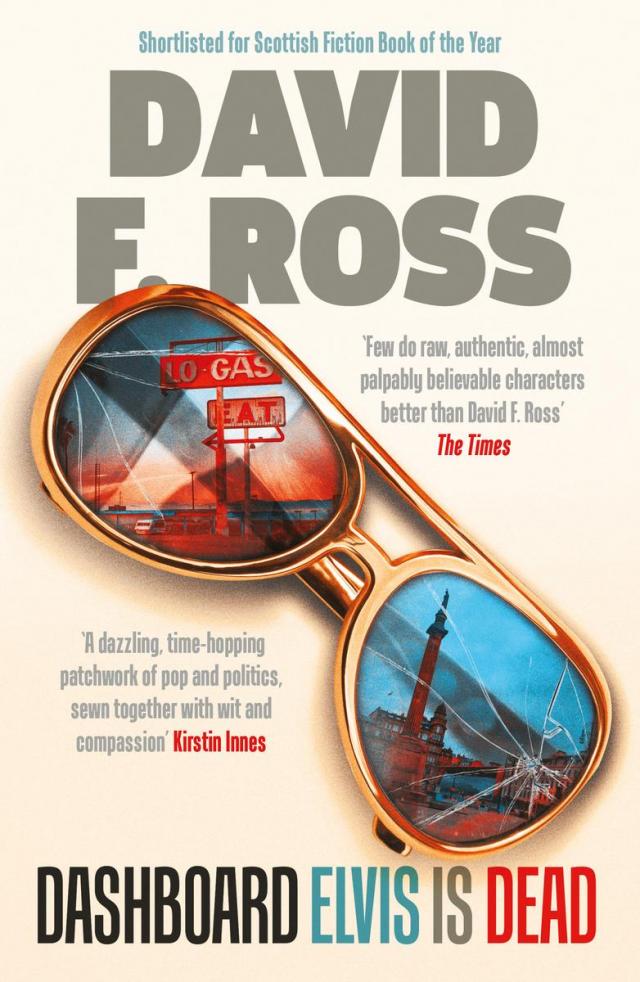
Dashboard Elvis is Dead, page 27


I’m also determined to follow up the loose ends of the Hyptones story, and Ms Mason’s former position as the band’s rights manager. With their only hit now soundtracking the Scottish National Party’s campaign, it’s easy to deduce that her sudden mood swing in Manhattan in April is connected to the use of the song. And, of course, there’s her relationship with Jamie Hewitt to dig deeper into.
And I have some personal searching to do. Looking for the young Jimmy Montgomery, or the strands of the lives that created him. But these are side issues. Cover stories. Rabbit is here in Glasgow too. This is my opportunity to address failing her, as a child and an adult, and to consign those past regrets to history and begin again.
28th July 2014:
Hello? Yes, hello, I hope you can assist me. My name’s Jude Montgomery. I met with Ms Mason in Manhattan recently and agreed access for a feature … Oh, sorry, yes, Montgomery … that’s right … Yes. I’m freelance. I’m sure she’ll remember me.
I flick pages on my diary, primed to provide available dates.
Oh, that’s … um, unusual. Could you check? Will I leave you a contact number? Okay. Yes, I’ll hold.
This isn’t an encouraging start.
2nd August 2014:
I spend a morning walking around various Glasgow locations – Glasgow Green, the Cathedral Quarter, the Merchant City – occasionally stopping to photograph people unaware their picture is being taken. In the early days of doing the same thing in New York, I never considered this a breach of anyone’s privacy. The whole point was to observe ordinary people doing ordinary things – their activity enlivening the context of the city. But now, with the internet a free, open, fully accessible gallery, what might appear ordinary is often rendered sinister by the skewed interpretation of a social-media pile-on. Photography retains the same purpose, but its truthfulness is routinely abused. Believe none of what you read and only half of what you see, as Lou Reed once sang.
I make a series of phone calls. I write notes, the phone wedged between shoulder and left ear. My pen scribbles furiously. Too early to say for definite, but things are looking up.
My impromptu city tour reaches George Square. Despite the late-afternoon rainfall, it is awash with excitement. Later this evening, Usain Bolt will compete in the sprint relay final. His appearance is so eagerly anticipated you would be forgiven for thinking he was representing Scotland at Hampden Park rather than Jamaica. I’ve noted a concerted attempt from the organizers to keep politics out of the event, but I detect the growing swell of patriotism with each passing day.
My phone rings.
Ben? Hi, how are you? Is everythin’ okay? I ask.
…
I look at my watch.
It’s, em … nearly five, I say.
…
In the afternoon, yeah.
…
Yeah, gettin’ used to it now.
… …
No. No not yet. I don’t want to push her. Hopefully, yeah, in her own time, I say, and then, after another exhortation to tread warily with Rabbit – which is the purpose of this brief call with him – we say ‘bye’ simultaneously.
10th August 2014:
Hello? My name is Jude Montgomery … (click) Hello? Hello? Is there anyone there?
Earlier optimism has ebbed away completely. It’s like trying to make customer complaints calls to the Kremlin.
18th August 2014:
I’m blending into the disbelieving crowd. Many carry expensive cameras just like I do. Many are press photographers – I can tell by the way they hold themselves and their equipment. They are poised, trained to see the details that others don’t notice, to anticipate a look or a situation that, captured, can say more than five thousand brilliantly crafted words ever could. I sigh deeply, witnessing the perilous state of Glasgow School of Art after the blaze. The characterless austerity of a new building immediately across Renfrew Street only serves to magnify the loss. Banks of ugly scaffolding overhang the open roof, propping up the shell of Charles Rennie Mackintosh’s masterpiece. The gaping holes offer painful glimpses of the substantial internal damage. I feel like a medical student observing my first post-mortem, shocked but unable to tear myself away. I can only imagine how traumatized Rabbit must be having witnessed this tragedy.
I photograph the dying monument, hoping, against logic, that it will survive and rise again. Not only for Rabbit, who taught and exhibited here until the day the flames rose. But for everyone who cares about beauty and imagination and craft. Glasgow is grieving for this broken emblem of its identity. For those seeking to be free of the Union, it seems like a portent for the weeks ahead.
25th August 2014:
Rabbit is ‘out of town’. Again.
I visit a gallery that will provide a temporary academic home for the returning Glasgow School of Art students next month. It will also be Rabbit’s base, as their fine art tutor, for the foreseeable future. Almost half of the artwork being exhibited here is for public sale, increasing the potential for much-needed income for those who lost work in the fire. Despite Rabbit being elsewhere, my spirits are lifted by the resilience of the young people I meet. The loss of the building has been traumatic for the city, but several of these students have had their entire course portfolio destroyed.
I wander through the exhibition. Some of the artwork displays smoke or minor fire damage. I can imagine Rabbit teaching her students to embrace the blemishes, using her own body to demonstrate that beauty is often found in the most unexpected places. Much of the display is an appropriately defiant stance for young, creative artists. It tugs at my heart and my imagination, inspiring me in the same way as Janet Delaney’s photographs of the effervescent Castro community did almost thirty years ago.
I climb narrow, metal stairs to a mezzanine space that has caught my eye from below. There is no-one in the upper gallery. I gaze at the colourful, vibrant canvasses. All are signed ‘Rabbit’ in their bottom right-hand corners. None are recognizable from the MoMA exhibition. I stop at one that looks a little like me. Unlike the others, it is flattering. The small white card on the right-hand side of the painting reads:
Dashboard Elvis Is Dead 2009
Oil paint on canvas
Courtesy of the artist and the Museum of Modern Art, New York
(Not for sale)
I turn sharply, head swimming. The light turning liquid. A vision of Brandy laughs, peeking out from behind a large white drape. Hide-and-go-seek amongst an artist’s studio paraphernalia. Brandy is wearing a white bath towel. Brandy runs around the mezzanine, splattering paint everywhere. The towel quickly becomes a psychedelic riot of color. She picks up pots and throws the paint at the canvases. It’s exactly what I think she’d do. And something I’m certain Rabbit would love. I laugh through the tears.
Are you okay, miss? asks a young student. And I continue to laugh.
Yes, I tell him. Yes, I am.
2nd September 2014:
Someone from Rabbit’s team informs me that she will be in England for the next week at least. I enquire further, hoping for, but not expecting elaboration. And I’m told that Rabbit is attempting to establish, through agents in London, links between Glasgow School of Art and studios in Hong Kong and Singapore.
I have a week to kill so I head to the location the sculptor Andy Scott pointed me to for information on Jimmy’s family. Glasgow’s Mitchell Library is another of the city’s buildings with a sad story to tell about the ravages of fire. You wouldn’t think it to look upon the substantial, classical stone façade, but it had the same fragile and combustible insides as virtually every other Victorian building in Glasgow. Much-loved and lauded structures gutted by fire is an all-too common occurrence in this city, I’ve found.
There’s a special section on family history. It’s situated high up the building, and it’s very quiet, with only two staff members covering a large floor area. The department is carpeted with a florid, headache-inducing pattern that momentarily transports me back to a three-night stay in a cheap El Paso motel when I first left home. I select a booth and with the cheerful assistance of the older of the couple on duty, I quickly get to work. After a few days of exclusive research through census records, and birth and death and marriage certificates, the mouse doing all the heavy lifting, a picture emerges that brings joy to my heart.
Larry’s description of the facts was essentially correct. James Patrick Montgomery, born on 1st April 1949, had a Protestant mother and a Roman Catholic father – not the other way around, as Larry had it. Elspeth, Jimmy’s mom, was a cleaner. His father, Brendan, was a shop steward in the Clydeside shipyards. There is little of note resulting from Elspeth’s family thread, but there is much to uncover in following Brendan’s. Brendan was the last of five children to Helen and Malachy. Jimmy’s grandparents lived in Govan, in the same house that Jimmy would be born in. Helen was a campaigning part of the women’s movement led by the Scottish political feminist activist Mary Barbour. Barbour organised the Glasgow rent strikes of 1915. Mary, Helen and twenty thousand others, many of whom were women, marched from Govan to George Square in protest at their unscrupulous landlord’s conditions. As I read, I feel connected to Helen. I hope she would’ve been proud of my written articles, especially ‘The Low Expectations of the Bowery Bums’, and of me speaking up for them. But as I delve further into her life, looking for other recognisable strands, I find them in an unexpected place. Looking for her in a photo archive, I discover her in several shots in folders named ‘The Women’s Peace Crusade, 1916–1918’. She is there, in sober dress and soft velvet hat bedecked with flowers. Standing alongside Mary Barbour and two female workers at Govan’s Harland & Wolff shipbuilding yard during the First World War. And she is there in a serious, posed photograph of the Glasgow branch of the Women’s International League for Peace and Freedom.
But it’s a photo credit that I almost miss that astonishes me. Several of the pictures were taken by Malachy Montgomery. My great-grandparents from Scotland; an ordinary woman campaigning for those without a voice, and a photographer, recording the struggle for future generations to learn from. I leave this place positively beaming.
17th September 2014:
I lean against a shop window on the corner of Buchanan Street and Bath Street. To my left, in the area surrounding Donald Dewar’s statue, there is a massed gathering of pro-independence activists. I’ve been here for almost two hours. Flash mobs sing a rousing song called ‘Caledonia’. It buoys them, and every time there’s a slight dip in levels of optimism, someone yells the opening line, and the effect is like helium being blown into an inflatable cheerleader at the Superbowl. I’m witnessing an unplanned, extended early-evening ceilidh. Those bedecked in the nation’s dark blue chant ‘yes we can’ and ‘hope not fear’, just like my cohort did in Central Park in 2008, although the mood here is pensive. From the people I’ve polled, the outcome is on a knife-edge. Even those most desperate for a YES to be returned acknowledge that in most circumstances, the status quo usually prevails.
Across town, the face of the No Campaign, former Labour prime minister, Gordon Brown, is delivering his final speech. I’ve discovered that he’s been something of a forgotten political figure of late, but the Scottish Independence campaign has revived his career. His enthusiastic, Biblical rhetoric has galvanized disparate forces of Conservatives, Liberals, and his own party – so often diametrically opposed on every issue – around their common goal: preserving a union that has lasted for three hundred years. There’s so much at stake. So much to lose and so much to gain, depending on your perspective. And right at the centre of it all is Anna Mason. The pressure on those slim shoulders must be colossal, because however the cards fall, win or lose, YES or NO, she will be the one charged with forging the way forwards.
I’m watching the final rallying calls. Famous actors – well, famous in their own country, at least – have been joined on stage by the YES Scotland executive and members of groups including Women for Independence, English Scots for YES, and Firefighters for YES. My Glaswegian ancestors would’ve most certainly been on this stage. YES, is indeed the word on everyone’s lips. And we all wait, not for the diminishing possibility of an appearance by First Minister Alex Salmond, but for the more likely contribution from his deputy, Anna Mason.
A cheer rises. Everyone looks towards the elevated platform. A blonde head can be glimpsed bobbing between those keen to extend good wishes or to capture the moment forever in a selfie. While this plays out, the opening chords of ‘Independent State of Mind’ strike up over a tannoy. The vocals, when they come, sound distorted, but it matters little. The song lifts the crowd, and they easily drown the singer out, lungs bursting with every word as if the success of this whole campaign depends on them.
YES, YES, YES, we’re done, England … Leave us on our own.
Lyrics adapted to suit. I wonder what Jamie Hewitt would make of it.
All I want is, an independent state of mind.
All I need is, an independent state of mind.
You can give me, an independent state of mind.
This final chorus repeats and reverberates, and becomes a determined, defiant chant that Anna Mason can’t speak over. I photograph her with the long lens, zoomed in close to see her features. Her make-up is typically perfect. Although her eyes betray an exhaustion that may – regardless of the outcome – border on relief. It’s the eyes. Always the eyes.
She raises her arms and pleads with the crowd to allow her to speak. And then, just as she does, everyone’s attention is suddenly drawn left.
Haw, Annafuckenbelle Mason, you’ve ruined ma fucken life, ya cow!
A man’s angry voice. A voice from her past. There’s a bald, tattooed head spotted briefly, before black-clad security men drag him away. I train the camera again. Focus. An extreme close-up. The lens captures a formidable woman struggling not to be seen to crumble in front of this crowd. Rather than a speech to echo those of Salmond, or challenge those of Brown, Anna Mason simply raises a weak arm, mouths, YES, and turns, escaping the platform, receding into the backstage throng.
Back in the hotel, I scribble spontaneous early-morning feelings about Scotland and my developing relationship with it. To capture the mood of those I’ve encountered before the result either validates or eradicates it. The desire of many to go it alone feels like my own back in 1983. Not hatefully dismissive of the past, just desiring a different future they’d feel more in control of shaping. I flick through the test photos on my phone, assemble the notes in front of me and start typing.
A NEW STATE OF INDEPENDENCE
By Judithea Montgomery
There are some incontestable certainties about Britain that the Scottish people will wake up to today. Firstly, and most obviously, it’s still actually there. As an outside observer to the YES and NO arguments, I might have assumed the physical location of the land mass was going to change; to be anchored further out to sea, making it even harder for the other people to get to. Secondly, the sun will still rise in the east and set in the west. Although – this being Scotland, after all – you may have to take that for granted rather than witness it with your own eyes. Thirdly – and of no interest to you at all, I’m sure – I will have been here in this wonderful country for exactly fifty-six days.
My experiences, attitudes, understanding, perspectives, etc, have changed in that short time. This change, subtle though it may be, has come about through my interactions with people from different walks of life. My profession (photography) is fundamentally about people. At its best, it records, empathizes with and understands social and cultural need. My work seeks to appreciate the values of cohesion and community, regardless of location. It aspires to capture environments that explain the quality (or lack thereof) of people’s everyday lives, regardless of ethnicity, class or boundary.
I’ve been extremely fortunate in my life. I’ve had the chance to put whatever skills I have in these areas to positive use in many culturally diverse places in the United States of America. Whether it’s been in poverty-stricken parts of New York City, or in the various sensitivities of San Francisco, or in the forgotten Mid-West where an irrational fear of the ‘other’ drives otherwise rational people to violence, photography has provided a common language that tries to understand people and their hopes, fears, dreams, and concerns.
I was born and grew up in a small part of Houston, Texas, commonly and lazily described as ‘socially deprived’. While life in Humble remains challenging for many, there’s a warmth and richness in the community to echo that of the other places I’ve been lucky enough to live and work in. Although I didn’t appreciate it when I should have, my hometown has intangible values that are a part of my soul and are the essence of the pictures I’ve taken. During the all-too brief period I’ve been here, I’ve seen people in Glasgow communities – not unlike those my forebears originated from – struggle daily with the pressures of simply living and existing. Addressing the unfairness and inequality in such situations should be the principal driver for those in elected positions of power. But sadly, it seems to me, that isn’t the case in the United Kingdom of today. Other, more self-interested and parochial priorities now exist, excluding those most in need of prioritising.
I am not a nationalist, very far from it … more – despite my limited travel experiences – an internationalist. I am suspicious of boundaries, too aware that race or religion or class are often the basis of such exclusion. Too many in Westminster are ideologically opposed to the core philosophy of welfare and equality that rebuilt post-war Britain. However, the ‘Britain’ of 2014 is an outdated and divided conceit. It certainly isn’t ‘Great’. A more liberal, left-leaning and federalist desire to share out opportunity equally isn’t reflected in an English-nationalist-driven United Kingdom where maximising shareholder profit and promoting low rates of corporate taxation are the apparent priorities.