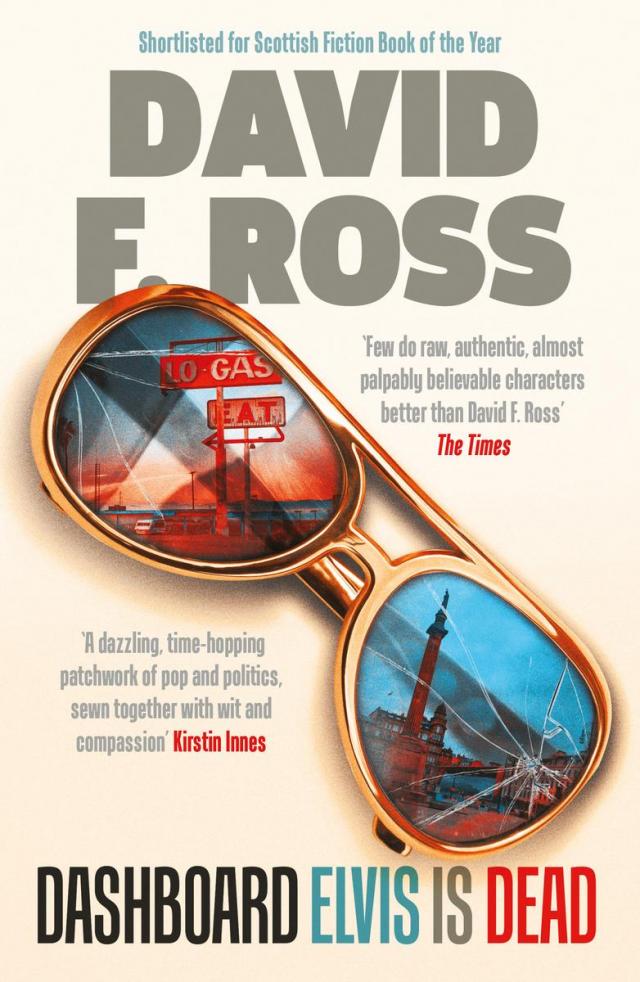
Dashboard Elvis is Dead, page 3


You look a bit … lost, he says. He laughs. I do too.
I could drive you back, if you’d like, he says. You could tell me more about you?
He is polite. And his interest seems genuine. But what is there to tell? I am a watcher. Constantly on the periphery of things. A loner. Tall, flat-chested. Invisibly asexual. I have few friends, since access to Humble High School for someone like me isn’t a birth right. I don’t really fit anywhere, other than on the athletics field.
I am wary about who I trust. I might be open to someone in the halls one week, the next week they might use the ‘N’ word. Or I’ll overhear low-level locker-room jealousy that my speed across the track is down to genetics. Centuries of practice borne of running away from the white man. Those who speak and act this way probably don’t consider themselves to be racists – and are most likely parroting opinions that they’ve grown up around. They might even come to consider their younger selves as just stupid, thoughtless kids being obnoxious to each other. Drilling down deep for a reaction. But it does happen. And it hurts. And that word, nigger, it has never lost its power to cut deep and right to the bone. To demean and isolate. I’ve learned to be detached.
The gates open. Larry drives the car through them. He pulls up next to the taller guard. I see Larry leaning over, and then the taller guard points at AJ Carter’s Chevrolet.
Thanks, I say. I better go.
Where are you goin’ for spring break? he asks.
It takes me so much by surprise that I lie without even thinking.
Uh, San Francisco, I tell him.
If only. Perhaps someday.
Cool. I’m just headin’ back to Fort Liquordale, he says. He flicks the head of a plastic Elvis Presley figure on the dashboard. It smiles back at us, legs spread, finger pointing. The figure’s head bobbles and wobbles. He flicks it again and Elvis falls over, the adhesive on the base giving way.
That’ll be me, he says, and then, Uh-huh-huh! He laughs and then seems embarrassed because I don’t.
I should go, I say. Again.
I’ll see you in school? he says. Upturned at the end. He is asking my permission.
Yeah, I say. You will.
My face is flushed. I’m not sure what to make of his attention.
Larry hadn’t gotten out of the car further up the drive. He hadn’t even made it to the members’ car park. Security was tight because there were VIPs visiting. A second gatehouse, with two more diligent guards – that was as far into the hallowed grounds as Larry was permitted to go. He didn’t get to see the course, or the clubhouse.
No teamsters. No trailer trash. And most definitely no Black – or even mixed-race – females. Unless they merely strive to keep the place clean. And as for Mexicans? Well, there can only be one Lee Trevino. He wouldn’t be exceptional, otherwise, would he?
Our drive home is conducted in silence.
I sit on our rotting timber porch every day, watching Larry dig up the early-season bug larvae. Occasionally I read, but I do little else. I think about AJ Carter a lot during the Easter vacation. I think about his freedom and contrast it with my own. Confined to this trailer park complex surrounded by people who never go anywhere. I hate this seasonal imprisonment. My subjugation. I imagine him on the Florida beaches. Playing volleyball in his shorts with his friends. Laughing. Letting off steam. Getting school and exams out of his system. Getting wildly drunk and the wild, drunken dancing afterwards. Having unprotected sex in convenient roadside motels. Sowing oats. Recharging as only the children of means are permitted to. Maybe even getting arrested. Things to brag about during the comfortable life that stretches out in front of him like a wide, open interstate highway. I think about him spending more money in one hedonistic week than Mom and Larry can spend on food in eight. Thinking about him like this gives me a panicked trembling in the pit of my belly. And it aches this time. Because, despite the unlikeliness of common ground, despite my ordinariness, his remarkableness – despite everything, I like him.
I see AJ Carter six times in the week following the return to school. I can’t say I was looking for him specifically, but in a student population of over two thousand, that seems too coincidental.
Strangely, given the significance I’ve attached to everything since, I can’t recall the lead-up to our first date. The precise words. Whether he stumbled over them nervously or delivered them with the assured confidence of a popular prom king. Much of the weeks that followed has been blanked out. Like a protective cover has been thrown over them to preserve them as sacred.
We’ve been hanging out in the shadows for a couple of weeks. Just the two of us. No-one else. We take the Greyhound into Houston. AJ’s idea. He wants to go to the new skate park. Devlin Carter doesn’t approve of skateboarding, fearing what injury could do to his son’s varsity prospects. Devlin Carter – a Republican senator, no less – wouldn’t approve of me. I would cause a different type of injury.
No-one knows where we are. We decide to go roller-skating instead. I don’t have my own roller-skates. AJ gives me roller-skates. He says he has stolen them. But I suspect he bought them. I’m sure he is sparing me any embarrassment. It’s sweet, both the gift and the lie. I find it endearing.
What type of music do you like? he asks on the bus.
We are slowly edging past the initial attraction.
Not sure, I say, giggling. I like Stevie Nicks. I like Hall & Oates.
Really?
You’d expect me to like somethin’ a bit less … Ivy League white boy? I am chiding him. But not really.
No, no … um, that’s not what I meant.
His pale cheeks blush.
Like Marvin Gaye? Or maybe James Brown, or… And then he starts singing.
People sat in seats in front turn around with looks of bemusement. Then disgust. He sings louder.
More passengers turn. A ripple effect that washes up to the driver’s seat. I glimpse the driver looking in the mirror. AJ stands. He looks down at me. A hand on his chest, the other waving freely before his hips swivel, and he points like the dashboard Elvis from his car. He serenades me as the people at the front of the bus frown their disapproval of us, the white quarterback and his racially indeterminate female companion.
She’s gone, she’s gone
Oh I, oh I … I better learn how to face it.
He sings louder. It’s amazing the unshakeable self-confidence that a secure future can breed. I blush. But it is exhilarating. We don’t reach Houston. The driver puts us off his bus at Kinwood. We walk home. Ten miles or so. Laughing, skipping, me on AJ’s back. Him briefly on mine before we topple over. We ignore the protesting horns from cars as they pass us. We repeat the ‘ha’ breathing sound from ‘O Superman’ for almost thirty minutes. It is the best day I can ever remember having.
4th June 1983:
2.25pm.
Momma goes outside. She stands on the trailer’s porch.
No sign of smoke, I hear her say.
Then a more distant voice yells: Somethin’ goin’ down at the High School.
But it’s a statement, not speculation.
2.50pm
We take Gonzo and walk. Some people run. Our pace naturally quickens. Everyone is heading in the same direction. And those that aren’t stand and stare towards the high school. I see old women at the five-and-dime hold trembling hands over their open mouths. The shockwaves have rippled this far already, it seems.
3.30pm
Oh my God! screams one woman repeatedly. Those poor boys! she manages to yell before being helped away from the police cordon. A large group has gathered. The road down to the school gates is now blocked. The insistent wail of the sirens has been supplemented by the buzz-buzzing of the overhead media helicopters. Flying low and competing for the shot.
What happened? asks my mom. No-one answers her.
3.45pm
Well, Christ Jee-sus! The radio’s sayin’ eleven of ’em. Eleven of those boys. All gone. Dear God in Heaven.
The man who says this is on his knees. Tears stream down both cheeks. He stands and calls on his Lord and punctuates the calls with awful high-pitched yelling noises. It’s as if he is possessed, like many who crutch religion often seem. Three women and another man run to him. He collapses as they reach him. Momma leads me away. Further to our right, on the other side of the stream near the school fence, a large group of students are hugging and crying. Paramedics tend to them. Beyond them, another cluster. And further round, on the edge of the tree belt, another. Each much larger in size than the previous.
It’s the football team! I hear another man’s voice in the distance.
He’s shot the fucking football team! shouts the man.
It is my birthday. Sweet fucking sixteen. Life – and all its challenges – stretches out in front of me.
Their bodies aren’t yet cold. There is widespread support for the bereaved in the wake of yet another mass shooting. But nothing will change. Devlin Carter’s Republican colleagues rally around the Second Amendment like it was the Alamo. Death has descended on Humble, and a compliant media is on hand to capture it. The death of an American dream. The right-leaning side of the dream. The one where an individual can achieve anything they want in life regardless of their race, religion, gender, or sexuality, so long as they are prepared to work hard enough to achieve it. The all-white American Dream that does go better with Coke. That does star Natalie Woods and Steve McQueen or Bullwinkle and Julia. That does come with a Jim Webb theme tune sung by Glen Campbell or The Rare Earth. The Suppression That Will Always Be Televised. There’s your commercial tagline, middle America.
I live alongside those who are conveniently brushed out of sight. Those individuals who can’t – or won’t – work hard enough. And those who might hold down multiple minimum-wage jobs and still can’t dream of ever owning their own home. Those forced to pay unreasonable rents for sub-standard properties. Those whose greatest hope in life is that they never fall ill. Those with a hand permanently out for welfare. That’s my community. That’s our immediate neighbors: the ones who despise Delphine and Larry because the mixed-races are somehow worse than Black people.
Although I’m aware from first-hand experience of the gulf between those who have and those who have not, I remain naïve about the restrictions my ethnicity, my background and my gender will impose on my future. The continuing fortune of the scholarship relies on maintaining a certain performance level on the field. The middle-class teenagers I share the classroom with do not have that pressure. Our deprived little part of Humble, where the trailer-trash kids live, sees none of the oil money that Reagan’s early presidency was built on. There is none of the palpable optimism that sustains Houston and Dallas – the boom cities that are gaining international capitalist attention.
14th June 1983:
AJ’s funeral is the eighth of the fourteen. His receives the most coverage. An unstoppable outpouring of grief for the school’s star quarterback. I enter at the back of the vast, modernist Christian Church, with its vaulting concave timbers rising to a peak like it is the mould for an upturned boat’s hull. I sit in the rear pew. The closest position to a side exit. Those in front and to the side of me have leathery skin, artificially ripened by the sun that shines righteously on condos down in the Florida Keys. My natural brown tone is lighter. Yet I am still their inverse, their opposite in every conceivable way. An older, paler Ruby Bridges, freed from the canvas of Norman Rockwell’s The Problem We All Live With. I listen to the praise and the celebration and the regrets, and observe the restrained public grief politely expressed for a young, promising life taken far too soon. I don’t recognize the eulogized him.
The death of an American Dream, says the minister. God-fearing Republican heads nod in agreement; the young man they are burying today was the epitome of their own American Dream. He represented their truth. The canvas onto which they painted their own vicarious ambitions. They grieve for themselves. Less for him. ‘From the Depths of Woe’ rings out enthusiastically, despite the doleful context. They exhort their Lord to turn a gracious ear. They lament their loss – a glorious young man with his whole adulthood ahead of him has been ripped from them. They acknowledge that no man can glory in God’s sight. And no-one is blaming God, for theirs is a God this congregation sees in their own likeness and not the other way around, and to apportion blame to God would be to acknowledge that He had forsaken them and the money that had built this House. It wasn’t an act of God that caused Timothy Allen Rennick to drive to his high school that May afternoon. To park up near the sports field. To advance towards his former team-mates and to fire bullets indiscriminately from an automatic rifle into their huddled bodies.
Those numbers. Twelve eighteen-year-old football players and two coaches, neither yet thirty years of age. Nobody can comprehend why he did it. What could’ve caused a good, white Christian boy from a good, white Christian family to act so savagely. To behave like an unprincipled savage. The sense of disbelief clogs the humid summer air, irritating everyone like a pesticide dusted over the entire city.
The savage is still alive. Leniency – perhaps even argued for by some of the people in this room – may yet save this privileged young man from a death-row gurney. Leniency can help them to understand what drove him to it, this barbarian brutality. Had he been Black, it would be easier for them to understand. Had he been Black, he’d be dead already. No need for trained negotiators to talk a Black boy down. The death of an American Dream, says the minister. Again, but slower. Underlining it as if this short life only makes sense when summed up by hyperbole. So much was expected of AJ Carter. He was destined for success in every aspect of his life. But the subject of this awful sermon is a different AJ Carter. The AJ I briefly knew didn’t want his life’s achievements to have been handed to him on a silver platter. My version of him didn’t want to go to the University of Houston. Didn’t want to study law. Didn’t want to follow his daddy and his grandaddy into Grand Old Party political circles. And didn’t want to spend conspiratorial whisky weekends with the likes of Larry’s boss over at the Lochinvar.
The AJ Carter I briefly knew wanted to escape from a life mapped out by others. He wanted to hit the road, Jack. To travel America and then keep going when America ran out. He talked of Kerouac. Of Allen Ginsberg. Of Bob Dylan. What did I know of the life, the love, the personal desires, and the cinemascope wishes that they sparked in him? At sixteen, I barely knew these names. But I came to appreciate what they represented for him. Freedom. And independence. The twin pillars of a dream that America denies so many of its own people. Everybody has their own version of the American Dream. Paradoxically, escaping the one painted at his funeral service was the kernel of AJ Carter’s. And gradually, as the darkness lifted, it became mine. That was his legacy.
The loss experienced by those who surrounded me in that church on that awful day in 1983 must have been immeasurable. None of them knew who I was, or why I was there, or how I could have known their boy so intimately. But I understood their grief. I just didn’t understand my own. His body left the building to the southern, plinky-plod piano death march of Elvis Presley’s ‘Amazing Grace’.
Yes, I too was blind but now I see.
The Ballad of the Band (1)
by David F. Ross
Why do we write about anything? I ask myself that question regularly, and not just in the dark hours when words dance on the periphery of my imagination but like truculent children, refuse to co-operate. Writing is a chore. Words that should fit together like Japanese tenon joints jar like ill-fitting false teeth. I get up and I move away. I change position. Cigarettes and alcohol. Anything to kick-start a bit of creativity. I try to fool myself. No-one will read these words, in any case. But that doesn’t work. I remind myself that any writing is only about the writer. I hope that universal truth will alleviate the burden of imminent criticism. It’s about me. My truth. My perspective. If the point of writing is for the writer to determine who they are, to express that in ways that are unique, then who gives a fuck if nobody gives a fuck?
I once authored a work entitled ‘Ballad of the Band’. It’s undoubtedly what you know me for – if my name does ring any bells, that is. Immediately prior to it being published in a fashionable UK magazine, I was a young, aspiring writer. I’d had a few inconsequential pieces placed here and about; nowhere of note. But like many who write, I was struggling. In much the way I’ve described above. Struggling to find the point in writing anything at all. I imagined what else I could do with the ridiculous amounts of time it absorbed. Building a wall. Fixing a leaking tap. Digging a fucking hole, only to fill it in again once dug. Anything else but sit for days in front of twenty-six letters that I couldn’t drill into meaningful composition.
Writing became an unrewarding habit that was affecting my fragile mental health. I read the work of others, searching for inspiration, but found only desolation in the knowledge that where they soared with angels, I stumbled and tripped. Writing didn’t provide me with a means of making a living. But I didn’t need a career – in writing, or in anything else. My late father was a musician. A relatively unknown one, his singular contribution to popular culture was the part-composition of a song, which, while not specifically about Christmas, has become a staple of the festive season. From the end of October to the start of Hogmanay, you’ll hear it hundreds, if not thousands, of times. From street buskers to department stores, hairdressing salons to television adverts. It’s everywhere. It will drive you mad. You can’t escape from it. Unless you kill yourself.
Most people intent on suicide and drawn to a river, throw themselves from a bridge spanning it. My father couldn’t swim. He hated the thought of being in open water throughout his life. His dry body was found, twenty feet above the Clyde, hanging from the City Union Bridge in the early hours of 1 January, 1978. There were other factors involved. It wasn’t solely attributed to the song. The day after my sixteenth birthday, my mother, having fulfilled the terms of the job as she saw it, left us. My father never got over this. Any guilt he had over his own failings he deftly transferred to me. He spent the rest of his life reminding me that he had remained when his opportunities to escape had been plentiful. I’ve neither seen nor heard from my mother since the day she walked out. There’s nothing quite like parental abandonment to reinforce a lifetime of low self-worth.