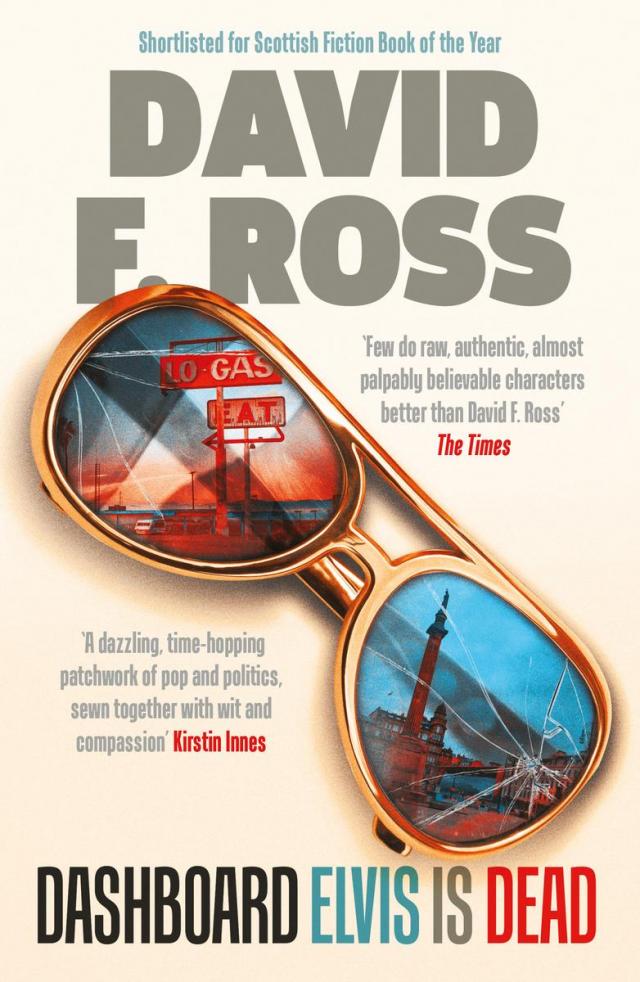
Dashboard Elvis is Dead, page 29


Reef runs his fingers through his hair again and swishes it back like a supermodel on a shoot before continuing.
It wis a total fucken bolt fae the blue when that happened. Ah hudnae heard fae him or the rest ae them in years. Of course, he wis just a front for AFB … Anna’s mob.
Were you happy with the deal you got? I ask him.
Jesus, aye. Like ah’d won the bloody lottery. Ah wisnae asked for permission, but as one ae the listed composers, ah got an upfront sum, an’ the royalty cheques still drop through the letterbox every six months. Cannae beat that, he says.
Not everyone got the same though? I ponder. I’m reaching here. Trying to join the dots.
Well, naw, but why should they? he replies, dander suddenly up.
But Chic Chalmers didn’t receive anythin’. Wasn’t that the reason he broke into Anna Mason’s house?
This is the basis of a developing thesis. Let’s see what Reef makes of it.
Ach … Chic. Ah don’t know aboot him. He wis always a walloper, that yin. Him an’ Anna never got on, that’s true. But he’s a junkie … a smackheid. Ye cannae believe a word they tell ye.
Hmm. He’s not biting.
And what about Anna? Are you still in contact with her? I ask.
She’s in a league ae her own, that yin. Salmond’s arrogance lost that vote. He’s just a dick, in my opinion. Once he’s buggered off, she’s gonnae be the top dog, y’know? Independence is just a matter ae time, he says.
How did you feel about them usin’ the song for the independence campaign? I ask him.
Aw adds tae the bank balance, right? Presumably, Jamie’s agreed tae it. Ah’m no’ gonnae object, am ah? Ye heard that crowd th’night. Defiant.
Does Anna Mason know you’re a supporter?
Em, ah’m no’, but dinnae print that, eh? Ye can be for independence without bein’ a nationalist, Reef says. And then adds, We had an arrangement.
With her office? I ask.
Naw, wi’ her direct, he says. Ah could play the song durin’ the gigs, as long as ah wis encouragin’ folk tae vote YES, he says. Small price tae pay.
I take some snaps with his permission, and he preens like Jagger has taught band frontmen the world over to.
Do you like her? I ask. Anna, I mean.
He takes a while to mull this over.
Ah like whit she represents, he says. No’ the party, though. It’s complicated.
An answer without answering.
Wouldnae want tae get on the wrong side ae her, he admits. And it sounds like he speaks from surviving the experience.
So … Jamie, I begin.
Look, we aw just leave each other alone. Only Anna, an’ mibbe Kenny, knows where everybody is noo, but apparently, it wis aw Jamie’s idea to go oor separate ways, Reef says. So, if it’s him yer really after … then McFadden might know. Doubt he’ll tell ye though.
How’s it goin’ with the new band? I ask.
Reef laughs at the question. Like he’s relieved we’re suddenly onto a subject with less hidden minefields.
It’s good. Ah’m constantly fucken knackered, but it’s better than bein’ a traffic warden.
I smile. I touch his knee this time.
Ah’ve done aw’right, tae be honest. Ah can think ae worse lives, he says.
No regrets, then? That’s not too bad, I conclude.
Aye. Life’s good, hen. He stretches. Ah’m glad they did, but Christ knows how they Apple dudes stumbled oan the song … Ah mean, it’s no’ like it wis a worldwide smash hit or anythin’ like that. We were one-hit wonders … naebodies in the big scheme ae things. It’s just a cool wee tune, nothin’ else.
I think it’s much more than that, I say.
Reef doesn’t hear this because a sudden noise is being made behind him.
Need tae shift, Reef, mate … ah’ve got tae lug they amps.
A stage technician brings the chat to a halt.
Aye cheers, pal, says Reef. We stand.
I should go, I tell him. I kiss him on the cheek. Thank you … for the ticket, for everythin’…
If ye dae see Jamie, tell him … well, y’know?
Yeah. I will. Goodbye Reef.
28th September 2014:
The phone rings out. Once again. An anonymous female voice politely encourages me to leave a message.
Hi. It’s me again. I’m sorry for leaving so many messages, but I really want to see you before I go back to the States. I have so much I need to say. To tell you about. About your mom. And I have something to give you.
It feels like I’m pleading, and that was the last place I wanted to be.
I grip the figurine in my coat pocket and conclude by simply saying, Yes. I do.
2nd October 2014:
The cab driver drops me on London Road.
Best lettin’ ye off here, darlin’, she says. Ye’d be quicker walkin’, time it’ll take me tae get through the crowds.
I thank the woman and hand a twenty-pound note through the tiny hole in the Plexiglas that separates us.
Mind yersel, now, the driver says, happy with the tip.
I head towards the stadium, swept along by a wave of green and white, and by visions of Hennessey walking excitedly alongside me.
I listen to the songs and the banter of the fans. How he’d have loved the spectacle. This is my first experience of a football match. It’s just a word but ‘soccer’ somehow doesn’t seem right here. It feels like a pilgrimage. That I am here representing him. I take photographs, lots of them, spellbound by the experience.
Inside the stadium, the atmosphere is electric. I’m shown to a hospitality floor. I notice the sign above the door: The Mason Suite.
My seat is amongst the guests of a loud, brashly dressed man who has a private box for the match. I’m not introduced to any of them.
How ye doin’, hen. Ah’m Matty.
According to the old man sat next to me, this European match against the team from Zagreb has not captured the imagination of the Celtic fans. He points to the closed top tier of the stadium.
Would normally be rammed, that, says Matty.
Despite this, the volume builds towards kick-off. Tens of thousands of supporters, glowing in the floodlights, stood under a green-and-white tapestry of scarves, singing ‘You’ll Never Walk Alone’ up into the dark sky over Glasgow’s East End is a spine-tingling moment. I look to my right and it’s not Matty I see, it’s Hennessey. He raises his scarf high above his head, looking to the heavens, tears in his eyes.
Better than I ever imagined it’d be, doll, he says.
I smile and reach out to hug him. Matty accepts the embrace. He winks and gives me a knowing smile.
It’s aw’right, hen. This place’ll dae that tae ye, he says, after I apologize.
The fans aren’t in their seats for long. Only a few minutes after the match starts and the home team score.
Piece ae piss, says Matty. But his relaxed demeanor changes during the game’s second half. I jot down the following:
Holy fuck, Stokes!
Delia, you’re a fud!
Ye couldnae kick yer ain arse, Gordon!
Away an’ lose some weight, Commons, ya fat bastart, ye!
Celtic hold on to win the match, and Matty relaxes.
Hope ye enjoyed that, he says.
I really did, I tell him. Much more than I thought I would.
That’s Paradise for ye. Matty winks. Here, take this, he says, handing me his scarf.
That’s you a fan for life now. See ye, hen, he says, heading off to the bar.
I’m left alone in the seats. I photograph coordinated lines of stewards climbing and descending the terraces in unison before a voice startles me.
You must be Ms Montgomery … the New Yorker?
I turn to see a stout, smiling man wearing a dark-green blazer with a crest on the breast pocket.
Ah see ye came prepared, he says, motioning to the scarf around my neck.
Oh, that, yes … Kenny?
Aye, love. Kenny McFadden, at yer service. D’ye enjoy that?
I didn’t quite follow the rules, but I had a guide who helped me, I say.
Good stuff, says Kenny.
A roar goes up over Kenny’s shoulder.
Is that Rod Stewart over there? I ask him.
Aye. Ah’ll maybe introduce ye later. He’ll be pished, nae doubt, but he’s a charmer, y’know?
You enjoy it here? I ask as Kenny sits alongside me.
Christ, who widnae? They’re ma team, like. Heart an’ soul. He taps the badge on his jacket.
They were aw Celtic fans tae, y’know, The Hyptones. This is where Jamie an’ Brian first came up wi’ the idea ae bein’ in a band. They could play … the music, y’know, but they were shite in the beginnin’ … apart fae Jamie. That boy wis a natural, says Kenny.
How did you know them back then?
Ah wis a scout – for Celtic. Lookin’ for young players. Ah first spotted Brian scorin’ goals for fun for his school team in the seventies. He’d’ve been aboot twelve. Cocky wee bastard, even then. Three years later, him an’ Jamie were playin’ in a youth team ah managed. But ye could tell their minds were oan other things. Music mainly, but lassies tae, he says, smiling.
Was he good … Jamie, I mean? I ask.
At fitba? Aye, an’ he knew it tae. He coulda played for the first team. But he loved the music more, y’know. The Ramones, The Clash, The Jam. Him an’ Brian just drifted away fae the game. Jamie was easy goin’ but Brian was hard work at the end. Bingo was Chic’s pal. Chic wis just an arsehole … still is, as far as ah know. But he had a drum set. Cannae remember where Reef came fae. He might’ve been Anna Mason’s pal. Reef was a good-lookin’ kid, an’ fucken full ae himself. A natural frontman.
Kenny laughs and shakes his head.
Ah put two an’ two th’gither. Spotted an opportunity, he says.
They were great though, weren’t they? They could’ve been really great, I suggest.
Ach. Aye, for about ten minutes … an’ then the flame blew oot. They blamed me. Qué séra. Thing is, it’s no’ always business that ruins it. Sometimes bands have one, mibbe two great ideas, if they’re lucky. An’ then they run out ae inspiration. It becomes a job, a pain in the arse just like every other yin. An’ that’s usually when they split up. Or when they should. Just bad timin’ that it happened when it did, he says.
But you left them in the States, I say.
I see an eyebrow rise.
Darlin’, it wis every man for himself back then.
Kenny stands to shake someone’s hand then sits down again.
No’ proud ae myself for that, but at least ah’ve made up for it since. They’re aw doin’ okay now. Except for Chic, but that’s aw doon tae him, naebody else.
I don’t update him regarding Bingo McAllister’s status.
Do you know where Jamie is? I ask.
Kenny draws air in through his teeth before blowing it out again.
Ach. Ah don’t know, love.
He pauses and looks around before whispering: Ah made a promise.
Too whom, I ask.
Kenny McFadden starts to answer but stops himself.
Do you even have a contact number? I ask, too forcefully. I must sound like a private detective.
Look, hen, he just wants tae be left in peace. Don’t get me wrong, he’s as grateful as the rest ae us tae whoever it wis that decided tae stick their song in that commercial – ye can put that in the piece you’re doin’ – but he’ll no’ see ye tae talk aboot it directly.
Someone knocks on the glass, trying to gain Kenny’s attention.
Listen, miss, ah’ll need tae go … Gerard Butler’s waitin’ for me.
Kenny stands and lifts a hand before turning away. But he stops before reaching the door. He turns, looks at me directly, pauses, and then sighs. He writes something on a piece of paper, and walks back, handing it to me. It’s a telephone number.
For Christ’s sake, don’t let Anna Mason know ah gie’d ye this, eh? Good luck tae ye. Ah hope it aw works oot for Jamie, wherever the hell he is now, he says.
We shake hands, and then Kenny McFadden is gone, lost in the celebrating crowds.
I sit again. I look out at the empty stadium seats. Two tiny groundsmen fork the grass pitch. They look like small birds pecking at it, dwarfed by the structures surrounding them. I reach for my phone.
Hi, hello … Reef? Yeah, it’s Jude. Jude Montgomery. Sorry to call so late but I have somethin’ for you.
4th October 2014:
I meet with the writer David F. Ross. He has suggested the Necropolis as a meeting place. High up among the tiered contours of gravestones overlooking the city. He is an awkward and pensive man. A loner, by his own admission. I tell him that I understand solitude, that I’ve also had to become comfortable with my own company.
It’s a fruitless venture though. Mr Ross has no insight to offer me. And no information other than a possible last-known address for Chic Chalmers. He won’t trade it without a reciprocal offer though. Even though it’s doubtful I’ll follow up on the Chalmers connection, I give him Jamie Hewitt’s phone number, the one I received from Kenny McFadden. I’ve left numerous messages on its voicemail, and it already feels like yet another dead end. Mr Ross tells me he already had it, and we part, both no doubt wishing we’d put the thirty minutes to better use.
8th October 2014:
I leave the coffee shop. Eileen and her friend, Sadie, are long gone. The bustle of the early-evening rush hour has died down. It’s dark outside but at least the rain has abated, and the wind has lessened. My phone vibrates in my hand, and I answer it.
Hello, Jude.
I don’t recognise the caller’s number. Nor, at first, the accent, so unexpected is the call.
It’s Rabbit.
Oh my God, I say.
The emotion is rising, and I have to work hard to suppress it for fear of it quickly overwhelming me.
Did you just pick up my message? I ask, trembling.
Hmm. How have you been? Rabbit asks.
Her mood is hard to decipher, still, she’s here, calling, reaching out, and that’s all that matters.
Uh, yeah … I’ve been fine. Desperate to reach you, I say.
Um, things have been kinda tough lately, with the aftermath of the fire an’ all, says Rabbit.
I can imagine, I say.
There’s a pause. It feels awkward.
Listen, Rabbit, I’m leavin’ next week. Returnin’ to the States. I really want to—
Yes, says Rabbit. I’ll see you.
My eyes well up.
I have meetings and classes in the afternoon but how about lunch tomorrow? she says.
Oh, yes, I say. God, yes … thank you.
I’ll text you, says Rabbit.
Okay.
And with that, she’s gone. No declarations of love or regret or forgiveness. That can wait until we are facing each other, I guess.
I hail a passing cab. It veers into the sidewalk, forcing me to move sharply to prevent it being taken by an aggressive man convinced he flagged first.
Do you take a card? I ask.
Sure. Where tae, love?
I read out the address given to me by David F. Ross:
33 Petershill Court, Petershill Drive, please.
The towers at the Red Road Flats – you sure about that?
I hesitate before saying, Yes.
The driver swings the car around and we head off to the East End.
Dashboard Elvis Is Dead
by David F. Ross
‘D’ye want me tae wait here, hen?’ The driver senses Jude’s unease. Her exhilaration at receiving Rabbit’s call has gone.
‘Would you?’
‘Aye, nae problem. Need tae keep the meter runnin’ though.’
The orange sodium at the base of these monumental towers makes everything seem scarier. A fog has also descended. Only the blinking red lights at the top give any indication of the scale of these desolate high-rise structures. The towers were once testament to the social experiments of the late sixties. Humans as lab rats, stacked in the sky in poorly built concrete boxes. Now, they stand as tombstones. Fit only for impoverished students or those desperately seeking refuge from genocidal dictatorships. Or Chic Chalmers. Beggars can’t be choosers. The towers are on borrowed time already. As part of the renewal legacy of the Commonwealth Games, their demolition has been announced. They have less than a year.
Jude considers leaving Chic out of the story. Considers simply walking away from this forgotten foreign wasteland and not looking back. But his perspective on Anna Mason is the story, Jude imagines. Her ruthless retribution, his imprisonment; that’s what she’s hiding. Jude shakes herself, reminded of dark nights in Queens, or Brooklyn, or of the time on 2nd Avenue when she faced down a gang demanding money from her and Andi. Although it’s easier to be feisty when you’re young and surer of your environment.
A group of youngsters veer out of the misty shadows. One holds a large dog, straining against its rope leash like Gonzo used to. Once upon a time she could’ve easily outrun the males. Maybe even the dog. Not anymore.
‘Help ye there, darlin’?’ one says.
‘Help ye oot yer scants, he means,’ says another. They all laugh.
‘Whit ye got in the bag?’
‘Lookin’ tae buy some smack, hen?’
‘…Or tae get a smack?’
‘Smack ma bitch up! Hahaha, man … fucken landit, ya cunt.’
The dog barks angrily at Jude, and the youngsters laugh in unison.
‘Tyson’s efter a bone!’
‘Haw-haw, he said boner!’
‘Much furra blow job then?’
‘Fuck, Daz, she’s too auld, man. Her teeth’d faw oot while she’s suckin’ yer boaby!’