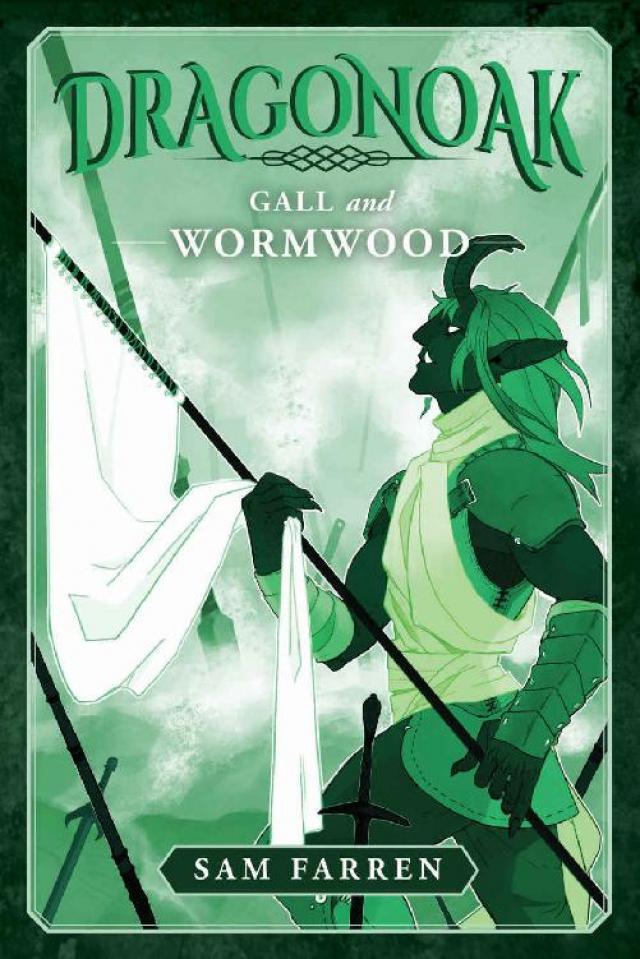
Dragonoak: Gall and Wormwood, page 43


The room was empty, beyond the three of them. My eye was drawn to bed, but the lumps under the covers were pillow-shaped; not even Kondo-Kana had mastered the skill of sinking so far into a mattress that she went unnoticed.
“Good afternoon, Your Majesty,” I said, bowing my head in a polite attempt to draw her attention away from her work. “How are things?”
“Well. Quite well. Did you know that I’m the first in my family to have experienced the leaves turning colour as they are? It is amazing how much work one can get done when people can neither reach me by letter or by presuming to barge into my study. Perhaps my dear aunt wasn’t entirely misguided in sending me here. After all, with Felheim’s aid, I ought to be able to put numerous plans that once felt like mere dreams into motion. I can start rebuilding bridges – literally, at that – and dedicate more farmland to food with a steady supply of bitterwillow,” she said. “We should be leaving within the week. Just enough time to avoid any war. Allies we may be, but all of this work will be for nothing if Canth falls into the hands of whoever my successor may be. Were you looking for Kana?”
“I was,” I said, trying not to linger on the thought of them being back across the Wide Waters in a matter of weeks.
“She’s outside. I couldn’t tell you why. In fact, I believe she might be doing it to get me to ask her why,” Queen Nasrin said with a shake of her head. She pointed towards the double-doors leading onto a small patio. “She’s been asking for you.”
“She has?” I asked cautiously. I was half-convinced she’d have forgotten I’d been in the Bloodless Lands at all.
“Oh, not in so many words. Rowan will find me when she realises that I need to be found. That sort of nonsense. It loses any sense of being self-assured when you hear it no fewer than five times a day.”
“Hopefully this will get her to stop,” I said, excusing myself with a bow.
Queen Nasrin returned to her writing and I headed for the patio doors. I pulled the latch across, stepped out, and the wind battered my sides. It wasn’t pleasant outside. The trees had already stripped themselves bare and the skies were grey and heavy with the threat of more rain. A storm was on its way and it may well have been what Kondo-Kana was waiting for.
She was clad in her usual red cloak. While it was excessive for Canth, it was barely enough for Felheim, and the shawl draped over her head did little more than ripple in the wind. She leant over and wrote as Queen Nasrin did, and I quickly learnt that the warmth I felt from necromancers wasn’t enough to banish the cold.
“Aejin,” Kondo-Kana said. Her back remained to me and her quill moved restlessly across the page. “It is cold and your bones are already brittle. Go back inside, where your marrow will warm.”
I considered it but convinced myself that rubbing my hands against my forearms was enough to keep the cold at bay. At least I’d thought to wear boots. I stepped around the table and brushed a few lost leaves off the seat in front of her.
The tip of her quill scratched against the parchment, ink flowing freely, and I saw myself in hundreds or thousands of years, sat across from a young necromancer, only able to recall Claire and Kouris and Akela and Reis because some dusty tomb laid claim to their names. I wrapped my arms around myself and watched as meaningless symbols filled the page. I let autumn’s tentative bite remind me that I was in the present, and the future was mine to shape.
“What are you writing?”
“Eulogies. Apologies. Histories,” Kondo-Kana said. “My life has been so much gall and wormwood, yet I wish I had made a record of it before this. I wish I had not forgotten that first truth of Myros. I wish that so much had not happened, and that if it had to unfold as it did, I wish I could remember every moment of it. But we are close to what you call the Bloodless Lands and so recollection comes easier. I ought not to waste this chance as I have wasted so many others. And so it is: Gall and Wormwood.
“But that is not why you are here. What do you wish to ask me, Rowan? Do you wish to speak of Myros and all that was rekindled within it?”
Kondo-Kana was as far removed from the flame of a woman bleeding light and beating the ground as Katja was from the person who’d once claimed to be my friend. I’d told myself I’d accepted that there were things in Kondo-Kana’s past that weren’t mine to understand or forgive, but curiosity still claimed me so.
“Was everything you said true? Everything you said about the necromancers and Isjin? About what we are?”
“Of course. In Myros, all knew this. We learnt these things as you learn the names of the seasons,” Kondo-Kana said, setting her quill down. “It is strange to think that you have not always understood what you are. A Daughter of Isjin in the truest sense.”
But how was I supposed to understand what I was when I didn’t believe in my supposed source? I had travelled from Felheim to Kastelir to Canth and back again and seen no proof of Isjin, no reason to believe that Bosma hadn’t become what it was through sheer chance alone.
“You talk about Isjin, but—”
“How do I know she is real?” Kondo-Kana interjected. “Not only do I feel her, Aejin, with each breath I borrow from her, and not only do I see her seared into my eyes where colour once was, but our friend Haru-Taiki has met her.”
It was so far removed from the words she usually reached out with. I’d been waiting for her to tell me that I already knew Isjin but simply didn’t know that I knew, or that all I needed to do was claw out my own light and stare without seeing. Instead, all she offered me was a single fact.
“You need to understand how real Isjin has always been to us, Rowan. I do not give thanks where none are due and I do not offer up prayers that will never be heard. Isjin is not an idea to us, not a concept abandoned by our ancestors,” Kondo-Kana said. “In Myros, after she left, the Aejin yu ka Aejin were said to be proof of her miracles. We were made as a reminder of her presence in the world. But centuries passed and revered though we once were, our services were expected of us. They began to see us as Isjin’s final apology.
“By the time I came into this world, the only choice we were given was what temple we wished to serve. They laid claim to us, Aejin. You saw the brand across my back, did you not? Our temples would tattoo us with patterns more intricate than star charts so that we would never be lost to them.”
“But how? How did they keep necromancers there? Couldn’t they just…?” I asked with a wince and pointed at my back.
“Carve off the brand? Some did, but many more were only too happy to serve. But what is more suspicious than an Aejin without a brand? They would never be able to tell anyone of their powers again. And if they wished to return to the temple, they would have to explain their smooth skin; their betrayal,” Kondo-Kana said, dropping her hands into her lap. “Of the few who ran, fewer still wished to fight. To see harm come to anyone. If their families were threatened with fire…”
“You escaped from that, didn’t you? And that’s why there was a war,” I said. Knots twisted in my stomach and tightened in bitter-sweet relief: I finally understood what had started it all. Necromancers hadn’t incited senseless violence and there was no reason for me to ever fear doing the same. “Why do you still have your brand?”
For once, Kondo-Kana had no answer for me. I met her eyes and knew she couldn’t bring herself to be rid of the ink that burnt into her skin, the reminder that she had not once belonged to herself.
“I am still the person you saw in Myros. I am the person history has whispered of. My surroundings and circumstances may have changed but the things I have done and thought and wanted remain true,” she said. “You do not have to forgive me. Nobody does. But understand that if you are hungry to change the past then I am starving.”
Kondo-Kana’s eyes blazed as she spoke.
Pressing a hand to the dry ink she’d penned, she held my gaze and said, “Would you like me to read to you, Aejin?”
CHAPTER XXIII
“It never occurred to me to think that I might be a necromancer, for they were establishments in and of themselves. Everyone on Bosma knew their names and could recite their deeds by heart. They were old, centuries, most of them, and their temples had been built from the ground around them. The youngest was more than eighty, by the time I was born. But you would not know it to see them,” Kondo-Kana said, eyes ghosting across the first page. “The Everlasting Kingdom of Myros was no longer in its golden age; that is what the philosophers said, though the common people noticed no changes. There was art and music, poetry and science. Celebrations of them all, in grand ballrooms. And there was theft and murder, deception and subterfuge.
“There were those who celebrated those things, as well.
“As I write this, I do so knowing that there are no words that can describe all that Myros was. All that it meant to me. The colours, the life therein; there is no expressing them. The dragon-born roamed the streets freely, arm-in-arm with humans, towers and houses and crumbling corner shops painted vibrant purples and gold, the stone of the street worn shiny beneath boots and talons and clawed toes. The phoenixes hopped from rooftop to rooftop, gathered on street lamps, and caught rides on the horns of obliging dragon-born.
“Temples to Isjin were found on every street, between tailors and bakeries, and incense burnt on the low sills, filling the streets with the scent of sandalwood and magnolia, of hope diffused into the air. When winter came – and it did, with thick, heavy snowfall – the people of Myros were prepared. The pane and humans worked together, pushing piles of snow to the side, that the phoenixes might melt them.
“Phos embodied all that Myros was from north to south, east to west. It was the Kingdom's heart long before it was its capital, and the centre of all the trade and innovation and piety that made us so everlasting. From the moment I awoke in this world, Phos was my home. It was my home and there will never be another, for that is the land my mother lived upon. She was the first one who breathed the words Kondo-Kana. In Myrosi, a Myrosi tongue older than the one I wield, it means little lamb.
“I did not grow up with any understanding of what I was. The knowledge was not withheld to me, was not denied. It simply didn’t occur to anyone to share it. Had I known the word for what I was, for what burnt within me, all in Myros would've fallen to their knees and held the answers out to me. But I had no questions. I lived my life.
“We were not poor. There were few who were truly poor in Phos, but we were not rich, either. Our neighbours were a baker, ever big-hearted and willing to share what they did not sell, and a young pane. Their name was Skalo-Halos, in the tradition of Myros. In spite of all we can be blamed for, we were never so foolish as to divide lands and nationalities between races. Skalo-Halos taught me many things: to sew, to cook, to sharpen a knife, and most importantly, how to apologise.
“My mother was from a small village in the north of Myros, close to the sea, where they dressed in thick furs for much of the year and hunted the fisher-beasts along the coast. When she was but twenty years old, her mother fell ill. The village had no healer. Only bitterwillow. She travelled to Phos, hoping to find a healer willing to trade their services for rich, silvery furs and salted meat. When the exchange was made after little more than a day spent searching, my mother did not leave.
“She did not leave the day after that, or the week after, either. She found work as a carpenter and always returned with dusty shirts, calloused fingers, and splinters she could no longer feel. Her mother, a renowned hunter in her youth, chose a quieter career: she became a poet.
“She wrote at dawn every day without fail. One poem, a four-line verse about the rebirth of phoenixes, The Sky Beneath the Sun, became a favourite amongst the Priests. But for the most part she worked in peaceful anonymity, making enough to buy new ink and paper and ensure her daughter did not have to work her fingers to the bone.
“For my part, I didn’t look upon the necromancers with envy. And they were necromancers then, not Aejin yu ka Aejin. I saw them no more than once a year, when we attended Phos' greatest festival, come the close of winter. They stood on platforms that were more plinths than anything else, and I watched with faint interest from a great distance. If anything stirred within me, I misplaced the source. It was the food, the festival, the dancing, the music. The music. All I wished to do was sing, from the days when I did not yet reach my mother's hip.
“I was thirteen when I first overheard my mother and grandmother whispering about me. I had been at Skalo-Halos', helping them prepare fresh cuts of meat – my mother had imbued me with the practical talents of her homeland – and returned home to change my shirt, or skirt. It does not matter what the garment was, or wasn't. What is important is that I had misjudged the angle of my knife and blood had splattered across my clothing. I crept back into my house, not wanting my mother or grandmother to see such a foolish mistake, and heard them murmuring in our living room.
“She has never been ill. Not once, my mother said. Sickness spreads throughout her school yet fever does not draw so much as a bead of sweat from her forehead.
“Do not linger on it. The girl has a tough constitution, like all the women in our family, my grandmother replied.
“I dragged you to Phos on what would've been your deathbed when you were not yet forty-five.
“I did not stay for the rest. I returned to Skalo-Halos' house without changing and did not appreciate the playful way they nudged my shoulder and asked if I had returned to a pile of dirtier clothing, having not kept up with my chores. I skinned Skalo-Halos' prize and severed fresh meat from the bone, and thought long and hard about what my mother had implied.
“I did not remember my skin ever burning with fever, my voice croaking or limbs aching, but that did not mean it hadn't happened. My mother and grandmother had raised me well. I ate meat and vegetables in equal amounts, and neither wasted anything nor bowed to gluttony. We were pious people; the healers at the local temple looked after all who came to them.
“At school, where we learnt the things the temple could not teach us, from the literature of the past to equations that would help us move into the future, I asked my friends when they were last sick. Each had a tale to tell.
“At the age of fourteen, I thought of taking a knife to my thumb to see how long the blood would flow for. I refrained. I became more cautious. I did not play outside or wrestle with my friends. I did not want to scrape my knees and watch as they refused to heal over.
“Fifteen, sixteen. And then, one night, there was a great clamour from next door. A cacophony of noise had me, my mother, and grandmother out of our beds before it could fade. Broken glass. Something heavy hitting the floorboards.
“Desperation. Anger.
“When I wrote that the philosophers said Myros was no longer in its golden age, as the philosophers before them did of the decades before ours, it was because they chose to believe that crime had not existed until they opened our eyes to it. In the same way, crime had not been real to me until that moment, for it had never been more than a story; a warning meant for someone else.
Until we found Skalo's body on their bedroom floor.
“They were moving, but it was a shuddering, roiling thing. It was a thing of defeat. To this day, I do not know what was stolen from them. Skalo-Halos always had enough to get by, but they did not have enough to steal. They had startled their intruder and ended up with a blade in their throat. My mother screamed for me to bring blankets to press to the wound and my grandmother was making her way out of the door in search of a healer, but it was too late.
“Too late for them. Not for me. Time no longer pressed itself around me.
“It was hazy. Distant. I understood what I had to do and more than that, I understood that there was no rush. I knelt by Skalo's side and placed my hand on their forehead. As death came for them, I felt their pain not because they were family and not because I wanted nothing more than to suffer in their place, but because I felt their pain. It was mine. They were dead when I pulled the knife from their throat. My mother yelled and caught my wrist, stopping me entire seconds too late. Time was her foil, not mine.
“The blood rushed from the wound, gurgling. For the first time, the sight of so much red did not frighten me. For the first time, the blood pooling around my knees and running across my fingertips elated me. I knew then as I now know the colour of the void that I was more powerful than what had dared to take Skalo-Halos from me.
“The wound closed and I exhaled.
“Skalo-Halos choked and spluttered and coughed, but the gold returned to their eyes and death did not hold them for long.
“The morning of the attack, I had been the daughter of a carpenter, the granddaughter of The Sky Beneath The Sun's visionary, and the next morning, I was something else.
“People remembered my name. They spoke of it with reverence and did not mock its ancient meaning. Priests came to my house. Our neighbours gathered in the street, trying to steal glances through the window, and those who had never so much looked my way at school had the gall to knock on my door, claiming we had been friends for as long as they remembered.
“It was too much at once. Perhaps that was the root of the problem. Perhaps not. Perhaps I would have become what I did had I been eased into the process minute-by-minute, second-by-second. It is not worth dwelling on what did not happen. Regardless: I had gone from a life of schooling and chores to being stood in front of the King within mere days.
“He was an old man. A seasoned ruler. He was two hundred, perhaps. I do not remember and it does not matter: he was less a person and more part of the throne itself. He congratulated me as though I had achieved something. As though I had worked for it. He said I was the first new necromancer he had the honour of meeting in almost a century and that he was certain I would succeed.