The Coming of the Third Reich, page 36


III
As 1932 dawned, the venerable Paul von Hindenburg’s seven-year term of office as President was coming to an end. In view of his advanced years - he was 84 - Hindenburg was reluctant to stand again, but he had let it be known that he would be willing to continue in office if his tenure could simply be prolonged without an election. Negotiations over automatically renewing Hindenburg’s Presidency foundered on the refusal of the Nazis to vote in the Reichstag for the necessary constitutional change without the simultaneous dismissal of Brüning and the calling of a fresh general election in which, of course, they expected to make further huge gains.112 Hindenburg was thus forced to undergo the indignity of presenting himself to the electorate once more. But this time things were very different from the first time round, in 1925. Of course, Thälmann stood again for the Communists. But in the meantime Hindenburg had been far outflanked on the right; indeed, the entire political spectrum had shifted rightwards since the Nazi electoral landslide of September 1930. Once the election was announced, Hitler could hardly avoid standing as a candidate himself. Several weeks passed while he dithered, however, fearful of the consequences of running against such a nationalist icon as the hero of Tannenberg. Moreover, technically he was not even allowed to stand since he had not yet acquired German citizenship. Hurried arrangements were made for him to be appointed as a civil servant in Braunschweig, a measure that automatically gave him the status of a German citizen, confirmed when he took the oath of allegiance (to the Weimar constitution, as all civil servants had to) on 26 February 1932.113 His candidacy transformed the election into a contest between right and left in which Hitler was unarguably the candidate for the right, which made Hindenburg, extraordinarily, incredibly, the candidate for the left.
Map 12. The President Election of 1932 First Round.
The Centre and the liberals backed Hindenburg, but what was particularly astonishing was the degree of support he received from the Social Democrats. This was not merely because the party considered him the only man who could stop Hitler - a point the party’s propaganda made repeatedly throughout the election campaign - but for positive reasons as well. The party leaders were desperate to re-elect Hindenburg because they thought that he would keep Brüning in office as the last chance of a return to democratic normality.114 Hindenburg, declared the Social Democratic Prussian Minister-President Otto Braun, was the ‘embodiment of calm and constancy, of manly loyalty and devotion to duty for the whole people’, a ‘man on whose work one can build, as a man of pure desire and serene judgment’.115 Already at this time, as these astonishing sentences showed, the Social Democrats were beginning to lose touch with political reality. Eighteen months of tolerating Brüning’s cuts in the name of preventing something worse had relegated them to the sidelines of politics and robbed them of the power of decision. Despite disillusionment and defections amongst their members, their disciplined party machine duly delivered more than 8 million votes to the man who was to dismantle the Republic from above, in an effort to keep in office a Chancellor whom Hindenburg actually disliked and distrusted, and whose policies had been lowering the living standards and destroying the jobs of the very people the Social Democrats represented.116
Map 13. The President Election of 1932 . Second Round
The threat of a Nazi victory was real enough. The Goebbels propaganda machine found a way of combating Hindenburg without insulting him: he had done great service to the nation, but now was the time for him finally to step aside in favour of a younger man, otherwise the drift into economic chaos and political anarchy would continue. The Nazis unleashed a massive campaign of rallies, marches, parades and meetings, backed by posters, flysheets and ceaseless exhortations in the press. But it was not enough. In the first ballot, Hitler only managed to win 30 per cent of the vote. Yet despite the efforts of the Social Democrats and the electoral strength of the Centre Party, Hindenburg did not quite manage to obtain the overall majority required. He gained only 49.6 per cent of the vote, tantalizingly short of what he needed. On the left, Thälmann offered another alternative. On the right, Hindenburg had been outflanked not only by Hitler but also by Theodor Duesterberg, the candidate put up by the Steel Helmets, who received 6.8 per cent of the vote in the first ballot, which would have been more than enough to have pushed Hindenburg over the winning margin.117
For the run-off, between Hitler, Hindenburg and Thälmann, the Nazis pulled out all the stops. Hitler rented an aeroplane and flew across Germany from town to town, delivering 46 speeches the length and breadth of the land. The effect of this unprecedented move, billed as Hitler’s ‘flight over Germany’, was electrifying. The effort paid off. Thälmann was reduced to a marginal 10 per cent, but Hitler boosted his vote massively to 37 per cent with over 13 million votes cast in his favour. Hindenburg, with the combined might of all the major parties behind him apart from the Communists and the Nazis, only managed to increase his support to 53 per cent. Of course, despite the hiccup of the first ballot, his re-election had been foreseeable from the start. What really mattered was the triumphant forward march of the Nazis. Hitler had not been elected, but his party had won more votes than ever before. It was beginning to look unstoppable.118 In 1932, better organized and better financed than in 1930, the Nazi Party had run an American-style Presidential campaign focusing on the person of Hitler as the representative of the whole of Germany. It had concentrated its efforts not so much on winning over the workers, where its campaign of 1930 had largely failed, but in garnering the middle-class votes that had previously gone to the splinter-parties and the parties of the liberal and conservative Protestant electorate. Eighteen months of worsening unemployment and economic crisis had further radicalized these voters in their disillusion with the Weimar Republic, over which, after all, Hindenburg had been presiding for the past seven years. Goebbels’s propaganda apparatus targeted specific groups of voters with greater precision than ever before, above all women. In the Protestant countryside, rural discontent had deepened to the point where Hitler actually defeated Hindenburg in the second round in Pomerania, Schleswig-Holstein and Eastern Hanover.119 And the Nazi movement’s new status as Germany’s most popular political party was underlined by further victories in the state elections held later in the spring - 36.3 per cent in Prussia, 32.5 per cent in Bavaria, 31.2 per cent in Hamburg, 26.4 per cent in Württemberg, and, above all, 40.9 per cent in Saxony-Anhalt, a result that gave them the right to form a state government. Once more, Hitler had taken to the air, delivering 25 speeches in quick succession. Once more, the Nazi propaganda machine had proved its efficiency and its dynamism.
Brüning’s attempts to curb the Nazi Party’s rise had obviously failed to make any kind of impact. The time seemed to many in President Hindenburg’s entourage to be ripe for a different tactic. Despite his election victory, Hindenburg was far from satisfied with the result. The fact that he had run into such serious opposition was highly displeasing to a man who was increasingly treating his position like that of the unelected Kaiser he had once served. Brüning’s cardinal sin was to have failed to persuade the Nationalists to support Hindenburg’s re-election. When it became clear that they were backing Hitler, Brüning’s days were numbered. Despite the Reich Chancellor’s tireless campaigning on his behalf, the old Field-Marshal, who embodied for many the Prussian traditions of monarchism and Protestant conservatism, was deeply resentful at his dependence on the votes of the Social Democrats and the Centre Party, which made him look like the candidate of the left and the clericals, as, indeed, in the end, he was. Moreover, the army was becoming impatient with the crippling effects of Brüning’s economic policies on the arms industry, and considered that his ban on the brownshirts got in the way of recruiting them as auxiliary troops, a prospect that became more enticing the more members they acquired. Finally, Hindenburg’s attention was drawn to a moderate measure of land reform being proposed by the government in the east, in which bankrupt estates would be broken up and provided as smallholdings to the unemployed. As a representative of the landed interest himself, with an estate of his own, Hindenburg was persuaded that this smacked of socialism.120 In an atmosphere heavy with behind-the-scenes intrigue, with Schleicher undermining Groener’s standing with the army and Hitler promising to tolerate a new government if it lifted the ban on the brownshirts and called new elections to the Reichstag, Brüning rapidly became more isolated. When Groener was forced to resign on 11 May 1932, Brüning’s position was left completely exposed. Continually undermined by intrigues in Hindenburg’s entourage, he saw no alternative but to tender his resignation, which he did on 30 May 1932.121
IV
The man whom Hindenburg appointed as the new Reich Chancellor was an old personal friend, Franz von Papen. A landed aristocrat whose position in the Centre Party, for which he had sat as an obscure and not very active deputy in the Prussian Parliament, Papen was even further to the right than Brüning himself. During the First World War he had been expelled from the United States, where he was military attaché at the German Embassy, for spying, or ‘activities incompatible with his status’, as the conventional diplomatic phrase went, and joined the German General Staff. During the 1920s he used the wealth brought him by a marriage to the daughter of a rich industrialist to buy a majority share in the Centre Party’s newspaper, Germania. Papen thus had close contacts with some of the key social and political forces in the Weimar Republic, including the landed aristocracy, the Foreign Office, the army, the industrialists, the Catholic Church and the press. Indeed, he had been recommended to Hindenburg by Schleicher as someone who would be sympathetic to the army’s interests. Even more than Brüning, he represented a form of Catholic political authoritarianism common throughout Europe in the early 1930s. Papen had long been at odds with his party, and he had openly championed Hindenburg against the Centre candidate Marx in the 1925 Presidential election. The Centre disowned Papen, who in his turn handed in his party membership card, proclaiming that he sought a ‘synthesis of all truly nationalistic forces - from whatever camp they may come - not as a party man, but as a German’.122 Now the break was complete.123
These events marked, explicitly as well as in retrospect, the end of parliamentary democracy in Germany. Most members of the new cabinet were without party affiliation, apart from a couple who were, nominally at least, members of the Nationalist Party. Papen and his fellow-ideologues, including Schleicher, saw themselves as creating a ‘New State’, above parties, indeed opposed to the very principle of a multi-party system, with the powers of elected assemblies even more limited than they had been in Brüning’s more modest vision. The kind of state they were thinking of was indicated by Papen’s Interior Minister, Wilhelm Freiherr von Gayl, who had helped create a racist, authoritarian, military state in the area ceded to Germany by the Treaty of Brest-Litovsk in 1918.124 Among Gayl’s proposals were the restriction of voting rights to a minority and the drastic reduction of parliamentary powers.125 Papen’s self-appointed task was to roll back history, not just Weimar democracy but everything that had happened in European politics since the French Revolution, and re-create in the place of modern class conflict the hierarchical basis of ancien régime society.126 As a small but potent symbol of this intention, he abolished the use of that classic symbol of the French Revolution, the guillotine, for executions in parts.of Prussia where it had been introduced in the nineteenth century, and replaced it with the traditional Prussian instrument of the hand-held axe.127 Meanwhile, in a more immediately practical way, Papen’s government began extending the curbs imposed by its predecessor on the radical press to democratic newspapers as well, banning popular left-liberal publications like the Social Democratic daily paper Forwards twice within a few weeks, pro-scribing popular left-liberal papers like the Berlin People’s Paper (Berliner Volkszeitung) on two separate occasions, and convincing liberal commentators that press freedom had finally been abolished.128
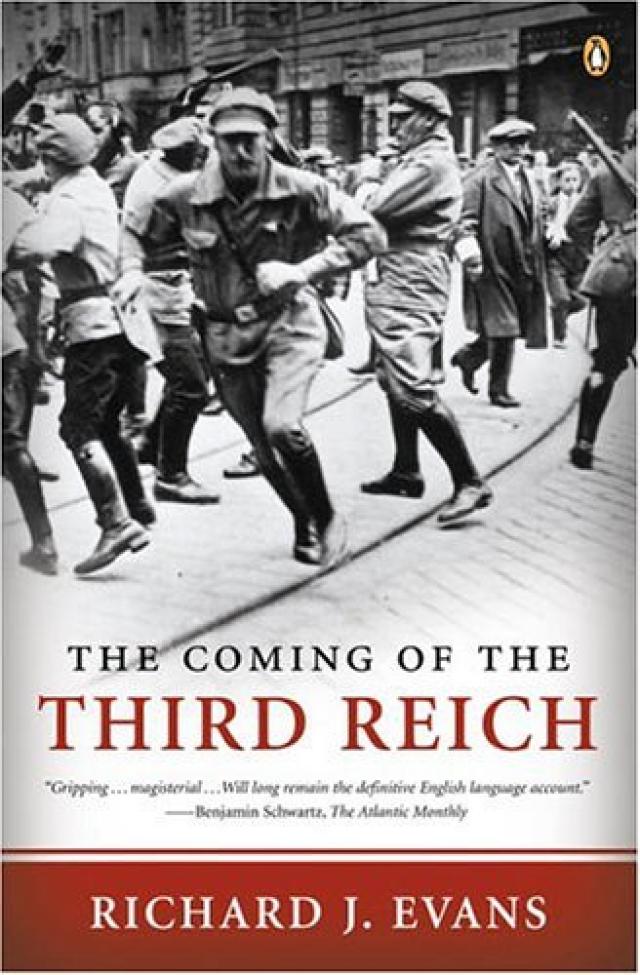
Papen’s utopian conservatism did scant justice to the political realities of 1932. Papen’s cabinet was made up of men with relatively little experience. So many of them were unknown aristocrats that it was widely known as the ‘cabinet of barons’. In the discussions that preceded Brüning’s resignation, Papen and Schleicher had agreed that they needed to win over the Nazis to provide mass support for the anti-democratic policies of the new government. They secured Hindenburg’s agreement to dissolve the Reichstag and call fresh elections, which Hitler had been demanding in the expectation that they would lead to a further increase in the Nazi vote. The elections were set for the end of July 1932. In addition, they also conceded Hitler’s demand for a lifting of the ban on the brownshirts. This would, thought Schleicher, tame Nazi extremism and among other things persuade the brownshirts to act as an auxiliary army with which the limitations on the strength of the German armed forces imposed by the Treaty of Versailles could be decisively circumvented. 129 But it proved another disastrous miscalculation. Masses of stormtroopers flooded triumphantly back onto the streets, and beatings, pitched battles, woundings and killings, never entirely absent even during the period of the ban since the previous April, quickly reached record new levels. Even so, public opinion was shocked when, on 17 July 1932, a march staged by thousands of Nazi stormtroopers through the Communist stronghold of Altona, a working-class municipality on the Prussian side of the state border of Hamburg, ran into violent resistance from thousands of heavily armed Red Front-Fighters. Richard Krebs, in charge of 800 Communist sailors and dockers ready to drive the Nazis from the waterfront, reported later how the Red Front-Fighters were under orders to attack the stormtroopers in the streets. Stones, rubbish and all kinds of missiles were hurled at the passing marchers. According to some reports, there were Communist sharp-shooters on the roofs, ready to massacre the stormtroopers below. Someone, nobody was sure who, fired a shot. Immediately, the police panicked and opened fire with everything they had, spraying the locality with bullets and causing panic flight in all directions. The Communists were driven away along with the rest. Their attempt to stop the brownshirt march through their territory had been an abject failure.130 Eighteen people were killed and more than a hundred injured. Most of the deaths were caused, as autopsy reports revealed, by bullets fired from police revolvers. The depths of violence to which German political confrontations had now sunk clearly demanded action by the government.131
Far from banning the paramilitaries again, however, Papen seized on the events of ‘Bloody Sunday’ in Altona to depose the state government of Prussia, which was led by the Social Democrats Otto Braun and Carl Severing, on the grounds that it was no longer capable of maintaining law and order. This was the decisive blow against the Social Democrats which he had been put into office to achieve. Papen had a sort of precedent in Ebert’s deposition of the Saxon and Thuringian state governments in 1923, but Prussia, covering more than half the territory of the Reich, with a population greater than that of France, was a far more significant target. The central position of the army in the strife-torn political situation of 1932 was graphically illustrated as heavily armed combat troops took to the streets of Berlin, and a military state of emergency was declared throughout the capital city. The Social Democrat-controlled police force was simply pushed aside; any attempt by the Prussian government to use it as a means of resisting the armed strength of the military would only have led to confusion. Its manpower was too small, and the senior and middle-ranking officers were either disillusioned with the Republic, sympathized with Papen, or had been won over by the Nazis.132
If Papen and Schleicher feared a workers’ uprising, they were wrong. Many rank-and-file members of the Reichsbanner were ready to take up arms, and machine guns, pistols and carbines had been assembled to defend the party headquarters in the event of a putsch until the police, who, the party assumed—wrongly, as it turned out - would resist any attempt to overthrow the Republic, arrived on the scene. A recent increase in numbers had brought the strength of the Reichsbanner’s Republican Defence Units up to more than 200,000. But they were heavily outnumbered by the combined forces of some three-quarters of a million brownshirts and Steel Helmets, who would certainly have mobilized against them had they staged an uprising. They were poorly trained and ill prepared. And they would have been no match for the well-equipped forces of the German army. The Communists, who had better reserves of arms, were certainly not going to take them up to defend the Social Democrats.133 .
In the situation of July 1932, when Hindenburg, the military leadership and the conservatives were all extremely anxious to avoid provoking a civil war in Germany, an armed uprising by the Reichsbanner might have forced a climbdown by Papen, or an intervention by the Reich President. One can never know. The call to resist never came. The law-abiding traditions of the Social Democrats compelled them to put a ban on any armed resistance to an act that was sanctioned by the head of state and the legally constituted government, backed by the armed forces and not opposed by the police.134 All that remained as an option for Braun and Severing were rhetorical protests and lawsuits brought against Papen on the ground that he had breached the constitution. On 10 October 1932, the State Court ruled in part at least in favour of the Braun cabinet, which therefore continued to be a thorn in the Reich government’s flesh by representing Prussia in the Reich Council, the upper chamber of the national legislature.135 Meanwhile, Papen secured from the President his own appointment as Reich Commissioner to carry out the business of government in Prussia, while punctilious civil servants dithered and suspended business until the legal position was resolved.136