Diary of a Malayali Madman, page 20


One of those new roads was leading me into folk traditions. The novel Ezhinum Meethe (Beyond Seven i.e. the mountain, specifically Kodagu mountain) is an example of this. I wrote this in 1985 and it came out in book form in 1986. It is the story of the folk-god Kathivanoor Veeran, and is written in the style and language of Thottam Pattu and the northern Malabar dialect. As you know, many of the stories told in the form of Theyyam are tragedies. And I find the story of Kathivanoor Veeran especially tragic. My attempt was to preserve this emotional content in the narration. More than anything else, it was an experiment in language. I think readers liked it, as it was quite different from anything I had written until then. It is my dream to rewrite this story, this time in more detail, engaging with the sociocultural context and history of Kodagu and north Kerala over three centuries. I have been working on this on and off for the last ten years, but it has been a slow process, interrupted by other engagements and pressures on my time.
JK: The interest in and influence of folklore and tradition is reflected in many of your other writings too, for example, the novella Janthujanam (Animal Folk), the play Pulijanmam (Born to be a Tiger) and the short story ‘Daivathinte Poombatta’. Paralleling, and sort of interconnected to this, is the place that nature has in your work. This is evident in the descriptive passages as well as the real and metaphoric roles that elements of nature and its creatures – forests, trees and plants, animals, even the wind – take on. This deep connection with nature – is it something that had always been there or something that has developed over time?
NP: I don’t belong to any group bearing the label ‘Nature Lovers’. In fact, I am not a good observer of nature. I feel nature. To be exact, I fall in love with some elements of nature. The primary school I attended was situated at the end of the northern slope of Madayippara, and the high school was also nearby. The greatest joy of my school days was wandering over Madayippara, in the Onam season for collecting flowers, and in the rest of the year to experience the various visual and sensory pleasures this vast expanse of rock, which changed its mood and expressions in accordance with the seasons, provided lavishly.
This intimate relationship with nature continued in a subdued manner even after my day-to-day connection became a memory. Wherever I go, I could easily sense the pulse of nature there, though details do not usually get registered in my mind. On many occasions, I ridiculed myself for not remembering things. But when I once again go through what I have written, I understand that nature – more than anything, an incomparable emotional truth – has come into my writing with utmost ease. For me, nature is not something to be objectively studied. I don’t want to place myself outside nature and study it.
JK: Your non-human characters, for example, the protagonist in Janthujanam, the fox Chembankutty, is in many ways as embedded, observant and reflective a chronicler of local history and community as the human protagonists in your stories, especially the ones in this anthology.
NP: In some ways, a novelist is a historian. You know that Vaikom Muhammad Basheer has repeatedly used the term ‘historian’ to refer to the writer, the novelist, in his work. The Chinese writer, Mo Yan, for example, writes epic histories through his fiction. The novel is a sibling of history; a more lovable sibling.
JK: Yes. But I think I am making two distinctions here. First, I’d argue that, beyond the writer, your protagonists themselves take on the work of the historian. History, then, is the telling of the mundane, everyday life. And second, this is different from historical fiction, which I see as having a different purpose.
NP: I agree. Yiddish writer Isaac Bashevis Singer, for example, is writing about local people and local history, while his protagonists do the work of historicizing the Jewish life of a period. I admire writers like him and Ngugi wa Thiong’o who use symbolism and magic realism as forms of history-writing. In Wizard of the Crow, the Free Republic of Aburiria is as real as any country of our age in the Global South. The story becomes history. I believe that there comes a point in the narration of the life history of a region when history and fiction come together to become inseparable, where it becomes difficult to say where fiction ends and history begins. I do believe that it can be almost a more authentic history, as long as the writer goes beyond the written, recorded, ‘authenticated’ histories and actively looks for historical knowledge located elsewhere, in memory and lore, and beyond his own imagined worlds into a genuine eagerness and interest in historical inquiry. I am adapted to this line. I try actively to find a balance between magic realism, realism and hyperrealism keeping in mind that my prime motive is to reach the core of a reality.
For my novel Janakatha (Peoples’ Story), I interviewed many men and women of the villages in and around Ezhimala and Madayi. The data I could gather from the interviews, I used freely. I think that the whole novel is a sort of local history reconstructed, giving ample space for imagination. If you do not insist upon specific dates and matter-of-fact descriptions of incidents, you can read it as the social and cultural history of the region in the twentieth century. I attach more importance to the fact that I could capture what I believe is the mental world of ordinary men and women who are usually denied entry into history.
In my current writing, as I said at the start, I am trying something else too, and that is to leave the writing free, free-flowing, with minimal editing – both ideological editing, and aesthetic editing that is concerned with formal structures or beauty of writing. I am eager to see where this process will take me. It definitely energizes me. It is a continuation of the move beyond the influence of modernism and revolutionary left-wing politics and Marxist philosophy that had characterized the writers of my generation, including myself. A move, even, beyond the complex discussions about a writer’s social responsibility and legitimacy. These are important considerations, but I do also feel the need to move beyond these in my writings. I would like to say that literature is nothing but freedom – freedom from all preconceived notions.
Acknowledgements
Reading the translations of my stories included in this book, I marvel at the impulse that made me write them. They got written at various points. I am using the passive voice here because, as I read through the translations, I was struck by the notion that, beyond any conscious decisions and planning on my part, the form and content of these stories have taken on a life of their own. Perhaps translation allows a writer to consider possibilities in his writing that he hasn’t considered before.
I have tried to look at the lives around me from close proximity, without getting bogged down in the details of their material contexts. My effort has been to find ways of recording the workings of their minds in the forms and language they demand. I feel proud that, rather than reconstructing other lives from my imagination, I was able to immerse myself in their inherent truths, stripping myself of preconceived notions about life and art. Will my readers agree with this claim? This is not a consideration I agonize over.
It was entirely unexpectedly that Jayasree Kalathil, then a complete stranger to me, came up with the idea of translating these stories. The simplicity and grace of these translations has convinced me that it was good I didn’t feel the need to ponder over it before making a decision. My gratitude to Jayasree, and to the publishers.
– N. Prabhakaran
I read the small paperback edition of ‘Oru Malayali Bhranthante Diary’ (Diary of a Malayali Madman) at a difficult time in my life, following the death of my father. Translating the book gave me something to do as I brooded over my difficult and complex relationship with him, which, on reflection, was also exquisitely ordinary. Soon, the idea of a translated collection of stories by the master narrator of the extraordinary in the ordinary in Malayalam literature took root. I am grateful to N. Prabhakaran for trusting me with this, and for working with me to finalize the selection, for the gentle and careful feedback on each draft, and for allowing me glimpses into his creative process.
I am also grateful to our editor, Rahul Soni, who embraced the project right from my first – unsolicited – email about it, to Tejaswini Niranjana for putting me in touch with him, and to Adley Siddiqi, Alison Faulkner, R. Srivatsan and Susie Tharu for reading early drafts.
– Jayasree Kalathil
About the Book
A research scholar whose notebook reveals a surreal pig farm...
A psychologist in search of the truth about one of his clients...
An aspiring writer who emulates Gogol...
The unforgettable men and women in N. Prabhakaran’s stories have an uncanny ability to expose the fault lines between the real and the unreal, the normal and the mad, as they explore their own inner worlds and psychic wounds.
A pioneer of the post-modern aesthetic turn, N. Prabhakaran weaves the nitty-gritty of everyday, small-town lives into his stories - all set in northern Kerala - that are steeped in folklore, nature, factional politics and the intricacies of human relationships.
Brilliantly translated by Jayasree Kalathil, Diary of a Malayali Madman marks the very first time this major Indian writer’s work is available in English.
About the Author
N. PRABHAKARAN (b. 1952) is one of the major contemporary writers in Kerala, and has published over forty works - novels, poetry, plays, short-story collections, essays and a travelogue. He has won numerous awards for his writing, including: the Kerala Sangeetha Nataka Akademi Award in 1987; the Kerala Sahitya Akademi Award in 1988 and 1996; the EMS Memorial Trust Award, Munnad, in 2005; the Vaikom Muhammed Basheer Memorial Trust Award in 2009; and the Malayatoor Award in 2010. In 2012, Prabhakaran won the Muttathu Varky Literary Award for his contribution to Malayalam literature.
JAYASREE KALATHIL’s translations have been published in the Malayalam Literary Review, aaina, India’s first and only mental health advocacy newsletter; No Alphabet in Sight, an anthology of Dalit writing; and as part of Different Tales, a book series for children. She is also the author of The Sackclothman (2009), a children’s book.
TALK TO US
Join the conversation on Twitter
http://twitter.com/HarperCollinsIN
Like us on Facebook to find and share posts about our books with your friends
http://www.facebook.com/HarperCollinsIndia
Follow our photo stories on Instagram
http://instagram.com/harpercollinsindia/
Get fun pictures, quotes and more about our books on Tumblr
http://www.tumblr.com/blog/harpercollinsindia
First published in India in 2019 by Harper Perennial
An Imprint of HarperCollins Publishers
A-75, Sector 57, Noida, Uttar Pradesh 201301, India
www.harpercollins.co.in
2 4 6 8 10 9 7 5 3 1
Copyright for the original Malayalam text © N. Prabhakaran 2014
English Translation Copyright © Jayasree Kalathil 2019
P.S. Section Copyright © Jayasree Kalathil 2019
Illustrations Copyright © Bhagyanath C. 2019
P-ISBN: 978-93-5302-675-2
Epub Edition © February 2019 ISBN: 978-93-5302-676-9
N. Prabhakaran asserts the moral right to be identified as the author of this work.
This is a work of fiction and all characters and incidents described in this book are the product of the author’s imagination. Any resemblance to actual persons, living or dead, is entirely coincidental.
All rights reserved under The Copyright Act, 1957. By payment of the required fees, you have been granted the nonexclusive, nontransferable right to access and read the text of this ebook on-screen. No part of this text may be reproduced, transmitted, downloaded, decompiled, reverse-engineered, or stored in or introduced into any information storage and retrieval system, in any form or by any means, whether electronic or mechanical, now known or hereinafter invented, without the express written permission of HarperCollins Publishers India.
Cover design: HarperCollins Publishers India
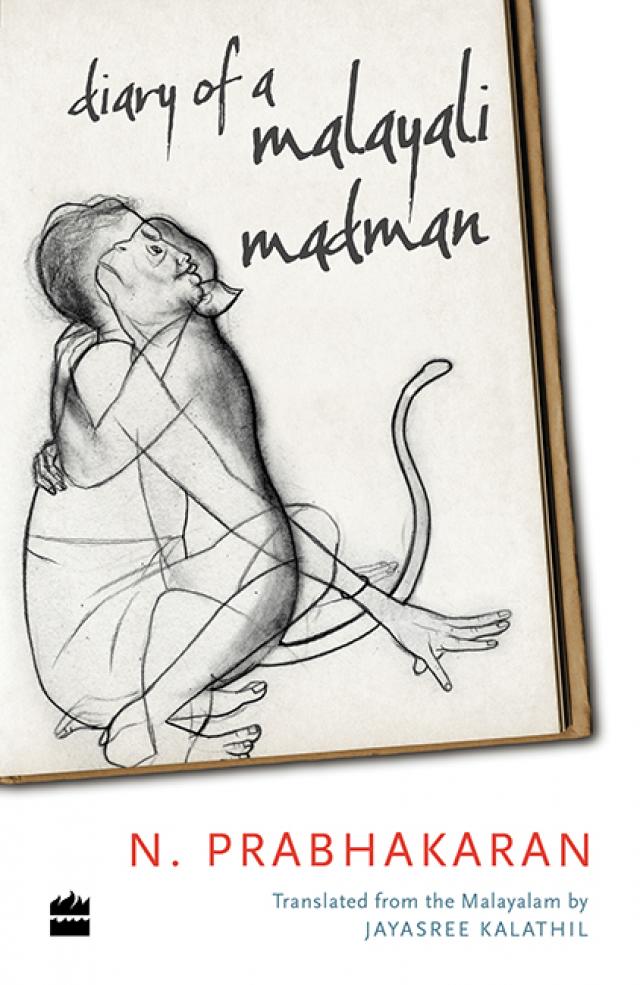
Cover illustration: Bhagyanath. C
www.harpercollins.co.in
HarperCollins Publishers
A-75, Sector 57, Noida, Uttar Pradesh 201301, India
1 London Bridge Street, London, SE1 9GF, United Kingdom
Hazelton Lanes, 55 Avenue Road, Suite 2900, Toronto, Ontario M5R 3L2
and 1995 Markham Road, Scarborough, Ontario M1B 5M8, Canada
25 Ryde Road, Pymble, Sydney, NSW 2073, Australia
195 Broadway, New York, NY 10007, USA
N. Prabhakaran, Diary of a Malayali Madman