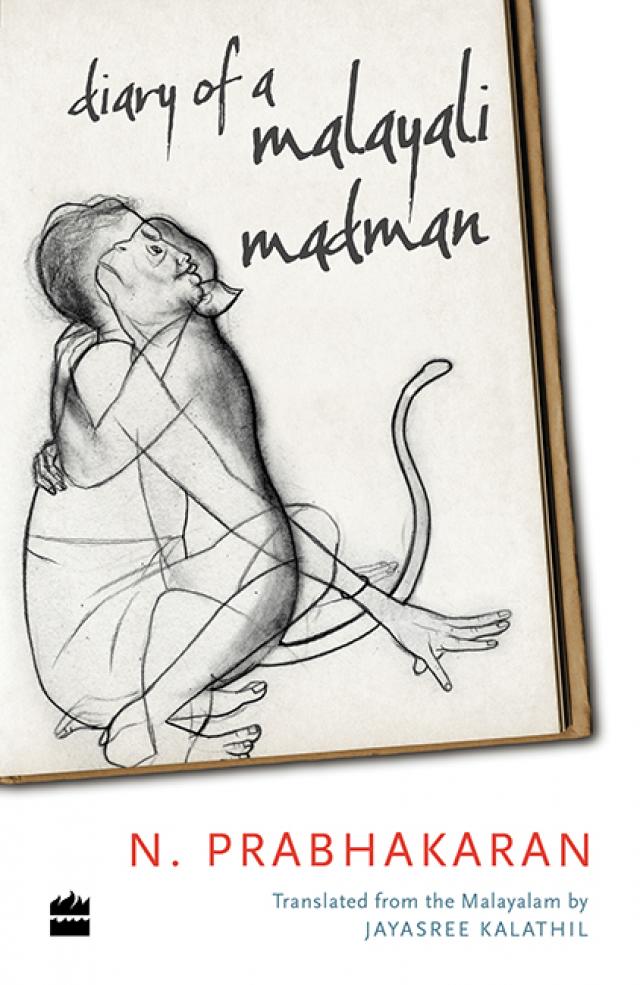
Diary of a Malayali Madman, page 14


One of the young men had a vertical line of kunkumam on his forehead, and the other had a brass bangle on his wrist. They had their arms around each other and walked on unsteady feet. As Krishna passed them, one of them said, ‘What do you reckon? First-class material or what?’
‘Absolutely. The back view is even better.’
‘A1 seating capacity. Oh, mate, I can barely contain myself.’
Their loud, loose laugh made Krishna sick, her body felt weightless as though all her organs had disappeared from within it. She hurried along, dragging the husk of her body blowing in the wind, and did not dare look back fearing that those strange men might be following her. Her only consolation was that she could see Gloria teacher’s house from where she was. She allowed herself to look back only when she reached the front gate. The men hadn’t followed her – they were gone, having said whatever came to their mouth in their drunken brazenness. It was nothing new; she’d had to put up with such nastiness before. In any case, she needn’t have been that scared. These were not deserted places any more – there were a few houses within earshot.
Krishna opened the gate and entered Gloria teacher’s house. Her husband was in the front yard among the plants, a pair of shears in his hand. Taking in his t-shirt with NEWYORKER printed on it and his ridiculous Bermuda shorts, Krishna suppressed a smile.
Gloria teacher sat on a wicker chair on the veranda, busy with some needlework. She looked younger and prettier in her light blue embroidered maxi. Upon seeing Krishna, she called out, ‘Hi,’ and got up with a big smile.
‘Vincent, you remember, we met Krishna at Gopan sir’s college.’
Her husband smiled and nodded, and turned back to his plants.
‘Come, let’s go inside,’ Gloria teacher said and led the way.
It had been at least twenty years since Krishna had been inside this house. With a start, Krishna remembered that the last time she was here was when Nanu Vaidyar killed himself by hanging himself from its rafter. She and Shantha had sneaked in without permission, eager to see what a suicide by hanging looked like but, by the time they got here, the body had been cut loose and there was a crowd of people around it.
That was the first suicide Krishna remembered. Since then, the house had never been constantly occupied. Nanu Vaidyar’s children were all grown up and lived in other parts of the country, and took very little interest in managing the house or renting it out. On the rare occasions when it was rented out, it was through his younger brother.
‘Something to drink?’ Gloria teacher asked her.
‘Thanks. I am okay.’
‘No, no. It’s your first visit. Give me two minutes, I’ll make some coffee.’ Gloria teacher went into the kitchen.
Krishna looked at the calendar on the wall, with the picture of a kingfisher sitting forlorn on a wooden post by a river.
‘Come into the kitchen, Krishna,’ Gloria teacher called out. ‘There’s no one else here.’
‘Come, sit,’ Gloria teacher said as she entered the kitchen. She set a pot of water on the stove for the coffee.
‘What does your husband do?’ Krishna asked.
‘Husband?’ Gloria teacher laughed. ‘No, no. He is my helper. Like you, everyone thinks Vincent is my husband.’ Leaning on her shoulder, she whispered into her ears, ‘He can’t do what a husband is required to do.’ Her entire body shook as she laughed at her own joke. Krishna felt uncomfortable, but Gloria teacher didn’t seem to notice and attended to the coffee.
Teacher served the coffee in light blue cups. As she drank it, she touched Krishna’s hair gently and arranged it a little lower on her forehead.
‘You have a lovely heart-shaped face,’ Gloria teacher said. ‘Comb your hair a little lower like this. It looks better that way. Otherwise your forehead looks big.’
Gloria teacher pinched her chin lightly. Krishna felt somewhat irritated by her blatant familiarity.
‘You’re unmarried, aren’t you?’ Gloria teacher asked. ‘Gopan sir told me. It’s good that way. Look at me. I married twice and got rid of both of them. Men are boring. I have no need for their help.’
After coffee, Gloria teacher led Krishna outside. The yard was full of plants in planters, pots, and plastic containers of various sizes and shapes. Hibiscus, orchids, roses, anthuriums, lilies, and a hundred others whose names Krishna didn’t know.
‘It’s only been a couple of days since we brought all of these over. I haven’t had the time to arrange them properly,’ Gloria teacher told Krishna, and took her to the south end of the yard where there was a variety of saplings in little plastic pots – banyan, mango, bamboo, pine, bougainvillea…
‘Here, look, this is a bonsai. I have around fifty of them,’ Gloria said. ‘It’s the loving labour of a very long time.’ Her face was suffused with a childlike pride, and Krishna felt a kind of affection for her.
‘Come, Krishna, over here,’ Gloria said, kneeling in front of a plant pot. There was a plant that looked to Krishna like a gooseberry. She sat down next to Gloria, expecting her to talk about the plant. Instead, Gloria suddenly hugged Krishna and, moving her hair out of the way, kissed her on the nape of her neck with a hissing sound.
Something crawled all over Krishna’s body. She scrambled up and rushed through the front yard and, by the time she was out of the gate, she was almost running.
The sun was on its way down.
As she walked home panting, the lane along the Poothakkavu was dim with shadows. Krishna felt that there were dense forests in front of her, behind her and around her, closing in on her from all sides. She felt the desperate urge to talk about something – anything – to rescue herself from the feeling of being engulfed. But what she muttered, as she struggled to breathe, was this: ‘Yes, forests. Definitely forests.’
Adrshyavanangal, 1998
diary of a malayali madman
Preface
I have been working on a novel for five or six years. Every so often I’d feel that it was not going the way I intended and then I’d stop, consider another structure, and start writing, only to feel, again, that I was going down the wrong path. A few months later, after many such starts and stops, I settled on a structure that seemed to work and began writing diligently. I had completed four or five chapters when, one night, a madman, one who had no connection whatsoever to the novel’s atmosphere or storyline, came to my mind, bringing with him an array of random musings. I was somewhat taken aback, but I also felt a surge of excitement and – I am not quite sure how – I remembered Gogol. I had a copy of his book, St. Petersburg Stories, which contained the story, ‘Diary of a Madman’. It took some effort to locate it among the piles of books strewn around the house. I read the story again and was satisfied that there was no relationship between Gogol’s madman and mine, and that the incidents that had entered my mind – those worthy of inclusion in the story – had no similarities with the experiential world of Gogol’s madman. There was no cause for concern. So I started writing in earnest. I don’t remember writing anything else with the ease or speed with which I have written this story.
Before passing your judgement on ‘Diary of a Malayali Madman’, know this: the protagonist of this story has already forgotten about this diary. He is currently immersed in work of a philosophical nature. Respected reader, I will take you there in due course. Let me stop for now.
– N. Prabhakaran
20 August 2012, Monday
Hahaha … Look at the title I’ve given to my diary: ‘Diary of a Malayali Madman’. Hahaha … Only a Malayali madman can write his diary in Malayalam, and only a Malayali can read it. Obviously, one can learn a new language, read and write in it. I was only talking about the normal state of affairs. You understand, don’t you? Let that be. Have you heard of a writer named Gogol? It is unlikely, if you are below the age of thirty. People below thirty are generally ignorant. They may have a degree or two, but when it comes to general knowledge they have none. There’s no way they would have heard of Gogol. In actual fact, Gogol is a great literary figure. Here, in Kerala, most people say they like Dostoevsky, or perhaps Tolstoy. Me, I like this fellow Gogol. Anyway, my intention is not to get into a literary discussion. The reason I thought of Gogol just now is because he has written a story called ‘Diary of a Madman’. It is this work of his that inspired me to write this diary. But there is one important difference. Gogol’s hero does not think of himself as mad. Even when he imagines things that other people would consider completely insane, he doesn’t think there is anything wrong with his state of mind. My situation is different – I am a little bit mad, and I am quite aware of this without having to be told. Given that I have this much self-awareness, you may also consider me quite sane. That’s all up to you.
This is intended to be a diary, but I’ve started writing it as if it were a story. So let’s continue in that vein for a while. I don’t need to specify that I am the hero of this story. The heroines are several, and I will tell you about them as and when the context demands. First, let me introduce myself properly. I have a polytechnic diploma in mechanical engineering. After completing this course, I went to Bangalore and drifted around for a while. Nothing good came out of it. So I went to Mumbai. I have an uncle who, having returned home filthy rich after spending forty-odd years in Mumbai, goes around pretending that he is a community leader because he is the president of the local temple committee. Through one of his acquaintances, he got me a job in Mumbai as an apprentice in a scooter company, complete with rent-free accommodation. Listening to him go on about it, you’d think I had won the lottery. I didn’t know how much I’d be paid, and when I came to know, I couldn’t believe it! How was one to survive in that megacity on such a low salary? I had no idea, and I said as much to my uncle.
‘You have to train for one year. Is it right to demand a one-lakh-rupee salary as soon as you get there? I did roadwork for one rupee when I first went to Mumbai. Put up with it if you can. If not, come back home and squander away your life getting drunk and what not.’
I didn’t listen to his advice and promptly left the job. Let me not go into the difficulties I faced afterwards. Eventually, I found a well-run workshop with a decent owner. Weekly wages, okay salary, and he seemed to really like me. There was a tiny, cage-like room behind the workshop. I cooked, ate and slept in it for six years, sharing the space with a Bengali lad. Then my relatives and people back home started saying that I should get married. I tried to look for girls with good jobs, but didn’t find anyone I liked. So I decided to select one from a well-to-do family and found a suitable girl with an ordinary BA degree. Her degree was in sociology, but she was completely ignorant of social sciences, history or geography. Ask her where China is, and she’d say it is near Nigeria! Nevertheless, she put on terrible airs. She’d studied in English-medium schools and could speak good enough English – definitely better than me. Still, no basic knowledge and, on top of that, she had a habit of saying something foolish and then going on and on about it.
One night, on our honeymoon – on the fourth day after our wedding – she started arguing with me saying that Leonardo da Vinci was born after C.V. Raman. That argument ended in a divorce. In the heat of the argument, I said some things that should not have been said, some bad, no, outright obscene words. That became an issue. Oh, I started writing a diary entry and now seem to be writing my autobiography. No, that’s not what this is about.
21 August, Tuesday
I felt lethargic from the moment I got up this morning and had planned to just stay at home today. But, at ten in the morning, my sister and brother-in-law dropped in. My brother-in-law gave me a good telling off for squandering away my time, not taking up a job, and hanging around political activists. He showed no consideration for the fact that I am a forty-something man. My sister also joined in and said a few things. Let them – let everyone say whatever they want. It doesn’t concern me. I have my path; they have theirs.
In fact, my brother-in-law is mistaken in his opinion that I hang around political activists. Actually, they don’t pay any attention to me and I don’t take them seriously. I go to their meetings sometimes, just for fun. As a listener, that’s all. I like those leaders who have a certain oratory style and speak gesticulating wildly with their hands and feet. I don’t care what their political affiliations are or which factions they belong to. I get goosebumps when I listen to them speak. The other day, at the Congress Party meeting in Kottayi bazaar, I stopped one of the leaders on his way to the stage and said, ‘Brother, rock it.’ And he rocked it. I think he may have been under the influence. Having worked himself up with his own enthusiasm, he began to have a go at an opponent he had within his own party:
‘I’ll gut him if he takes issue with me,’ he said. ‘I will squeeze out his liver, add it to lemonade and drink it.’
This was greeted with thunderous applause from the audience. I also applauded.
There is another thing. In my part of the world, unlike in the olden days, there is no great rivalry between politicians from different parties. They’re all businessmen. Come election time, they pretend to be arch-rivals like snakes and mongooses. Behind the scenes, though, there are many ‘adjustments’. Let that be. There’s no point in wishing that these things should not happen. So let them carry on, isn’t that better? There was an incident the other day. It was around ten or eleven in the morning, and I was sitting in the chai shop near the jetty. Some young politicians walked in – city folk, by the look of it – representing parties on both the left and the right. None of them knew me, except perhaps vaguely recognizing my face from somewhere. There’s been some controversy around the sale of a ten-acre property belonging to Dubai Avullakka, and these looked like mediators who’d come to find a solution. In situations such as these, the mediators receive a set percentage of the sale price as commission. They seemed quite beside themselves with the excitement of it all.
‘Yes, send twelve to the District Committee. Hand it to Dingan, he knows where and how to give it. Eh? That guy’s case? Call the Mumbai-wallah and tell him. He’ll take care of it. Avullakka’s problem? That’s why we’re here first thing in the morning, isn’t it, to get it solved.’ A khaddar-clad youngster, clean, wholesome, and full of youthful enthusiasm and energy, talked with great self-importance into a mobile phone as big as a diary. There was no one else in the shop except me, and Chandrettan who made the tea. As he hung up, one of his friends asked me with a sour smile on his face:
‘Brother, do you mind if we hung around here for a while and had some brandy?’
It was quite clear that he was having me on – his voice and overall demeanour reflected the heavy weight of sarcasm.
‘What do you reckon?’ I asked him. ‘This shop belongs to Kocha Nanuvettan. Some tosspot politicians like you beat him up and broke his left leg when he went to picket a brandy shop during the prohibition campaign. You think you can come into his shop and ask such vulgar questions?’
Baduvathi the Cat was lying asleep under the bench. She woke up just then, and came out and said to them, ‘Better clear off quickly. My husband Kandan Kannan will soon be here, and if he catches sight of you, he’ll cut off your cockles. He hates alcohol.’ As soon as they heard her, they fled. I couldn’t stop laughing, seeing them panic and scramble. But my laughter seems to have annoyed Chandrettan.
‘Why are you laughing, Aagi?’ he asked.
‘I was laughing at what the Cat said, and the way those politicians ran away.’
‘What cat? What politicians? What the heck are you going on about, Aagi?’
So Chandrettan was not aware of anything that had happened there.
This is the problem with our country, as far as I can figure out. No one sees anything. No one hears anything.
Ah, and one more thing. Chandrettan called me ‘Aagi’. I am sure you’d be keen to know my name.
My name is Aagney, which means son of Agni, the fire god. My father was a teacher and a Sanskrit scholar. My mother was a nurse. I’ve heard it said that the biggest mistake my father made was to marry my mother. My mother does not know Sanskrit. She is always angry. It must have been all the hard work at the hospital, anger has become her default position. Nurses have really hard jobs – it’s not without reason that they are always on strike. My mother was a nurse in a government hospital, so she had a good salary. Now she has a very good pension. That is why I can afford to walk around in these ironed shirts and trousers.
So today got over like that. Well, not quite. Because Chandrettan said to me, ‘Aagi, why don’t you go home and take your medicine?’
I got pissed off so I shouted at him, ‘What medicine? Whose medicine? Ask your woman to take her medicine.’
To be fair, that last bit was uncalled for. So what happened? Chandrettan rushed at me and slapped my face. I slapped him right back. He didn’t give in. So we stopped with the slapping and started fighting in earnest. Some people came running and pulled us apart, so both of us got out of it without much damage. But I think I’ve sprained my neck, and my left arm is in some pain too. I’ll have to get it massaged by Kumaran Vaidyar tomorrow. Yet another expense to worry about.
22 August, Wednesday
My plan was to go back to Mumbai after my wedding and bring my wife over within three months. I’d even looked for suitable accommodation for us. But when she left, thoughts of Mumbai also left me. For a couple of years after that, I worked in a local car company’s service station. After that, I spent some time doing odd-jobs, repair work and such. I am not quite sure why I’m recalling all these things and writing them down here. What a pity … I wish I could write something literary. Since leaving high school, I had not even touched a Malayalam book until three years ago. I was going through a period of great distress – I was even scared that I’d lose my mental balance. That’s when my brother-in-law took me to a clinical psychologist – Dr Subodh Kumar at the Specialty Hospital. He was a good man. He talked to me at length over several days. He’s the one who persuaded me to start reading novels and short stories. After that, I just read and read and that was really helpful.
‘Absolutely. The back view is even better.’
‘A1 seating capacity. Oh, mate, I can barely contain myself.’
Their loud, loose laugh made Krishna sick, her body felt weightless as though all her organs had disappeared from within it. She hurried along, dragging the husk of her body blowing in the wind, and did not dare look back fearing that those strange men might be following her. Her only consolation was that she could see Gloria teacher’s house from where she was. She allowed herself to look back only when she reached the front gate. The men hadn’t followed her – they were gone, having said whatever came to their mouth in their drunken brazenness. It was nothing new; she’d had to put up with such nastiness before. In any case, she needn’t have been that scared. These were not deserted places any more – there were a few houses within earshot.
Krishna opened the gate and entered Gloria teacher’s house. Her husband was in the front yard among the plants, a pair of shears in his hand. Taking in his t-shirt with NEWYORKER printed on it and his ridiculous Bermuda shorts, Krishna suppressed a smile.
Gloria teacher sat on a wicker chair on the veranda, busy with some needlework. She looked younger and prettier in her light blue embroidered maxi. Upon seeing Krishna, she called out, ‘Hi,’ and got up with a big smile.
‘Vincent, you remember, we met Krishna at Gopan sir’s college.’
Her husband smiled and nodded, and turned back to his plants.
‘Come, let’s go inside,’ Gloria teacher said and led the way.
It had been at least twenty years since Krishna had been inside this house. With a start, Krishna remembered that the last time she was here was when Nanu Vaidyar killed himself by hanging himself from its rafter. She and Shantha had sneaked in without permission, eager to see what a suicide by hanging looked like but, by the time they got here, the body had been cut loose and there was a crowd of people around it.
That was the first suicide Krishna remembered. Since then, the house had never been constantly occupied. Nanu Vaidyar’s children were all grown up and lived in other parts of the country, and took very little interest in managing the house or renting it out. On the rare occasions when it was rented out, it was through his younger brother.
‘Something to drink?’ Gloria teacher asked her.
‘Thanks. I am okay.’
‘No, no. It’s your first visit. Give me two minutes, I’ll make some coffee.’ Gloria teacher went into the kitchen.
Krishna looked at the calendar on the wall, with the picture of a kingfisher sitting forlorn on a wooden post by a river.
‘Come into the kitchen, Krishna,’ Gloria teacher called out. ‘There’s no one else here.’
‘Come, sit,’ Gloria teacher said as she entered the kitchen. She set a pot of water on the stove for the coffee.
‘What does your husband do?’ Krishna asked.
‘Husband?’ Gloria teacher laughed. ‘No, no. He is my helper. Like you, everyone thinks Vincent is my husband.’ Leaning on her shoulder, she whispered into her ears, ‘He can’t do what a husband is required to do.’ Her entire body shook as she laughed at her own joke. Krishna felt uncomfortable, but Gloria teacher didn’t seem to notice and attended to the coffee.
Teacher served the coffee in light blue cups. As she drank it, she touched Krishna’s hair gently and arranged it a little lower on her forehead.
‘You have a lovely heart-shaped face,’ Gloria teacher said. ‘Comb your hair a little lower like this. It looks better that way. Otherwise your forehead looks big.’
Gloria teacher pinched her chin lightly. Krishna felt somewhat irritated by her blatant familiarity.
‘You’re unmarried, aren’t you?’ Gloria teacher asked. ‘Gopan sir told me. It’s good that way. Look at me. I married twice and got rid of both of them. Men are boring. I have no need for their help.’
After coffee, Gloria teacher led Krishna outside. The yard was full of plants in planters, pots, and plastic containers of various sizes and shapes. Hibiscus, orchids, roses, anthuriums, lilies, and a hundred others whose names Krishna didn’t know.
‘It’s only been a couple of days since we brought all of these over. I haven’t had the time to arrange them properly,’ Gloria teacher told Krishna, and took her to the south end of the yard where there was a variety of saplings in little plastic pots – banyan, mango, bamboo, pine, bougainvillea…
‘Here, look, this is a bonsai. I have around fifty of them,’ Gloria said. ‘It’s the loving labour of a very long time.’ Her face was suffused with a childlike pride, and Krishna felt a kind of affection for her.
‘Come, Krishna, over here,’ Gloria said, kneeling in front of a plant pot. There was a plant that looked to Krishna like a gooseberry. She sat down next to Gloria, expecting her to talk about the plant. Instead, Gloria suddenly hugged Krishna and, moving her hair out of the way, kissed her on the nape of her neck with a hissing sound.
Something crawled all over Krishna’s body. She scrambled up and rushed through the front yard and, by the time she was out of the gate, she was almost running.
The sun was on its way down.
As she walked home panting, the lane along the Poothakkavu was dim with shadows. Krishna felt that there were dense forests in front of her, behind her and around her, closing in on her from all sides. She felt the desperate urge to talk about something – anything – to rescue herself from the feeling of being engulfed. But what she muttered, as she struggled to breathe, was this: ‘Yes, forests. Definitely forests.’
Adrshyavanangal, 1998
diary of a malayali madman
Preface
I have been working on a novel for five or six years. Every so often I’d feel that it was not going the way I intended and then I’d stop, consider another structure, and start writing, only to feel, again, that I was going down the wrong path. A few months later, after many such starts and stops, I settled on a structure that seemed to work and began writing diligently. I had completed four or five chapters when, one night, a madman, one who had no connection whatsoever to the novel’s atmosphere or storyline, came to my mind, bringing with him an array of random musings. I was somewhat taken aback, but I also felt a surge of excitement and – I am not quite sure how – I remembered Gogol. I had a copy of his book, St. Petersburg Stories, which contained the story, ‘Diary of a Madman’. It took some effort to locate it among the piles of books strewn around the house. I read the story again and was satisfied that there was no relationship between Gogol’s madman and mine, and that the incidents that had entered my mind – those worthy of inclusion in the story – had no similarities with the experiential world of Gogol’s madman. There was no cause for concern. So I started writing in earnest. I don’t remember writing anything else with the ease or speed with which I have written this story.
Before passing your judgement on ‘Diary of a Malayali Madman’, know this: the protagonist of this story has already forgotten about this diary. He is currently immersed in work of a philosophical nature. Respected reader, I will take you there in due course. Let me stop for now.
– N. Prabhakaran
20 August 2012, Monday
Hahaha … Look at the title I’ve given to my diary: ‘Diary of a Malayali Madman’. Hahaha … Only a Malayali madman can write his diary in Malayalam, and only a Malayali can read it. Obviously, one can learn a new language, read and write in it. I was only talking about the normal state of affairs. You understand, don’t you? Let that be. Have you heard of a writer named Gogol? It is unlikely, if you are below the age of thirty. People below thirty are generally ignorant. They may have a degree or two, but when it comes to general knowledge they have none. There’s no way they would have heard of Gogol. In actual fact, Gogol is a great literary figure. Here, in Kerala, most people say they like Dostoevsky, or perhaps Tolstoy. Me, I like this fellow Gogol. Anyway, my intention is not to get into a literary discussion. The reason I thought of Gogol just now is because he has written a story called ‘Diary of a Madman’. It is this work of his that inspired me to write this diary. But there is one important difference. Gogol’s hero does not think of himself as mad. Even when he imagines things that other people would consider completely insane, he doesn’t think there is anything wrong with his state of mind. My situation is different – I am a little bit mad, and I am quite aware of this without having to be told. Given that I have this much self-awareness, you may also consider me quite sane. That’s all up to you.
This is intended to be a diary, but I’ve started writing it as if it were a story. So let’s continue in that vein for a while. I don’t need to specify that I am the hero of this story. The heroines are several, and I will tell you about them as and when the context demands. First, let me introduce myself properly. I have a polytechnic diploma in mechanical engineering. After completing this course, I went to Bangalore and drifted around for a while. Nothing good came out of it. So I went to Mumbai. I have an uncle who, having returned home filthy rich after spending forty-odd years in Mumbai, goes around pretending that he is a community leader because he is the president of the local temple committee. Through one of his acquaintances, he got me a job in Mumbai as an apprentice in a scooter company, complete with rent-free accommodation. Listening to him go on about it, you’d think I had won the lottery. I didn’t know how much I’d be paid, and when I came to know, I couldn’t believe it! How was one to survive in that megacity on such a low salary? I had no idea, and I said as much to my uncle.
‘You have to train for one year. Is it right to demand a one-lakh-rupee salary as soon as you get there? I did roadwork for one rupee when I first went to Mumbai. Put up with it if you can. If not, come back home and squander away your life getting drunk and what not.’
I didn’t listen to his advice and promptly left the job. Let me not go into the difficulties I faced afterwards. Eventually, I found a well-run workshop with a decent owner. Weekly wages, okay salary, and he seemed to really like me. There was a tiny, cage-like room behind the workshop. I cooked, ate and slept in it for six years, sharing the space with a Bengali lad. Then my relatives and people back home started saying that I should get married. I tried to look for girls with good jobs, but didn’t find anyone I liked. So I decided to select one from a well-to-do family and found a suitable girl with an ordinary BA degree. Her degree was in sociology, but she was completely ignorant of social sciences, history or geography. Ask her where China is, and she’d say it is near Nigeria! Nevertheless, she put on terrible airs. She’d studied in English-medium schools and could speak good enough English – definitely better than me. Still, no basic knowledge and, on top of that, she had a habit of saying something foolish and then going on and on about it.
One night, on our honeymoon – on the fourth day after our wedding – she started arguing with me saying that Leonardo da Vinci was born after C.V. Raman. That argument ended in a divorce. In the heat of the argument, I said some things that should not have been said, some bad, no, outright obscene words. That became an issue. Oh, I started writing a diary entry and now seem to be writing my autobiography. No, that’s not what this is about.
21 August, Tuesday
I felt lethargic from the moment I got up this morning and had planned to just stay at home today. But, at ten in the morning, my sister and brother-in-law dropped in. My brother-in-law gave me a good telling off for squandering away my time, not taking up a job, and hanging around political activists. He showed no consideration for the fact that I am a forty-something man. My sister also joined in and said a few things. Let them – let everyone say whatever they want. It doesn’t concern me. I have my path; they have theirs.
In fact, my brother-in-law is mistaken in his opinion that I hang around political activists. Actually, they don’t pay any attention to me and I don’t take them seriously. I go to their meetings sometimes, just for fun. As a listener, that’s all. I like those leaders who have a certain oratory style and speak gesticulating wildly with their hands and feet. I don’t care what their political affiliations are or which factions they belong to. I get goosebumps when I listen to them speak. The other day, at the Congress Party meeting in Kottayi bazaar, I stopped one of the leaders on his way to the stage and said, ‘Brother, rock it.’ And he rocked it. I think he may have been under the influence. Having worked himself up with his own enthusiasm, he began to have a go at an opponent he had within his own party:
‘I’ll gut him if he takes issue with me,’ he said. ‘I will squeeze out his liver, add it to lemonade and drink it.’
This was greeted with thunderous applause from the audience. I also applauded.
There is another thing. In my part of the world, unlike in the olden days, there is no great rivalry between politicians from different parties. They’re all businessmen. Come election time, they pretend to be arch-rivals like snakes and mongooses. Behind the scenes, though, there are many ‘adjustments’. Let that be. There’s no point in wishing that these things should not happen. So let them carry on, isn’t that better? There was an incident the other day. It was around ten or eleven in the morning, and I was sitting in the chai shop near the jetty. Some young politicians walked in – city folk, by the look of it – representing parties on both the left and the right. None of them knew me, except perhaps vaguely recognizing my face from somewhere. There’s been some controversy around the sale of a ten-acre property belonging to Dubai Avullakka, and these looked like mediators who’d come to find a solution. In situations such as these, the mediators receive a set percentage of the sale price as commission. They seemed quite beside themselves with the excitement of it all.
‘Yes, send twelve to the District Committee. Hand it to Dingan, he knows where and how to give it. Eh? That guy’s case? Call the Mumbai-wallah and tell him. He’ll take care of it. Avullakka’s problem? That’s why we’re here first thing in the morning, isn’t it, to get it solved.’ A khaddar-clad youngster, clean, wholesome, and full of youthful enthusiasm and energy, talked with great self-importance into a mobile phone as big as a diary. There was no one else in the shop except me, and Chandrettan who made the tea. As he hung up, one of his friends asked me with a sour smile on his face:
‘Brother, do you mind if we hung around here for a while and had some brandy?’
It was quite clear that he was having me on – his voice and overall demeanour reflected the heavy weight of sarcasm.
‘What do you reckon?’ I asked him. ‘This shop belongs to Kocha Nanuvettan. Some tosspot politicians like you beat him up and broke his left leg when he went to picket a brandy shop during the prohibition campaign. You think you can come into his shop and ask such vulgar questions?’
Baduvathi the Cat was lying asleep under the bench. She woke up just then, and came out and said to them, ‘Better clear off quickly. My husband Kandan Kannan will soon be here, and if he catches sight of you, he’ll cut off your cockles. He hates alcohol.’ As soon as they heard her, they fled. I couldn’t stop laughing, seeing them panic and scramble. But my laughter seems to have annoyed Chandrettan.
‘Why are you laughing, Aagi?’ he asked.
‘I was laughing at what the Cat said, and the way those politicians ran away.’
‘What cat? What politicians? What the heck are you going on about, Aagi?’
So Chandrettan was not aware of anything that had happened there.
This is the problem with our country, as far as I can figure out. No one sees anything. No one hears anything.
Ah, and one more thing. Chandrettan called me ‘Aagi’. I am sure you’d be keen to know my name.
My name is Aagney, which means son of Agni, the fire god. My father was a teacher and a Sanskrit scholar. My mother was a nurse. I’ve heard it said that the biggest mistake my father made was to marry my mother. My mother does not know Sanskrit. She is always angry. It must have been all the hard work at the hospital, anger has become her default position. Nurses have really hard jobs – it’s not without reason that they are always on strike. My mother was a nurse in a government hospital, so she had a good salary. Now she has a very good pension. That is why I can afford to walk around in these ironed shirts and trousers.
So today got over like that. Well, not quite. Because Chandrettan said to me, ‘Aagi, why don’t you go home and take your medicine?’
I got pissed off so I shouted at him, ‘What medicine? Whose medicine? Ask your woman to take her medicine.’
To be fair, that last bit was uncalled for. So what happened? Chandrettan rushed at me and slapped my face. I slapped him right back. He didn’t give in. So we stopped with the slapping and started fighting in earnest. Some people came running and pulled us apart, so both of us got out of it without much damage. But I think I’ve sprained my neck, and my left arm is in some pain too. I’ll have to get it massaged by Kumaran Vaidyar tomorrow. Yet another expense to worry about.
22 August, Wednesday
My plan was to go back to Mumbai after my wedding and bring my wife over within three months. I’d even looked for suitable accommodation for us. But when she left, thoughts of Mumbai also left me. For a couple of years after that, I worked in a local car company’s service station. After that, I spent some time doing odd-jobs, repair work and such. I am not quite sure why I’m recalling all these things and writing them down here. What a pity … I wish I could write something literary. Since leaving high school, I had not even touched a Malayalam book until three years ago. I was going through a period of great distress – I was even scared that I’d lose my mental balance. That’s when my brother-in-law took me to a clinical psychologist – Dr Subodh Kumar at the Specialty Hospital. He was a good man. He talked to me at length over several days. He’s the one who persuaded me to start reading novels and short stories. After that, I just read and read and that was really helpful.