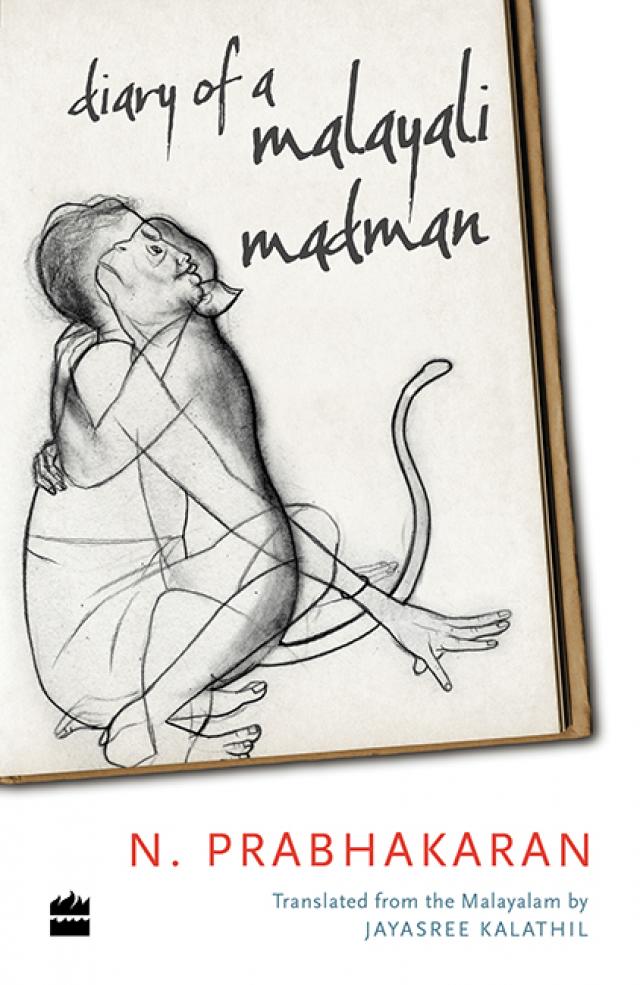
Diary of a Malayali Madman, page 19


The story is also a commentary on contemporary Kerala. Kerala is progressive and developed but, looking at it from a different angle, there is also something somewhat ‘mad’ about how we go about our politics, the grandiose nature of it all. You’ll remember Aagi’s commentaries on the politicians in his diary. The social life here has lost the charm of humaneness to a large extent. Here and there you may find people in all walks of life living with some principles. But there is widespread decay and despair. Offices function in the silently approved culture of red tape. Cultural activities have lost their vigour and become ritualistic. The first consideration of any organizer who plans a public programme is that it should in no way create displeasure for the authorities or the major political party of the area. Everybody is jubilantly eloquent about freedom of expression but, at the same time, is willing to join hands with hegemonic powers to silence anyone who presents their opinions and emotions without fear. As the revolutionary spirit has turned into a feeble shadow, all superstitions once driven out have come back to the centre stage of day-to-day life in Kerala. Nothing seems to be real – there is a level of deceit in it all. So we have to constantly ask questions about how ‘normal’ people are and how ‘real’ things are.
JK: In a sense, we have to ask questions about the idea of normality and reality itself.
NP: Yes, and the reflection of that in many areas of our lives.
JK: This is a running theme in the stories in this collection. You explore the cultural construction of what is deemed normal through what one might call everyday madness, especially in relation to politics, spirituality and spiritual life.
NP: I have always thought that many of the things that have social approval, things that are considered normal, are really what should be considered abnormal or even mad. I believe that, just like politics, the area of spirituality functions as a way to fool people while, internally, the people of Kerala generally experience a terrible sense of emptiness. I truly believe this. We have so many positive things in our society: for example, daily labourers are paid a better wage compared to many other parts of India; our government employees are also paid much better. We could say that people’s lives as a whole are much smoother than before. But we have lost many things: ideological vigour, love for drama and other performing arts, interest in serious discussions about literature, philosophy, and the like. As individuals, we have become terribly anaemic in our social concerns, and as communicators we are perhaps the poorest. I would even say that we live in a state of broken-down communication and, as a result, are engulfed in a sense of emptiness. One might even ask: What is madness if not the inability to communicate?
In Kerala, politics works almost like caste: If your father was/is a Marxist, then you are a Marxist. If your father was/is a BJP supporter, then you are a supporter or activist for the BJP. That’s how it works. Marxists, socialists and Gandhians are all totally apathetic in learning the political philosophy which is supposed to make them what they are. There is very little critical thinking involved in this. On an everyday level, people simply don’t engage in any kind of critical reflection about the parties they support, functioning, instead, under a sense of obedience – a kind of caste-loyalty and duty to ‘their’ people. Beyond that, there is very little communication. It is difficult to imagine an alternative way of being, to get really involved in society, influence its thinking in any fundamental way.
JK: The ‘mad’ people in your stories – Aagi, Sreekumar, Mohanan, Georgekutty, Krishna – are really the commentators and chroniclers of this madness. This idea of inhabiting other worlds simultaneously is something that runs through all of the stories in this anthology. In essence, a sense of aloneness, and a disconnect of the mind and intellect rather than of the body, which might allow some people to become more receptive to worlds outside of consensus reality or a normality that is accepted and validated by sociocultural norms. As a person whose experience of these ‘non-consensus realities’ was diagnosed as ‘psychosis’, I think one reason I was attracted to these stories was because you enable this different way of thinking without being pedagogic about it. And within this possibility of traversing the gossamer-thin walls of reality and normality, each of your characters retain their own individuality.
NP: Yes, for example, I think Sreekumar in ‘Pigman’ and his intense reaction to the situation he finds himself in is quite different from Aagi and the way he goes about facing the world around him. Within the sociopolitical milieu of Kerala, our communications have become formalized, based on half-truths intended to hoodwink rather than reveal. In another sense, the manifestation of madness, if we can call it that, is in the pointless political and religious arguments that have made Kerala politics what it is at present. My fictional ‘madmen’ have come from my thoughts about the contemporary sociopolitical and cultural situation in Kerala. But within their own individual contexts, their reactions and actions are also quite individual.
I’d also like to comment here on the education system in the state. There is a widespread feeling that some fundamental errors have crept into the system and made it hollow. Teaching of literature and the humanities has been marginalized, and even at the post-graduate level the meaning of education has become a thoughtless collection of information. Thus, on many levels, even the highly educated turn out to be illiterate. Contradictions like this also demand a thorough rethinking of normality.
JK: I want to ask you about the story ‘Invisible Forests’ now. It is, in some ways, a prequel to your novel Theeyoor Rekhakal (Theeyoor Records) which won the first award of the EMS Memorial Trust, Munnad, in 2005. In it, you tell the social history of a ‘suicide village’ – an idea that is also at the centre of ‘Invisible Forests’. There’s plenty of research that has linked Kerala with high suicide rates as well as high alcohol consumption. Did you write the story, and later the novel, as a direct response to these issues?
NP: Dharmadam, where I have been living for about four decades now, was, not so long ago, a village that had especially high suicide rates. The idea of a ‘suicide village’ may have come from that. But beyond rates of suicides, there are the sociopolitical contexts. As I have already said, there is the issue of genuine communication between people. The public sphere is haunted by sheer apathy. Political parties compete to excel each other in arguments, especially at a performative level in visual and print media. But people have become largely apolitical. I think there is a sense of not belonging that this creates, especially among the youth who are also simultaneously struggling to find employment or other contexts for social interaction. Many of them turn to alcohol. This is a particular problem in northern Kerala. There used to be enabling spaces for political, literary and cultural discussions – reading rooms, libraries, other community spaces. Now, with the exception of a handful, these are functioning only formally. I have personal memories dating fifty or so years back, where every village had people interested in and promoting literature and reading as part of everyday village life. Literacy levels were lower, but engagement and interest with creative modes of communication were higher.
Let me give you an example: When G. Sankarakurup received the first Jnanpith Award in 1965 for Odakkuzhal, there was a big controversy here. Did Malayalam literature really deserve a Jnanpith? Was there any Kerala writer who deserved this accolade? This was primarily following a comment made by the then president of the Kerala Sahitya Akademi. He allegedly said something about Malayali writers being ‘mukkananji’ (of very low stature). So out came the reply from the people: ‘If our writers are mukkananji, then you are Chief Mukkananji.’ I remember heated discussions in many villages debating whether or not Odakkuzhal was a work worthy of the award. I have clear memories of taking part in this discussion – I was a high-school student then – in my own village.
What I am trying to say by way of this example is that such an interest and engagement with literature was alive in the villages. And it was something that enabled and supported village life and sociocultural interactions and communications within it. I believe firmly that this mode of communication is all but dead. Around 300 crore rupees worth of books are sold in Kerala every year, supported by government grants as well as commercially organized book markets. Yet, the culture of reading as part of everyday life has not grown with this. If anything, it has withered away. Instead, reading literature has become utilitarian, as part of a process of assignments and exams in schools and colleges. I would even argue that, while young people might be reading as part of this process, they are illiterate in terms of literary culture and the enjoyment and reflection that go with it. Derrida, Deleuze, Guattari, Foucault, Badiou and others are common subjects of literary discussions here. But when a genuinely different work appears, it takes months to form an opinion. The readings pretending to be up-to-date on a theoretical level fail to reach the crux of the content.
And there is a parallel process of decline in engagement with political philosophy as well. There was a time when Marxism was probably the most discussed subject in Kerala. These days, there are very few who engage with Marxism as political philosophy. Even the so-called staunch Marxists are not interested in knowing the later developments and changes in Marxist philosophy. For them, it is unthinkable to admit that many findings and predictions in the foundational texts of Marxism have become obsolete, and a redefining of their political stance, taking into consideration the economic, cultural and political realities of the contemporary world, is inevitable. I strongly feel that people who consider Marxism a religious doctrine which can only be approached with utmost reverence can never have a meaningful understanding of it. Communists should have the intellectual honesty to admit that an unwillingness to continuously update Marxism in accordance with changes and developments in all spheres of human life will make people reactionary, even if they vehemently argue for the philosophy.
Malayali philosophy was based on literature. Our big ideas have come from poetry and literature – Sri Narayana Guru’s poetry, for example. The decline in that cultural process has created a vacuum. What remains is a context in which sensitive individuals find it hard to thrive, and experience mental and emotional distress. My understanding is that, in most cases, what gets termed as ‘hallucination’ and ‘delusion’ – madness, if you will – is a way of coping in this context, an attempt to overcome this situation through imagined worlds that might seem strange to others. Even those who exhibit a thorough practical sense and a sort of cunning in life accumulate energy for maintaining such qualities away from the life of unbridled imagination or ‘hallucination’ they lead secretly.
JK: Kerala boasts of a high literacy rate. But this idea that you are talking about – engagement with literature and political philosophy as a mode of communication – is different from the idea of literacy.
NP: Yes. Recently, I had been involved in two endeavours here in Kannur. One is in Alakode where there is a Readers’ Forum. What we did is start a ‘Sahitya Patashala’ – a school of letters of sorts, based in the community. I chose Alakode to start this effort because of a friend of mine, Benny Sebastian, who is a karate master. Benny was part of organizing an event to commemorate a South Indian karate grandmaster, Ravindran, on the occasion of a thousand of his students becoming black-belts. They were releasing a souvenir at this function, and Benny invited me to do the honours. I have no connection with karate, but I went. I had prepared a few short remarks on literature and reading and, when I began to speak, I found the entire audience, hundreds of them, listening very keenly, receiving each and every word with utmost interest and enthusiasm. This was a revelation to me. As I was talking, the idea that the experience of literature is thoroughly communicable, even to those whom we generally do not count while considering the teaching of literature, flashed through my mind. Later, I thought very seriously about it. The possibility of training people in the appreciation of literature is not something to be confined within the walls of a classroom; a school of letters could exist in the community.
I communicated the idea to Benny, and he got together with two teachers, Prasad Master and his brother Pradeep, who had a key role in the running of the Readers’ Forum at Alakode. Alakode is a place where the Marxist party, the Congress and the Kerala Congress held equal political strength, and so we decided right from the start that party political differences would be set aside in this space. We formed a syllabus including children’s literature, short stories, novels, drama, literary theory, the contemporary relevance of literary writing, and reading. The classes were attended by over sixty people – farmers, rubber tappers, small-scale merchants, a few school students and teachers. Many of them had no preconceived notions or background in literature. And I found that, by the time we got to the end, I could talk to them about Derrida, Foucault and high theory, and they were engaged.
The second Patashala was started in Madayi. Madayippara has become a familiar name among nature lovers in Kerala. It used to be over 660 acres, rich in natural diversity. In the distance, at one end of this expansive rocky area, is Ezhimala. This is a place of great natural beauty that instigates a sense of mental freedom. There is a small group here called ‘Janakala Madayippara’. Janakala was very helpful, and here also I could conduct the Patashala very successfully, although the group was smaller with around thirty-five participants. In Alakode, they have continued the Patashala by organizing ‘Veettumutta Sahitya Charcha’ – literary discussions in the front yard.
So I believe that, in contemporary Kerala, if people are given opportunities to expand their skills to engage with literature and creative writing, it can make a huge impact on communication as well as mental well-being and intellectual abilities. I also believe that these are best organized independently, outside of the influence of party politics and organized sociocultural politics. You are aware, I am sure, of Azar Nafisi’s book The Republic of Imagination. I guess we were trying to create a republic of imagination so that people can think beyond caste, religion and political leanings that inhibit real communication. I can tell you from my experience in Alakode and Madayi that this is possible.
JK: These are inspiring developments. Translation is also, in a sense, an attempt to expand the communication of ideas. When I started, I was quite surprised to find that not many of your works, apart from a previous translation of ‘Pigman’ and a few other stories, had been translated so far.
NP: True. ‘Daivathinte Poombatta’ (God’s Butterfly) is one of my stories that has been received well in translation and has been translated into Urdu, Kannada, Telugu and English.
JK: Having worked on these stories, I believe that your work does not lend itself to a kind of straightforward translation, not that any translation is a simple, straightforward rendering into another language. I was very aware of the cultural specificity of the northern Kerala language, and the unique musicality within your very specific usage of it. The question was how to translate this without fetishizing it, without resorting to some kind of patois English. So my effort was to find a writing style that lends itself to preserving the uniqueness of your language while trying not to make it exotic. But I also think that it is not just a question of language and idiom. There is something about the stories that you tell that, even as they speak to a certain universality of experience, cling to the specificity of locale and context.
NP: I am not able to judge the translation from a perspective of English language proficiency. All I can say is that as far as I, the writer, is concerned, I felt that the translations captured the stories as I would have wanted them to be. As you said, it is not just a question of language. It is also culture – not just cultural references of specific words or metaphors, but the culture within which the characters and their lives are steeped. The success of the translation is based on the translator’s ability to capture that. And I am pleased with what you have done with the stories.
JK: Thank you. ‘Diary of a Malayali Madman’ is the first story I worked on. I was in Kerala for an extended period after my father passed away. It is interesting that you talked about the culture of red tape that consumes our public offices, because I started translating the story, scribbling in a notebook, while spending endless hours in the waiting rooms and verandas of various government offices, trying to sort out his affairs. I finished the first draft really quickly. But this story is deceptively simple. It is only in the second and third reworking that the story and the characters – especially Aagi – reveal themselves. And that took several months. From my point of view as a translator, it has been a challenging but immensely pleasurable task. In terms of finding publishers, I think there are editors interested in regional language translations who are familiar with the northern Kerala milieu through the works of writers such as M. Mukundan. But your work opens up an entirely different world and writing style.
NP: I hope so. One of the issues writers of my generation have had to reckon with was the idea of modernity. The first story I wrote under the name N. Prabhakaran – I had been writing under another name for four or five years before that – was ‘Ottayante Pappan’ and that was in 1971. This was a time when modernity was being established in Malayalam literature. In some ways, it puts forth the philosophy of Existentialism which I talked about earlier. So in some of the writings at the time, there was an attempt to engage with existential issues without really having any experience of it and not knowing what existentialism as a philosophy means. There are many writers in my generation who felt that there was something fundamentally wrong with writing within a philosophical framework that one hasn’t quite lived. But it was also a struggle to find ways of voicing things differently, because of the hegemony, in literary production, of modernity in the guise of versions of Existentialism – and it was difficult to overcome that hegemony. For example, N.S. Madhavan received the Mathrubhumi Prize for his short story ‘Shishu’ in 1970. My story came out in 1971. Madhavan had a long gap between his first anthology and his famous story ‘Higuita’ which he published in 1990. I too had such a gap. I published my first anthology in 1986, and when I was selecting stories for it, I realized that I had only eleven. I had been struggling to write and publish for almost fifteen years since 1971. It was only after that first anthology that I start making forays into other areas and ways of telling a story – both in form and content.