Limelight: Rush in the '80s, page 22
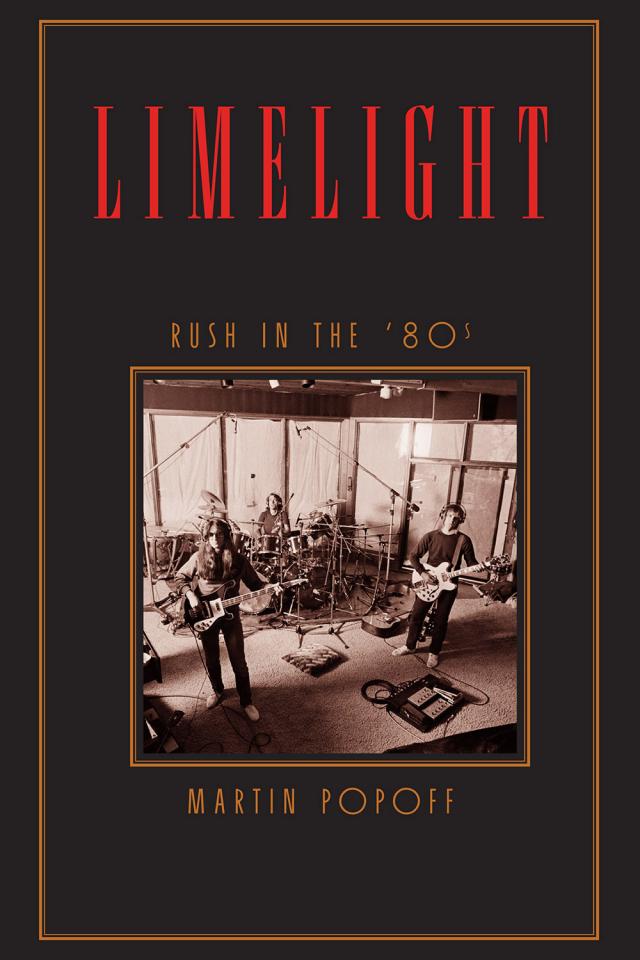


Getting together at Elora Sound Studios commencing September 27, 1986, the guys already had bits and pieces to the likes of “Time Stand Still,” “Turn the Page,” “Open Secrets” and “Mission.” Creativity on the music end would be sparked by carefully cataloged ideas generated at sound checks on the Power Windows tour along with Alex’s tapes. By November they had the brunt of the album fleshed out — “Force Ten” would be the last track to come, on the last day in Elora, December 14. The next month, they brought Peter Collins in. His most material changes were to “Mission” and “Open Secrets.”
“First of all, I had just finished one of the worst projects of my life in between Power Windows and Hold Your Fire, which was a Billy Squier record,” recalls Peter Collins, on being brought back by Rush for a second time. The album he is referring to is 1986’s Enough Is Enough, which he worked on with Jim Barton. Following three platinum and multi-platinum records, Enough Is Enough stalled well short of gold. “That really brought me down to the ground with a resounding thump. That was the first time I had actually had a real failure — it completely tanked. Up to that point I had been like a rising star in rock music, and when I got the call from Rush to do Hold Your Fire it was really a huge shot in the arm for me, because I thought, well, my career is over with this Billy Squier record. When they called me, I was very, very pleased and had a great enthusiasm for diving in and doing it.”
The heavy lifting began at the Manor in Oxfordshire on January 5, 1987, and utilized digital recording techniques for Geddy and Alex, while Neil was captured in analog with a later conversion to digital. Hold Your Fire was shaping up to be as glossy, hard, thin and high-strung as its predecessor.
“In terms of the direction, I don’t remember any discussion about should the sound be any different,” continues Collins. “I got the sense there was no problem keeping it in that direction at all, and they didn’t have a problem using Andy Richards again.”
Andy came into the picture when the guys transitioned to Ridge Farm, which is also where everything was converted to digital. Then, on March 1, it was back to Montserrat, and for the same purpose (other than swimming and drinking), namely Alex’s guitar overdubs.
“It was not as difficult,” says Peter, remembering the flare-up of Alex’s skin condition on the previous trip. “We went back to Montserrat, and I don’t think he had the same problems the second time. And we all had a better working relationship. By that time, we got his pedal board sorted out and the dynamic between all of us was much more comfortable. So he knew more what to expect and I think he was slightly more prepared, and we didn’t have to go through all the guitar options. Having been through them on Power Windows, we knew more what would work quicker, so that was less stressful for him. Jimbo, the engineer, was more accepted by them. Having been through the process of figuring each other out during Power Windows, it was naturally going to be easier.
“I don’t think we used Andy quite as much. Geddy stepped up more on Hold Your Fire. We had the power drill sound that Andy came up with, but I don’t remember Andy doing a great deal on that record, certainly not as much as on Power Windows. It was getting toned down, the keyboard element. Alex was probably more vocal about us not needing as many keyboards. Also my son was born in the middle of that. I had forecasted for my son to be born in a certain week and we made that week a week off, and he didn’t show up in that week so I had to leave in the middle of Andy’s overdubs.”
In terms of the record’s sonics, the guys were looking to make one adjustment — get more bass.
“We had a very good engineer, James Barton on that,” says Peter on the use of bass on the record. “Geddy was comfortable with James. But the bottom end was always an issue with Geddy, because it was coming more from an English sensibility where the bottom end is not as low as the American sensibility. Geddy was always worrying about the real low-end frequency. After Power Windows, we resolved to try to get more low end in on Hold Your Fire from a technical side. Geddy was definitely driving that, as I was — I became aware that we needed to address that. Part of Jimbo’s sound though was that kind of mid-rangey thing; it didn’t involve a lot of low end. Low end would come in at certain moments, particularly when Geddy was using the Taurus pedals, to distinguish itself from the regular played bass. But that was an issue, and an issue in mastering as well. But I was totally unaware of that. It didn’t mean anything to me until I became much more aware of the American sensibility towards bass. And even to this day it’s quite different between England and America.”
As Peter alludes to, in the end, they didn’t quite get where they wanted — Hold Your Fire was a notoriously trebly record, as bass-challenged as the one before it and the two after.
Geddy continued to show interest in all aspects of the recording process. “I would say definitely he was my co-producer. You know, it’s always a co-production credit with the band, but Geddy had the greatest interest in production. He would be my go-to point of reference representing the band. But of course, with guitars and drums, the guys would speak up if they had a point of view. But in order of involvement on the production side, it would be Geddy, Alex and Neil.”
“He has a nice balance of both spontaneity and careful application,” reflects Neil, offering a rich explanation of Geddy’s role in the band. “For instance, he and Alex can sit and just noodle away for a couple of hours. It’s Geddy whose gonna sit there and sift through those ideas and assemble them into something. And when I bring him lyrics, I just give him a pile of stuff. It’s not like, ‘Here’s my favorite new thing that I wrote.’ It takes the pressure off both of us. He’ll find lines that he likes, and he’ll find a part of the song that they go with, and he’ll take the time to work out things like that.
“And then of course having to work on so many levels, as part of the composition and arrangement, and the songwriting part of the band, he then has to think as the bass player, keyboard player and the vocalist. And it’s interesting for the two of us, particularly, not only drummer and bass player, the tightest possible relationship in music, but lyricist and singer, the tightest possible relationship in songwriting. So, necessarily, we had to learn early on to be both considerate of each other’s feelings and also so appreciative. That’s why I feel inspired by Geddy liking something when I bring in lyrics, or a drum part. Because his standards are high, for himself, and necessarily, for all of us. If you have high standards, you’re gonna apply them to everybody else.
“But that’s one way in which the two of us are alike. Both of us are very methodical, and both of us aim for the highest possible standards on our instrument. The amount of time he’s put in to just his bass playing, for example. I know he always likes to consider himself as — and I always list him in the credits as — bass player first. That’s the most important thing. Then vocals and then the keyboards and stuff. All of us have tried to fill in for just being a three-piece. That’s just a useful tool. Bass guitar is certainly his first passion.”
But as Neil explains, Geddy also pays much thought and consideration to his singing and his respectful delivery of Neil’s lyrics.
“When I bring lyrics to him that he has to respond to musically and emotionally, nowadays, with maturity, of course, there’s a lot of dialogue possible. What he’s looking for is the emotional essence of the words to get through. And sometimes he likes a phrase. He says, ‘I don’t care what it means; I just like the way it feels to sing, and what I can convey with that.’ Everybody knows there is an impressionistic aspect to singing words — sometimes the words don’t matter too much. But he has to feel that affinity with them, and as we work through the phrasing, a lot of little adjustments are made for the sake of the vocal performance. Melody and phrasing are one thing, but delivery is the other important part of vocalizing, and something he’s incredibly attuned to.
“And I know he builds a persona, like an actor, to sing a song. He puts himself in a certain persona, and even adopts different attributes of that singer, that imaginary singer, that he would bring to that performance of the song, pretty much like an acting role. Something all three of us share a little bit is the comic acting. But the serious actor’s also part of what we do, and how we interact together in our conversations. He’s able to inhabit a song, and live that song, time after time.
“And we build that atmosphere between us, I would say, from the beginning, by getting the words he’s comfortable with, sometimes not their meaning, but in their tonality, which is very important to him. A lot of times I’m tweaking words and tweaking lines just to fulfill a certain rhythm, a certain tonality he’s looking to sing. That’s a challenge for me — a welcome challenge. From the first time he says he likes something, I’m on board, right? That’s all the inspiration I need. And if I have to go back and rewrite everything but those two lines — fine, you know? The fact that he likes it, or in Alex’s case too, if they like a drum part or if they like the lyrics, then I couldn’t be happier, and I’ll do anything to make them like them more. Geddy brings that same dedication to all those analytical aspects of singing that only the singer probably has to know about. That’s an important thing.”
Neil elaborates on his point that Geddy does things only singers need to know about, saying, “When the art is concealed, it succeeds. It’s part of what we’ve learned in technique over time, and he’s learned as a singer. He’s approached that very seriously. His singing and his voice, and the fact that his range has endured into forty years of working, is fairly superhuman. Alex and I have to recognize that if he couldn’t do it, we couldn’t do it. You know, if he was not able to sing — as happens to singers, especially when they sing with that kind of brio — we’d be done. If the singer can’t sing, then the band can’t play.”
But Neil doesn’t try to second-guess what Geddy wants in terms of singing methodology. That all comes later. “A lot of times when I’m handing in the lyrics, maybe a couple of lines or a verse is gonna survive out of them, so I try not to be that precious about it. When I’m writing lyrics, I have a tempo and often a melody in mind, but I don’t tell Geddy or Alex that, because I want to see what they do. And many wonderful surprises happen that way. Sometimes if Geddy’s having trouble with phrasing, for example, it’s something I’m thinking of in syncopation as a drummer. I say, ‘Well, I sort of saw it falling like this kind of phrasing.’ Phrasing is one element that the two of us do discuss. If I have a way that I think a line can fall, during vocal recording, even, if we’re working together, there’s quite a lot of interplay around phrasing. If he’s having trouble with a line, I might suggest a back-phrasing solution or rewrite it. You know, whatever it takes.”
With respect to Neil’s other role in the band, namely his status as “the world’s greatest drummer,” Peter says that during this period, Peart was full-on into the possibilities afforded the melding of old-fashioned acoustic and newfangled machine tooling.
Still, it was Geddy who was most interested in the guts of making records. Collins quipped that during the production of Hold Your Fire, “Neil would be off doing an eight-mile run or something, pushing himself to the limit,” adding that, “he presented us with his sounds, and it was up to us just to record them. Some of his electronic sounds were very odd to us because we thought we were the masters of electronic sounds in England, and what do these North Americans know? We thought they were quite backward. And some of the sounds sounded, to be honest with you, just not hip. But Neil was very positive: ‘Well, if you don’t think this is hip, what do you think it should be?’ And it was up to us to offer some other suggestions, which sometimes he’d take and sometimes he didn’t. But basically, by the time we got in the studio, as you probably know, he was absolutely one hundred percent rehearsed on exactly what he was going to do and what his sounds were going to be. There was very little wiggle room once we were in the studio.”
“Neil listened to a lot of English music,” says Peter. “He spent quite a lot of time in England in his, teenage/early adult years. I think he worked in Carnaby Street. So he was very plugged into the English sound. He was excited that we were incorporating some of the British sensibility into their music, and the cutting-edge technology and the new reverbs. We used a lot of effects on his drums and he was really happy. We would try things, and some got used, some didn’t. But big reverbs, the effects, the really highly compressed snare drum . . . he seemed to be thrilled with it at the time.
“But I think they were more interested in establishing their sound — they certainly didn’t want to chase anybody else’s sounds. They never said, ‘Why can’t we sound more like this?’ Or gave me an example of something they thought they should sound like. That never happened, like it happens with a lot of bands. They bring in their favorite band — ‘Why can’t our bass sound like this?’ No, they were interested in establishing a genre of sound.”
A genre of sound. Quite telling, since Rush were essentially alone across the rock spectrum in the types of records they were making at this time. Nobody from the ’70s had loaded up on the electronics this radically, and no one this electronic had the grounding in original heavy metal that Rush had. It was a marriage of two wildly divergent worlds. Was it a shotgun marriage? Something that didn’t exactly work? Many fans think as much. Pretty objectively, Power Windows and Hold Your Fire sound extremely dated, wholly of the ’80s, where Rush’s ’70s material has become unassailably hip, and probably never again to be seen as anything but. If and when the ’80s ever become hot again, these records might see renewed respect.
But the band maintains a brave defense of this period. “Hold Your Fire was a good record,” affirms Alex. “We were sort of coming to the end of our foray into the world of keyboards. Power Windows was so layered with keyboards and Hold Your Fire was a bit of a relief; we kind of pulled back a bit on the use of keyboards. But it was part of the ’80s thing; that was the sort of headspace we were at then.” On the subject of that headspace, Alex takes a break to have a chuckle over press shots of the band back then, pointing out the bright new wave outfits, pageboy haircuts and Geddy’s big glasses. Stopping at one of many live shots of himself in various Miami Vice suits and tuxes, he offers, “Yeah, and right after this, I ask the crowd, ‘May I take your order?’”
Post-Montserrat, the band and their entourage would return to Toronto, specifically to McClear Place Studios, for more overdubs and some fancy orchestral stuff. Done by April 24, the record was then mixed at William Tell Studio in Paris, France. After mastering in New York, Hold Your Fire had been assembled in five different countries.
For an album cover, the band went with something as austere as the music enclosed, but that wasn’t initially going to be the case. The much more action-packed photo used on the inner sleeve, of a man juggling three flaming balls, was painstakingly assembled with the intention that Hugh and photographer Glen Wexler were making an album cover. References to past albums are in the shot, and indeed, the guys had originally brought back Neill Cunningham from Power Windows to peer through a window. Instead, they went with the less gratuitous shot of the three floating red balls, which is indeed photography, with red painted billiard balls and even the Rush logo fashioned then photographed. Wexler had also designed the cover for Black Sabbath’s Reunion double live package and Van Halen’s Balance album, the record that was issued when Ray Danniels was managing the band.
Like the album’s production, after twenty years, the juggler photograph looks dated, the whole thing an orgy of computer-generated imagery. But it was a physical, painstakingly assembled set, basketballs coated with rubber cement and lit on fire, actors (Dennis Hopper was supposed to be part of the scene, but they couldn’t get him scheduled), painted bits, meticulous Frankensteining of parts by a highly skilled photographer.
As for the fit of the cover to the record’s ostensible themes, it’s a stretch. Originally, Hold Your Fire was going to be about time, spurred on by early composition “Time Stand Still,” but then the word instinct became operative. But it’s still all a bit nebulous. Hold Your Fire indeed lines up with the juggler photograph, but the balls on the cover are neither on fire nor juggled. And other than a pervasive and saturated red, there’s no fire. It’s been vaguely explained that one instinctually fires first and asks questions later, but that’s a stretch as well.
The album opens with a curious collage of industrial sounds before “Force Ten” shuffles into view, stage right — of note, this would be the first song delivered to radio. Fairly rocking for this period, it demonstrates the band’s will to diminish the use of keyboards and fill some of that space with Alex, although his tone is still astringent, anemic even. Geddy, inspired by friend and fusion bass wizard Jeff Berlin, plays bass chords on the song. The lyric uses the Beaufort scale to measure storms as a device to discuss the whirlwind of an active life, although the lyrics are fairly obscure, Peart also intimating that it’s about having the courage to fail in the face of endeavor. This is his second co-write with Max Webster lyricist Pye Dubois, who collaborated with Neil on “Tom Sawyer.” As is their process, it’s less a collaboration and more like Neil taking sketches and aphorisms Pye has provided and sculpting them into shape, adding along the way.
Next is what would be the record’s biggest song, “Time Stand Still” serving as a moderately successful single in the U.S. and the U.K. The song got full-on video treatment, Zbigniew Rybczynski directing the band floating across the screen somewhat comically, not intentionally so. The song is distinguished by a vocal cameo: ’Til Tuesday’s Aimee Mann was called on for angelic contrast to Geddy’s plaintive yet wistful sentiments on the passage of time (Mann also appears in the video).