Climbing the Mango Trees: A Memoir of a Childhood in India, page 9


If Taiji was trying to compensate her children for their emotional deprivations by giving them choice foods, this could be written off as one of the smaller ripples created by Shibbudada's behavior towards his family. As we all got older, the ripples would reach further and further and enmesh Shibbudada's family and ours in the worst tangle of human relationships.
THRTEEN
Family Picnics in Delhi • The Art
of Getting Thirty People into Two Cars •
Cinema Trips • Story Time
We all looked forward to family picnics in Delhi. They if helped to cloud nagging worries, to take our minds off the daily grind.
The best time was winter, when the days were sunny and crisp, but the monsoon season, with its romantic, cool, moisture-laden breezes, was just as attractive. Our chosen destination was rarely some glorious wilderness. No, when we were in Delhi, we preferred familiar territory, perhaps the well-tended garden of an eighteenth-century tomb or a twelfth-century palace on the outskirts of our own beloved city, which affirmed our deep connection to the land and its history, our sense of entitlement. The entire family would go on the picnic. During my childhood it did not occur to me that families came in sizes smaller than thirty people, swelling beatifically to a few thousand at the mere hint of a grand event.
Preparations for the picnic would begin at dawn. All the short ladies of the house—and they were all short—would begin scurrying around in the kitchen. One would be stirring potatoes in a gingery tomato sauce; another, sitting on a low stool, rolling out pooris (small puffed breads requiring deep-frying) by the dozen; yet another would be forming meatballs with wetted palms. Pickles had to be removed from pickling jars, fruit packed in baskets, and disposable terra-cotta mutkainas —handleless cups for our water and tea—given a thorough rinse.
I would run from the kitchen, where the smells would serve as a reminder of future pleasures, to where the servants were packing the charcoal and the ungeethis (braziers). From here I would make a dash for the garage, where the trunks of the cars were being coaxed to hold the dhurries, sheets, pots, pans—indeed, a whole batterie de cuisine piquenique. The servants were all masters at it by now and carried on with military precision.
Two cars, the gleaming Dodge and the Ford, would stand at the ready in the brick driveway, with Masoom Ali, Babaji's fez-hatted driver, giving last-minute flicks with a dustcloth to the cars' exteriors.
The art of getting thirty people into two cars had long been mastered. The first layer consisted of alternating short ladies and teenage children, with the teenagers sitting perched on the edge of the backseat. On their laps went the slim ten-to-twelve-year-olds. The third layer, sitting on the laps of the second layer, consisted of those under ten. The tall men and servants sat in the front seat. On their laps sat the fat ten-to-twelve-year-olds, holding all the baskets and pots that could not be stuffed into the trunk.
The cars would grunt and groan but always start. The Ford would lead the Dodge through the northern Kashmiri Gate of the Old City, past the St. James Church, built by a nineteenth-century Anglo-Indian, past Shah Jahan's seventeenth-century Red Fort, and out of the Old City through its southern Delhi Gate. Soon we would be traveling along the wide, tree-lined boulevards of Lutyens's New Delhi. It was from here that British governors-general and viceroys, known by the Indians as “Laat Sa'abs” (Lord Sahibs), ruled from their own Lutyens-designed pink sandstone palace in a setting that one Englishman described as “the court of the Great Moghul run with the quiet precision of the court of St. James.” Beneath the entire four-and-a-half-acre palatial building (the palace is now the official residence of the Indian president) ran a full Edwardian basement, a downstairs to the upstairs, replete with domestic offices, sculleries, bakeries, larders—even a press to spew out streams of menus. Bands played when these viceroys came down to dinner, with one particular ruler choosing “The Roast Beef of Old England.” (We children did get something out of all this. Whenever someone was acting too grand, we would put him down with “Don't be such a Laat Sa'ab.”)
Our cars would now head towards open fields of mustard and millet (the mustard and millet of my childhood have given way to concrete as the city has grown from fewer than a million to over twelve million). Well before we got there, far away in the distance, standing upright like a welcoming beacon, could be seen the tower towards which we were heading, the Qutb Minar, built in the early thirteenth century by the first Muslim dynasty to rule Hindu India.
The cars would pull up beside the gardens and unload their passengers. The short ladies, coming out last, would inhale the fresh country air and, with their hands, try vainly to iron out their now very crushed sarees. While the children rushed to climb the tall sandstone tower, the short ladies would amble to the base of the tower, touch it to establish that they had been there, and, having exerted themselves enough, amble back to the garden to pick a site for the picnic. A large blue-and-red-striped cotton dhurrie would be spread out, and a slightly smaller white sheet laid on it.
From the top of the tower, we children could survey all the Delhis below us with a certain degree of propriety. This was our city: there was the thirteenth-century Delhi of the Khilji dynasty, the fourteenth-century fort of the Tughlak dynasty, the fifteenth-century tombs of the Lodhi dynasty, the sixteenth-century tomb of the Moghul emperor Humayun, Shah Jahan's seventeenth-century mosque, and then British India with its elegant avenues and circular shopping center, Connaught Place.
Soon our eyes, impelled by our stomachs, would settle on something closer—a brightly edged cotton dhurrie over which hovered some familiar short ladies. We would think of the meatballs cooked with cumin, coriander, and yogurt and come thundering down the hundreds of steps.
As we settled cross-legged on the edges of the dhurrie, the servants would lay out the freshly heated food. We rarely used plates or cutlery for eating. Instead, we would take two pooris at a time, using the first as a plate, a kind of medieval trencher, and the second to make our little morsels.
Meanwhile, Jai Singh would be making tea in a kettle set on top of an ungeethi (brazier). After our meal, we would hold out our handleless, disposable terra-cotta mutkainas towards him, making sure to wrap them in our handkerchiefs first so our fingers would not burn, and Jai Singh would pour: steamy hot tea, milky and sweet, so hot that we would have to start by breathing in tiny little sips.
Indian movies encouraged another kind of picnic, a mini-picnic of a more informal, impromptu nature. When we were in Delhi, we never saw movies with our parents, only with our cousins. An older cousin acted as escort and was given the task of buying tickets, generally for the upstairs balcony.
Movies were just an extension of storytelling, which was second nature to most of us in the quill-and-ink set. We did not grow up with bedtime stories: that sort of cozy intimacy was hardly possible with twenty or so bedded-down children. We grew up more with the family huddle in the middle of the day. We would drag an aunt or an uncle to a sofa and drape ourselves all around them, on the arms and back of the sofa, on the carpet below, on their laps, a little hillock of overlapping bodies, hanging on every word. “Please, please, tell us another story.” My family's fund of riddles, poems, and anecdotes seemed endless. My aunt Saran Bhua's husband was an accomplished golfer who impressed us no end with his plus fours and beret. He was hardly home from a round of golf when we would corral him to regale us with several folksy tales told in th epurabia dialect of his home state, Uttar Pradesh. One story that we loved to hear again and again had to do with the trip he'd made to England with an Indian athletic team. At a grand dinner, all heads of foreign delegations were asked to sing their national anthems in “their native languages.” “What could I sing?” he would say. “Our national anthem then was ‘God Save the King’ and it was in English. So I sang this …” And he would proceed with his rendition of a folk song that he had taught us all, so we could join in: “Bibi maindaki ri, tu tow pani may ki rani” (“O lady frog, you are the queen of the waters”).
My cousin Mahesh's paternal grandmother looked most dignified and formidable with her shock of white hair, her straight back, her peg leg, and her cane, but her whispered tales rocked us with giggles, as they were full of the naughtiest scatological humor. Shibbudada's yarns were either about musicians and the training of musicians—“So-and-so could not look his guru in the eye, he was not allowed to play a single note for ten years”—or about hiking across the Himalayas, another of his passions.
We children made up our own stories, too. Sometimes they took the form of plays, which we enacted for our enthusiastic elders, setting up curtains, arranging seating, and even selling tickets. No mean reviews here! Our very first play, when our proportions must have been diminutive, used the space between the four legs of a rolltop desk in Shibbudada's annex as a stage! This was still in the days of innocence, well before I had learned to question my contradictory uncle.
Filmgoing was just another step. We liked all movies, but going to Hindi movies had added benefits. These Indian films were particularly conducive to whetting our appetites and then to satisfying them. They generally lasted about four hours, and whole families, including infants, would come to view the mythological-historical-tragicomical musicals. There was a great deal of yelling, crying, getting up, singing along, and sitting back down among the audience throughout the show. Certainly no one minded the noisy unwrapping of paper cones containing chane jor garam, small chickpeas that had been flattened and roasted, then flavored with cumin, chili powder, sour mango powder, and black rock salt. We would munch on the chickpeas as we watched Hanuman, the Monkey God, fly across an indigo sky dotted equidistantly with hundreds of five-pointed stars, all cut from the same stencil.
During the long intermission, we would all go in a horde to buy potato patties, aloo ki tikiyas, from vendors who had carefully posted themselves just outside the cinema doors. These patties, a Delhi specialty, depended for their unique flavor partly on the way they were cooked and partly on the spices in the stuffing. They were not deep-fried, they were not shallow-fried. Instead, they were pan-roasted.
Each vendor carried a brazier on which he had set up a very large, barely concave, round cast-iron griddle (tavd). Patties that were ready to sell sat waiting on the outer fringes, staying warm until needed. Those that were still cooking were in the center, sizzling away in the few tablespoons of oil that pooled in the middle. In one pot were the vendor's seasoned mashed potatoes, and in another the stuffing, made out of highly spiced split peas that had been cooked until they were dry and crumbly. To make a patty, the vendor would pinch off a ball of mashed potatoes, flatten it into a small patty, pinch off a smaller ball of the stuffing, place it in the center, and cover up the stuffing with the potato to make a ball. The ball was then flattened and slapped onto the griddle.
The squatting vendor kept turning each patty this way and that until it was reddish brown and completely crisp on both sides. By this time our mouths could almost taste the tikiyas. As soon as he got the order, the vendor would place a patty on a leaf, split it open into two parts, and smother both with sweet-and-sour tamarind chutney. We would carry these hot patties back into the dark cinema house and eat them as we watched Hanuman trying to rescue Sita, the good queen, from the clutches of the demon king of Sri Lanka.
FOURTEEN
Summer Holidays in the Hills • The
Great Exodus • Grandmother's Magic Potion •
Mountain Picnics • The Taste of Ecstasy
During the same eight years that we shuttled between our homes in Delhi and Kanpur, our summer holidays, three or more glorious months of them, were spent in “the hills.” The official version of this custom had started in 1864, when the British government, unable to suffer the heat of “the plains,” moved the entire administration up to Simla, in the central Himalayas, for the “summer”—a good six months, from April to early October. Seventeenth-century Moghul emperors, also originally outsiders from colder climes, had set a precedent. In a mighty cavalcade of elephants, horses, and camels, these Moghul rulers had traveled annually even farther north, to a lake-filled valley in the heart of Kashmir, Srinagar. Once there, they had quickly declared, “If there be a Paradise on earth / It is this, it is this, it is this.” For the English, who governed India first from Calcutta and then from New Delhi, a similar cooling respite was provided by the hill town of Simla.
Known as Shimla today, the area, in the state of Himachal Pradesh, once contained a few small hamlets and, on top of the highest peak, Jakko, a temple dedicated to the goddess Kali. Though it was sparsely populated by humans, nature was fully represented in its resplendent glory, providing stately forests of deodars, pines, and oaks, and a profusion of rhododendrons that climbed all the way up to the snowline.
The early nineteenth century was to see a war here, first between local chiefs and the Nepalese Gurkhas, and then, when the British came to the aid of the chiefs, between the Gurkhas and the British. Leading the British to their final victory was Major General Sir David Ochterlony, the same gentleman who would insist on hiring my grandfather's grandfather in Delhi somewhat later. The first cottage was built in Simla in 1819 by an assistant political agent for the hill states, Lieutenant Ross. As more and more English officials visited, more and more British-style cottages with very British gardens sprang up to accommodate them. The main road was called the Mall, and the town developed the feel of a British transplant.
Around April and May, when scorching loo winds swirled hellishly in the plains, Britons began leaving in droves and heading north. Armybattalionswere stationedinthe hills forthesummerso they could rest and recoup. British businessmen tried their best to flee the plains, but if they could not, they sent their wives and children. In the government, everyone from the viceroy down to the petty officers packed their bags and traveled to the Himalayas. The viceroy had a domed sandstone palace in Delhi to stand up to the grand remnants of Moghul architecture. In Simla he took refuge in a more English mansion with a countrified name to match its countrified look, Viceregal Lodge. As the High Court moved up, too, my grandfather, an eminent barrister, followed. His business was now in the hills. Besides, it was cool and much more pleasant.
Babaji was the head of the family, and if he moved we all moved.
Oddly enough, he never built a house in Simla or in any other hill station. He rented, instead, not one large house but two or three adjacent ones, according to the number of people expected that year. These houses, nestling in the mountains and surrounded by sun-kissed dahlias and hydrangeas, with semi-British names like “Choor View” and “Pentland,” came with only basic furniture. This meant that everything else, including the servants, had to come from Delhi. The contents of kitchens, bedrooms, bathrooms, along with toys and games, were all put in trunks, canvas “holdalls,” baskets, and bundles. The whole army of forty or so people—all in a state of excitement, as we loved the hills—would then embark on the annual exodus. We would take the overnight train to Kalka, in the foothills of the Himalayas, which, at twenty-four hundred feet above sea level, already hinted at the pleasures to come. There we would have a British Railway breakfast in the waiting rooms—generally, slightly greasy eggs, toast, and tea served on heavy railway crockery—and then pile into the eight or nine cars that had been hired for the four-hour drive.
The first sight of the Himalayan peaks towering over the plains, range after purple range, was exhilarating enough. But as the procession of cars started up those hairpin bends, as the air got cooler, as we saw the first pines, the first ferns, the first waterfalls and gushing mountain streams, as we climbed to six, seven, then eight thousand feet above sea level, as the first mist licked our cars, all of us, separately and together, felt that this was our Paradise.
Some of us with delicate constitutions got a little nauseous on those hairpin bends. No need to worry—my grandmother had a cure. She would call a halt to the moving procession. “Jai Singh, Jai Singh, where is the lime pickle?” she would yell out. Everyone would start jumping out of the cars. A break felt good.
Jai Singh, who knew where every last spoon was located, would quickly get his hands on the to-be-opened-on-the-journey basket. There, in a crock, would be Bari Bauwa's homemade lime pickle. Black with age and with black pepper, cloves, and cardamom, it was my grandmother's magic potion. When she ministered tiny portions of it, nausea just vanished. She had many such tricks up her sleeve. Once when I was stung by a bee, I yelled with pain and my grandmother came running. The next I knew, she was stroking my afflicted cheek and reciting some Sanskrit verse. I could not understand a word, but it cured me right quick. She was a useful short lady to have around.
As new houses were rented each time, the first thrills were provided by the exploration of their nearly always damp and musty, unaired interiors. How many bathrooms? What sort of toilets? Enough tables to play bridge and rummy? Oh well, the floor would do. Was there a glazed veranda? We could not live without a glazed veranda.
Glazed verandas were enclosed with glass windows to protect them, when necessary, from the cold and from monsoon downpours. When the sun shone, all the windows could be flung open. Most hill houses had them, either running on one side of the house or, if we were lucky, on all four sides. We children lived in the verandas and sometimes slept in them, too. They gained such a grip on our psyches that when my husband and I bought our country house in upstate New York, the first room I added, to take advantage of southern and western exposures, was a hill-station-style glazed veranda!
Once everyone had settled in and unpacked, the children were pretty much left to themselves, to explore mountain pathways, to
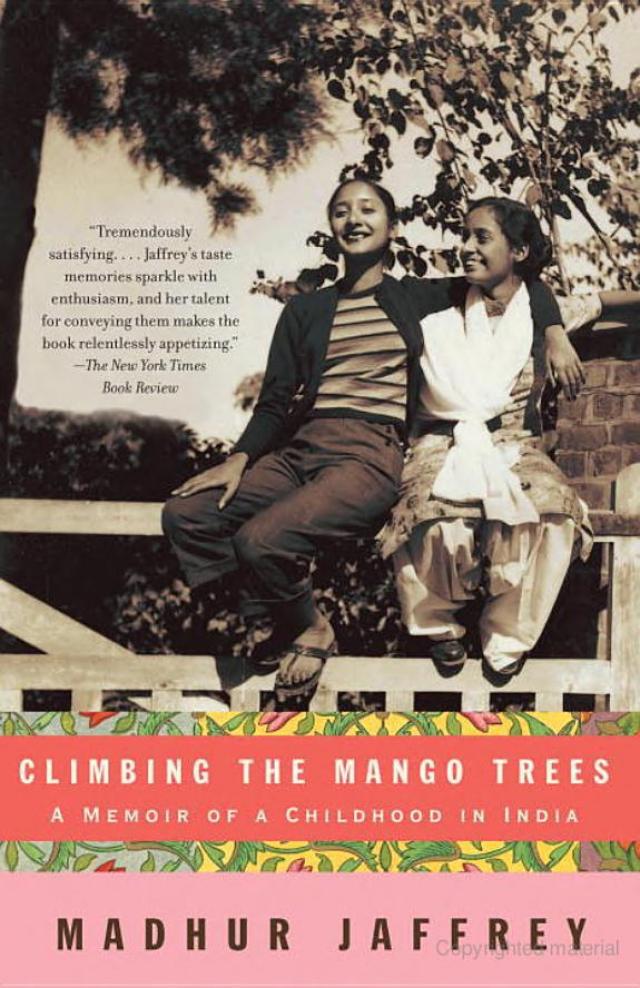
I (second from left) stand next to Veena, aged about eight. Sheila leans over me. Lalit is on the extreme right, with Santoshjiji beside her. We are at one of our Himalayan rented residences, with glazed veranda in the background.