Climbing the Mango Trees: A Memoir of a Childhood in India, page 15


Until then, our school, Queen Mary's Higher Secondary School, had been a haven of tolerance. Our class was fairly evenly divided between Hindus and Muslims. We picked our friends on the basis of intellectual companionship and common interests, not religion. My intimates included the Muslim twins Abida and Zahida; Sudha, a vegetarian Jain; and Promila, a Hindu Punjabi.
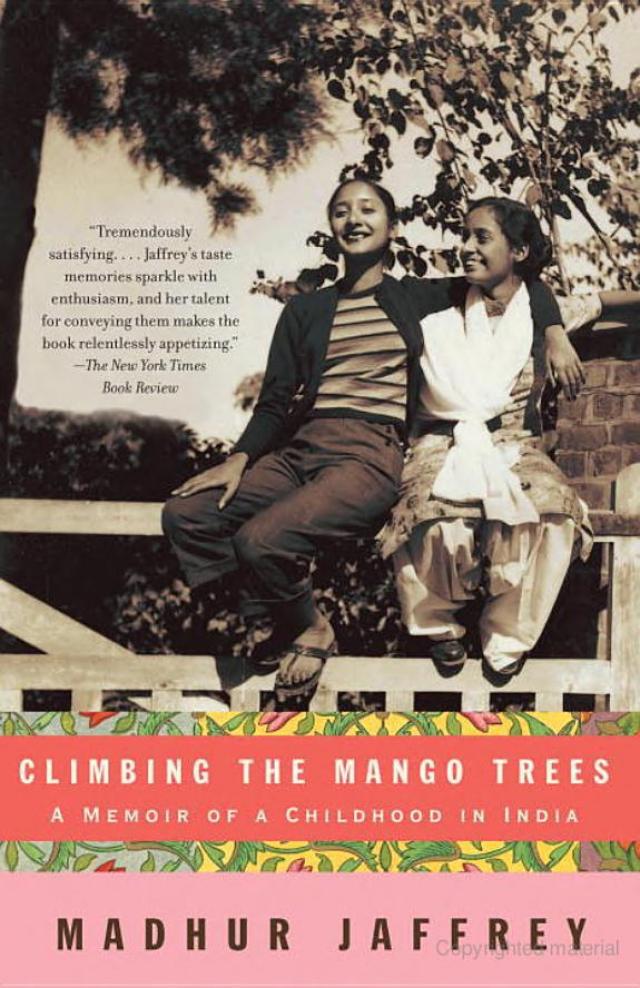
Abida and Zahida came to school wearing the most exquisite ghararas as their lower garments, with short kurtis (shirts) on top. Ghararas were worn only in Muslim families and resembled culottes. However, they were unlike the izars —the wide, floor-length pajamas—of my mother's childhood. Ghararas were so full of gathers that they gave the appearance of being floor-length, ample skirts. As all the gathers were pushed to the back and collected there, the general effect was that of an elegant bustle. Very smart, I thought. I wanted to wear them, too. I borrowed a gharara from Abida and had our tailor, Ram Narain, copy it several times over. Now all I needed were the long scarves, chunnis, the two-and-a-half-yard cloth pieces we draped across our bosoms and then threw back over our shoulders—not ordinary chunnis but the hand-dyed, hand-pleated ones, often with sparklers in them, that my Muslim friends wore.
I dragged my mother to the market to get a whole bolt of the finest mulmul (muslin). I cut this up into two-and-a-half-yard sections and left the pieces in a shop that specialized in covering them with the tiniest embroidered silver stars. Then I rushed them to the dyer and picked the shades I wanted—aqua, a soft spring-leaf green, maroon, cobalt blue, peach—and left clear instructions that the muslin needed to be heavily starched. Once this was done, I was left to do the hand-pleating myself. Each chunni took about two hours if I worked fast. The highly starched fabric wore down my fingers to the bone, but I was determined to do it. Abida and Zahida had taught me how.
It needed two people. My mother, or my younger sister, Veena, could always be drafted. The second person held a comfortable length of the chunni in front of her, as if she were playing the thread game Cat's Cradle. I sat opposite them with my hands closed in loose-fist formation. I grabbed one edge of the fabric between my thumbs and curled fingers and proceeded to form the pleats, one at a time, in a kind of horizontal milking action, one hand moving quickly after the other, until I had gone across the whole width. I did this a million times for each chunni, then twisted the chunni like a rope several times over, so the pleats would firm up and hold. I could now float through school just like some of my friends, holding up the folds of my gharara elegantly to one side when I ran, my newly dyed, pleated, sparkling chunni dangling from my shoulders. I never did manage to look quite as elegant as Abida and Zahida, though. They had single, thick, ever-moving braids going down their backs all the way to the bottom of their hips. My two thinner braids, ending in ridiculous black-ribbon bows, ruined the entire effect.
Abida and Zahida excelled in mathematics and embroidery. I could barely even say the word “mathematics” without having clouds of confusion descend upon me. Mathematics and I were born on two separate planets. When given a choice in the upper school of higher or lower mathematics, I had quickly opted for the lower kind, which allowed me to drop algebra and geometry altogether. Lower mathematics, on the other hand, was a startling composite. It consisted of arithmetic, which I could just about manage, and domestic science, a catchall subject that must have drawn its inspiration directly from Mrs. Beeton's Book of Household Management. I found myself learning some turn-of-the-century British “Downstairs” refinements, like how to use a scrubbing board and how to make food for invalids, such as blancmange. (I just made it and threw it away, it being totally alien to Indian sensibilities.) I also learned how to tie a tourniquet and assorted head-to-toe bandages, how to remove stains, basic embroidery stitches, and the names and number of bones in the human body. There are 206 bones in the body. You must always remember to count the six in the ears.
In arithmetic, when the very words “If it takes a train six hours to travel 145 …” made me desperate to reach out for a good novel, Abida and Zahida took firm charge of me, guiding me through a labyrinth of ratios and square roots. The genius of these twins, for me at any rate, lay not so much in their mathematical abilities as in their fine embroidery. The school was teaching us the British standards, embroideries using the cross-stitch, the chain stitch, the herringbone, and others that I already knew, but Abida and Zahida could do kasheeda. Perfected probably in purdah homes, where veiled Muslim women were isolated for hours at a time, this was a form of magical embroidery that allowed both sides of a fabric to end up looking exactly the same. There were two right sides and no wrong side. I had to learn it, and there were no better teachers than my twin friends.
They also taught me some games. Gittay was a picking-up-stones game similar to jacks, except we played it with pebbles, andpitthoo was a two-team game rather like baseball. They were both street games, a world away from the more formal badminton, tennis, and cricket that I'd grown up with. But I loved playing them in my newly donned gharara and chunni, as it allowed me to enter into the inner-city life of my peers that I desperately wanted to share.
There was one other way at school of sharing—and actually tasting—the inner city, not the inner city that my mother had introduced me to, but the inner city of my growing group of friends: that was at lunch, which we ate together, as far away from the stone school building as possible. We all brought our lunches from home.
The moment the bell clanged for lunch, we would lift up our many-tiered tiffin-carriers by their handles and make a dash for the outdoor area at the back of the school. We'd run through the corridor where burqas hung on either side in desultory rows, down the back steps, past the ancient neem tree with stone seating built around it, and past the netball courts. We kept running even beyond the second old neem tree, where our Girl Guide classes were held, and where our little fingers had been drilled in the art of perfectly executed reef and sheepshank knots. We were aiming for the back of the school grounds, where the land sloped upwards, and where the heat of the day was kept at bay by the soft breezes wafting under rows of tall shade trees. Here we stopped, took a few deep breaths, and sat down on the ground to picnic.
Tiffin-carriers were taken apart, tier after tier. What wonders did they contain today? Abida and Zahida could be relied upon to bring meats—and what meats they were! Goat cooked with spinach, browned onions, and cardamom, or goat with potatoes, cinnamon, and cloves. It was not so much the ingredients—the ingredients we used at home were not all that different, though we did use less chili powder—as the hand that put these ingredients together, and the order and timing it chose to use. That hand had a different rhythm, a different energy from my mother's, and from our own Hindu cooks from Himalayan villages. It produced a Muslim result.
That was the peculiarity of India's cuisines. There were dozens of traits, habits, and traditions that could be used to define regional foods. But such definitions were never entirely satisfactory, as there also hovered over each dish an air of indefinable religious sensibility that could be seen and tasted but eluded pinpointing. This stamp was present even if the dishes had the same names but were being prepared by families of differing religions. These families might even have lived in the same city for centuries.
Abida and Zahida's food was inner-city, Delhi, and Muslim. As my fingers tore off a small piece of meat from a bone, formed a morsel with the roti (flat whole-wheat bread), dipped the morsel in the spicy meat sauce (shorva), and then placed it in my mouth, I could taste all three influences. In the winters, when fat from the meat dish formed a stiff yellowish red icing over its surface, the twins heated up that particular container of the tiffin-carrier over a small kerosene stove, which they lit with a match. Those smells—the cardamom, cinnamon, kerosene, and the freshly lit match—would swirl around my head as I sat through the next class, whatever it was.
Sudha was also a Delhi girl. Her family, like mine, had moved out of the Old City and gone straight to Lutyens's New Delhi, to Firoz Shah Road, a road named after the same emperor whose ruined battlements had provided the foundation stones of my great-great-grandfather's inner-city home. Sudha's food was as Jain as Abida and Zahida's was Muslim. It was completely vegetarian, devoid of onion and garlic, as those bulbs were thought to arouse base passions; devoid of tomatoes and beets, as their color was reminiscent of blood; and contained no real root vegetables (though rhizomes were acceptable), as pulling out roots killed the entire plant. The preservation of life demanded by her religion did not stop her food—green beans, peas, chickpea-flour dumplings, or cauliflower—from being scrumptious in a haughty, austere way, nor did it stop her from sharing her food with us.
Promila's family were relaxed Delhi Punjabis. A few “modern” Punjabis had begun giving their children Western-sounding names, hoping to propel them fully into a modern world they were only half in then. Their food, though, would never change. They did not want it to change. It would always stay Indian— Punjabi-Indian at that. They were proud of it.
Promila lived within the inner-city walls but at one end, in Daryagunj, an area that used to lie by the Yamuna River, before the river idiosyncratically moved farther east. It was less crowded there than in the heart of the inner city. Here roads and houses had at least some room to breathe. She, too, lived in a joint family, in a house as large as Number 7 but without the countrified gardens. We visited each other often.
She brought parathas (griddle breads) stuffed with cauliflower, and mango pickle to eat with them. In the winters, Promila's tiffin-carrier was crammed with makki ki rod (corn flat-breads) and sarson ka saag (mustard greens), all so buttery-rich and mouth-wateringly good that she knew we would devour every last bit.
I always found my own food the least interesting and barely touched it. It was all too familiar. The others might enjoy my poori (fried bread) and aloo (potatoes with ginger), at least at those school lunches, but I wanted the contents of their tiffin-carriers. After we ate, sharing what we could, we either played gittay or wrote the letters of the alphabet in a circle on the dry earth or on the floor of the art-room veranda, making an instant Ouija board, and, using an ink-bottle top as a guide, called the spirits. We were big into spirits then, into Life, Death, Love, even Elopement. Shahida, a Muslim girl in my class with pale green eyes, was crazily in love with a first cousin and was contemplating running away. We were following that story closely.
The school, we had been told, was built on an old graveyard, and spirits seemed to be there for the asking. We pestered the spirits with questions about exams, about our crushes and loves, and about our futures. Most of the answers were spelled out without hesitation, but sometimes the ink-bottle top refused to be contained within the Ouija circle. It rose upwards by itself and flew out angrily, landing yards away. We did not know whether to be alarmed or to giggle.
Most of our teenage friendships withered and died as soon as talk of Partition began. It was as if two icy hands had descended and split our class into two, Muslims on one side, fully armed with appropriate arguments, demanding a partition of the country, Hindus on the other, with their own much-repeated counterarguments, saying, “Never.” Not surprisingly, I was left in the middle, trying to hold the two sides together. And, not surprisingly, I was mistrusted by both sides. I did not belong to the one, and I seemed to be a traitor to the other. The hurts and angers were such that we had turned into a class of righteous fanatics. I would not, could not, allow all Muslims to be condemned, as some of my Hindu friends wanted, but I also could not bear to see India divided and, as I saw it, a great country frittered away in bits and pieces. Tolerance and nuanced thinking had been shoved out of the window. It was an unbearable time of hardheaded black and white, them and us.
Without giving it much thought, at that somewhat tender age, I had become a firm follower of Mahatma Gandhi, with my dear softhearted father and mother serving as my guides. I had initially become agitated with their descriptions of the Salt March. This was not in our school history books and predated my birth, but I already knew all the details of Gandhi's Dandi Salt March on March 12, 1930. At that time our British colonial rulers had decided to impose a draconian law that prohibited salt production by anyone they did not control. This law affected every single Indian. We all ate salt, and it felt like a salt tax. Gandhi decided not only to make his own salt in a seaside town named Dandi, but to stage a very public 240-mile march to get there.
In my earlier years, Gandhi had begun advocating that we stop our reliance on foreign fabrics and that we spin, weave, and produce our own handloomed cloth as a symbol of our independence struggle. By now, I was determined to participate. I bought myself a spinner. At least I would spin the cotton thread. The simple spinning gadgetry, sold to millions of eager Indians, was housed in a black box, similar in shape to the portable wind-up gramophone I also possessed. Instead of a spinning wheel, it held a simpler spinning turntable that I could rotate with my left hand while my right hand expertly pulled a ball of cotton wool into a fine thread. Every week, I delivered several large spools of freshly spun thread to a central collection center.
As anticipated, the British soon drew final lines through the India they were partitioning. Produced in some faraway office, the newly formed boundaries cut right through the middle of farms, villages, rivers, and homes. A wail went up from the nation. Fear and uncertainty ruled. Would the new Muslim Pakistan allow Hindus to coexist? How would a Muslim minority really fare in the new secular India?
Independence Day for India was August 15, 1947, two days after my fourteenth birthday. My father took me to watch the transfer of power at India Gate, where a statue of Queen Victoria stood guard right in the center of a wide Lutyens boulevard called Kingsway at that time. I cannot remember where we parked our car, but it must have been quite far away. We walked and walked through dense crowds—hundreds of thousands of us had collected there—and stood near enough to Kingsway to have a clear view as Jawaharlal Nehru and Lord Mountbatten, both exceedingly handsome in all white, came riding down in an open horse carriage. The Union Jack was formally lowered, and the Indian tricolor went up. We screamed our lungs out. Thousands of caps were flung skywards. I felt giddy.
In what was the new West Pakistan, the joy did not last too long. Muslim fanatics began butchering Hindus and Sikhs and appropriating their houses. Hindus in the truncated India began butchering Muslims, whom they blamed for the breakup of their country. Neighbors who had trusted each other now betrayed each other. Some neighbors who had never paid much attention to each other now hid and saved each other. Mobs marched through villages, towns, and cities, killing those of faiths other than their own. Cornered men would be asked to drop their pants to distinguish circumcised Muslims from uncircumcised Hindus. If what came into view did not suit the viewers, daggers, guns, and knives put a quick end to precious lives.
A massive multidirectional migration began: Hindus crammed trains headed for India, clinging to doors and roofs; Muslims jammed trains headed for the two Pakistans. Sometimes the trains arrived at their destinations filled with nothing but dead bodies, having been intercepted by a mob with massacre on its mind. A million people died. Several million lost all their belongings as they ran or were chased from their homes. Angry, hapless refugees were piling up on both sides of the new borders.
Until then, I had seen the men in my family pick up guns only to hunt, to hunt for delicacies of the edible sort—venison and partridge and duck and quail. But there was fear in our houses, too. Unruly gangs, some bent on religious mischief, some just old-fashioned looters taking advantage of the chaos, were on the attack. This time family guns were being picked up and patrols organized to protect our neighborhood. I could hear my father say, “You two take the 2 a.m. shift. Patrol from Number 5 to Number 8 on Jumna Road, and walk back on Raj Narain Road the Number 4 way.” All the men, our fathers, brothers, uncles, and cousins, oiled and polished their guns with no sense of adventure or enjoyment. One night, the mob got so close we could hear the wild cries and shouts. We barricaded ourselves indoors, fearing for our men still patrolling the streets. But the mob melted away before doing us any harm.
This was not the case with the mob advancing on the house of Dr. Joshi, Shibbudada's close friend and uncle to one of Lalit's dearest friends. As it marched menacingly through the gate, Dr. Joshi thought he could reason with the leaders and approached them in friendship. They shot him dead. When Shibbudada received the call, he jumped into his two-tone Chevy. We begged him not to go, as he would have to drive through dangerous sections of the Old City, but he paid no heed. I remember so well seeing the back of his car as it sped out of the Number 7 gate and fearing that he, too, would be shot and that we would never see him again.
The Old City had erupted. Hindus and Muslims, who had for centuries lived there cheek by jowl, in the closest proximity, were now turning on each other. Mainji's son, my inner-city first cousin, was in his late teens at the time. He left his house for some minor shopping and did not return for several days. By then he had lost his mind. Literally. Was he beaten? Raped? Tortured? He never spoke coherently after that.
Delhi's Muslims began disappearing, making their way to Pakistan. All of my Muslim classmates left without farewells. I can only assume they had safe journeys. I have not seen even one of them since. Amina's father, rightly gauging the roughness of the Novelty Cinema area and Delhi's general instability, bundled up his family and deposited them in London. He, however, chose to stay in India, rising much later to be mayor of Delhi. My father's dearest friends, Bashir Zaidi and Zakir Hussain, also chose to stay. One would become vice-chancellor of Aligarh University and a member of Parliament and the other the president of India. But other Muslim friends of his did leave. Badr-ul-Islam had a large, grand house on Curzon Road (now Kasturba Gandhi Marg) in Lutyens's New Delhi. His sons were friends of my brothers, often going on hunts with them or playing bridge at their homes. They all left for Karachi. One of the sons would marry into the politically powerful Bhutto family of Pakistan. Once they had moved out, a family of desperate Punjabi refugees, the Bhagats from Lahore, moved in, not into Badr-ul-Islam's mansion but into the servants' quarters at the back, upstairs, over the garage. By the oddest coincidence, we would get to know this family with its several young daughters as well. One of the daughters would become my sister Kamal's best friend, and her older sister, the personal secretary to Prime Minister Indira Gandhi.