Climbing the Mango Trees: A Memoir of a Childhood in India, page 5


I started school the same year as my sister Veena was born, and my father had begun to worry seriously about the war. What happened to me was what probably happened to my sisters as well. At the age of five, I was thrown into an English-speaking class of Indians, Anglo-Indians, and Britons, speaking not a word of English myself. Until then, I had spoken to my mother and the servants in Hindustani. My father and sisters also switched languages when speaking to me or to my mother, so, even though I had heard English spoken all around me, I could not speak a word of it myself.
But I learned fast. Rather like learning to swim by being dropped in the deep end of a pool, I kicked my hands and feet and within a month surfaced speaking the language of our colonial masters. I could git-pit with the rest of them.
My school years in Kanpur were, like everything else in our lives, sometimes severely compartmentalized and sometimes a zany mix and match of cultures. In the morning we got into our white blouses, navy blue tunics, socks, and tightly laced shoes, which my mother double-knotted. We were never going to lose these shoes! We could not even get out of them. Our coconut-oiled hair was parted in the middle, braided tightly into two pigtails, and secured firmly at the bottom ends with black ribbons. Our pigtails were not going to come loose, either.
My mother handed us our khaki solar topees (hard, brimmed
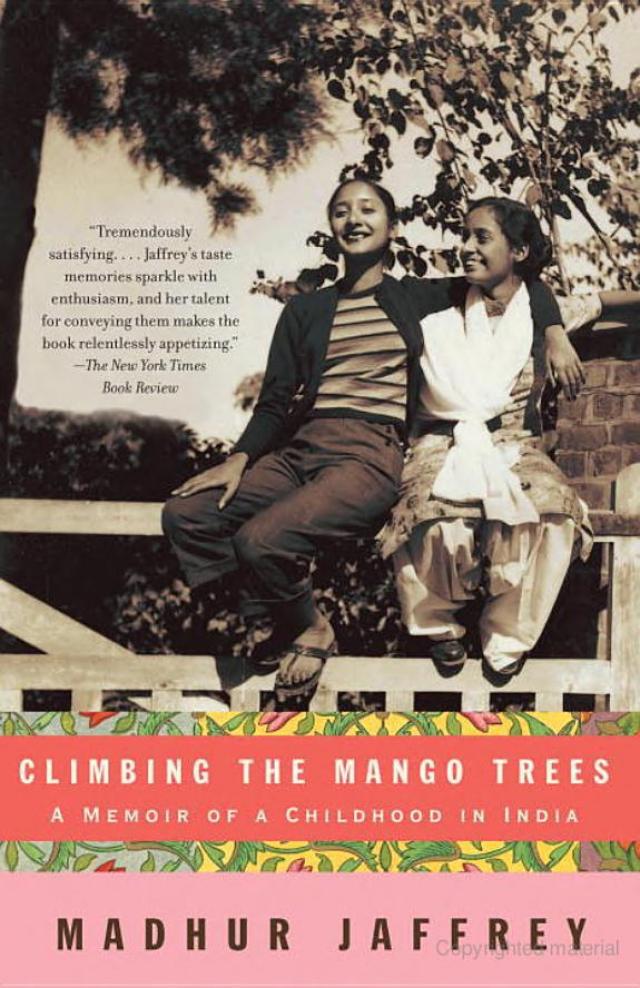
My sisters Lalit (to my left) and Kamal and me (aged about four), wearing my favorite red dress, in the back garden of the house in Kanpur.
hats) and our hard leather schoolbags, filled with textbooks she had covered with brown paper, and then escorted us to the car, her lightly starched cotton voile saree crackling as she walked.
Once we got out of our front gate, it was we who were in charge. We instructed the driver to go “faster, faster.” The whole aim of this was to be at top speed as we reached a small arched bridge over a narrow tributary of the Ganges River. At that speed, the car went up the bridge and then flew. Our stomachs lurched, and we held our breaths until we landed with a bit of a thud. Not very good for the car, but it made our morning and prepared us for the nuns!
Our convent school, quite naturally, recognized only one religion: Catholicism. If you were not a Catholic, you could not go to the chapel for mass in the morning. This was a bit of a disappointment, as the chapel always looked and smelled so, well, holy. Instead, all non-Catholics, the few Hindus and Parsis—and many Anglo-Indian Protestants—had to attend Bible-history class, which was held in our everyday classrooms. I enjoyed reading the King James Bible. Even more, I enjoyed the free exchange of holy pictures afterwards. I liked to collect the slightly raised ones printed on hard, smooth cardboard, outlined with gilt.
At school we recited “Half a pound of tuppenny rice, half a pound of treacle” and “four and twenty blackbirds, baked in a pie” as if to the manor born, even though we had never eaten a pie in our lives and had no real sense of what treacle was. At morning break, we were allowed to use the small daily allowance given by our mother, about two annas each (an anna was a sixteenth of a rupee), on goods offered by the toffee man. This was the highlight of the school day.
The toffee man was Indian but had been vetted by the nuns. He sat cross-legged on the stone floor of a back veranda, his homemade wares taken out of a tin trunk, spread on a cloth in front of him, and sold to us on squares of paper. And what wares: half pink, half white coconut toffees, cut in diamond shapes that melted in the mouth; chocolate toffees that were part fudge and part caramel, cut in thin squares; and the barley sugar … fat twists and roughly shaped, dimpled balls of candy in yellow and orange and red, opaque on the outside, translucent inside, not too brittle, but hard to bite off and, once in the mouth, teeth-sticking and chewy. These were treats only the toffee man had. They disappeared from our lives once we left St. Mary's Convent.
Not entirely. Years later, in the 1980s, I was in Calcutta's covered New Market researching a cookbook and preparing to act in Merchant Ivory's Heat and Dust to be shot in Hyderabad a week later, after a stop in Delhi. I looked at the fish shops selling Bengal's famed rahu (a kind of carp) and hilsa (a shadlike mackerel), and the men who shopped for them in the early hours of the morning. I went to the spice shops to examine Bengal's Five-Spice Mixture, which once included the now disappearing spice radhuni. All of a sudden, something made me turn my head, and there, across a narrow market lane, was a shop that announced “Barley Sugar.” It just could not be true. Barley-sugar labels had deceived my sisters and me many times before. It always turned out to be some brittle, machine-made rubbish that lacked the chewy texture and the very slightly caramelized taste of the real thing. Barley sugar was now a mirage, surely.
I crossed the narrow lane anyway. Lord, it looked like the real thing: fat, twisted sticks; misshapen, dimpled balls. I tasted a piece. This was it. This was it. The Anglo-Indian (mixed-race, with Indo-British ancestry) owners had been making and selling it for decades. I could have kissed them. I bought several pounds of it, carrying it on the plane to Delhi to offer to my sister Kamal. She was skeptical at first, having been deceived many times before, but one bite convinced her. Kanpur came rolling back, and the two of us went out of our minds. Even though we admonished each other with “Are you crazy? It's pure sugar!” we behaved like children and managed to finish every last bit of the barley sugar in less than a week. I personally put on six pounds, which I had to get rid of with a month-long diet of just tandoori chicken and salad at my Hyderabad hotel.
The toffee man was followed by arithmetic, which I loathed; English—reading or essay writing or dictation—which I loved; and nature study, which allowed me both to draw and to write, so it was a great favorite. By then it was lunchtime. My sisters and I would meet up again; our food was freshly made and came in a four-tiered tiffin-carrier from home. Our turbaned bearer brought it. In the car. It was the second trip for the car.
One of the side verandas of the school was lined with benches and tables for all the children whose food came from home. The bearers' job—our bearer and other people's bearers—was to spread out tablecloths and set the crockery, cutlery, and napkins before the end of the last class. As my sisters and I came flying out, our bearer would open up the tiffin-carrier and spread out the containers, putting a serving spoon in each of them. The food was still warm. There might be koftas with cinnamon and cardamom in one, rice with peas or chapatis in another, cauliflower with potatoes in a third, and perhaps homemade yogurt or a salad in a fourth. Afterwards there were some easy-to-eat fruits such as bananas or the Indian orange, which is really like a large, loose-skinned tangerine.
I was very curious to see what those around me were being served. Some children had sandwiches. Tomato-and-cheese was popular, as was the spiced-egg sandwich. Some children had leftover roast from the night before. One Anglo-Indian girl with thin brown hair, who sat at the bench next to me, always startled me with her unusual combinations. I remember looking over once and seeing on her plate the following: at nine o'clock there were cornflakes; at twelve o'clock there was plain rice; at three o'clock there was cooked masoor dal flowing slightly into the rice; and at six o'clock there was an English sausage. She ate all this with a fork and spoon.
After lunch there was drill (up, two, three, four; down, two, three, four; feet astride, two, three, four), singing (hated it) or needlework (loved it but hated needle-nosed Sister Alberta, who taught it—“WHAT did you say? WHAT DID YOU SAY? Get up, young lady. You will NOT say ‘thanks.’ The expression is ‘thank you.’ Say, ‘Thank you, Sister.’ Stand up and put your needlework down. Now. Put your needlework down NOW”), then history or geography (loved both) and library, where I took out just as many books as was possible, the whole world of English classics.
After school, the car would bring us back home. I would tear off my uniform, my shoes and socks, fling down my hat and bag, put on chappal s (backless sandals) and a cotton frock of my mother's design, and, with my sisters, make a dash through the dining room into the pantry. Whoever got there first got the end of the bread loaf.
I do not know who started this, but suspect it was my sister Lalit. My mother now had our baby sister, Veena, to look after, so she often rested in the afternoon. All the servants were off taking a break as well. Knowing how hungry we would be when we came home from school, my mother would leave food in the cast-iron warming oven, whatever she and my father had eaten for lunch, generally a meat—my father rarely ate a meal without meat—some goat-and-potato curry, and some chapatis. At first we used to roll the meat up in a chapati and eat it in a form that my mother called a batta. Then my sisters began improving on the chapati roll. They ignored the chapati completely. Instead, they cut the thickest end slice from a loaf of bread and hollowed it out, removing most but not all of the soft portion. Into this crusty “container” they first put a layer of meat, then of potatoes, then of mango or lime or chili pickle. As they could run much faster than I, the two of them generally ended up with both crusty ends of the loaf; I was left with the softer middle. But often they were known to share.
That was the trouble with my two older sisters: they were models of decorum and decency—thoughtful, fair, polite, pretty, demure, soft-spoken, and considerate. If I was hurt and angry, I bawled and beat my fists; they cried softly into their pillows. If I rode first our tricycle and then our “lady's” bike like a fiend, they wafted along on them like dainty clouds. If I complained about the behavior of an uncle or a cousin, they pointed out his good side. If I was the somewhat unruly Elizabeth Bennet, they were decidedly versions of Jane Bennet. If I was Jo in Little Women, they were just as clearly an amalgam of Meg and Beth. I was doomed by comparison. (Yet you see how I reserve the role of heroine for myself?)
I sometimes think that I was a creation of my father's imagination. Everything he could not allow himself to be, he let me be. When I came along, he already had his perfect family, two good-looking boys followed by two good-looking girls, all bright and healthy. I was odd-looking anyway. Huge, honest, I-see-everything, you-can't-fool-me eyes, and angry, flaring nostrils. With me, he let go. He let me be outspoken and independent.
SEVEN
Fasting for My Father • Lighting Up for
Diwali • An Opulent Dining Room • Chewing
the Bones • Bookworms • A Role Model
When we came home from our convent school, we put our if holy pictures aside and reverted to being a simple Hindu family. If it was Karvachauth, the fourth day of the waning moon in autumn, we knew my mother would be fasting for the health and longevity of my father and would not eat until the moon showed its face in the dark sky. She did this every year, as did all the married women we knew—though why my mother was obliged to pray for my father and my father never felt the need to pray for her remained perplexing. The ritual was writ in stone and never varied.
At night we all slept in a row on the veranda that faced the rose-and-jasmine garden. Even though our beds were next to each other, we were really quite isolated, as each bed was enshrouded by a large white mosquito net held up by four bamboo poles. My father slept at one end, with my mother next to him, then my baby sister, then me and my two older sisters.
Since married women were supposed to begin their Karvachauth fast at sunrise, my mother would set the alarm for four o'clock in the morning. This would allow her to get a quick bite to eat before the official fast began. The alarm would disturb my father, who would twist and turn and pull the quilt over his head.
My mother would emerge from her mosquito net, awaken any of her daughters who had so requested (Lalit, Kamal, and me), and begin to brush her teeth vigorously with a twig from a neem tree. We would then all tiptoe to the pantry. Here my mother would take out labdharay aloo and pooris (sauced spicy potatoes and deep-fried puffed breads) from the warming oven and begin to eat. We sisters sat and watched. Every now and then, Bauwa would pop a bit of food from her plate into our mouths. Perhaps at that witching hour, when it was neither night nor day, my mother was quietly passing on an ancient tradition from her generation to ours.
Eventually, we dressed and went to school, and never said a word about what was happening at home. Even though I felt like shouting out, “My mother is fasting for my father today so he won't die,” I said nothing. It was understood that what happened at home and what happened at school were unconnected. I had no school friends. I did play with and talk to many of the children, including Nash Engineer, a Parsi boy who was sweet and clever at arithmetic, but I never saw him or any other student outside the school. Our only real friends were our cousins in Delhi.
That evening my mother and the girls would go into the storeroom, where, in the prayer section, mats had been laid down, oil lamps burned, fresh flowers poked out of brass vases, and the “holy fo od,” puas (sweet whole-wheat dumplings, rather like Italian zeppoles), were heaped on the lids of spouted terra-cotta karva pots. We sat down cross-legged on the mats and began praying for my father. My father meanwhile smoked, read the paper, and listened to the BBC.
Dadaji was much less distant at Diwali, the Festival of Lights, which also happened to be the Indian New Year. He did not participate much in the prayer part—he left that to my mother—but the lighting, the beautification of the house, and the parties were just up his alley. Here was a Hindu festival that demanded—not suggested but demanded—that the house be cleaned and painted, that it be lit up, and that its owners open the doors wide, party, and gamble so that the bright lights, gaiety, and clinking of money might entice Lakshmi, the Goddess of Wealth, to visit and perhaps stay.
The scraping of old paint would start a good six weeks before, but my father's planning would start much before that. Each and every one of his friends had dressy Diwali dinners, preceded and followed by gambling. No one gambled the rest of the year. But Diwali was, well, Diwali. As the dinners went on for a whole month and were held every day except Diwali Day, when celebrations were family affairs, dates had to be cross-checked, invitations handwritten, envelopes licked shut and posted to friendly addresses all around Kanpur.
My father's lighting designs for his house were like no one else's. Our neighbors might believe in tiny and large electric lights running around their doors and bushes, but this would be too common for my father. He believed only in oil lamps and candles: candles in the verandas, and oil lamps outside, where a few drips would not make a mess. Not only did oil lamps line the roof and every parapet, but my father had railings of rough wooden branches built around the gardens, onto which dollops of wet clay were put at four-inch intervals. Small terra-cotta oil lamps were pressed into the clay and allowed to dry in place. On Diwali Day, oil was poured into the lamps from long-spouted jugs, and wicks that we had all helped make out of cotton wool were dropped in the center of each lamp.
Prayers began at dusk, and as soon as they were over, the first oil lamps were lit in the prayer room. We would rush out with these and use them to start lighting all the candles and lamps. Soon the whole house would be glowing. My father would set off rockets, and the children would be handed sparklers. Round and round I would spin with my sparkler, until the house and I felt like one big ball of glitter.
Just before Veena was born, Dadaji decided that he would not just paint the house but enlarge it to almost double its size. He would add an inner courtyard, two bathrooms, a new bedroom, a dressing room for his wife, a study for his girls, a dining room, a pantry, a storeroom, and a long back veranda that aped the one at Number 7 in Delhi.
He consulted my eldest sister, Lalit, about the study. What color would she want it? After poring over color charts, she came up with mauve. For the molding, she suggested gold. And why not? We probably had the only mauve and gold study in India, with a desk and chair made to my father's specifications.
Dadaji got even bolder with the dining room. He was a grand designer at heart, saddled in this life with a ghee factory. The dining room was large and rectangular, about thirty feet in length. First he had the walls covered with thick plaster. Then, while the plaster was still wet, he had the workmen go in with stiff, round brushes, stick them into the thick plaster, and twist them slightly to form rosettes. Once the plaster dried, he had the walls painted a bright salmon pink. While his friends held back their dismay, he fearlessly went further and had the painters spray the rosettes whimsically with uneven showers of gold. Every day, when we had returned from school, we were glued to the daily developments in the dining room, unable to tear ourselves away. There was a fireplace in the dining room as well, and all the lighting fixtures were European Art Deco. We were so proud.
My father ran all manner of contests here in that room to teach us table manners. One of them was aimed at keeping our starched white damask napkins as clean as possible. The dhobi (laundry-man) came once a week, and the napkins had to last us for seven days. As our breakfasts were generally Western, the napkins fared pretty well except for the occasional bit of egg yolk. Lunches were Indian, and on weekdays we ate them in school. Dinners were often a mixture of what we called “English” food and Indian food. We might start off with soup—a tomato soup made with our overabundant produce and served with slices of bread, nicely crisped in the oven—then go on to an Indian course, rogan josh (goat with cardamom), beet curry, okra with onions, and whole-wheat chapatis, and end with a freshly made jam tart which our cook prepared to perfection.