Climbing the Mango Trees: A Memoir of a Childhood in India, page 17


All our meals were in Number 5, and our little kitchen there was humming busily from morning until night. Sunday lunches provided us with two of our most beloved dishes. One had a Hindu pedigree, the other a Muslim one. My mother and I preferred the very local, Hindu karhi-chawal— by a few degrees. Made with chickpea flour and buttermilk, karhi was soupy and sour, filled with light, bobbing dumplings. It was always eaten with plain Basmati rice. The men preferred the very Muslim pullao (pilaf)—by a few degrees. So we alternated between the two—unevenly—somehow always ending up in favor of the men.
By midmorning, the aroma of boiling Basmati rice would spread through the house, and I found myself drawn towards the kitchen to watch my mother make the dumplings. She would put the chickpea flour in a bowl and slowly add water, mixing away until she had a thick, smooth paste. She would beat it with her little hand, my father's signet ring firmly on, until it fluffed up and turned quite pale. “This is the step that makes the pakoris [dumplings] light and fluffy,” she explained. She carried the bowl to our simple, hand-built brick-and-earth stove, lit with charcoal. A karhai with hot oil already sat on a burner. My mother would pick up a lump of paste with her fingers and then release it with her thumb. It plopped into the oil, sank, and then quickly rose to the surface, creating a frenzy of little noisy bubbles. She dropped in another dumpling and another and another, until the surface of the oil was covered with them, all bubbling away. When they were golden and cooked through, she scooped them up with a slotted spoon and released them into the hot, soupy karhi to soak and soften. Her dumplings, the heart of a good Delhi karhi, were always perfect.
Pullao Sundays were another matter. They were, without a doubt, a product of our Muslim heritage. The proper name for our pullao would probably be yakhni pullao, yakhni being the flavored stock used for cooking the rice. (Even the name of the dish was derived from Arabic and Persian sources.) That flavor was heady. Pieces of goat, from the neck and ribs in particular, were boiled with whole spices—cardamom, cumin, cinnamon, cloves, bay leaves, fennel seeds, black peppercorns, and coriander seeds—as well as a whole onion and chunks of ginger. The stock simmered slowly. We would inhale aromas of the feast-to-be as it cooked for hours, getting hungrier by the minute. Once the meat was tender, it was removed and the soup strained to produce the precious yakhni. The rest was easy. All that was needed was to brown the meat with sliced onions and some black cardamom pods, add Basmati rice and yakhni, and allow the rice to steam through. A yakhni pullao was earthy, basic, and honest. Rather like a good pasta or risotto dish, it required only choice ingredients and perfect timing.
Pullao days were good, because my mother indulged my father completely. She would include the kofias (meatballs) he so loved, some gingery green beans, a potato raita made with yogurt that had just the right degree of sourness he was partial to, and a spicy salad made with tomatoes, onions, and cucumbers. The table was always graced with scallions stuck, green side up, in a Waterford cut-glass filled with water. They did double duty and served as our floral—green, at any rate—centerpiece as well. We chased each mouthful of pullao with a bite of the scallion, and then went on to the kofias and green beans. After such a meal, bodies naturally turned lethargic, so pullao-Sunday lunches were invariably followed by serious pullao-Sunday naps.
TWENTY-FOUR
The Looming Banyan Tree • New School
Friends and Fresh Tastes • Learning to Love
Hindi • Two Types of Indians • Hated
Cookery Lessons • Divine Potatoes
Until I was well into my teens, my father's beige-and-chocolate two-toned Plymouth had dropped me off at school. I now insisted that I was old enough to travel by myself on a bicycle. I had a basket in front for my books, and my three-tiered tiffin-carrier dangling from the front handle. Extra tennis shoes or clothing required for school plays or sports could be clipped to the carrier at the back.
My father had taught me how to bicycle on our rear lawn in Kanpur. Holding from the back the small-sized lady's bicycle he had given us, he had pushed me around the badminton court, along the rose beds, and up near the rear wall, until one day he just gave a big shove and let go. I was bicycling by myself and did not even know it, bicycling hard and fast, the little wheels turning like a dynamo.
That is how I bicycled throughout my childhood years in India, afraid that if I slowed up I would lose control and fall. I had a million fears, the first being the looming banyan tree that stood twenty bicycling-seconds away from our house. It was an ancient specimen with the dimensions of a cathedral, its many branches drooping to the earth and rerooting themselves again and again to form hundreds of crazy Gaudi-like arches. It was home to so many creatures that passing under it presented a world of hazards. Bird droppings were one of the more palpable ones. If I did not hit the pedals, I could receive a virtual shower.
Less palpable was a presence that lingered there imperceptibly, one I had been introduced to by our ayahs, the nannies who cared for us. Each successive ayah, whether Hindu or Christian, whether illiterate or semiliterate, had a similar stash of stories set in a pantheistic world filled with ghosts, spirits, giants, and fairies. We loved hearing their tales and, quite wisely, refrained from repeating them to our parents, lest this source be silenced. We quietly added the heroes and demons of these tales to our own growing lists drawn from Greek and Hindu mythology, from the Bible, from comics, from films, and from the books we read daily. One of the ayahs had impressed on me again and again that I should beware the spirits that peopled banyan trees. Then she had told me a “true” story that would haunt me for the rest of my life.
There was a young man, she had said, who traveled to work every morning and had to pass under a banyan tree to do so. A female spirit who lived on the tree watched the young man on his daily journey and fell deeply in love with him. She begged the Leader of the Spirits to let her assume a human form so she could meet the young man. The leader at first refused but relented in the end, saying, “I will grant you a human form for only as long as you live a proper human life, performing only human actions. The moment you do anything extraordinary and spiritlike, this boon will end.”
The spirit was transformed into a beautiful damsel, who appeared before the young man repeatedly in different settings until he fell in love with her and married her. They had a joyous life together, eventually producing a son. She lived as a human, cooking, cleaning, and caring for her son in a small second-floor apartment. On weekdays, the husband went to work and the boy, eventually, to school.
One day, when the husband was still at work, the boy, who was about ten now, asked his mother if he could go downstairs to play in the common garden. The mother gave her permission but sat at the upstairs window, watching. She noticed that the local young bully had picked up a large boulder and was approaching her son from the back. She watched as the bully raised the boulder to smash it down on her son's head. Without thinking, she stretched out her arm—and stretched it and stretched it—until she was able to reach the bully and push him aside. Then, of course, she had to disappear and become, once again, a spirit in the banyan tree.
The road, as it passed under the vast edifice of the banyan tree, was on a slight upward incline. I lowered my head and, with my heart throbbing and two neatly beribboned pigtails flying behind me, raced uphill at top speed. No birds or long-armed spirits were going to get me.
From there onwards, I traveled mostly on back roads, choosing to enter the school through its front gate, which was on a quiet, narrow lane, and not the back gate, which was on an unsavory, busy thoroughfare. Sometimes I was followed by lecherous goondas (petty hoodlums) in loose pajamas and fitted shirts, who came too close and whispered what good little girls were not supposed to hear, but I looked straight ahead and bicycled away.
The school was still reeling from the upheavals of Independence and Partition. Perhaps to provide an overlay of order, it had been decided that all the schoolgirls would wear uniforms. The uniforms would not be the traditional navy blues or browns of most schools. Ours were to be mauve. Not a nice mauve, but a vile one that even Mother Nature might not tolerate. Our kameeies (long shirts) and chunnis (long scarves) would be mauve, while our shalwars (baggy pants) would be white.
There were hardly any Muslims left, none at all in my class. Newer girls had poured in. We were just getting to know them. Manoranjana, a refugee, was a tall Sikh who had fled small-town Punjab. Hindi was not her language at all, so, given the circumstances, our school had made an exception and given her permission to study Punjabi instead, with a private teacher who came for her alone. English was not her language, either, though she spoke it well enough. She sighed frequently in the English classes. She had not grown up with any of the books we had been absorbing since childhood, from English nursery rhymes to Dickens—or the everyday proverbs we used—and felt like an alien. But, like Abida and Zahida, she was brilliant at mathematics. With mathematics, which required no language skills, or, better still, was its own language, all her awkwardness vanished, and she became serene and confident.
My Hindi, meanwhile, had improved by leaps, and all because of a new teacher. He was a tall, slightly pockmarked, bespectacled male, the only one of his gender among our teaching staff. I was shocked that Queen Mary's had hired him at all. At first, our relationship had been somewhat distant and wary. I was, on the surface, this Westernized, bold know-it-all, and he, in his Indian kurta and pajamas, was shy, hesitant, and seemingly ultra-conservative. When I was asked to read in class from a book we were studying, I watched his eyes glaze over at the slowness of my attempt. Reading Hindi was still an effort for me; I could not just zip along. Then, whether I was doing the reading or someone else was, I could not let a sentence pass by without making sure that I knew the meaning of every word in it. With my Hindi vocabulary still deficient, I was the cause of many stoppages. He frowned at me repeatedly for slowing down his class.
His attitude towards me changed entirely after one homework assignment. It was the kind of assignment that was usually given out only by our English teachers: Write an essay about your holidays … Write about someone you admire … Write about the happiest day in your life. Most of the children hated such subjects, as they seemed too vague and general. I, perversely, loved them, as I felt I was being granted the freedom to write whatever I wanted, create a holiday I had not had, conjure up a “person to admire” who did not exist, or turn what had been a tedious day into a “happy” one.
For homework, our Hindi teachers until then had stuck to questions raised in our textbooks. This new teacher—Masterji, as we called him—asked us to write an essay on our relatives.
Here was a subject I could handle, or at least manipulate to my own design. What had been becoming clearer to me as I was getting older was that there were two distinct types of Indians. There was my kind of Indian—a privileged product of British colonial India, who spoke English fluently but also spoke Hindi. We ate at a table with napkins, knives, and forks, but would eat with our hands when we wished. We were avid filmgoers who watched both Western and Indian films, and we could talk about Tudor England just as easily as about Moghul India. One part of us was completely Indian, but there was this sophisticated Western overlay, a familiarity and ease with the West, that set us apart.
If my father had decided to send us to Mahila Vidyalay, the Hindi-language school in Kanpur, we might have become the second kind of Indian. Most of India consisted of this second kind of Indian, whose mastery of English was nil or limited; who, like my mother and her relatives in the Old City, like Manoranjana, and, yes, like Masterji, my Hindi teacher, lived much more traditional, unbifurcated lives. Were they the real Indians and we just hybrids created by a particular time and place, and would we now, after Independence, just be plowed under or left with no standing in our new society?
I did not really want to write about any relatives. I wanted to write about the relationship between the two different types of Indians and to pass that off as an essay on “my relatives.” I devised a short story about a poorer, more traditional man (someone, say, like Masterji) coming for a dinner at the home of his richer and more Westernized relatives (to a family, say, like ours). I decided that I would view this encounter through the eyes of the youngest two children of the Westernized family. This way I could comment and analyze, be rueful, compassionate, or rude, whatever I wished. I did not need to dig up big San-skritized Hindi words. After all, the story was being told from the point of view of children. My own vocabulary would be sufficient.
I wrote the story and added my book to the pile of homework exercise books on Masterji's desk. The following week, we got our homework back. Masterji handed out one book at a time, making small comments as he did so—“Good effort,” “Watch your spelling,” and the like. My book was last. He slapped it on his table, took off his glasses, and just looked at me as if he were seeing me for the first time. “Brilliant,” he said, “that was just brilliant.” He handed me back the book, still staring. I opened it up just a little bit to peek at my marks. I had received a ten out of ten. Across the top of the first page was scrawled in English, “Excellent. Brilliant psychological analysis.”
Our relationship underwent a dramatic overhaul. He stopped looking at me with dismissive eyes, and I soon became his devoted follower. Instead of staid textbooks, he made us read the Bhagavad Gita, the ancient treatise, a dramatic speech really, given on the battlefield by Lord Krishna, on the subject of duty and action. He had us study the sixteenth-century poet Mira Bai's devotional love songs, and Tulsidas's version of the Ramayana of the same period. Looking directly at me, he stopped to translate the more difficult Old Hindi words, because he knew I would demand an explanation otherwise. Knowing I loved to read, he suggested Hindi novels and poems quite out of our curriculum, such as Premchand's rural novel, Godan, and Harivansh Rai Bachchan's poem about our struggle for independence, Madhushala.
Academically at least, I was now riding a crest. I was comfortable in all the subjects needed for high school. English, history, and drawing were old friends. Hindi had become an exciting new one. That left only lower mathematics—i.e., arithmetic combined with domestic science. I could manage the arithmetic, the needlework, the removing of stains, the naming of all 206 bones in the human body, and the tying of bandages wherever required. What I absolutely could not stomach was the cookery. Oh yes, I could light a charcoal fire and set a pot on it. What I could not bring my body and soul to do was cook the food. The textbooks had not changed suddenly after Independence. We were still being asked to prepare British invalid foods from circa 1930 and not much else. Blancmange still loomed large.
The foods I was actually eating at lunchtime in school were far more tantalizing. They had changed considerably since Partition. My new friends were bringing new foods from much farther afield. Manoranjana brought very thick, large, earthy Punjabi-village parathas (griddle breads) stuffed with white radish. The accompanying condiment was a rough-cut sweet-sour pickle made with jaggery and mustard-laced cauliflower, turnip, and carrot. Leela, another new student, a Syrian Christian from what is now the southern state of Kerala, intrigued us with her food, idlis (steamed rice cakes) and coconut chutney flecked with whole brown mustard seeds. She left us with our mouths agape as she described her tropical home state, which none of us had visited. “There are coconut palms everywhere,” she said, “and we all—everyone, rich and poor—walk barefoot, as the roads are so clean. …” A second, even more orthodox Jain girl from Rajasthan, also named Sudha, brought just boiled potatoes and some mixed spices in a newspaper packet. As we watched, she peeled the potatoes and crushed them coarsely. She then opened her newspaper packet, lifted some spice mixture with the tips of her fingers, and sprinkled it over the potatoes. I was never able to work out what that magical mixture was. I have not been able to re-create it, perhaps because it has attained mythical proportions in my head. Her potatoes were divine.
TWENTY-FIVE
Exam Season • Brain Food• The
Honey-Seller • Sweetening the Mouth
As soon as I got home, hot and sweaty from bicycling, my mother would produce cold phirni from the refrigerator. This was a very light cardamom-scented pudding made with coarsely ground rice that my mother set in shallow terra-cotta bowls (shakoras). A layer of varak, real silver tissue, was laid over the surface, and pistachios, slivered into havaiyans, airy nothings, sprinkled over the top. I would slide the spoon in and begin eating. The sweet, cool, milky pudding, tasting of the cardamom and pistachios, with an earthy aroma of terra-cotta, went down smoothly. It was worlds away from blancmange!
There was no time to rest afterwards. May was the time for our annual exams, and all of April had to be spent doing revision work. Indian history was the most demanding, as it started in the early B.C's. Battles, sieges, dates, planting of trees, emperors, ever-changing maps, kingdoms expanding and contracting, planting of trees, new laws, statutes, declarations, acts passed, planting of trees. Indian emperors planted a lot of trees. India probably needed them for the shade they provided. We seemed to
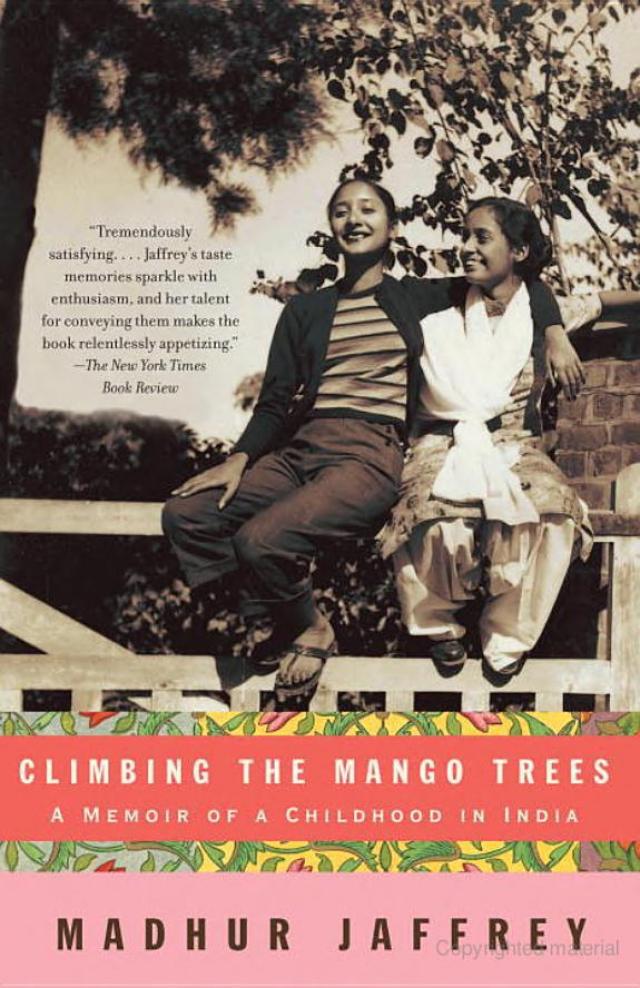
I pose by the neem tree at Number 5, aged about sixteen.
be always writing sentences like “King Ashoka gave alms to the poor, spread Buddhism, and planted many trees….” The British-history textbook was somewhat thinner than the one for Indian history. As I struggled to retain the causes of the Wars of the Roses or remember the cast of characters championing the Spanish Armada, my mother brought me cooling glasses ofchha, buttermilk flavored with salt and roasted cumin.
While I studied in my hot back room, my mother sat knitting for my sisters in their frigid Himalayan convent. In the super-heated Delhi of April, I could hardly even look at wool, let alone touch it. My mother just carried on heroically.