Climbing the Mango Trees: A Memoir of a Childhood in India, page 4
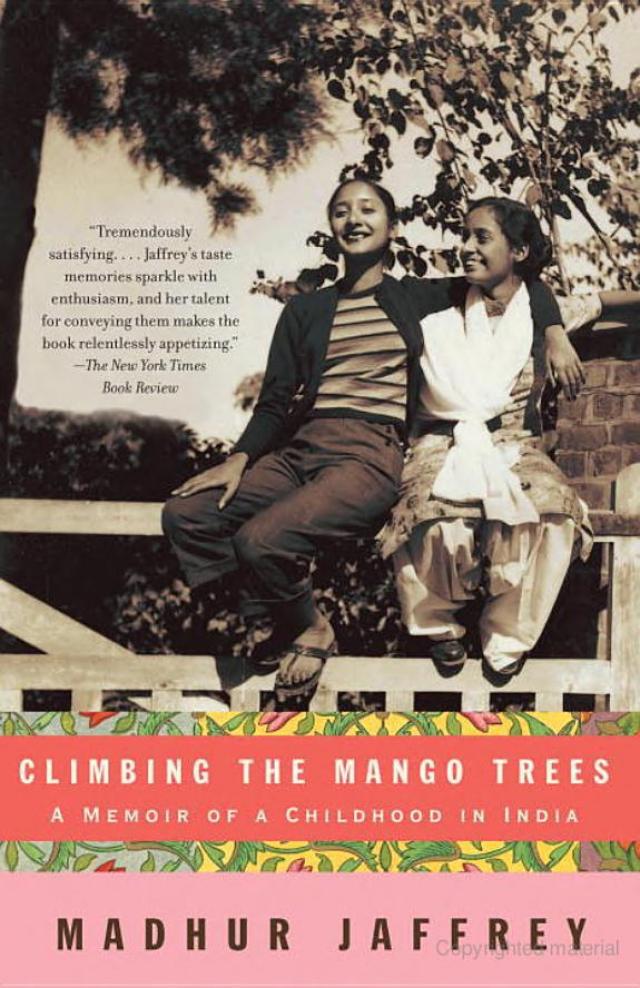


Sometimes in Kanpur, when my mother would be sitting on a takht (divan), her legs folded to one side, doing her mending on a small Singer sewing machine, I would ask her for the umpteenth time to tell me how she got to marry my father. She was still filled with the wonder of it all, and for me the story was more moving than anything in Grimm's Fairy Tales.
It was an arranged marriage, of course. Everything took place in the Old City.
In the Old City of Delhi, there were two large families living just a few narrow lanes apart. One was rich and powerful. The other was humble but good. Their paths rarely crossed, as the rich family was always busy with important government people and important university people and important industrialists.
One day, when the handsome youngest son of the rich family had just finished college, his father approached him, saying, “Son, it is time for you to marry. As is the tradition among us, we have asked the barber to nose around and find a girl who is worthy of you.” “I am perfectly willing to marry,” the handsome son said, “but I want a girl who is beautiful, sweet-natured, bright, and talented. Is this at all possible?” “We can only try,” said his father.
The barber-matchmaker was dispatched. He went to Agra and did not find anyone. He went to Jaipur and did not find anyone. He went to Lucknow and Allahabad and saw no one who fit the handsome son's desires. The barber returned to the Old City and reported to the father, “I am sorry to bring bad news, but such a girl does not exist.”
Just then, the handsome boy's sister spoke up: “But I know such a girl. She is my friend. She went to school with me. The barber should look there. It is just a few minutes' walk from here.”
The barber looked, talked to the girl's parents, and asked for her horoscope.
The barber returned to the rich family's home and handed the horoscope to the handsome boy's parents. “Now, I have done my work. If the girl's horoscope matches with that of your son, we are in business.”
The horoscopes matched perfectly. A wedding was arranged. But the girl had never even set eyes on the boy.
One day the handsome son's sister went to play with her friend at the humble family's home. They were eating some squiggly jalebi s [pretzel-like sweets filled with syrup] when the sister looked out of the window and saw her handsome brother walking by. “Look, look, look,” she said to her humble friend, “there, outside the window, is the man you are about to marry.” The humble girl looked out and was astounded. “Why, he is a prince,” she exclaimed.
On the wedding day, as the sound of the shehnai [oboelike instrument] that led the wedding procession got closer and closer, the humble girl's heart beat faster and faster. Her prince was approaching on a big white horse and he would take her away.
That was my mother's version of the story, as told to a little girl. But the truth was that she never stopped thinking of my father as the prince who had, by some miracle, taken her to his heart. She trod lightly through life, feeling no urge to leave an imprint. My princelike father, on the other hand, was totally dependent on her quiet strength. In our large joint family with many strange marriages, my parents' union seemed the most comfortable and joyous.
They were, in many respects, quite different from each other. My father had a B.A. degree from St. Stephen's College and spoke English fluently. He liked to read biographies and histories and study maps. He smoked. He listened to the BBC news in the evenings as he drank his whiskey and soda. He played bridge and tennis at the club. He loved to hunt and fish with his friends. He loved good food, especially the meats, pullaos, and breads that came with our Islamic veneer.
My mother was “eighth-class-pass,” which meant that she had not even gone to high school. She spoke no English. Whenever the rest of her family went on for too long in English, she would say in Hindi, “Arey Ram [Oh God], so much git-pit, git-pit, git-pit.” That is what English sounded like to her: git-pit, git-pit, git-pit. But, rather like an American mother whose children can manage to natter away in French, she also looked pleased. Pleased to have lucked out with this git-pitting group.
My mother made up for her lack of schooling with her uncommon intelligence. After she died, we found in her neat cupboard, still laid out with pride, several silver medals that she had won in school for top scholastic honors. In those days, it was not thought necessary for girls to study too long. After all, their only purpose was to be married off. Whatever my mother did do, she did to perfection. She cooked the foods my father loved to eat plus all the traditional Hindu festival foods, papris (chickpea-flour pop-padums) for Holi, the Spring Festival of Colors; glazed lotus seeds for Janmashtmi, the birthday of Lord Krishna; and” a s (sweet whole-wheat dumplings) for Karvachauth, the day women prayed for their husbands. She sewed, she knitted, she embroidered with silk and gold thread, not just ordinary things but extraordinary creations. One of them, a set of finely wrought gold-thread-and-sequin crowns she made for herself and her firstborn to wear at a horoscope naming ceremony, I have had framed, and they sit in my New York living room.
I feel I inherited my mother's desire to excel. But whereas she quietly accepted the limitations of her times, I was given the luxury of rebellion by very loving and indulgent parents. I was already the fifth child, and a girl. I was way beyond the heir and the spare. They could take a chance with me as they could not with their older ones.
FIVE
Choosing a School• A Milky Nation:
The Milk Beauty Secret and Milk for Breakfast •
Our Morning Rituals • The Magic Garden
My memory begins in earnest at about the age of four. We were in Kanpur. Dadaji, determined to get his daughters as educated as his sons, had explored Kanpur schools and had come up with two very different options: there was the Mahila Vidyalay, an all-girl school where every subject was taught in Hindi and the emphasis was on Hinduism and Indian traditions; and there was St. Mary's Convent, a coeducational school, at least until the middle grades, where most of the teachers were German and Irish nuns, the medium of instruction was English, and the education was basically Western. And, of course, Christian.
I remember my father driving us slowly past the Mahila Vidyalay again and again, as if by just looking at the school and the girls who came rushing out he would be able to divine its suitability for his daughters. I think that a part of him, the part that was fighting for Indian independence as a member of the Indian Congress Party, would have liked us to go there. But the girls at the Vidyalay seemed to lack the all-round sophistication he thought we should have, and in the end he put my two older sisters in the convent. He trusted us to withstand tsunamis of Westernization and Christianity that might follow, and to hold on to our Indianness as he and his father before him had managed to do. His approach contained inherent contradictions, but that was how we seemed to live our lives.
Bauwa woke us up early each morning, only to rush us to the sink in our bathroom to brush our teeth and do our “milk cleansing.” My mother was the simplest of women, who wore minimal East-West makeup. There was her hindi, the dot of red powder (sindhoor) she put between her brows; the kohl she made herself by burning camphor under an upturned terra-cotta bowl, collecting the soot and adding oils to it, which she used to line her eyes (and ours); and there was the Hazeline Vanishing Cream, which she put on her face. When she went out, she dabbed on her neck a few drops of Evening in Paris perfume from a small blue bottle.
I have no idea where she picked up the milk “beauty secret” or why she set so much store by it. Perhaps my father offhandedly mentioned to her that Cleopatra had bathed in ass's milk. Perhaps she was made to do it as a little girl and it really was some ancient family beauty secret going back to well before 4000 B.C., when Aryans with their cows came from the Ural Mountains in great waves to set up dominion in North India. She never explained, we never asked, and in India you never know. She did have a convincing air of authority about her, and who could question a walking advertisement for perfect skin?
There would be a bowl of fresh raw cow's milk waiting at the sink. It came from our cows, which had been milked at dawn, delivered by the gwala, or cowherd. It was rich and creamy. First we splashed this onto our faces. It clung to our lashes, big white blobs of it. Then we had to rub the milk in with our fingers, back and forth, back and forth, until it dried and came off in little dirty threads. We could now wash our faces with warm water—and was our skin soft and smooth!
After our baths, my mother went off to pray in the little section of the storeroom she had decorated with her pooja (worship) paraphernalia. She would water the tulsi (holy basil) plant just outside the storeroom and then help her husband and daughters get ready for work and school.
For breakfast the girls and Bauwa always had tall glasses of milk. My mother never developed a taste for tea or coffee, though she served them at all proper occasions in the prettiest of English porcelain. We had hot milk in the winter and cold in the summer. Those who wished could add Ovaltine to it. I never wished such a thing. The milk, of course, came from the same cows that had provided our beauty treatment. India is a milky nation: milk with sugar; milk with saffron and nuts; tea with milk or cream; yogurt with fruit, nuts, vegetables, dumplings, and rice; steamed yogurt; hung-up yogurt; fresh milk cheese (paneer); fresh-milk-cheese sweets from rasagullas to chum chums; milky rice puddings (kheer and phirni); and milk ices and ice creams. Without milk, India, this highly lactosed country, would just wither away.
My father had tea, two fried eggs, and toast for breakfast, day after day. He ate the whites of the eggs first. Round and round he'd go with his fork and knife, the whites slowly disappearing, until all that was left were two glistening yellow orbs, shaking like Jell-O on his white plate. He would pick up one whole yolk on his fork and slip it into his mouth. He would chew it slowly, the blue vein at his temple throbbing in rhythm. Then he would pick up the second yolk. All activity stopped as we gazed in wonderment.
With our milk we sometimes had bread and cheese, sometimes just fruit, and sometimes eggs sprinkled with my mother's special salt, which was always kept in small cut-glass containers on the table. We now considered this the “house salt,” and the recipe, apparently my grandmother's, consisted of salt, pepper, and ground roasted cumin seeds. Breakfast was, except on special weekends, Western, with jams in proper silver-lidded cut-glass jam jars, toast in silver toast-racks, Kraft cheese straight out of a tin—tins were considered modern and exotic—Marmite housed in its traditional dark brown bottle, and, every now and then, ham or bacon or sausages bought from Valerio's, a specialty bakery and meat shop owned by a Goan couple, Mr. and Mrs. Noronha.
One car with a driver then took my sisters to school. My father either drove himself to his office or walked: the office was right inside the walled compound that included the ghee factory and the homes of other, lesser officers of the company.
My day was then all my own, and I spent it mostly in the garden. Perhaps I should say “gardens,” as there were several of them, including vast lawns, a badminton court, a tennis court, a rose garden, mixed flower borders edged with sweet peas, and several gardens devoted just to flowers and vegetables. We grew not only almost every kind of flower that might flourish in our subtropical climate, from cannas to lupines, but all our own vegetables—potatoes, onions, carrots, okra, eggplant, cauliflower, cabbage, kohlrabi, peas, and tomatoes. There was a head mali (gardener) with assistants to do the hard labor, but all the designing, choosing of trees, ordering of seeds, and planting was micro-managed by my father, whose chief passion in life, other than his family, was his garden.
The farthest garden area, at one end of the compound, was the cowshed, which I visited several times a day. A very long, narrow path formed by the high brick compound wall, hedges and trees on one side, and an endless trellis of green beans on the other, led up to it. I would skip along the path, or tricycle along it, breaking off beans and nibbling them as I went. Dadaji had created such a complete universe for us. For a dreamy little girl growing up, it lacked absolutely nothing. There was the reality of the specially ordered “black” roses, which were really a deep purple, or the snapdragons, which could be made to “bark” by pinching the flowers in the middle, or the marigolds, whose centers we called “coconuts” and devoured. But there were also little corners of the garden where I could escape, lean my head against a tree, and vanish into a kaleidoscopic world of English knights and princesses, Indian gods with multiple arms, Bombay movie heroes, Indian detectives from my mother's nightly readings-aloud of Hindi detective stories, and characters from British and American comic books.
At the cowshed the tethered cows would be engrossed in licking hunks of rock salt suspended before them with wire. Like determined sculptors, they would lick them and lick them with their coarse tongues, smoothing out all rough edges until creations worthy of Henry Moore would magically appear. Every day the sculptures changed slightly, getting smaller and smaller and more full of holes. Every day I would note the changes and marvel at their ravishing forms.
I would then rush to observe the daily churning of butter. It was done just outside the pantry, on the covered brick pathway leading to the kitchen. We ate only white homemade butter. I did not know any other kind existed. White homemade butter smeared thickly on our toast. Sometimes with salt and pepper on it. The milk was poured into a round earthenware pot to which the wooden churner was attached. As ropes pulled the churner this way and that, this way and that, little bits of white butter flew out onto the ground. Crows would collect to eat this. One day, as I watched, I decided to shoo the crows away. Most looked angrily at me and left, but one stayed. I took a step forward to shoo it. The crow took two steps forward in defiance. I ran away in fear.
All morning I wandered around with the mali, dogging his footsteps. I carried salt and pepper with me so I could season and then bite into a red-ripe tomato still smelling of its green sepals. I helped dig up tiny potatoes while mud still clung to them. I broke off the sweetest green peas, shelling and eating half of them, throwing the rest into the mali's basket. And I helped pick the prickly okra, which, when cooked and combined with the equally glutinous split pea called urad dal, sent me into paroxysms of ecstasy. (Perhaps that accounts for my partiality to Japanese glutinous foods, like mountain yam and fermented beans, natto.) When the mali went to the massive pit that held the manure and organic leafy matter, there I was, watching him turn the compost around. I could not leave the mali alone even when he ate his lunch.
He always settled down to eat near the shady water tank. I followed him there. First he would wash his hands and feet and dry them off. Then he would sit down with a deep sigh, throwing all the weight of the world off his shoulders, and open up a small cloth bundle to reveal two thick whole-wheat rotis (flatbreads), some sliced raw onion, and some green chilies. I would sit down with him, leaning against the same brick wall he was. Bauwa had warned me not to take the mali's food, but the mali was too generous and I was too greedy. I never took too much—just a bite. All I know is that nothing tasted more heavenly than that simple combination: grainy whole-wheat roti, raw onion, and green chili. Years later, as I traveled the world, I would compare this to the pasta with olive oil, garlic, and red chili I had in Italy, or the plain rice with chili sambal I had in an Indonesian village … the wonder of very basic national starches enhanced only with the most basic of local seasonings.
In our Kanpur home, my mother, Bauwa, had the daily task of keeping household accounts. In the morning she would give the cook a list of what was needed and the money to buy it. Generally, it was just meat and spices, as we produced all dairy and vegetables ourselves and buying fruit was my father's responsibility. The cook would then go off on his bicycle. On his return he would have to recite what he had bought and what it cost while my mother, sitting on her bed with her knees pulled up, wrote it all down in the endless registers she filled up in Hindi. The smallest item, with its price, was noted down. Even salt. She may not have had much education, but she did not have ancestral ink flowing through her veins for nothing. Her job, our job, was to keep records.
When my father returned from work, we all gathered around him as he had his tea. The girls were subjected to their second glass of milk for the day. If it was summer, I sat out on the back lawn watching my parents and sisters try their hand at badminton while I listened to the crickets. Or my father taught the girls how to ride a bicycle. As we built up a sweat, we were allowed cooling fresh lemonade (neebu ka sharbat), fruit squash (fruit syrup diluted with ice water), and that newfangled drink Vimto as well. If it was winter, my father stayed indoors listening to the news on his Phillips radio. War was on the horizon, and my father did not like what he was hearing.
SIX
Summer Holiday • Baby Sister • Starting School
and Learning English • The Toffee Man •
The Quest for Barley Sugar • My Perfect Sisters
My youngest sister was born when I was five, just before the first salvos of World War II, during our summer holiday in Dalhousie, a “hill station,” built on three Himalayan peaks at about seven thousand feet above sea level and named after a British governor-general in India, the tenth Earl of Dalhousie.
The large house we had rented that year was, rather grandly, named Teera Hall. As usual, the entire extended family was present, with a few dozen, including my mother, sleeping in a large dormitory-like room on the second floor. As my sister was expected, a hill palanquin (daandee) was kept at the ready to take my mother to the hospital if needed. But my sister was born suddenly, during the night. At first we were all asked to cover our heads with our quilts, and then my mother was rushed to my grandmother's room, which was adjacent to ours. I could hear my mother moaning gently. Every now and again her door would fly open and an aunt would rush out for hot water or towels, shutting the door behind her. I was frightened out of my wits. Then I heard an infant crying. The door opened. A weary aunt stepped out and whispered to a cousin, who ran down the room yelling, “She's been born, he's been born” (“Ho gai, ho gya”). He'd been told of a birth but not the sex of the child.