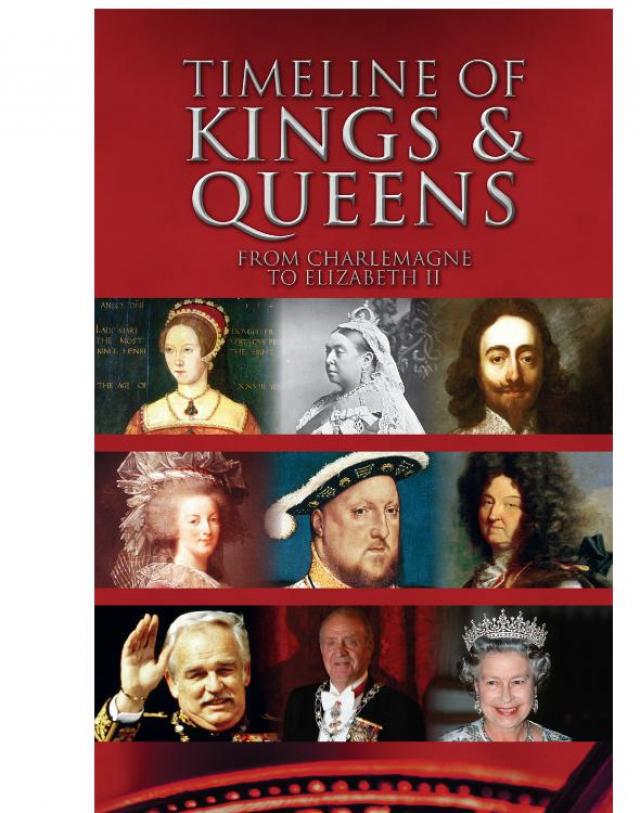
Timeline of Kings and Queens, page 2


875
Provence, Holy Roman Empire and Italy On the death of Louis II, Charles II the Bald becomes king and emperor. Norway Harald Fairhair, Viking king, subdues Orkney and Shetland, and adds them to his kingdom.
876
East Francia Louis the Younger becomes king.
877
Scotland Constantine I dies fighting the Vikings; Áed mac Cináeda, son of Kenneth MacAlpin, succeeds him as king of the Picts. France Louis the Stammerer becomes king of the West Franks and Provence. Italy Carloman, eldest son of Louis the German, king of East Francia, becomes king.
878
England Alfred defeats the Vikings under Guthrum, at Ethandune; the Treaty of Wedmore divides England between the Anglo-Saxons and the Danes. Scotland Giric mac Dúngail becomes king of the Picts, known simply as Giric.
879
West Francia On the death of Louis the Stammerer, his sons Louis III and Carloman II become joint kings of France. Provence Bishops and nobles elect Boso, a nobleman of Provence, king, the first non-Carolingian king in western Europe for more than a century; he strengthens his position by marrying the daughter of Emperor Louis II. Italy Charles III the Fat becomes king. Byzantine Empire Basil I begins to secure his family’s tenure on the throne by crowning his son, Constantine, co-emperor, but Constantine dies soon after; Basil’s youngest son, Alexander, takes his place. Kievan Rus’ Rurik, prince of Novogorod, and founder of the Rurik dynasty, dies around this date.
880
Bavaria Carloman abdicates, following a stroke, and dies; his brother, Louis the Younger, already king of East Francia and Saxony, becomes king.
881
Venice Giovanni II Participazio, son of Orso I Participazio, is elected doge. Holy Roman Empire Charles III the Fat is crowned Holy Roman Emperor.
882
France Louis III of France dies; Carloman II rules alone. Pamplona Fortún Garcés becomes the last king of the Arista dynasty. East Francia Louis the Younger dies without an heir; his brother, Charles the Fat, Holy Roman Emperor as well as king of Italy, becomes king, reuniting the entire East Frankish kingdom. Rome Marinus I is elected pope. Kievan Rus’ Oleg becomes ruler of all the Rus people and captures Kiev from Viking warlords, making it his capital and laying the foundation for the great state of Kievan Rus’.
884
France Holy Roman Emperor and king of East Francia, Charles the Fat, becomes king also of West Francia. Rome Adrian III is elected pope.
885
Rome Stephen V is elected pope. Byzantine Empire Basil I dies in a hunting accident; his belt is caught in the antlers of a deer and he is dragged 16 miles (25.75 km); Leo VI the Wise becomes emperor; the Byzantine Empire enters a golden age.
886
England Alfred the Great makes a treaty with the Danes formalizing the partition of England with the Danelaw – northern and eastern England – coming under Danish control.
887
Provence Louis the Blind becomes king. East Francia Charles the Fat is deposed and dies the following year; the Slovenian Arnulf of Carinthia, illegitimate son of Carloman of Bavaria, is elected king. Venice The elderly and much-loved Giovanni II Participazio retires, and Pietro Candiano is elected doge; he becomes the first doge to die in battle when he is killed, the same year, attacking the Narentines; his great-nephew, Pietro Tribuno, is elected doge; during his reign he has constructed a huge wall from eastern Olivolo to the Riva degli Schiavoni, turning Venice into a civitas or city.
888
Western Francia Charles the Fat dies; Odo, count of Paris and son of Robert the Strong, count of Anjou, is elected king; he is chosen for his courage and skill as a soldier. Italy Following the death of Charles III the Fat, Italy falls into disunity until 963, with many rulers claiming to be king.
889
Scotland Around this time, Donald II, son of Constantine I, becomes king of the Picts, now known as king of Alba. Bulgaria Boris I abdicates, in favour of his son, and becomes a monk; Vladimir becomes khan.
890
Norway Around this time, Harald I Fairhair becomes the country’s first king.
891
Holy Roman Empire Guy III of Spoleto, descended from Charlemagne through marriage, becomes Holy Roman Emperor. Rome Formosus is elected pope.
892
Holy Roman Empire Lambert II of Spoleto becomes Holy Roman Emperor.
893
Bulgaria Former King Boris I comes out of retirement when his son tries to revert to paganism; Vladimir is defeated and blinded by his father; Boris’s third son, Simeon I the Great, one of the most famous figures in Bulgarian history, becomes khan; during his reign, Bulgaria extends its empire over territory between the Aegean, the Adriatic and the Black Sea.
894
England Northumbrians and East Angles swear allegiance to Alfred the Great, but promptly break their truce by attacking the south-west of England. Great Moravia On the death of Svatopluk I, the kingdom is divided between his three sons, against his stated wishes; the country is weakened.
896
Germany The eastern Franks invade and conquer Italy under the leadership of Arnulf of Carinthia; he is elected Holy Roman Emperor. Rome Boniface VI is elected pope, following riots in Rome; Boniface dies, possibly of gout; Stephen VI is elected pope. Bulgaria Simeon I defeats the Byzantine Empire at the Battle of Bulgarophygon.
897
Rome The remains of Pope Formosus are exhumed and put on trial in the notorious ecclesiastical trial known as the Cadaver Synod; he is found to have been unworthy of the pontificate; Pope Stephen VI is imprisoned and strangled, following the Cadaver Trial; Romanus is elected pope, but is deposed three months later; Theodore II is elected pope.
898
West Francia Charles III the Simple, posthumous son of Louis the Stammerer, becomes king of France. Rome John IX is elected pope.
899
England The death of Alfred the Great; he is succeeded by Edward the Elder as king of Wessex; during his reign, he conquers Mercia, East Anglia and Essex. East Francia Louis the Child becomes the last Carolingian king of East Francia; his reign is plagued by Magyar raids from Hungary.
900
Scotland Constantine II, cousin of previous king, Donald II, becomes king of Alba; during his reign, he fights with the Vikings and the English. Rome Benedict IV is elected pope. Serbia Archont Petar, also known as Predimir, is prince of Duklja, on the Adriatic Coast; Hvalimir I, Sylvester, Tugemir and Hvalimir II rule in the early years of the 10th century; Duklja consists of Montenegro, north-eastern Herzegovina and Koplik, in Albania.
901
Holy Roman Empire Louis III the Blind, usurper king of Provence, becomes Holy Roman Emperor.
903
Rome Leo V becomes pope for 30 days, before being deposed and murdered by antipope Christopher.
904
Rome Antipope Christopher is ejected; Pope Sergius III succeeds Pope Leo V as the 119th pope, beginning the 30-year era of the Pornocracy, a time of great excess and violence; he is the only pope to have ordered the murder of another pope, and the only pope to father an illegitimate son who also became pope; he is also the first pope to be depicted wearing the triple-crowned papal tiara.
905
Pamplona Fortún Garcés is deposed by a coup and retires to a monastery; Sancho I Garcés, son of García Jiménez, king of another part of Navarre, becomes the first king of the Jiménez dynasty.
907
Great Moravia Weakened by its division among the sons of Svatopluk I, the country is finally destroyed in a Hungarian attack and vanishes as a state.
910
Galicia, León and Asturias On the death of Alfonso III, his kingdom is divided between his three sons; García becomes king of León; Ordoño becomes king of Galicia and Fruela becomes king of Asturias.
911
Provence Hugh of Arles, brother-in-law of Louis the Blind, becomes king, although he never uses the royal title. East Francia Louis the Child dies aged 18; Conrad I, son of Conrad, duke of Thuringia, is elected king. Rome Anastasius III, possibly the illegitimate son of Sergius III, is elected pope.
912
Venice Orso II Participazio, unrelated to the previous Participazio incumbents, is elected doge; he establishes better relations with the Byzantine Empire. Byzantine Empire Leo VI’s brother, Alexander, who has been co-emperor since 879, becomes co-emperor with Leo VI’s son, Constantine VII Porphyrogennetos. Kievan Rus’ Igor becomes ruler; he twice tries to conquer Constantinople.
913
Rome Lando is elected pope, but dies six months later; he is the last pope to use a papal name that has not been used previously, until Pope John Paul I in 1978. Bulgaria Simeon I decisively defeats the army of the Byzantine Empire and is recognized as tsar (emperor) by Patriarch Nicholas.
914
León and Galicia Ordoño, king of Galicia, also becomes king of León after the death of his brother, García. Rome John X is elected pope.
915
Holy Roman Empire Berengar of Friuli, grandson of Louis the Pious, is elected Holy Roman Emperor.
916
England The Mercian warrior queen Aethelflaed conquers Wales.
918
England By this date, all Danes south of the Humber have submitted to King Edward the Elder of Wessex.
919
East Francia Henry I the Fowler is elected king as the only man capable of holding the kingdom together in the face of internal rivalries and raids by the Magyars; he is the first of the Ottonian dynasty and is reckoned to be the first king of the medieval state of Germany and founder of the Holy Roman Empire of the German nation; Arnulf the Bad is a rival king until 921.
Ottonian Dynasty
919
The Ottonian dynasty was a succession of kings of Germany. It is also regarded as the first dynasty of the Holy Roman Empire. Although Henry I the Fowler was never emperor, he is considered to be the founder of the imperial Ottonian dynasty. Under the Ottonian rulers the kingdom of the Eastern Franks became Germany and the union of Germany with the Holy Roman Empire started with the coronation of Otto I the Great (pictured) in Rome in 962. The Ottonian dynasty became extinct after the death of Henry II in 1024.
920
England The Saxons retake East Anglia from the Danes. Byzantine Empire Romanos I, son of a former imperial guardsman and father-in-law of Constantine, becomes co-emperor, and then quietly usurps the throne.
922
France Robert I, brother of Odo, becomes king of France.
923
France Robert I dies in battle, possibly killed in single combat with his great rival, Charles the Simple; Rudolph, Robert’s son-in-law, succeeds him.
“And thus it has reached us that the English nation, by the compassion of God, eagerly desired to be converted to the Christian faith, but that the priests of the neighbourhood neglect it and refrain from kindling by exhortation the desires of the English.”
Pope Gregory the Great
924
England Edward the Elder dies leading an army against a Welsh–Mercian rebellion; Ælfweard, possibly a hermit, becomes unlikely king of Wessex; he is never crowned and is killed, possibly on the orders of his older half-brother, Athelstan, who becomes king; he can claim to be the first king of England, if not de jure, then de facto. Portugal Count Mendo Gonçalves, son of Count Gonçalo of Galicia, marries Mumadona Dias, daughter of Onega Lucides and Diogo Fernandes, and becomes count of Portucale; Ramiro II, son of Ordonho II of León, was the first to bear the title ‘King of Portuguese Land’. Holy Roman Empire Holy Roman Emperor Berengar is assassinated by one of his own men, leaving no heirs; the title remains vacant until 962.
925
León Fruella II’s son, Alfonso Froilaz, becomes king; the sons of Ordoño II, Sancho Ordóñez, Alfonso and Ramiro, rebel against him, drive him out and divide the kingdom among themselves; Alfonso IV gets León, Froilaz is left with Galicia.
927
Pamplona Jimeno Garcés, brother of Sancho I, becomes king. Bulgaria Simeon I dies of heart failure; Peter I becomes khan.
928
Rome Pope John X is imprisoned and possibly murdered by wealthy and powerful Roman noblewoman, Marozia, and her husband, Guy of Tuscany; Leo VI is elected pope; then Stephen VII becomes pope for seven months.
930
Norway Erik Bloodaxe, oldest son of Harald Fairhair, becomes king; he quarrels with his brothers and has four of them killed.
931
León Alfonso IV of León abdicates, in favour of his brother Ramiro II, and enters a monastery. Pamplona García Sánchez I becomes king, aged 12. Rome John XI, son of Pope Sergius III and Marozia, is elected pope; his mother is Roman ruler and ensures his appointment, but exerts authority over him. Norway Eric Bloodaxe becomes second king of Norway. Rome John XI is elected pope.
932
Rome Marozia is overthrown and imprisoned; her son, Pope John XI, comes under the control of his younger brother, Alberic II, who styles himself as ‘Prince and Senator of the Romans’; the pope’s power is restricted to purely spiritual matters. Venice Orso II Participazio retires; Pietro II Candiano, son of Pietro I Candiano, doge in 887, succeeds him.
933
Provence ceases to be a separate kingdom when Hugh of Arles exchanges it, with Rudolph II, for the Kingdom of Italy.
934
Burgundy Rudolph II becomes king of a reunited Burgundy. León and Galicia The former king, Alfonso IV, tries to regain the throne, but is defeated and blinded by Ramiro II; he returns to his monastery. Pamplona García Sánchez I comes of age and begins to rule. Denmark Gorm the Old founds Denmark’s first ruling dynasty, lasting until 1448. Norway Haakon, brother of Erik Bloodaxe, returns from England, where he has been fostered by King Athelstan, and with the support of Norwegian nobles, ousts Erik from the throne; Haakon takes the throne as Haakon I and reunites the country.
936
France Louis IV becomes king. Germany Henry the Fowler dies; he has united the German states into a single kingdom; Otto the Great becomes king. Rome Alberic II secures Leo VII’s election to the papacy.
937
England Athelstan defeats a large army of Scots, Irish and Danes at the Battle of Brunanburh, northern England, securing the submission of King Constantine II of Scotland; he claims the title ‘King of all Britain’.
Burgundy Conrad the Peaceful becomes king of Burgundy on the death of his father, Rudolph II.
939
England Edmund I becomes king; he regains control of Mercia from the Vikings and reconquers the Five Boroughs of the Danelaw. Venice Pietro Badoer Participazio, son of previous Doge Orso II Participazio, is elected doge. Rome Stephen VIII is elected pope.
942
Venice Pietro III Candiano is elected doge. Rome Marinus II is elected pope.
943
Scotland Constantine II abdicates and retires to a monastery, after reigning for 43 years; he will be the second-longest reigning Scottish monarch; Malcolm I, son of Donald II, becomes king.
944
Byzantine Empire Romanos I is deposed by his sons, and forced to become a monk; followers of Emperor Constantine VII revolt and send Stephen and Constantine into exile.
945
England Edmund I conquers Strathclyde, but Cumberland and Westmorland are annexed by the Scots. Italy Lothair II takes control of Italy, and rules until 950. Kievan Rus’ Igor is killed while collecting tribute from the Drevlians; his wife takes terrible revenge on his killers and becomes regent for Igor’s heir, his young son, Sviatoslav; she is the first ruler of Rus’ to convert to Christianity.
946
England Edmund I is murdered by the exiled thief Leofa, at a feast at Pucklechurch; his brother, Edred, becomes king; a sickly man, he can only eat the juices of already-chewed food. Rome Agapetus II is elected pope.
950
Portugal Gonçalo Mendes becomes count of Portugal.
951
León Ordoño III becomes king; during his reign he has to deal with rebellion and Muslim attacks. Italy Otto I of Germany invades and is crowned ‘King of the Lombards’; the Kingdom of Italy is now ruled within the Holy Roman Empire, with the emperor as monarch.
954
Scotland Malcolm I is killed; his cousin, Indulf, succeeds him. France Lothair, son of Louis IV, becomes king of France, aged 13.
955
England 14-year-old Edwy the Fair, King Edred’s nephew, is chosen by the nobility as king; he feuds with his family and the Church. Germany Otto the Great, king of the Germans, defeats the Magyars at the Battle of Lechfeld, near Augsburg, and the Slavs at Reichnitz. Rome John XII, son of Alberic II, is elected pope; his papacy is immoral and scandalous; he loses papal territories.
956
León Sancho the Fat, half-brother of Ordoño III, becomes king.
957
England King Edwy is defeated in battle at Gloucester, but, fearing civil war, agrees to the country being divided along the Thames; Edwy rules Wessex and Kent in the south, and his brother, Edgar, rules north of the Thames.
958
Denmark King Harald Bluetooth becomes king, and accepts Christianity. León Ordoño the Wicked, son of Alfonso IV, usurps Sancho the Fat’s throne, supported by disaffected nobles and the Kingdom of Castile.
959
England King Edwy dies, aged only 18 or 19; Edgar I the Peaceable becomes king, consolidating and uniting the kingdom. Byzantine Empire Constantine VII dies, possibly poisoned by his daughter-in-law, Theophano, or his son, Romanos, who becomes emperor as Romanos II.
960
León Sancho the Fat regains the throne with the support of Navarre.
961
Germany Otto II the Red becomes king. Norway Haakon I is mortally wounded in the Battle of Fitjar, in which he finally defeats the sons of Erik Bloodaxe; Harald II Greycloak, third son of Erik Bloodaxe, becomes king; his rule does not extend beyond the west of the country.
962
Scotland King Indulf is killed fighting Vikings at the Battle of the Bands, near Cullen; he is succeeded by Dub mac Maíl Coluim, son of his predecessor, Malcolm I. Holy Roman Empire of the German Nation Otto the Great is crowned Holy Roman Emperor; he is arguably the first true emperor, as he becomes the guarantor of the independence of the Papal States, the first emperor to do so since the Carolingian Empire; the Holy Roman Empire at its peak will encompass Germany, Italy, Burgundy, Austria, Switzerland, the Netherlands, Liechtenstein, Luxembourg, the Czech Republic, Slovenia, Belgium and parts of France, Italy and Poland.