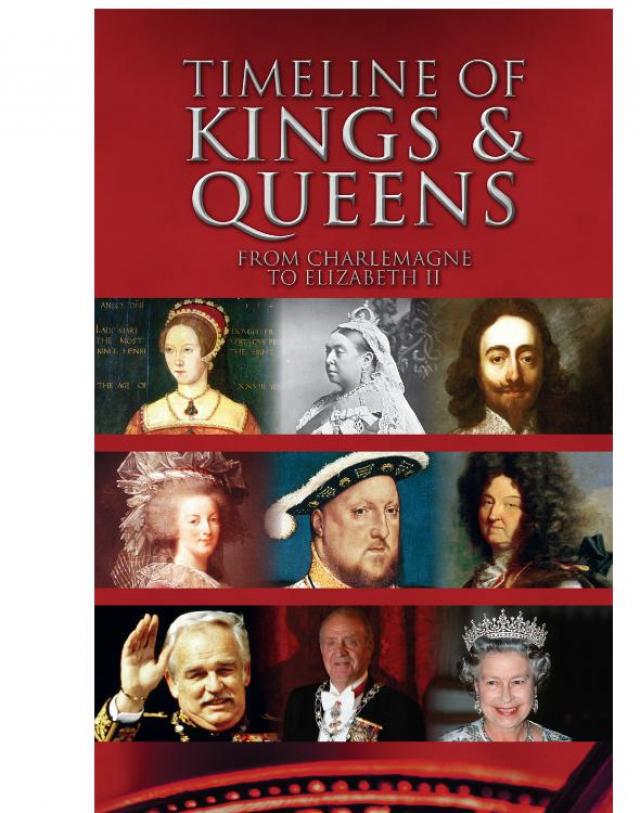
Timeline of Kings and Queens, page 18


1880
Romania Heir to the Romanian throne, Crown Prince Leopold, elder brother of Carol I, renounces his right of succession in favour of his son William.
1881
Romania Following its independence, the Principality of Romania becomes a sovereign kingdom; Carol I is crowned its first king. Bulgaria Prince Alexander assumes absolute power. Russia Tsar Alexander II is assassinated when a bomb is thrown at him by Russian-Polish revolutionary Ignacy Hryniewiecki, in St Petersberg: his second son Alexander III, who has been openly critical of his father’s reforms, takes the throne.
1883
Bulgaria Prince Alexander’s absolute monarchy experiment fails and he restores the constitution.
1885
Spain Alfonso XII dies without an heir; his pregnant wife, Maria Christina, becomes a ‘child-bearing regent’ for six months.
1886
Spain Maria Christina gives birth to Alfonso XIII; he is the first child to be born already a king since the short-lived John I of France, in 1316. Bavaria Ludwig II drowns himself five days after abdicating, due to insanity; his mentally unbalanced brother, Otto, becomes king; his uncle, Prince Luitpold, acts as regent. Austria-Hungary Crown Prince Rudolf of Austria and his mistress, Baroness Mary Vetsara, die in an apparent suicide pact at Mayerling. Bulgaria Discontented army officers seize Prince Alexander and force him to abdicate; he is restored by a counter-coup, but his position is untenable and he resigns the throne.
1887
Bulgaria Ferdinand of Saxe-Coburg, son of Prince August of Saxe-Coburg-Kohary and his wife Clémentine of Orléans, daughter of King Louis Philippe I of the French, is elected prince of Bulgaria; it becomes the leading Balkan state; he is also grand-nephew of Leopold I, first king of the Belgians, nephew of Ferdinand II of Portugal and a first cousin of Queen Victoria of Britain; he is also related to the medieval tsars of Bulgaria.
1888
Germany William II becomes kaiser (emperor). Romania The heir to the throne, Crown Prince William, surrenders his claim in favour of his son, Prince Ferdinand.
1889
Monaco Albert I becomes sovereign prince. Portugal Carlos I becomes king.
1890
Luxembourg Grand Duke William III dies, but his sons have also all died and, under the 1783 Nassau Family Pact, territories of the Nassau family in the Holy Roman Empire at the time of the Pact (Luxembourg and Nassau) are bound to use Salic Law, which forbids inheritance by the female line; his daughter Wilhelmina cannot inherit and 73-year-old Adolphe, the dispossessed duke of Nassau and head of the House of Nassau-Weilburg, becomes grand duke.
1891
Portugal The Portuguese Republican Revolution breaks out. Württemberg William II becomes king.
1894
Russia In spite of several assassination attempts, Alexander III dies of natural causes; Nicholas II, the last tsar of Russia, takes the throne.
1897
United Kingdom Queen Victoria celebrates her Diamond Jubilee.
1898
Austria-Hungary Empress Elisabeth, consort of Franz Joseph I, is assassinated by Italian anarchist Luigi Lucheni; ‘I wanted to kill a royal,’ he said. ‘It did not matter which one.’
1900
Italy Umberto I is assassinated by the anarchist Gaetano Bresci, in revenge for the Bava-Beccaris massacre when hundreds of striking workers were killed by the army; Vittorio Emanuele III becomes king. Montenegro Nikola I begins to style himself ‘Royal Highness’.
1901
United Kingdom Queen Victoria dies, after reigning for 64 years; she is succeeded by Edward VII who is almost 60, first king of the House of Saxe-Coburg and Gotha.
France Church and state begin to separate. Russia The Russian Social Revolutionary Party (Bolsheviks) is founded.
“Great events make me quiet and calm; it is only trifles that irritate my nerves.”
Queen Victoria
1903
Serbia King Alexander is assassinated; the House of Karađorđević (the descendants of the revolutionary leader Đorđe Petrović) assumes power under Peter I. Rome Cardinal Giuseppe Melchiorre Sarto Pius X is elected pope.
1905
Luxembourg William IV becomes grand duke. Germany Kaiser William II visits Tangier and provokes a crisis with France. Sweden and Norway After some months of tension, the union between Sweden and Norway is dissolved and Sweden recognizes Norway as an independent constitutional monarchy; Oscar II renounces his and his family’s claim to the Norwegian throne, and prince Karl of Denmark, son of future King Frederick VIII of Denmark, is elected king of Norway as Haakon VII; a referendum, called for by Karl, confirms the monarchy. Montenegro Nikola I gives his country its first constitution.
1906
Denmark Frederick VIII becomes king; Iceland gains independence from Denmark during his reign.
1907
Luxembourg Following the death of his uncle, the only other legitimate male in the House of Nassau Weilburg, the grand duke declares his eldest daughter Marie-Adélaïde as ‘Heir Apparent to the Grand Duchy’, overturning the Salic Law that has previously applied. Sweden Gustav V becomes king; he maintains Sweden’s neutrality during the two world wars.
1908
Portugal Carlos I is assassinated by two Republicans in Lisbon, while travelling in an open carriage with the royal family, the first Portuguese king to die violently since Sebastião I in 1578; the heir to the throne, Luís Filipe, is also wounded, dying 20 minutes later; Prince Manuel, wounded in the arm in the incident, is declared king as Manuel II; he will be the last king of Portugal. Austria-Hungary Austria annexes Bosnia and Herzegovina. Bulgaria declares independence from Turkey; Prince Ferdinand I becomes tsar. Greece Crete unifies with Greece.
1909
Belgium Albert I becomes king of the Belgians.
1910
United Kingdom George V, second son of Edward VII, becomes king. Portugal Revolution breaks out; following three days of street fighting, Manuel II flees on the royal yacht to British-ruled Gibraltar; he lives in exile in Britain; Portugal becomes a republic. Montenegro In celebration of his jubilee, Prince Nikola I assumes the title of king of Montenegro.
1911
Portugal The monarchy is abolished and a republic is declared.
1912
Luxembourg Marie-Adélaïde becomes the first grand duchess; she is also the first sovereign of Luxembourg, since 1296, to have been born within the country. Denmark Christian X becomes a much-loved king; in 1943 he will be imprisoned by the Nazis.
1913
Bavaria Ludwig III becomes the last king of Bavaria when he deposes his cousin Otto. Greece King George I is assassinated by Alexandros Schinas, variously described as a socialist and an alcoholic vagrant; Constantine I becomes king and leads Greece to victory in the Balkan wars. Albania After British traveller, diplomat and MP, Aubrey Herbert, turns down the crown, William of Wied, from Rhineland-Palatinate in Germany, becomes sovereign of the principality of Albania.
1914
The First World War; Austria-Hungary Archduke Franz Ferdinand, heir to the Austrian throne, is assassinated by Bosnian student Gavrilo Princip, triggering the outbreak of the First World War. Rome Cardinal Giacomo Della Chiesa is elected pope as Benedict XV. Albania Prince William, sovereign only from March to September, goes into exile due to lack of support.
1916
Romania Romania’s first king, Carol I, dies childless, after 48 years on the throne; his great-nephew, King Ferdinand I, married to British Princess Marie of Edinburgh, takes the throne; the Romanian Constitution specifically bars the heir to the throne from being married to a woman of Romanian birth; when Ferdinand enters the First World War on the side of the Triple Entente, German Kaiser Wilhelm has his name erased from the Hohenzollern House register.
1917
United Kingdom Due to the First World War, George V changes the royal family name from the German Saxe-Coburg and Gotha to the more British-sounding ‘Windsor’. Montenegro The royal family flees to Italy. Greece Constantine I is forced to abdicate in favour of his second son, Alexander I, due to his lack of sympathy for the Allies in the First World War. Russia Tsar Nicholas II’s reign ends in the October Revolution, when the Bolsheviks, led by Vladimir Lenin, seize power and declare a republic; the tsar and his family are imprisoned; he is forced to abdicate, initially in favour of his 12-year-old son, Alexei, but because of Alexei’s haemophilia, he changes it to his brother Mikhail; Mikhail defers his acceptance and never actually rules.
1918
Germany Revolution breaks out; William II abdicates and goes into exile in Holland, where he will live as a private citizen until his death in 1941; a republic is declared. Bavaria Ludwig III is the first of the monarchs in the German Empire to be deposed; it marks the end of 738 years of Wittelsbacher rule in Bavaria. Württemberg William II is deposed by a revolution that leads to a republic being declared. Austria-Hungary Archduke Karl I steps down but never abdicates. Serbia, Croatia and Slovenia Peter I, son of Alexander, prince of Serbia, emerges from a 60-year exile, to be elected the first king of the Serbs, Croats and Slovenes; due to Peter’s ill health, Crown Prince Alexander acts as regent. Montenegro His kingdom having been united with the other south Slav lands, King Nikola I goes into exile in France. Romania Following his support for the Triple Entente in the First World War, Ferdinand I’s country is greatly enlarged with the union of Bessarabia, Bukovina and Transylvania. Bulgaria Following a heavy defeat by the Allies in Greece, Tsar Ferdinand I abdicates in order to save the Bulgarian throne; his son, Boris III, becomes tsar and is a target of several assassination attempts. Russia In the early hours of 17 July, Tsar Nicholas and his family are executed by the Bolsheviks.
The Struggle to Survive
1919–present day
1919
Luxembourg Grand Duchess Marie-Adélaïde abdicates without marrying and enters a convent following criticism of her cordial relationship with German occupiers during the First World War; her younger sister, Charlotte, becomes Grand Duchess; a referendum votes 77.8% in favour of retaining a grand ducal monarchy with Charlotte as head of state; she marries Felix of Bourbon, prince of Parma, creating the House of Nassau-Weilburg and Bourbon-Parma. Germany adopts the Weimar Constitution. Austria-Hungary The Treaty of St Germain ends the Habsburg monarchy, and Czechoslovakia, Poland, Yugoslavia and Hungary gain independence.
1920
Greece Alexander I dies after being bitten by his two pet monkeys; following a plebiscite in which he won 99% of the vote, Constantine I is reinstated as king.
Alexander I
Reign: 1917–1920
Alexander I was born on 1 August 1893 at Tatoi near Athens. He was the second son of Constantine I and Sophie of Prussia.
During the First World War Constantine was insistent that Greece remained neutral, while the prime minister, Eleftherios Venizelos, was determined to go to war. When troops entered Greece, Constantine and his first born son George were forced into exile. The young Alexander took the throne, although he had very little say in the matters of his country as he was overpowered by the prime minister.
Alexander made relations with Venizelos worse by eloping with Aspasia Manos, who the prime minister considered to be a commoner. The wedding was finally legalised but they were not allowed to travel together or attend official functions together.
Following the Treaty of Sèvres in 1920, Greece increased its territories making Alexander the ruler of a much larger kingdom. Alexander died prematurely at the age of 27. He was taking a walk through the royal gardens when his pet dog was attacked by two monkeys. He tried to fight the monkeys off with a stick but received a couple of bites which became infected. He died from a severe reaction to the infection on 25 October 1920. Alexander had one daughter, Princess Alexandra, who was born after his death, in 1921.
1921
Bavaria Former King Ludwig III dies in exile; Crown Prince Rupprecht becomes titular heir to the throne and head of the Wittelsbach family; he is also the Jacobite heir to the thrones of England, Scotland, Ireland and France, through his mother, Archduchess Maria Theresia of Austria-Este, although he never lays claim to these titles. Liechtenstein Prince Aloys, heir to the principality, renounces his right of succession in favour of his son, Franz Josef II, who becomes heir. Serbia, Croatia and Slovenia Alexander I becomes king; his dictatorial style makes him unpopular. Montenegro Former King Nikola I dies; he has continued to claim the throne of his country since he began his exile; Crown Prince Danilo Aleksandar Petrović-Njegoš becomes claimant to the Montenegrin throne, leading an unrecognized government in exile; for unknown reasons, he abdicates after only six days, in favour of his nephew Prince Michael Petrović-Njegoš.
1922
Monaco Louis II becomes sovereign prince; during his reign, Monaco football club is founded and the first Monaco Grand Prix takes place. Rome Cardinal Achille Ambrogio Damiano Ratti is elected pope as Pius XI. Romania Ferdinand I is crowned king of his greatly enlarged nation in a lavish ceremony.
Greece Constantine I abdicates again, after disastrous losses in the Greco-Turkish War; his eldest son, a great-grandson of Britain’s Queen Victoria, becomes George II.
1923
Spain General Primo de Rivera becomes dictator, until 1930. Greece George II goes into exile in his wife’s native Romania, following a coup.
1924
Greece George II is officially deposed and stripped of his Greek nationality. Russia After a gap of six years, Grand Duke Cyril Vladimirovich, grandson of Tsar Alexander III and heir to the Russian throne, becomes head of the imperial family, ‘Titular Emperor and Autocrat of all the Russias’; he spends his exile in France.
1925
Romania Following a scandal, Crown Prince Carol renounces his right of succession to the Romanian throne in favour of his son Michael.
1927
Romania Ferdinand I’s grandson, a great-great-grandson of Britain’s Queen Victoria, becomes king as Michael I, aged 6; a regency acts on his behalf.
1928
Albania Zog (Ahmed Bey Zogu), former president, becomes king.
1929
Rome The State of the Vatican City, a landlocked sovereign city-state ruled by the pope, is created. Liechtenstein Johann II the Good dies; his reign of 70 years and 3 months is the longest in European royal history; he has never married and dies without issue; his brother, Franz I, becomes prince of Liechtenstein. Serbia, Croatia and Slovenia King Alexander abolishes the constitution, prorogues parliament and introduces a personal dictatorship; he changes the name of the country to the Kingdom of Yugoslavia. Montenegro The claimant to the Montenegrin throne, Michael, renounces his dynasty’s claim and swears allegiance to the Kingdom of Serbs, Croats and Slovenes; he is rewarded by the king with a pension from the Civil List.
Vatican City
Founded: 1929
The Vatican City is the smallest independent state in the world. It occupies an area of 44 hectares (109 acres), the borders of which are represented by its walls and its travertine (or rock) curved pavements that join the two wings of the colonnades in St Peter’s Square.
Even before the arrival of Christianity, this previously uninhabited tract of land on the opposite side of the Tiber from the city of Rome (ager vaticanus), had always been considered sacred. The first person to make use of the land was Agrippina the Elder (14 bc–ad 33). She had the land drained and built her gardens there in the early 1st century ad.
The Vatican City State was founded after the signing of the Lateran Pacts between the Holy See and Italy on 11 February 1929, which granted Roman Catholicism special status in Italy. The Vatican City is unique in that the head of the Catholic Church, or pope, takes complete power in place of a monarchy. He exercises judicial power of the Vatican City, an entity which is completely separate from the Holy See. The government of the city also has a unique structure. Although the pope is the sovereign of the state, legislative authority is vested in the Pontifical Commission — a body of cardinals appointed by the pope for a period of five years. Executive power is given to the president of that commission, who in turn is assisted by the general secretary and deputy general secretary. The pope is currently the only absolute monarch in the whole of Europe.
1930
Romania King Michael I’s father, Carol II, returns suddenly; dissatisfaction with the regency results in Carol being proclaimed king as Carol II.
1931
United Kingdom The Statute of Westminster makes dominions of the British Empire self-governing. Spain The Second Spanish Republic is declared; King Alfonso XIII leaves the country but refuses to abdicate. Albania During an assassination attempt, King Zog opens fire on his assailants; it is the only occasion in modern history when a head of state has returned fire on potential assassins.
1932
Portugal Former King Manuel II dies suddenly in exile in Twickenham, in England; some suspicion lingers due to the arrest the previous night of a prominent member of the Portuguese republican terrorist group, the Carbonária, in the grounds of his residence; Manuel dies without issue; he has declared his cousin from a previously rival branch of the family, Duarte Nuno, duke of Braganza, as the heir to his throne.
“I rule a nation, not a road.”
Albert I of Belgium
1934
Belgium King Albert I of the Belgians dies in a mountaineering accident; Leopold III becomes king.
Yugoslavia The deeply unpopular Alexander I is assassinated on a state visit to France by a gunman, Vlado Chernozemski, on behalf of the Internal Macedonian Revolutionary Organization; it is the first assassination to be caught on film; Peter II becomes king, aged 11. Bulgaria A coup by the Zveno military and political organization and the Military Union, with the help of the Bulgarian army, establishes a dictatorship, abolishing political parties; Boris II is reduced to the status of puppet king.