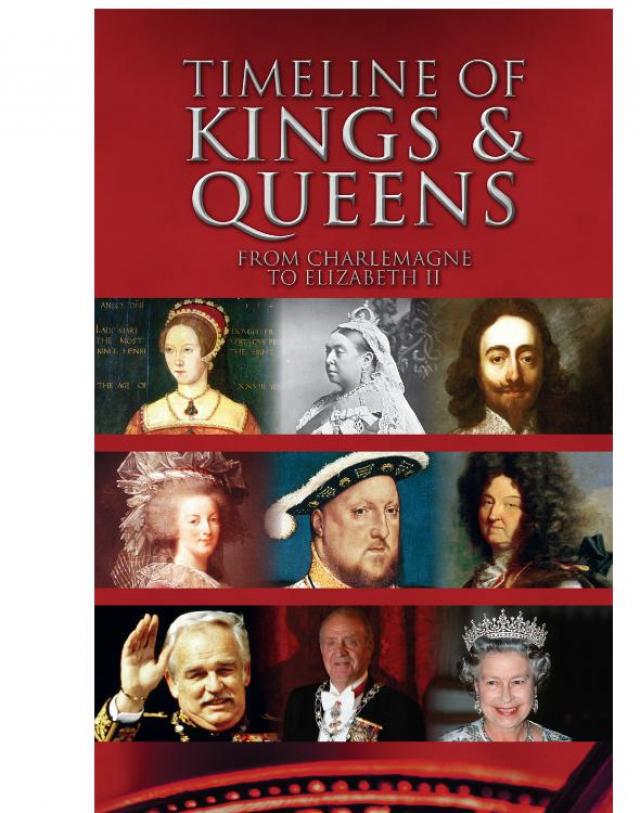
Timeline of Kings and Queens, page 13


1524
France recaptures Milan.
1526
Hungary and Bohemia Louis II is defeated and killed by the Turks, in the Battle of Mohács; Ferdinand I becomes king of Bohemia; John Zápolya, Hungary’s most prominent aristocrat, is elected king by the Hungarians, but is a puppet of the Turks; the succession is disputed by Louis II’s sister Anne and her husband Archduke Ferdinand of Austria.
1527
France Charles de Bourbon, the Constable of France, dies; he is the last of the Bourbon line. Rome Charles V’s troops sack Rome and capture Pope Clement VII.
1529
England Cardinal Wolsey is dismissed for failing to obtain a divorce for Henry VIII; Sir Thomas More becomes lord chancellor; Henry begins to cut ties with the Church of Rome. France renounces its claims to Italy in the Peace of Cambrai. Wallachia Moise becomes prince.
1530
Italy Charles V is crowned king of Italy. Montenegro Pavle becomes prince-bishop. Wallachia Moise is killed; Vlad the Drowned becomes prince.
1532
England Sir Thomas More resigns over Henry’s divorce. Wallachia Vlad the Drowned is so named after he gets drunk and rides into the Dâmboviţa river, where he drowns; Vlad Vintilă de la Slatina becomes prince.
1533
England Henry VIII’s 24-year marriage to Catherine of Aragón is annulled; he marries Anne Boleyn and is excommunicated by Pope Clement VII, an action that leads to the English Reformation; Thomas Cranmer becomes Archbishop of Canterbury. Henry VIII and Anne Boleyn celebrate the birth of a daughter, Elizabeth. Denmark and Norway Christian III, son of Christian I, becomes king; a Protestant, he founds the Lutheran Church in 1536. Montenegro Vasilije I becomes prince-bishop.
1534
England Henry VIII breaks with Rome; he declares himself head of the English Church. Rome Pope Clement VII dies, having ordered Michelangelo to paint The Last Judgement, on the ceiling of the Sistine Chapel, a few days before his death; Cardinal Alessandro Farnese is elected pope as Paul III; he fails in his attempts to stem the tide of Reformation in Europe.
1535
England Sir Thomas More is executed. Wallachia Radu Paisie becomes prince.
1536
England Henry VIII’s second wife, Anne Boleyn, is executed on the grounds of adultery, incest and high treason; Henry VIII marries Jane Seymour.
1537
England Jane Seymour dies after giving birth to the future Edward VI.
1538
Venice Pietro Lando is elected doge; he is forced to cede Venice’s remaining possessions in the Peloponnese to the Ottoman Empire.
1540
England Henry VIII marries Anne of Cleves, divorces her and marries Catherine Howard. Montenegro Nikodim becomes prince-bishop and dies soon after; Romil succeeds him.
1541
Hungary The Ottoman Turks conquer Hungary.
1542
England Henry VIII has his fifth wife, Catherine Howard, executed after less than two years of marriage, on the grounds of treason in the form of adultery. Scotland James V dies after the Battle of Solway Moss; his daughter, 6-day-old Mary I, Mary Queen of Scots, succeeds him as queen; she adopts the French spelling of ‘Stuart’ for her surname. Ireland enters into personal union with England when the Protestant Ascendancy that dominates the Irish parliament passes the Crown of Ireland Act 1542, proclaiming Henry VIII of England as king of Ireland.
1543
England Henry VIII marries Catherine Parr; his daughter, Elizabeth, is deemed illegitimate, making Mary Queen of Scots the true heir to the English throne; Henry’s will stipulates, however, that Stewarts may never rule England; this is formalized by the Third Act of Succession.
1544
England The Act of Succession restores Elizabeth to the line of succession to the throne of England. Sweden Succession is tied to the male line.
1545
Venice Francesco Donato is elected doge. Wallachia The Ottoman Turks replace Radu Paisie with his stepbrother, Mircea V Ciobanul, as prince.
1547
England Henry VIII dies; aged 55, Edward VI becomes king. France Henri II of the House of Valois becomes king; his reign is marked by wars with Austria and the persecution of the Protestant Huguenots. Russia Ivan the Terrible, grand-prince of Moscow since 1533, is crowned the first ‘Tsar of all Russia’.
1548
Scotland Mary Queen of Scots is sent to France after a treaty promises her in marriage to the dauphin, François; she remains there for 13 years. The Holy Roman Empire annexes the Netherlands. Poland and Lithuania Sigismund II August becomes king of Poland and grand duke of Lithuania; he is the last ruler from the Jagiellon dynasty.
1549
Russia Ivan IV creates Russia’s first national assembly.
1550
Rome Cardinal Giovanni Maria Ciocchi del Monte is elected pope as Julius III.
1552
Wallachia Mircea V Ciobanul puts to death 47 nobles and then flees after losing in battle to Radu Ilie, who becomes prince.
1553
England Edward VI dies, aged 15; Lady Jane Grey, grand-niece of Henry VIII, is declared queen of England; her reign lasts nine days, before she is deposed and the Catholic Mary I becomes queen. Venice Marcantonio Trivisan is elected Venice’s 80th doge. Wallachia Mircea Ciobanul retakes his throne.
The ‘Nine Days’ Queen
Reign: 10–19 July 1553
Lady Jane Grey (1537–1554) had the shortest reign in royal history — it lasted just nine days!
Lady Jane Grey was the eldest daughter of Henry Grey, the duke of Suffolk. She was proclaimed queen after the death of her cousin, King Edward VI. Mary Tudor, who should have been the next in line, was disregarded due to the fact that she was Catholic and Edward wanted to keep England firmly Protestant. Lady Jane ascended to the throne on 6 July 1553 at the tender age of 16.
Her reign was cut short when the country rose up in favour of the true royal line and proclaimed Mary Tudor queen just nine days later. Lady Jane, along with her husband Lord Dudley, were taken to the Tower of London and then beheaded on Tower Green on 12 February 1554.
1554
England Lady Jane Grey is executed; Mary I marries Philip, heir to the Spanish throne. Venice Francesco Venier is elected doge.
Wallachia Pătraşcu the Kind replaces Radu Ilie as prince.
1555
Spain Having spent only 17 of his 40-year reign in Spain, Charles I abdicates and enters a monastery; his son Philip II, king of Portugal, becomes king and leads Spain’s global exploration; he is the husband of Mary Tudor, queen of England; Charles I awards his non-Spanish territories to his other son, Ferdinand I. Navarre Joanna III becomes queen, ruling with her husband Antoine de Bourbon; she declares Calvinism the official religion of Navarre, and becomes the acknowledged political and spiritual leader of the French Huguenot movement. Rome Cardinal Marcello Cervini is elected pope as Marcellus II, the last pope to use his own name; he dies after just 22 days; Cardinal Giovanni Pietro Carafa is elected pope as Paul IV.
1556
Spain, Germany, Bohemia, Naples and the Holy Roman Empire Charles V abdicates, giving Spain, the Netherlands and Naples to his son Philip II; his brother Ferdinand I, king of Bohemia, becomes king of Germany and the Holy Roman Emperor. Venice Lorenzo Priuli is elected doge.
1557
Portugal João III dies of apoplexy; his grandson, Sebastião I, becomes king, aged 3; his paternal grandmother, Catherine of Habsburg, becomes regent, and then his great uncle, Henry of Évora, takes over.
1558
England Mary I’s half-sister Elizabeth I, daughter of Henry VIII and Anne Boleyn, becomes queen of England and reigns for 45 years; Catholic legislation is repealed; Spain’s naval power is destroyed. Scotland Mary Queen of Scots marries François, heir to the French throne; he adopts the title ‘King Consort of Scots’. Holy Roman Empire Charles V’s brother, Ferdinand I, becomes emperor; he is also archduke of Austria and king of Bohemia as well as Hungary. Wallachia Mircea V Ciobanul returns to power for the third time.
1559
France The Dauphin François marries Mary Queen of Scots, when he is 14 and she is 15; Henri II is accidentally killed in a jousting match by Gabriel, Comte de Montgomery of France’s Scots Guards; François II becomes king; Mary Queen of Scots becomes queen consort of France. Spain now controls almost all of Italy. Venice Girolamo Priuli is elected doge. Rome Cardinal Giovanni Angelo Medici is elected pope as Pius IV. Denmark and Norway Frederick II becomes king, and he emerges as one of the best-loved Danish monarchs. Montenegro Makarije becomes prince-bishop. Wallachia Petru the Younger becomes prince.
“In my end is my beginning.”
Mary Queen of Scots
1560
England and Scotland The Treaty of Berwick is signed between England and the Scottish reformers; it is agreed that the two countries act jointly to expel the French from Scotland. France King François II dies, aged 15, when an ear infection causes an abscess in his brain; the mentally and physically weak Charles IX becomes king, and his mother, Catherine de’ Medici, effectively rules until 1574; the French wars of religion begin (until the 1590s); the Protestant minority is in conflict with the Catholic majority, as nobles fight for power under the weak Valois kings. Sweden Erik XIV becomes king; he has unsuccessfully wooed Princess Elizabeth Tudor, later Elizabeth I of England.
1561
Scotland Mary Queen of Scots returns to Scotland a widow, following the death of François II. Montenegro Ruvim I becomes prince-bishop.
1562
Germany Maximilian II is elected co-king with his father, Ferdinand I.
1563
Hungary Maximilian II is crowned king of Hungary.
1564
Holy Roman Empire Maximilian II, already crowned king of Bohemia and Hungary, becomes emperor.
1565
Scotland Mary Queen of Scots marries her cousin Henry Stuart, Lord Darnley; the marriage is a disaster.
1566
Scotland Lord Darnley, consort of Mary Queen of Scots, brutally murders her secretary, David Rizzio, suspecting he and Mary were having an affair. Rome Bishop Michele Ghislieri is elected pope as Pius V.
1567
Scotland Mary’s suitor, the earl of Bothwell, is implicated in the murder of her husband Lord Darnley; Mary marries Bothwell, is imprisoned and forced to abdicate; she flees to England looking for sanctuary; her son by Darnley, James VI, becomes king at the age of 1. Venice Pietro Loredan is elected doge.
1568
Scotland Mary Queen of Scots is imprisoned by Elizabeth I in England.
Netherlands A Dutch campaign for independence from Spanish rule begins; it is finally achieved in 1648. Sweden Erik XIV becomes insane and is replaced on the throne by his brother John III; it is thought that John later orders Erik’s murder by poisoning. Wallachia Alexandru II Mircea becomes prince.
1569
Polish-Lithuanian Commonwealth The Union of Lublin formalizes the union of Poland and Lithuania in the Polish-Lithuanian Commonwealth, and introduces an elective monarchy to determine the succession; until this time, the Lithuanian Grand Duchy has always been hereditary. Montenegro Pahomije II Komanin becomes prince-bishop.
1570
Venice Alvise I Mocenigo is elected doge; Cyprus is lost to the Turks during his reign.
1572
Navarre Henry III becomes king. Rome Cardinal Ugo Boncompagni is elected pope as Gregory XIII; he creates the Gregorian calendar. Poland and Lithuania Sigismund II August dies childless, despite three marriages; Henri of Valois, brother of Charles IX of France, is elected King Henry III of Poland and grand duke of Lithuania.
1574
France Henri of Valois, king of Poland, secretly returns to France, on the death of his brother Charles IX, to be crowned Henri III of France.
1575
Germany Rudolf II is elected co-king. Montenegro Gerasim becomes prince-bishop.
1576
Germany and Holy Roman Empire Maximilian II dies while pre-paring to invade Poland; Rudolf II, also king of Bohemia and Hungary, becomes king and emperor; his poor decisions will lead to the Thirty Years’ War. Polish-Lithuanian Commonwealth Anna Jagiellon, daughter of Sigismund I, is elected queen; her husband Stephen Báthory, a prince of Transylvania in Romania, becomes king consort of Poland and duke consort of Lithuania; he is crowned king and grand duke, and will become one of the greatest elected rulers of Poland and Lithuania; a skilled politician, he strengthens royal authority.
1577
Venice Sebastiano Venier is elected doge. Wallachia Mihnea the Turned-Turk becomes prince.
1578
Portugal Sebastião I dies in the Battle of Alcácer Quibir in Morocco, trying to help Abu Abdallah Mohammed II Saadi regain his crown; unmarried and without male issue, Cardinal-King Henry, younger brother of João III, becomes king. Venice Doge Sebastiano Venier allegedly dies of a broken heart after the Doge’s Palace (Palazzo Ducale) is badly damaged by fire; Nicolò da Ponte is elected to succeed him.
1579
England forms an alliance with the Netherlands against Spain. Netherlands The Dutch northern provinces form the Union of Utrecht.
1580
Portugal Cardinal-King Henry dies without issue and without appointing a council of regency to choose a successor; King Philip II of Spain, a claimant to the Portuguese throne, invades and captures Lisbon; Philip is elected king of Portugal on condition that neither it nor its overseas possessions would become Spanish provinces; he is the first Portuguese king from the House of Habsburg, also known as the Philippine dynasty.
1581
Russia Ivan the Terrible kills his son, Ivan, during an argument.
Monaco Charles II becomes lord of Monaco. Netherlands The Union of Utrecht declares independence from Spain, calls itself the Dutch Republic and elects William of Orange, known as William the Silent, leader of the revolt that sets off the 80 years’ war for independence from Spain William becomes the first ruler of the House of Orange-Nassau.
1582
Montenegro Venijamin becomes prince-bishop.
1583
Wallachia Petru Cercel becomes prince.
1584
Netherlands Prince William of Orange, of the Dutch Republic, is assassinated by a supporter of the Spanish. Russia On the death of Ivan the Terrible, probably from poisoning, Fyodor I becomes tsar; Fyodor is probably mentally retarded, and his brother-in-law, Boris Godunov, actually governs the country.
1585
Venice Pasqual Cicogna is elected doge. Rome Cardinal Felice Peretti is elected pope as Sixtus V. Wallachia Petru Cercel, facing hostility from nobles and aggression from his rival, Mihnea, flees; Mihnea the Turned-Turk returns to the throne.
1586
England Mary Queen of Scots is implicated in a conspiracy against Elizabeth I, led by Anthony Babington; she is tried and sentenced to death. Polish-Lithuanian Commonwealth Stephen Báthory dies, and an interregnum of one year ensues.
1587
England Mary Queen of Scots is executed; Elizabeth I is furious, and she claims she has not ordered the execution, even though she has signed the death warrant. Polish-Lithuanian Commonwealth Sigismund III Vasa, son of John III of Sweden and grandson of Sigismund the Old, is elected king of Poland and grand duke of Lithuania; trying to regain the Swedish throne, he instigates a series of wars with Sweden that continue until the 1660s; as a condition of his election, he agrees to a reduction in power in favour of the Sejm, the Commonwealth’s parliament.
1588
England Francis Drake, leading the English fleet, defeats the Spanish Armada off the south coast of England; Spanish power declines. France Henri of Guise, leader of the Catholic League that has been formed to keep the Protestant Henry of Navarre off the throne, is murdered on the orders of King Henri III; there is outrage, and the king has to take refuge with Henry of Navarre. Denmark and Norway Aged 11, Christian IV succeeds his father Frederick II; a council of regents rules; he creates one of Europe’s most splendid courts.
“There is plenty of time to win this game, and to thrash the Spaniards, too.”
Catherine II of Russia.
1589
France Henri III of France, the last of the Valois kings, is assassinated by a monk, Jacques Clément, while besieging Paris; the Protestant Henri, king of Navarre, succeeds him as Henri IV, the first king of the House of Bourbon. Navarre The crown of Navarre is held by the kings of France from this date. Monaco Charles II dies without issue; his younger brother, Hercule, becomes ruler.
1590
Rome Cardinal Giovanni Battista Castagna is elected pope as Urban VII; he reigns for just 13 days, making him the shortest-reigning pope; Cardinal Niccolò Sfondrati is elected pope as Gregory XIV.
1591
Rome Titular Archbishop of Jerusalem, Giovanni Antonio Facchinetti, is elected pope as Innocent IX. Montenegro Nikanor and Stefan rule jointly as prince-bishop. Wallachia Ştefan Surdul becomes prince.
1592
Rome Cardinal Ippolito Aldobrandini is elected pope as Clement VIII. Sweden On his father John III’s death, Sigismund, already king of the Polish-Lithuanian Commonwealth, becomes king of Sweden. Wallachia Alexander the Wrongdoer, already ruler of Moldavia, becomes prince.
1593