Poison in the Colony, page 8
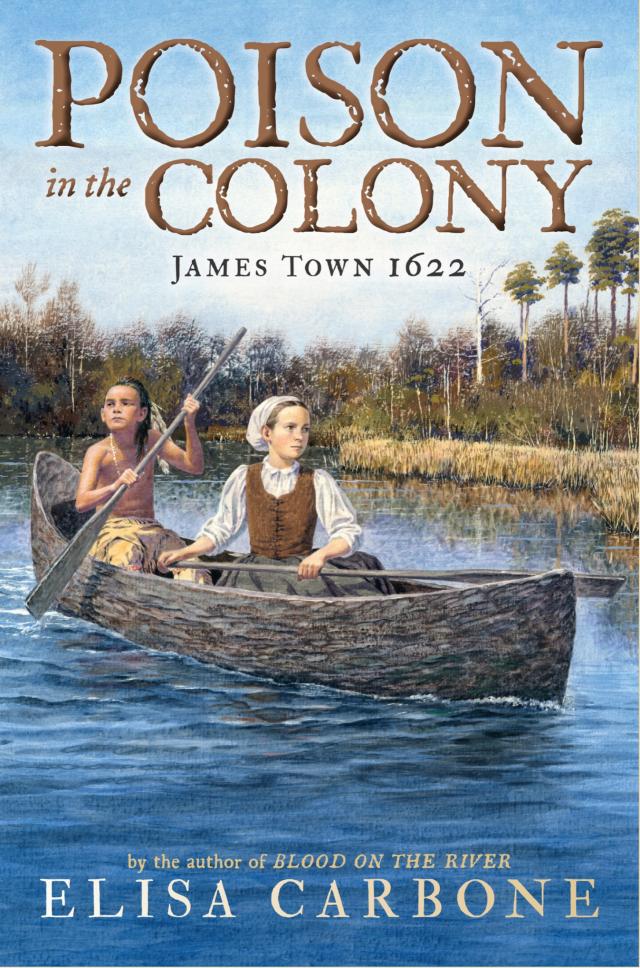


I push us free of shore and hop in. We are taking Angela back to James Town.
We keep to the edge of the river where the current is weaker. I sit at the front, with Samuel at the rear and Angela in the middle between us. At first, we paddle in silence. Then Samuel asks, “Are you from Ndongo?” And the two of them are off on a conversation that uses English, along with words I don’t understand that must be either Spanish or her language, and hand motions that I keep turning around to see until Samuel tells me I’m rocking the canoe too much. “You just paddle, and I’ll tell you what her hands say,” he tells me.
And so, Angela’s story takes shape. She was captured during a war with the Portuguese—they were taking over Ndongo land. A very bad tribe of people, the Imbangala, fought alongside the Portuguese and captured the good people of Ndongo to sell them into slavery. She is from the nobleman class. She was stolen away from her husband and baby daughter. She will never see them again, and her heart is broken. But God wants her to live. That is why she is coming with us—so she will not starve.
I scowl. That wretched ship, the Treasurer, has once again taken a young mother away from her child.
“What will they do with her in James Town?” I ask Samuel when Angela’s story has ended.
“Put her to work like anyone else, give her a place to sleep and food to eat like anyone else. There’s not much difference among us common folk,” he says.
“Do you think they’ll send her off to the tobacco fields at one of the boroughs?” I ask. I hope they won’t. I hope Angela will stay in James Town so that I can get to know her more.
Angela makes a clicking noise with her mouth.
“She’s shaking her head,” says Samuel. “She must have understood your question about working in the fields. Maybe since she is from a noble family, working in the fields would be beneath her. . . . Yes, she’s making motions; sewing, cooking, these are the things she is willing to do.”
“Do you think they’ll let her choose?” I ask.
“I’ll see what I can do,” Samuel says.
The sun is sinking low. My arms ache terribly.
“Hey, keep up the pace,” Samuel says. “We need to get back before dark or your mum will worry.”
I groan.
“Virginia.” It is Angela speaking to me.
I turn to look at her. She raises her eyebrows, opens her hands, motions to my paddle.
“Go ahead. Give it to her,” Samuel says.
Angela moves closer to me and I gladly hand the paddle to her. She sets to work with strong, swift strokes.
“Yes. Now we’ll make it home,” says Samuel.
I am slightly annoyed by the insult, but in truth I don’t know how much longer I could have kept going, and we are far from home. I scoot down low in the canoe, rest my head on my knees, and doze off.
* * *
. . .
There is quite a commotion when we arrive in James Town at dusk. Everyone says how lucky we were to find Angela near our fishing spot. Reverend Buck offers prayers of thanks that a Christian woman has been saved from starvation. Governor Yeardley paces, totally confused about what to do with this person who was supposed to be a slave, but for whom no money has been paid, and so she is not a slave. Men, commoners and gentlemen alike, stare. Just like the rumors said, Angela is quite beautiful, with long, graceful arms and dark, flashing eyes.
Samuel explains that she is nobility and cannot be sent to be a field-worker, and this confuses Governor Yeardley even more. I stand with Angela, feeling protective of her. She seems to be understanding some of what is going on, but mostly she looks overwhelmed.
I notice Joan Pierce talking to her husband, Captain William Pierce, and motioning toward Angela. Finally, Captain Pierce marches over to Governor Yeardley and speaks to him.
“My wife says we will bring her into our home. She may work alongside our other servants and share a bed with Ester, our maidservant,” he says.
I look at Angela to see if she has understood. “Will you go with them?” I ask quietly. “They live here in James Town, in a nice cottage. They are good people.” I want to add, Then I’ll get to see you every day, but I don’t.
Captain and Mrs. Pierce approach us. I suddenly notice how very exhausted Angela looks. She has not said no, and she has not made that clicking sound with her mouth. She has not said yes, either.
Mrs. Pierce speaks to Angela briskly, telling her she must come home with them. Angela allows herself to be led away.
It is nearly dark now, and the air is filled with the sound of night insects. As I watch Angela walk away, I think of her little daughter and husband in Ndongo. I wonder if they still think of her every day, or if she has become a dim memory, lost forever to a foreign land.
Nineteen
THE LONG DAYS of summer shorten into fall. The tobacco harvest is finished and the large fragrant leaves hang in the barns to cure. Some nights are cool, and the insects keep quiet. Then it turns warm again, and the crickets and cicadas keep up their chirping nearly all night. I harvest the pumpkins from our garden and put them under my parents’ bed. That’s where they will stay until the dead of winter, when hot pumpkin soup will keep us fed.
The next time I see Angela, she is dressed in English clothing, with her arms properly hidden under long sleeves, though she still wears her indigo head wrap. Sometimes she chats in her own language with other Africans like Anthony and Isabella, but I am amazed at how quickly she is learning English.
An interesting thing happens to the music played in James Town in the evenings after work is done. The African men build drums in much the same way the natives build them, with deerskin stretched over a wooden frame. The rhythms they play are quick and cheery and complicated, and when a group of musicians come together to play, the Africans join in. The African women dance, with their arms flying and hips keeping time. When we gather to listen and watch, I feel like I am flying as well. When I see Angela dance this way, I hope that just for a moment, she feels like she is back home in Ndongo.
We have another wedding with John Rolfe as the groom. He marries the Pierces’ daughter, Jane. Angela helps Mrs. Pierce gather fall flowers to decorate the church.
Whenever Angela is not working, she is with Samuel. They go digging for clams and mussels together and go berry picking together. He even comes to help her with her work after he leaves the fields for the day. There is a sparkle in his eye whenever he talks about her.
I’m not the only one who has seen the sparkle. Cecily has not yet accepted a proposal of marriage because she has still been hoping that Samuel will choose her as his wife. She is furious about his new companion. One day I hear her gossiping at the well.
“She’s married. And since she is a Christian, it must have been a Christian marriage, so she can’t marry again unless her husband dies, and she’ll never know if that happens. Not only that, she’s a slave. What is he going to do, buy her?”
“She’s . . . not really a slave.” Mary speaks up hesitantly. Good-hearted, level-headed Mary. “No one owns her because she escaped, so no one paid any money for her.”
“Oh, you know what I mean. She’s an African.”
I take my buckets of water and hurry away. In whatever way I look at the situation, it confuses my mind and my heart. I just want Samuel to be happy, and he seems to be walking down a path that promises heartbreak.
* * *
. . .
As winter sets in, there is excitement in our family. With the corn harvest in storage and the tobacco harvest already shipped to England, my father finally has time to begin work on our homestead in Elizabeth City. Da and Samuel build a small shelter there so that they can travel down the river and stay for weeks, clearing the land and beginning to build our house. When they’re gone, I miss them both, and I still don’t like the idea of us moving. But when they come back each time so enthusiastic, with reports of their progress, I am happy for them, and some of their excitement rubs off on me.
Alice is becoming more of a help, and Katherine is growing strong. My father says he is building a house with not just one room like our cottage, but with actual “bed” rooms separate from the kitchen. This seems very strange to me, though I know this is how the fancier houses, like those of the noblemen, are built. Da says that when more brothers and sisters come along, we’ll need more space.
At least during winter there are no new ships carrying colonists. We simply settle in to feed those of us who are here, stay warm, and as long as the ground is not frozen, bury those who die.
One Sunday afternoon in February, I go to see what Bermuda is doing. He has two piles of stones on the ground in front of him where he sits in the cold sunshine near his cottage. Next to him is an earthenware jar.
“What are you doing?” I ask.
“Counting ships,” he answers.
I sit down in the dirt with him. “Are you pretending that those stones are ships?”
Bermuda shakes his head. “They represent the ships that have come to James Town since I started counting.”
“When did you start counting?” I ask.
“About two years ago. Here, this pile is 1618,” he says, and neatly separates six round stones. He points to a much larger pile. “These are 1619.”
I widen my eyes. “No wonder it feels so crowded around here,” I say. “Did you count them yet?”
“Fourteen,” he says. “Fourteen ships with a thousand new colonists. My father says that’s too many.”
I feel slightly dizzy. I remember my dream of ships, and the feeling of too many ships coming to James Town.
“I wonder how many they’ll send this year,” I say.
Twenty
MY MOTHER SAYS springtime comes earlier in Virginia than it ever did in England. This makes me very glad I live in Virginia and not in England: I love springtime, and I would hate to have to wait for it to arrive. I am happy to dig and plant our garden and open up the shutters on our cottage that have been closed all winter. We have fresh turnip greens to eat, sprouting from the turnips we left in the ground during the cold months. Most of all I am happy that my father has to come home to begin work in the fields and leave our unfinished house in Elizabeth City to wait until next winter.
One day, just as the weather is warming up, a ship approaches. When the gangplank is lowered and the passengers unload, I am reminded of my dream of a shipload of women in white dresses. All of the passengers are young women dressed in upper-class finery. The gentlemen of the colony finally have their bride ship.
The women are not allowed to consort with servants or other commoners. They have been sent for the gentlemen only.
The next few weeks are like watching a rooster-strutting contest. The gentlemen, in competition for the ninety or so young women, wear their swords, grease their mustaches, puff out their chests, don their finest clothes, and shine their shoes. Within a couple of weeks, the weddings begin. More than once an engagement has to be broken because it is discovered that the gentleman in question is already married to a wife in England. But as the honest men woo their mates and pay the Virginia Company for their brides with 150 pounds of choice tobacco, Reverend Buck performs the wedding ceremonies.
There aren’t nearly enough brides to go around, and so the order is sent back to England: send more suitable young women.
We also receive several shiploads of convicts. Ever since Governor Dale asked King James to please send us everyone in England who has been sentenced to death, we’ve been getting shiploads of convicted criminals.
Right from the beginning, Samuel reminded me that he himself was a convicted criminal, when he was eleven years old, sentenced to death for stealing his mother’s locket back from a pawnshop. He told me not to be afraid of them, that they are not all bad people. And he’s right. Many of them are thankful to be alive and throw themselves into working hard for the colony. But when the summer flux hits, or when our stores run low and everyone is hungry, I’ve heard some of them complain that they should have chosen to be hanged in England rather than to come here.
Another shipload of London street children arrives. Then the Treasurer returns with more slaves to sell, and Captain Elfrith demands payment for Angela, his escaped “property.” Angela is terrified that Captain Elfrith will take her on board the ship again, but Captain Pierce quietly pays the price, and the Treasurer sets sail away from James Town.
At supper one evening my father says, “Between the convicts, the Africans, the London street children, and all these indentured servants, we’re becoming crowded with people who don’t want to be here.”
Katherine is on my lap, grabbing chunks of stew from the plate we’re both sharing instead of letting me feed her. Alice is tapping her hands on the table, pretending she is playing an African drum.
“I didn’t want to come here,” my mother reminds him. “I was afraid of the journey across the ocean and I was afraid of the New World.” She gives him a sweet smile. “But I’m glad I did come here.”
“Oh, I remember you getting off the ship that day with your master and mistress,” my father says. Alice stops tapping and listens, sensing a story coming on. “No one could believe they’d actually sent two women to James Town. Conditions were terrible in those days. And then there you were, looking terrified, just fourteen years old.” He leans toward her. “I didn’t know if you were terrified of the place, or of being the one unmarried woman among all those lovesick men.”
“Both!” my mother says.
I love hearing these stories about the time before I was born. Samuel was just a boy then. He has told me how he was worried about my mother, that she might starve that first winter if her selfish mistress didn’t share enough rations with her. He says when my father won her heart and she had permission to marry, he thought, Good, now she won’t starve.
Katherine splats her whole hand into our plate, ready to play now instead of eat. I clean her up with my napkin and set her on the floor. Alice reaches her spoon over to my plate and scoops up some of my stew. “Alice, what is wrong with your food?” I ask her.
“It’s cold,” she says.
“Well, mine is nice and warm because Katherine had her warm hands in it,” I say.
“Good,” says Alice, and she takes another spoonful of my stew.
“And now we have these three lovely daughters,” my father says, beaming at each of us.
I sigh and pull Alice’s plate over to my place so I can at least eat food that has not been mashed by baby hands.
Twenty-One
JUST AS THE hint of spring becomes a promise and it is time to plant pumpkin seeds in the garden, a ship arrives carrying more colonists, including a man named George Thorpe. The Virginia Company has set aside thousands of acres at Henrico to build a college where young Indian children can live and be taught the English ways of religion and culture. George Thorpe has been sent to carry out this plan, as the official “deputy for the college lands.”
Mr. Thorpe wishes to meet with Chief Opechancanough in order to work with him on this plan. Samuel is asked to translate during the meeting.
I am hoeing weeds in the garden in late afternoon when Samuel returns from that first meeting. He looks worn-out.
I lean on my hoe as he approaches. “Are we soon to have a college filled with Indian children?” I ask, already knowing the answer.
Samuel shakes his head wearily. “Mr. Thorpe and Governor Yeardley and the Virginia Company officials, sitting in London—they are completely ignorant of the native ways. They think that the Powhatan people will send their children away like English nobles who send their children off to be educated.”
“Was Mr. Thorpe angry when Chief Opechancanough said no?” I ask.
“He would never show it if he was angry,” Samuel says. “They went round and round and round. Send the children; we will take excellent care of them. No, we do not send our children to live far from us. Our children are too precious to send away. But we will educate them and teach them to read and write, and then they will come home. No, we will not separate them from their families. I will send entire families to live with you if you would like.”
“Did Mr. Thorpe like the idea of whole families coming?” I ask hopefully.
“No. Because he wants the Indian children to become more English. He doesn’t want them to live in their own culture. So now he has all this land they have set aside—land that rightfully belongs to the natives, but the Company says it’s for the college—and money that has been donated to build and run the college, and not a single student.” Samuel runs one hand through his hair.
I frown. “Isn’t Governor Yeardley trading for the land? I mean, not just for the college land, but all the land we’re expanding into—the homesteads for the ancients, and the new plantations for all the newcomers. Aren’t the Indians being paid for it?”
Samuel lets out a groan. “No, they’re not. The chief said there are many more of us than there used to be.”
“Is Chief Opechancanough angry about the land being taken over?” I ask.
“He said that he and his brother Chief Opitchapam are both committed to peace between our people.”
“That’s good, right?” I ask.
“And Mr. Thorpe promised that he would make sure that our people treat all of his people with kindness and respect at all times,” Samuel says.
I cock my head. “Then why do you look so worried?”
Samuel looks at me hard. “What happened to your knowing, Virginia? Can’t you feel this one?”
I have been holding myself above it, keeping a thick veil between what my mind wants to think and what my heart would know if I only let it. On Samuel’s suggestion, I allow an opening in the veil. For a moment, I sink into the knowing. Immediately, I feel it—the roiling cloud of Chief Opechancanough’s rage, the fear for his people, the belief that the only way for his people to survive is to send the invaders away. I stagger at the power of it. “He wants us gone,” I say softly.