Poison in the Colony, page 14
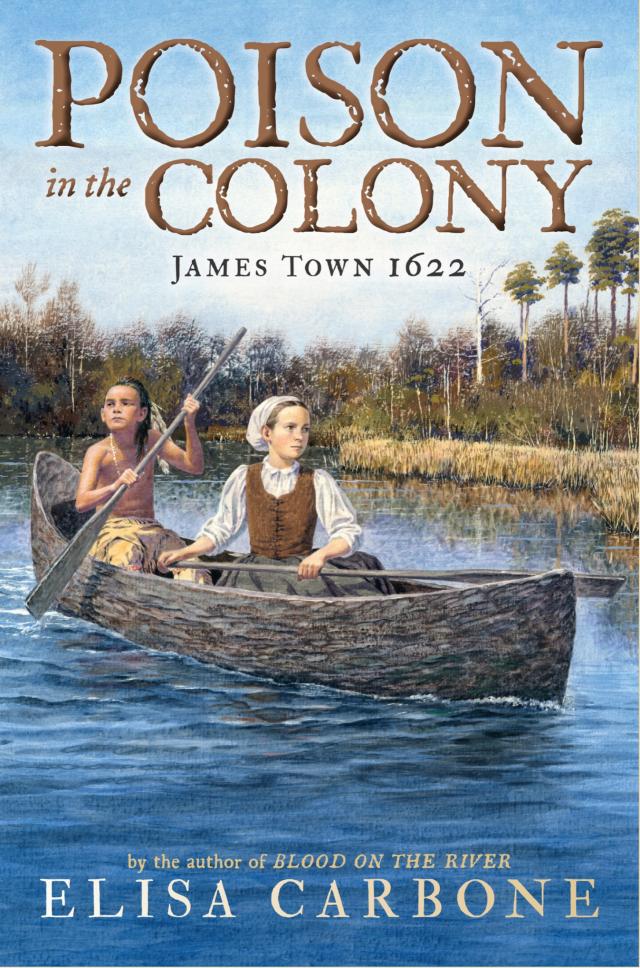


Pipsco sits at the back of the canoe so that he can steer us. We take strong strokes as we enter the current, pointed downstream but always moving ourselves closer to the opposite shore.
We watch the north shoreline as it glides past us. Suddenly I see it: a break in the trees and an English barn up on the hill. I laugh out loud, elated. I have finally made it to Elizabeth City!
We guide the boat to shore. I thank Pipsco in English, and he says something back to me in Algonquian that I assume must be “you’re welcome.” I wave at him as he pushes the canoe back into the river to go home.
As I walk up the hill toward the settlement, my elation dims. I must now face my father, who will surely be furious at me for the way I chose to travel.
Thirty-Two
“YOU DID WHAT?!” Da is almost as angry as when he heard I was going to be on trial for witchcraft.
“But it turned out all right, Da,” I say, trying to calm him. “I’m not hurt, nothing bad happened, and Samuel can take me home tomorrow so Mum won’t have to worry about me.”
Da shakes his head and rubs his temples. I have told him only that I have come because I missed him so much, which is part of the truth, so he thinks I endangered myself for no good reason. If I could tell him the whole story, he would not think I was so irresponsible. Samuel, on the other hand, keeps giving me puzzled looks. He knows something more is going on.
Once Da calms down, he and Samuel proudly show me the progress they have made: land cleared for planting, trees felled and being split into clapboard for building, the beginnings of a house, a chosen site for a barn. They have also built a small windowless shed for them to sleep in now, and to be used for storage in the future. Though it is built of wood, it has a roof made of woven reeds, and a hole in the roof to let smoke out. It also has platform beds along the walls, just like the native cottages. I realize that these are things Samuel learned to make when he lived in the Warraskoyack village.
“Let me show her where my house will be someday,” Samuel says. “Then we’ll get back to work.”
I am relieved. He knows I need to talk to him in private.
Da agrees and says he will put some peas on to soak for our supper. It’s very strange for me to think of Da cooking. “I’ll cook supper tonight,” I say.
I follow Samuel up the hill to where stakes have been driven into the ground, marking the four corners of his future house. But he doesn’t start in about how someday he will live there with Angela and have a family. He simply says, “What is going on, Virginia?”
I tell him all of it, about Alice’s snakebite and knowing that we must not eat or drink anything from the natives, and about needing to get the warning out to the rest of the colony very soon.
“I know the Nansemonds are not planning anything,” I say. “I could tell from being in their village, they have no anger toward us. Do you think it could be Chief Opechancanough?”
Samuel nods. “Word has come to us that Chief Opechancanough and his brother Opitchapam have changed their names. Opechancanough is now known as Mangopeesomon and Opitchapam is now Sasawpen. This is what chiefs do when they will soon lead a great military strike.”
“It sounds like they are planning to get rid of us,” I say.
“Chief Opechancanough is ruler over all of the tribes, the way Chief Powhatan was,” Samuel says. “He will demand that all the tribes work together to attack us. It won’t matter that the Nansemonds consider us their friends. They will have to obey their paramount chief, or face a tortured death.”
I shudder. “Chief Opechancanough believes the only way to protect his people is for us to be gone. He is afraid of the prophecy, that we will cause the end of his kingdom.”
“Yes,” says Samuel. “I think he believes that if he can kill a large number of us, then the rest of us will go back to England and he will be free of us. That is what almost happened after the Starving Time.”
“So, our leaders know that the chiefs have changed their names. What will they do to protect us now?” I ask.
Samuel groans. “Nothing!” he says. “I seem to be the only one who really understands what this name change means. I’ve tried to talk to Captain Newce and Captain Tucker, our leaders here in Elizabeth City. But they think I am worrying for no reason.” He puts one hand on my shoulder. “When I take you back tomorrow, I will go right to the governor. You can come with me if you like. We will tell him that Chief Opechancanough is planning to poison the colony.”
“He will ask us how we know,” I say, “and you can tell him—” To my horror, I suddenly realize that my plan for Samuel to get out the warning is deeply flawed: it would require him to lie. Surely the knowing, if it is from God, would not require either of us to lie. “How will we tell him we found out?” I ask in a small voice.
“You can tell him you learned it from the Nansemonds while you were staying there,” he suggests.
“Which is a lie,” I say. “And anyway, how could I have heard it from them? I don’t speak Algonquian.”
“Right,” he says. Then he gives me a sideways look. “How did you tell them to bring you here?”
I feel my face flush. I will keep Sarah’s secret, but I don’t want to lie to Samuel. “Hand motions can say a lot,” I say.
He doesn’t press me further. “Then I will have to say I heard it from one of the native tribes.” He hesitates. “The only problem is that we have had no contact with them for months now. Captain Newce knows that. I could be accused of lying to the governor.”
“Treason,” I say.
“Well, better for me to be hanged for treason than the whole colony perish,” he says.
“And if either of us lies, it will endanger our souls for eternity,” I say firmly. “I would rather be hanged as an honest girl and go to heaven. I will tell Governor Yeardley that it is through the second sight that I know this.”
Samuel rubs his forehead. “Let me think on it,” he says. “There might be a safe, and honest, way to get this done.”
* * *
. . .
Da starts a fire in the outdoor pit, which they use for cooking when there is no rain. I hang the pot of peas over the fire to get it boiling. Samuel opens their storage barrel and I find some turnips and carrots to add.
“We have only two spoons,” Da says.
But I see oyster shells in their trash heap. I pull one out and show him. “Now we have three spoons,” I say.
I hear the crunching of footsteps, and when I look up, I see two figures coming toward us across the cleared field. One is an Englishman wearing the simple breeches and jacket of a commoner. The other is a young native man, bare-chested, wearing a breechcloth and leggings.
“Samuel Collier,” the Englishman calls out as they come closer.
“I am here,” Samuel calls back.
“This man desires an interpreter.”
“Wingapo,” Samuel says. The native man speaks, and Samuel interprets.
“He says that the chief of the Accomack tribe, Chief Debedeavon, will be coming from across the Chesapeake Bay for a visit to our leaders tomorrow. He wants an interpreter present because he has many questions.” Samuel speaks to the native man in Algonquian, then says to us, “I have assured him I will be there.”
After the two men leave, Da asks Samuel, “What do you think this is all about?”
Samuel glances at me, then quickly looks away. “I guess I’ll find out tomorrow.”
* * *
. . .
I awaken early in the shed. Samuel is asleep, sitting on the earthen floor, leaned up against the wall, since he gave up his bed and blanket for me. Da is snoring on the other platform bed. The fire in the middle of the floor, which we used for heat last night, has gone out. Dim morning light filters in through the hole in the roof.
I push open the shed door and slip behind a tree to relieve myself. It is cold. Winter weather has returned.
I hear a big yawn and Da stumbles out of the shed.
“Good morning,” I say.
“G’morning,” he mumbles.
I go to the outdoor firepit and get the fire going again. Then I retrieve the cook pot from the shed and uncover the leftover peas. Even with the lid on tight, quite a few ants have found their way into our peas. I scrape out as many as I can and put the pot on the fire to heat. I slip my new moccasins on. They are even warmer than wrapping my feet in rags.
Da joins me at the fire and warms his hands. “I suppose that mild weather couldn’t last forever,” he says.
I hold my hands close to the fire as well. “So, I guess Samuel and I will go back to James Town tomorrow, then,” I say. I want badly to hear what the Accomack chief has to say.
“Absolutely not,” Da says. “I will not have your mother worrying another day. I will take you back today myself.”
My face falls. Then, in the next instant, I correct my expression. “Wonderful!” I say. “Mum and the girls will be so happy. And I will be happy to have you at home as well.”
“I thought you would be,” Da says.
Suddenly a terrible thought strikes me. We will be taking their one canoe. Samuel will be stranded in Elizabeth City. He will not be able to come to James Town to warn Governor Yeardley of the threat of poison. Yet I can’t tell my father any of this. “I’ll go wake Samuel,” I say.
When I go back into the shed, I see that Samuel has crawled into the bed I vacated.
“Samuel, wake up. I have to talk to you,” I say, jostling him.
He groans. “Leave me alone. I’m finally getting to sleep comfortably.”
“But Da wants to take me home in the canoe,” I say quietly, urgently. “How will you get to James Town to talk to the governor? You promised you would find an honest way to warn him.”
Samuel pulls the blanket up over his head, shutting me out.
“Samuel, we have to talk!” I say, a little too loudly.
Da peeks his head in the door. “Leave him be, Virginia. Let him sleep before he has to be interpreter. He gave you his bed, after all.”
And so, I am silent. I will not get to hear what the Accomack chief has to say. We will be leaving Samuel with no boat to get to James Town. I came all the way to Elizabeth City and now Samuel will not be able to help me warn the colony, even if he can figure out a safe way to do it.
But I will do one thing properly today: I will obey my father and go home to my mother so that both of my parents can stop worrying about me. And if, in order to save my family and the colony, I have to confess to Governor Yeardley that I have the second sight, then I will do that properly as well.
Thirty-Three
MUM IS NOT surprised to hear that I traveled with the very men she told me not to travel with. She says I am becoming a difficult child to raise. I apologize to her as best I can. At least she realizes it is the knowing that is behind all of this, and not just me being a disobedient daughter. Above all, she is relieved that I am home safe.
I am thankful to be back home, to wash the clothes I lived in day and night, and to be with my whole family again. Mum and the girls are very glad I’ve brought Da back for a visit. Alice proudly shows him the fading purple on her leg where the snake bit her.
“You’re a brave girl, Alice,” Da says.
“I know,” says Alice.
Katherine shows Da her leg, too, even though there isn’t anything to see.
My mind will not let me be. It goes in circles, waging a heated argument between me and me.
Samuel can’t get here. You need to just go to Governor Yeardley yourself.
I would never be able to explain how I know these things without confessing to the second sight. Then I will be hanged as a witch.
So? Give your life to save the colony.
If I could be sure it would be that simple, I would do it. But what if Governor Yeardley doesn’t believe me? Then my life will be wasted and the colony will perish as well.
You have to take that risk. If you do nothing, then death for the colony is certain.
Or what if he believes me but the accusations of witchcraft spread to Mum? Then my little sisters would lose their mother. I can’t let that happen.
So, you’re just going to sit here doing nothing while the natives stir their pots of poison, ready to bring it to the colony mixed into bread and stew and—
Be quiet! You are no help at all.
Well, what are you going to do?
This argument has no ending point, and no good answers. All I know is that I must be who I am, nothing more and nothing less. I’m not a gentleman who can speak with authority, nor a leader who can make decisions. I am only a girl whom God has chosen to know something the gentlemen and leaders do not know. If God leads me to speak the warning myself, and lay down my life for the colony, I will do it. But in the meantime, with no natives coming to the fort with food for us, I will wait and hope for a better way.
The next day is Sunday. When church services are over, Bermuda’s father gives us the news: Bermuda has finally been accepted as an apprentice at the tar pits. After our midday meal, Mum gives me permission to go visit Bermuda and his family.
I walk through swirling wind to the Easons’ cottage. The sky is steel gray with low clouds and I can smell snow in the air. Mrs. Eason welcomes me into their warm cottage.
Bermuda is very excited about his new job. “Now, when they start up the glass house again, I can switch to being an apprentice there,” he tells me.
“Well, you badgered those Polish workers until they let you become an apprentice, so maybe you can find someone to badger until they start up the glass house again,” I say.
Mrs. Eason offers me a cup of hot tea, which makes me feel very grown-up. Mr. Eason is cleaning his musket and smoking his pipe, filling the small cottage with tobacco smoke. I blink in the haze and think maybe I agree with King James about the evils of tobacco.
I like Mr. Eason very much. He has already claimed his land at Martin’s Hundred, just a few miles down the river from James Town. He travels there to work on his house and land, but since it is so close, he returns home often.
“Have I ever told you about the night we saw St. Elmo’s fire?” Mr. Eason asks me between puffs on his pipe.
He has, and it is a wondrous story. “I would love to hear it,” I say.
Bermuda settles in at the table with me to listen, and Mrs. Eason puts us to work shelling corn off dry cobs.
“I’ve never seen such a storm,” Mr. Eason begins. “For four days and nights, the ship tossed like a wild horse, wind a-howling, rain coming sideways so hard, I could scarcely open my eyes. We dropped the sails just before the waves got so big, they’d have capsized us for sure.”
Behind his story is the crackle of the fire, the toc-toc-toc of our corn kernels dropping into the bowl as we break them off the cobs with our thumbs, the creaking of the cottage in the February wind. But in my imagination, I am on a ship in the tropics in a roiling storm at sea.
“With the sails down, the wind caught the rigging and set up a high wailing, like a thousand ghosts lost in purgatory.”
I shudder. Bermuda looks at me and gives a devilish grin. He has heard this story a hundred times and enjoys seeing other victims scared by it.
“I thought for sure we would die!” Mr. Eason’s voice rises. “We all thought we would die, drowned and lost forever, our bodies torn apart and eaten by sharks.”
I stop shelling and hold my breath, anticipating the next part.
“That’s when we saw it.” Mr. Eason’s voice goes low and mysterious. “It started as a soft glow, up atop the mast. I thought maybe I was already dead, seeing the light of my Lord. But no, the others around me saw it, too, and there were shouts and gasps, even some cursing from the rougher sort.
“The glow grew brighter and bigger, floating there atop the mast, until men dropped to their knees and begged God for forgiveness for whatever evil they’d done in their lives.”
I close my eyes, to better see that glow in my imagination. A ball of fire, holding out hope of safety and salvation.
“It hung there, like it would set fire to the rigging, though it never did, and the storm raged on.”
Bermuda pipes up. “That’s when you made God a promise about me, right, Da?”
“That’s right,” Mr. Eason says. “I promised God that if I could live long enough to see my child born, I would make sure to tell this story and scare all his friends.”
I snicker, and Bermuda rolls his eyes. Mrs. Eason says, “Edward, that is not what you promised.”
“That’s true,” Mr. Eason says. “I promised that I would make sure he got to go fishing every Sunday.”
“Da!” Bermuda objects. “Tell the real promise.”
Mr. Eason takes a puff on his pipe and blows a smoke ring into the air. “I promised God that if I could live to see my child born, I would love and protect him my whole life.”
Bermuda grins. It’s his favorite part of the story.
“But the storm only got worse!” Mr. Eason continues. “The sea washed over the deck and gushed into the hull, full of holes as it was by then. Every man and woman, sailor and passenger alike, worked to pump and bail and plug the holes with whatever we could, even meat from the larder. We threw our trunks and barrels overboard, hoping to lighten the ship. Then just before dawn on the fourth day, I saw the twinkling of a star. I felt the wind blow a little less hard. I sensed that the rolling of the ship had settled down. And when I heard the shout, ‘Land ho!’ I knew we were saved.”
“Tell how I got my name,” Bermuda says.
“Well, of course, because the land we sighted was the island of Bermuda, and that’s where you were born,” Mr. Eason says.
“Tell about the play and that Mr. Shakespeare,” Mrs. Eason urges him.