Poison in the Colony, page 7


A few colonists catch a glimpse of her as she runs, and soon everyone is talking about her. Why is she not in chains like the others? What is she so desperate to escape by running off into an unknown forest? Is she a Christian, like the slaves from the White Lion, who have baptismal names like John, Mary, Peter, and Margaret? Will Captain Elfrith come back for his stolen “property” and risk arrest for piracy? Rumors spread quickly, reaching James Town that very same day. Some say she is very beautiful and was Captain Elfrith’s mistress on board the ship. Some say she has scars and must have been mistreated on the ship. Some say it was so blasted hot, she must have thought they were back in Africa and she could run home. By the end of the day, everyone has an idea about who she is and what she is thinking. But no one knows where she has gone.
That night I lie awake in the heat. I think about the young woman lost in the forest. Is she afraid? Is she lonely? Has she found water to drink? Does she know which berries and roots are good to eat? How long can she live out there by herself? What will the Indians think of her if they find her? Will they welcome her into their tribe to live, the way they did with Samuel when he was a boy?
Each day search parties go into the forest to look for her. Each day they come back without her.
On Sunday during church, Reverend Buck exhorts the congregation to pray for the “young Christian woman” lost in the woods. “If she starves and dies,” he says, “her blood will be on our hands.”
I do exactly as he says. I sit in the cool of the church, and as Reverend Buck continues his sermon, I pray for her, that God will keep her safe until we can find her. I pray that He will somehow let her know that we colonists will not harm her.
As I sit quietly, an image comes to me: a creek with boulders alongside it; a break in the boulders that is the entrance to a small cave. It feels a little bit like the knowing, but there is not enough information to tell me anything, and the knowing has been dead in me for a long time now, so I ignore the image and go back to praying.
Reverend Buck’s sermon drones on. I get sleepy but work hard to keep myself awake—I don’t want to anger Reverend Buck. My head droops and as I snap it up, the image comes again. This time it has the unmistakable ping of the knowing. My heart races. If I focus, will I be able to see where the creek is? Will I be able to find the lost African woman?
It is then that I do a very bad thing. Lord, please help me find her, I pray. I am asking God for more knowing rather than to keep the knowing from me.
Immediately, the image in my mind sharpens. I see that the creek runs into the river where a large oak has been hit by lightning and is cracked and charred down its middle. I suck in my breath. Samuel, in the pew next to me, nudges me and questions me with his eyes. I scowl at him. The punishment for talking during church is very painful.
I bow my head again. It is there, clear as the living day: the creek, the oak, the boulders, the cave. I can find the young woman, I am sure of it.
I am also sure, to my horror, that I have opened the door to the knowing again, and it is with me, stronger than ever. My heart pounds in my ears. I can save the young African woman’s life. But my life is now in danger.
Sixteen
AFTER CHURCH SAMUEL drags me away from the crowd of worshippers.
“What?” he asks simply. He knows me well.
“I can find her,” I whisper.
He glances around furtively, making sure no one can hear. “I’ll go with you. Is it over land or water?”
“Water. We need a canoe,” I say.
He thinks a moment. “Go tell your mother I’m taking you fishing. Then go home and find any food you can. I’ll meet you where the fishing canoes are docked.”
At our cottage, I wrap stale bread and summer apples in a cloth sack. It is now or never. Sunday is the only day we can get away from work, and in a week, the African woman may well be dead from hunger.
Samuel has brought along two fishing sticks to make the fishing trip official. As we push the canoe into the river, he asks, “Upstream or down?”
The moment he asks it, I know. “Downstream,” I say.
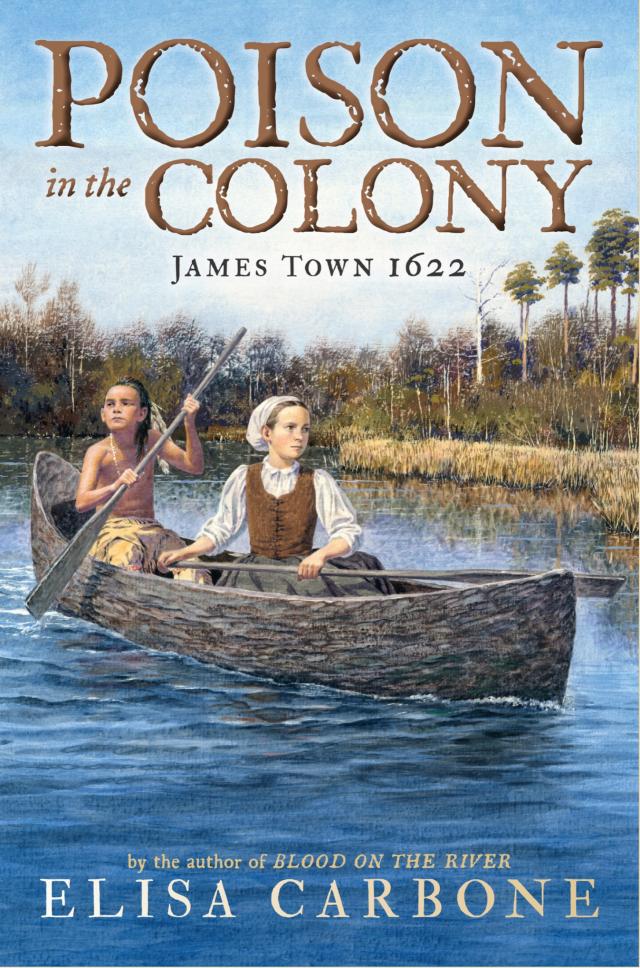
We paddle out into the current and then let the river do most of the work. We watch the landscape glide by, Samuel paddling and steering in the back of the canoe, me in the front. We both search the shoreline for the lightning-damaged oak.
At first, I am excited, like a cat ready to spring, expecting to find the oak right away and race up the creek to find the woman. But as time passes, and we paddle in silence, the quiet rush of the river makes my mind wander. I wonder if this will be the end of me. Will Charles figure out that I used the knowing to find the African woman, and accuse me of being a witch? Will Governor Yeardley believe him? Or will Nemattanew come back to James Town, touching the middle of his forehead and telling everyone that the Indian god Ahone has given me the gift of the second sight? Will I be branded a devil worshipper? I imagine the pyre, lit to burn me, and the strangling cord. . . .
“Virginia, what is it?” Samuel’s voice is urgent.
It shakes me out of my morbid thoughts. “What is what?”
“Why did you moan like that?”
I am shocked to realize I moaned out loud. I take a deep breath. If I can trust anyone with my thoughts, it’s Samuel. “Do you think the Powhatans worship the devil, the way Reverend Buck says?” I ask.
Samuel dips his paddle into the water and pulls, dips and pulls. “They marry and they love their children the way we do. They play games and create music and dances the way we do. They have laws the way we do and punish those who break the laws the way we do. When they fight their wars, they have rules about it, the way we do. They share their food with each other and are kind to their animals and respect their elders. I don’t see how they can be so much like us and be devil worshippers. Maybe they worship the same God as we do, and just have a different name for Him. That’s what I think,” he says. Then he adds quickly, “But you can’t tell anyone I said that.”
“I won’t tell,” I promise.
“Why do you ask?”
“Because that day Nemattanew came to James Town, as I was leaving, he spoke to me with his hands. I am almost certain that he spoke of the knowing. Even though I thought it was gone, he saw that it was still there.”
Samuel is silent, and I listen to the swish of our paddles in the river.
I continue. “If Nemattanew knows I have it, and if that means that it comes from their god and not ours, then I must be possessed by the devil, just like they said about my grandmother.” There, I’ve said it.
Suddenly I feel a shower of cold water against my back. I swing around. Samuel splashes me with his paddle again, this time in the face.
“Hey, stop!” I splash my paddle into the river and send a spray of water at him, but more water ends up in the boat than on him.
“Don’t sink us!” he shouts, but he is laughing, and by now I am laughing, too.
“Virginia, you being possessed by the devil is the most ridiculous thing I have ever heard,” he says. “I don’t know if Okeus or Ahone or the Great Spirit have anything to do with our God, and I don’t know what Nemattanew was really saying to you that day. But I will ask you this: Where were you today when you had your vision about how to find the young African woman?”
“In church,” I say quietly.
“Exactly. The devil doesn’t go to church. I think God is trying to tell you that it is a gift from Him, and that you are to use it to serve Him.”
For a moment, Samuel’s words make me feel light inside, as if a great burden has been lifted. But then I feel the darkness again. “That boy Charles . . .” I begin.
“That boy who has nothing better to do than torment younger children?” Samuel asks.
“Yes, that one. He is determined to prove that Mum and I are witches. He has that in his head because his da told him about my grandmother in England.”
“He has no proof of anything,” Samuel says.
“But what if he finds out how I knew where to find the African woman?” I ask.
“You mean what if he finds out that you and I were out fishing together and happened to come across her?”
Samuel is right. Charles has no proof of anything. When I turn to thank Samuel, I see it: the lightning-split oak. We are drifting past it.
“That’s it—we’re here!” I cry. “Paddle to shore!”
Seventeen
WE PADDLE THE canoe to shore and I jump out. I grab the cloth sack that holds our bread and apples.
“Wait,” says Samuel. “Let me give you some Spanish words to say to her.”
I huff. “Samuel, I don’t have time for jokes.” I hurry toward the creek bed.
“I’m not making a joke,” he says. “Come back.”
I march back to him and cross my arms over my chest. “So, you’re saying that Africans speak Spanish, and you speak three languages, and I’m supposed to believe it’s not a joke?” I am impatient. “Hurry up,” I say. “She might be about to starve to death.”
“The other Africans speak some Spanish because they’re from the kingdom of Ndongo, where there are lots of Spanish and Portuguese,” Samuel says. “I learned from them how to say ‘Good day.’ If you greet her in Spanish and she understands you, she’ll feel at home.”
“All right. I’m ready,” I say. I’ve learned a little bit of Algonquian, so why not Spanish?
“When you find her, just say buenos días,” he says. He sounds it out for me “Bwe-nos dee-as.”
“Bwe-nos dee-as,” I say. “Can I go now?”
“Go,” he says. “I’ll catch a few crayfish for bait and do some fishing.”
I pick my way up the side of the creek, sometimes hopping onto rocks to avoid thick brush growing along the banks. I practice as I go, “Bwe-nos dee-as.” Now I know how to say a greeting in three languages: Good day. Wingapo. Buenos días.
As I make my way, I watch for any sign of the boulders I saw in my mind’s eye. I begin to wonder about what I’ll really find when I reach the cave. The decaying body of someone already dead? An injured person in need of a splint or herbs? A woman so crazed with hunger and fear that she runs from me? Or will I find no one? Will I never find the boulders and cave at all? Has this all been a game of my imagination?
I suddenly feel like a ridiculous young girl. Brambles catch on my leg and tear my skin. “Ow!” I say out loud, and wipe blood from the scratch. I sit down hard on a rock near a calm pool of the creek. I feel so foolish. I’ve brought Samuel all this way because of a daydream I had in church. And even if I do find the woman, what are the chances she’ll even be willing, or able, to come back with us? I hang my head. Then I cup my hands into the creek and take a drink, causing ripples to go out in all directions. As I look into the water, the surface becomes calm again and I see my own reflection with trees and clouds above. “You’ve gone mad, Virginia,” I say to the face in the water. “Go get Samuel, go fishing, and go home. Be done with this nonsense.”
Suddenly another face appears in the reflection behind me. It is a dark, menacing face.
I scream. I hear another blood-chilling scream. I scramble to my feet, try to run, slip on the rocks, and fall into the water.
Then I hear something I do not expect: laughter.
She is slender and tall, hardly older than a teenager. She has arching eyebrows and bright eyes, and she is studying me.
I stand up, dripping wet. I stare at her. Her head is wrapped in a swath of beautiful patterned indigo cloth. Her body is wrapped in similar cloth, torn in several places, draped over one shoulder, with her arms bare. She seems to be neither sick nor injured and she definitely isn’t running away. On her ankles and wrists are the same scars I’ve seen on the other slaves that were brought to James Town: scars from the chains she was kept in during the months-long passage from Africa on the Portuguese slave ship.
She makes the fierce grimace she made when I saw her in the reflection, then points to me and mimics my scream. Then she’s off into another round of laughter. I am still shaken up, but I laugh a little, too. It is, after all, funny.
Suddenly I remember the words I’m supposed to say to her. “Buenos días,” I say
Her eyes light up. “Buenos días,” she answers.
I decide to try to introduce myself. I tap my chest. “Virginia,” I say.
She nods, sets her fist against her own chest, and says, “Ndongo.”
But Ndongo is the name of a kingdom, the place Samuel thinks she is probably from. Then I realize that Virginia is the name of a place as well. She must have heard, on the English ship, that they were going to Virginia, and she thinks I’m saying I’m from Virginia.
I begin to shake my head, to correct her, when I remember something much more important: the food I’ve brought for her, tied in a sack to my apron. I open the sack and pull out a soggy piece of bread. I hold it out to her. It drips a bit.
She reaches to receive the food. “Thank you,” she says.
She must have learned some English during her time on the Treasurer. I hand her an apple as well and decide to try again with the introductions.
“My name is Virginia,” I say, pointing to myself.
She points to herself. “My name, Angela.”
A Christian name. She is a Christian, then, just as Reverend Buck said.
Angela eats sitting on a rock. As I watch, my own stomach growls, but I know that Angela has been without food for longer than I have.
The next thing is to convince her to come with us. “I have a boat,” I begin. “I can take you—”
Angela’s eyes flash. “No boat!” She puts up one hand, resisting.
I shake my head. “No, not the ship that brought you here. It is gone.” I use hand motions to better clarify my words. “I have a little boat.” I show small, a space of a yard between my hands. “A canoe with paddles.” I make a paddling motion.
She looks more relaxed, but still wary.
“We can go back to James Town, get more food, and some rest.” I motion paddling, eating, sleeping.
Angela frowns as she chews the apple. She seems to be considering my offer. Of course, I can’t be sure she has understood. I motion for her to follow me, and I start down along the creek. We can’t dally. Sunset is only a few hours away and we have a long way to paddle upstream.
I look back. She has not moved from the rock she is sitting on, but she is watching me. What more can I do? I still have an apple and another piece of soggy bread in my sack. The least I can do is help her not to starve. I go back and give her the food.
“I’m going to the boat—I mean the canoe. You can come if you want,” I tell her. Then I begin the hike down to where Samuel is waiting for me. Angela does not follow.
When I reach Samuel, he is just pulling a smallmouth bass out of the river on his fishing line. “Did you find her?” he asks.
“Yes. But she wouldn’t come with me. She knows some English, and when I told her we have a boat, I think she was afraid it was the ship that brought her here.”
“Is she hurt or sick?” he asks.
“No, and she must have been finding things to eat, because she doesn’t even seem weak. And of course, there is plenty of water from the creek. But she was hungry enough to eat the food I brought even though the bread was soaking wet.”
Samuel raises his eyebrows. “What did you do, drop it in the creek?”
“It’s a long story,” I say. Then, to change the subject, “We need to head back; it’s getting late.”
But Samuel will not miss this opportunity to tease me. “Mmmm. Nothing like wet bread to whet your appetite, I always say.”
“Samuel, can we just go?” I plead.
“Yes, of course, Miss Laydon,” he says. “And would you like some of our delicious creek-soaked bread to eat while we travel?”
“All right, fine,” I say, knowing he won’t stop until I’ve told him everything. “She came up behind me and scared me and I fell into the creek. Now are you satisfied? Can you stop teasing me now?”
But he isn’t looking at me. He is looking behind me. He stands up slowly and raises his arms—the motion the Indians make when they are showing us they have no weapons.
I freeze, afraid to look. I expect him to call out a greeting of friendship, to protect us from attack. I wait for him to say “Wingapo” or “Netoppew.” But he doesn’t.
Finally, he does call out a greeting.
“Buenos días!”
Eighteen
ANGELA STANDS, TALL and serious. Her eyes dart around. She is looking for anyone who might grab her and put her back in chains. It has taken tremendous courage for her to come find us.
Samuel crosses his arms over his heart. “Friends,” he says. “Don’t be afraid.”
Angela comes a few steps closer. She points to the canoe. “Boat?” she asks.
“Yes, that’s the boat I was telling you about,” I say. “A canoe.”
She shows an inch between her thumb and forefinger. “Boat,” she says in a high voice. She is saying our boat is tiny. Hopefully, she is also saying she has no reason to fear it, or us.
“Will you come home with us?” I ask her, making the paddling motion. “Where we can eat, and rest?” I show her eat and sleep. It is getting late. If we don’t start paddling very soon, we won’t be back before dark. “Let’s go,” I say to Samuel.
Samuel and I go to the canoe. Samuel picks up a rock and gives the flopping bass a sharp knock to the head to kill it, then tosses it and our fishing sticks into the boat. We push it partway into the water and Samuel gets in. I motion to Angela. She hesitates a moment, then she seems to take an inner leap of faith and comes to join us. She balances expertly, and I wonder if they have canoes in her homeland.