Poison in the Colony, page 13


“Won me?” I ask, still groggy.
“Ya. He called me bluff.”
“He won me from you?” I wonder for a moment if I might still be asleep, having a terrible dream.
Flat Nose scoffs at me, as though I shouldn’t sound so surprised. “You didn’t think your passage was free, did you? You’ll have to work to pay it off. Not seven years like the passage from England, mind you. Just a few months.”
A few months? Working as an indentured servant? At a strange settlement? My heart races. In a few months we could all be dead from the Indians’ poison.
Scar motions to me and speaks to me in Gaelic. Flat Nose translates. “He says bring him his blanket and take his shoes,” Flat Nose says. He rolls his eyes. “He’s going to have you serve him like he’s the blooming king.”
I am fuming, but I fetch the blanket and carry it to Scar. He holds up one foot, expecting me to take his shoes off for him. I glare at him and keep my hands at my sides.
“Go on, do what he says, lassie,” Flat Nose says. “He’s had more than his share of ale tonight.”
I open and close my fists. The scar on the side of his face seems to move in the firelight. He speaks to me again in Gaelic, a one-word demand. I scowl. I pull his stinky old shoe off his foot and throw it at him. He has to duck so it doesn’t hit him in the head, but he grins and lifts his other foot. Quickly, I pull his other shoe off and drop it.
Flat Nose shakes his head. “Thinks he’s the blooming king.”
The men wrap themselves in blankets and settle down for the night. “You keep the fire burning, lassie,” Flat Nose says. “You can sleep in the boat tomorrow—I’ll give you me blanket then.”
I look around and see that there are no more blankets. Of course, I think, I am an indentured servant now. I am expected to sit up and stoke the fire all night while they sleep.
I huddle close to the flames and warm my hands. I am across the wide, cold river from anyone I know. Tomorrow these men will take me right past Elizabeth City, out into the Chesapeake Bay and around the horn up to Dale’s Gift. They will hold me captive there. No one in my family will even know where I am. Now I wish I’d listened to Mum.
Sitting, curled up, I am reminded of the night I spent locked in the storehouse cellar awaiting my trial. As on that night, I think of Angela. When she arrived here, she was across the wide, cold ocean from anyone she knew. Go inside, Virginia. Find who you are.
The Irishmen are snoring. The forest is dark and threatening around me. I begin to whisper softly. “I am Virginia. I love the forest and the trees and the life I feel in them that is like the life in me.” I blink as smoke wafts into my eyes and burns them. “I am Virginia. I love who I am. And I am angry!”
My anger flares. How dare they decide to keep me captive as a servant? How dare they stop me from my mission? In that flash of fury, I want to strike out, to hurt them. But then I calm. I take a breath. These men are commoners, probably even servants themselves. The thought of having their own indentured servant for a little while must be fascinating. And they did give me passage, and food. I continue my whispering. “My anger helps me protect those I love. I can channel it and do the right thing.”
The fire is burning lower now. I gather more logs and sticks and build the fire up until it is blazing. It casts dancing orange light on the trees. It is like my fire-breathing dragon but channeled so that it sheds warmth and light but no fighting. I look at the three sleeping men. “Thank you for bringing me this far and sharing your food with me,” I say softly. Then I walk off into the dark forest and keep going.
Thirty
THE MOON AND stars light my way. I am careful not to stub my bare toes. I will walk until daybreak to stay warm. I will keep the river always on my left and will not get lost. When dawn comes, I will retreat to a hiding place and watch for the shallop to come by. When I know the Irishmen have gone on their way, I will walk back to that spit of land jutting out into the river, where they camped. The shelter is there, and surely there will be burning coals left in the fire. I will be able to get it blazing again. In that spot, the river is narrow, only about three miles across.
From our many hungry winters, I know which roots and plants are edible, so I will be able to easily stay and wait until the next boat comes by. I will shout and signal until the travelers hear me. And whichever way they are going, my only request will be passage across to the other side so that I can walk to Elizabeth City.
As I make my way through the dark forest, I try to feel the life in the trees the way I used to when I was small. I hear a loud creak, and it startles me. But it is only the trees swaying in the wind, their branches scraping together. A hoot owl sends out his echoing call. I know there are things in the forest that can kill me: bears, copperheads, unfriendly Indians. If I were to die out here, without a burial, there would be nothing left but my bones to bleach in the sun.
I keep walking, willing my mind to focus on each step instead of the dangers in the forest. I climb over fallen logs and scratch my legs on brambles. I step on sharp rocks and have to keep from crying out.
When finally I see pink spread across the eastern sky, I am exhausted, scratched and bruised, and very ready to stop walking. I find a place just close enough to shore that I’ll be able to watch the river, and just far enough away that I can hide myself behind the trees and brush and not be seen. I don’t believe these men have time to spend searching for me. I’m sure they have their own “betters” who are waiting for the supplies and would be angry if they were late.
I sit and lean against a tree, determined to stay awake until I see the shallop pass by. But as I sit, weariness overcomes me and I lay my head back against the tree. I’ll just close my eyes for a moment, I think.
First, I dream that I am being poked. Then, I realize I am being poked. Barely awake, I try to scramble to my feet, to flee. A strong hand grabs my shoulder and pushes me down. I hold one arm above my head, ready to be struck.
When no blow comes, I peek out from behind my elbow. I expect to see the dark eyes and scarred face of my new “master.” Instead, I am looking into two pairs of dark eyes.
One is a boy, about my age. He is bare-chested, wearing several shell necklaces and two feathers in the long side of his hair. The other is a little girl. She also wears several shell necklaces and a buckskin skirt. Her hair is cropped short in the front and hangs long in the back. She peers at me with curious eyes.
My mind is racing. Women and girls are protected in Powhatan society. I am unarmed. I pray they will not think I have come to do harm.
A word floats to me, one of the Algonquian words Samuel taught me. “Netoppew,” I say. Friend.
The little girl bursts into a smile. “Netoppew!” she says happily. But then she looks serious as she touches my shawl, my bonnet, the buttons on my dress, fascinated by these new things.
Her brother pulls her hand away and speaks sternly to her in Algonquian. She keeps her hands at her sides, but again she says, “Netoppew.” We are friends. We mean no harm.
The sun is high in the sky, so I know the Irishmen must have passed long ago. It is safe for me to make my way back to the campsite. I try to stand, but the boy pushes me down again. He is armed. He has a bow across one shoulder and a quiver full of arrows on his back. A small club, what the natives call a tomahawk, and a stone knife hang from his apron. These things are for hunting and cleaning game. But they can easily be used against me.
He speaks loudly to me, as though I will be able to understand if he just talks loud enough. I listen closely for anything I might understand. I hear the word werowance, or chief, and he says “Peyaquaugh,” to come with him.
Does he want to take me to his chief and let him decide what to do with me? He motions to me and says, “Peyaquaugh,” again, and so I rise to my feet and follow these two children where they lead. I imagine running away, but just as quickly I imagine feeling the sharp pain of an arrow piercing my back.
* * *
. . .
Smoke from cook fires wafts to us. The little girl points ahead of us. “Nansemond,” she says. We must be approaching one of the Nansemond villages. I have heard that they are one of our trading partners.
Soon, through the trees, I see the same kind of cottages I remember from my visit to Pocahontas’s village when I was small. They are similar in size to our cottages, but with walls and curved roofs made of woven reeds. I smell the delicious aromas of meat and fish grilling over the fires. It makes my mouth water. But then I remember I should not eat anything offered by the natives, lest I become the first victim of their poison.
Once we are in the village, the girl takes my hand and leads me to a big cook pot. It is made of copper, not clay, and I realize it must have been traded from our colony. The girl motions to me to eat, but I shake my head. She looks at me quizzically. She can’t figure out why someone who was found starving in the forest would not want food. So, she demonstrates what I am to do. She reaches into a basket for a loaf of bread and rips off two pieces. She hands one to me. She takes the other piece and uses it to scoop up stew from the large pot. It is a thick mix of hominy and oysters. She blows on it to cool it down, then pops it into her mouth, nodding to me. Unless they have poison that kills only English and not little girls, I am safe. I dip my bread into the stew and eat. It is delicious.
A woman comes to turn over the strips of meat being smoked on wooden racks over the fire. This meat will not be for eating today but stored for later in the winter. The woman looks at me curiously, and I look at her. She is bare-chested, with only a leather skirt that reaches from her waist to her knees. Her black hair hangs in a long braid down her back. She wears several shell necklaces and has tattoos on her face and arms. One of the tattoos is of a snake slithering up her arm. I think it makes her look strong.
The boy motions for his little sister to come with him and I am left in the company only of women. An older woman grasps my arm and pulls me over to a large mortar and pestle with corn in it. It looks very much like the ones we use. She pantomimes the motion of pounding the corn to grind it. So here, too, the women must work every waking moment. I am being treated not as a guest, but rather as just another female worker. I pick up the pestle and pound the corn as I have done since I was four years old. The rhythm is wonderfully familiar, and it helps me think.
I will find where they keep their canoes. I will escape at night, when all are asleep. Then I will paddle across the river myself and walk to Elizabeth City. As I pound and think and plan, I hear the boy’s voice behind me. “Peyaquaugh,” he says. Has he brought the chief to decide my fate?
But when I turn, what I see shocks me to my core. She wears the deerskin skirt that all the other women wear, and a deerskin mantle. Her neck is adorned with necklaces made of shells. Her arms are tattooed with images of flowers and birds. Her hair hangs in a long braid down her back, like the other women.
But this woman is different. Very different. Her hair is curly and reddish blond, her skin is freckled, and her eyes are green.
She looks at me and says, “Hello.”
Thirty-One
I KNOW THAT some of the native tribes have women as their chiefs. But this woman is not even native, and her clothing is nothing like the beautiful feather mantles the chiefs wear.
“They told me you need an interpreter,” she says. She has the same accent as those poor London street children they’ve been sending.
“Yes, thank you,” I say.
She continues, “They think you escaped from a cruel master like I—” She stops herself.
Suddenly I understand who she might be. I have heard of girls and women who disappear rather than be beaten by a cruel master, and who find safety with the natives. “Did you escape from the colony?” I blurt out.
She eyes me suspiciously. “Are you staying with us or going back?” she demands.
“I’m going back,” I say.
“Then I didn’t escape; I was captured,” she says, defiantly. She adds quickly, “But don’t be sending anyone to rescue me. My husband will kill them if they come.”
I shake my head. “I promise I will not tell anyone about you.” I know that men who have tried to escape the colony and find a better life with the Indians have been brought back to James Town and executed. I certainly would not endanger this young woman.
The boy, who has been patiently listening to our foreign conversation, now speaks to her.
“He wants to know why you were alone in the forest, far from the English,” the girl says.
My story is so long and complicated, I decide to tell only the part that is important now. “I am trying to get to Elizabeth City,” I say. “To my da.”
She interprets, but they both look puzzled. “Elizabeth City?” she asks. “Where is that?”
“Across the river,” I say. “All I need is for someone to take me across.”
Again, she interprets, and again the boy looks puzzled. Elizabeth City is new, just being settled, so he may never have heard of it. “It is near the old Indian village of Kecoughtan,” I say.
They both light up. “Kecoughtan,” the boy says, and he rattles off a long sentence.
“He says you will stay here tonight and tomorrow he will take you across the river to Kecoughtan. You will stay in my home.”
“Thank you,” I say. I am very relieved and grateful. “Thank you so much.”
* * *
. . .
Her name is Sarah. She takes me to her cottage. An older native woman is sitting on a mat in front of the cottage, holding a baby in her lap. The child has curly black hair and green eyes.
“This is my mother-in-law and my little girl,” Sarah says proudly.
The woman and I nod to each other. She bites off a chunk of dried meat, chews it, then spits it out and puts the chewed-up wad into the baby’s mouth. The baby girl gums the meat and drools.
“My husband is away on a hunt,” Sarah explains as she takes me through the doorway into her home.
Inside the hut there are platforms against the walls with deerskins on them. These must be their beds, I think. There are also shelves above these platforms, where baskets and bowls are kept. In the center of the floor is a fire, and when I look up, I see that a hole in the roof is pulling the smoke up and out. The cottage is cozy and warm, and sunlight streams in through the doorway.
Sarah sits down on a mat in the ray of sunlight and invites me to sit with her. She pulls out her sewing. Her needle is made of bone and her thread is of sinew. She is working, sewing little shells onto a pair of moccasins. She tells me her story as she works.
“Life in London was hard, and even though we were forced onto that ship, some of us thought it might be better here.” She scoffs. “Maybe for some it was. Not for me. He about wore out his stick on my back, my master did.
“One day two native men came in a canoe to trade. One of the men was looking at me, and I was looking at him.” She widens her eyes to show how they were flirting. “So, I slipped off and laid down in their canoe. When the men found me, they didn’t say a word, just paddled out into the river and brought me home.” She smiles, remembering.
“We were married as soon as we could build our house,” she says. Then quietly, she adds, “He never beats me.”
* * *
. . .
After dark, I bed down on one of the platforms, under a deerskin blanket, with the fire crackling. Sarah’s daughter is tucked in with her, and her mother-in-law sleeps on one of the other platforms. When I was alone in the forest, I imagined many ways I could get myself to Elizabeth City, but none of them involved being this warm and well fed.
In the morning, we go to the communal cook pot again to eat. The stew has had some red berries and pieces of rabbit added. It is still delicious. I am amazed that here, even in winter, they have no rationing. Anyone can eat whenever they want to. Samuel says they have great trust in their gods, Ahone, Okeus, and the Great Spirit that breathes life into all things. They trust that there will be enough, and so no one needs to hoard. In the hungry month of March, if their stores run low, they are all hungry together.
The boy comes to fetch me. He taps his chest. “Pepiscunimah,” he says.
“He is saying his name is Pepiscunimah,” Sarah tells me. “But we all call him Pipsco.”
He nods. “Pipsco.”
I tap my chest. “Virginia,” I say.
He and Sarah have a short conversation, and she translates for me. “I told him you’ll be looking for a break in the trees, that’s where the English are,” she says.
“Peyaquaugh,” says Pipsco, knowing I understand this word.
I move to follow him, but Sarah puts her hand on my arm. “Here,” she says. “These are for you.” She holds out the pair of moccasins she had been working on, beautifully adorned with the small shells.
I catch my breath. “They are beautiful,” I say. “But . . . I have nothing to give you.”
She holds one finger to her lips. She is asking for my silence in return for this gift, something I would have given her anyway. I put my own finger to my lips. “Until my death,” I say.
Sarah nods. “Godspeed,” she says.
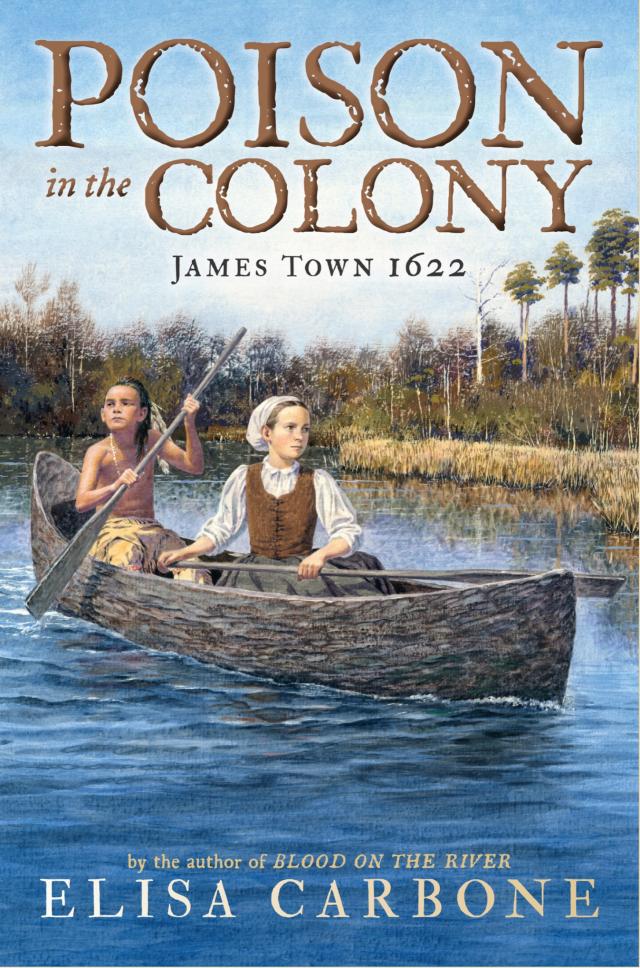
I follow Pipsco to the river’s edge, where several canoes are lying onshore. Together we carry one of the boats to the water, along with two paddles. I don’t want to get my new moccasins wet, so I put them in my apron before I wade into the river. I take off my shawl and put it into the boat. I want my arms free for paddling.