Camera And Action, page 26
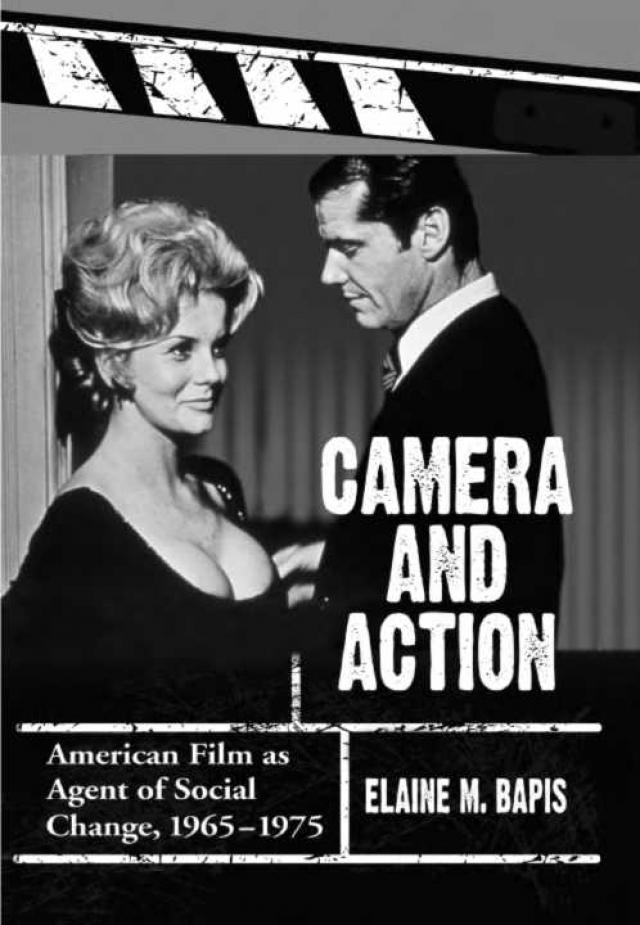


Mike Nichols' Carnal Knowledge (1971) tells it like it is between men and women. AnnMargret's allure became the film's primary marketing tool. She is shown here with Jack Nicholson (Photofest).
Carnal Knowledge diverts its attention from the beauty of Bobbie to the trouble with her dependence once Cindy enters the screen. Rather than Cindy's feminism, it is Bobbie's weakness that is a threat to male power, since Jonathan accepts his fate after Bobbie's two attempted suicides, marries her, has a child, and divorces. From a feminist point of view, which Cindy represents, women's social status stems from their neediness. The narrative proves that the logical conclusion to the problem with women's inclination to mix lust with love leads to disaster. The trouble, as Feiffer would have it, is with women's desire and men's obligation. Divorce frees Jonathan physically from the burden of Bobbie, but the effects are lifelong.
Though Cindy's screen presence lasts a few minutes, the impact of her image goes unquestioned. Her prototype was clearly visible off screen in the personality of Cosmopolitan, the magazine that legitimized women with drive, ambition, and promiscuous entitlement. They were the females who could deliver the Jonathans. Voice, drive, and an upper hand were cer tainly not bestowed on Bobbie. Bobbie's last image as "a tub of lard" keeps her inert and unconscious. Cindy, on the other hand, reconfigures women's image and reconciles the Cosmo Girl with the new focus on feminism. She sadistically destroys the illusion of Bobbie and allows Jonathan the possibility of a new fantasy and life. Both Cindy and Jonathan prey on the sexkitten's fear that her future is limited if sexuality cannot be reconciled with the conventional value of marriage. Indeed, Bobbie must now ask what's sex got to do with it, since shacking up resolved nothing for her.
Cindy does not break or destroy Jonathan but clarifies his situation and obligation. She establishes her authority but is by no means a sympathetic character and is attractive only as an authority figure. She walks out of Jonathan's and Bobbie's apartment, out of Jonathan's life, on her conditions. She is the flip side of Bobbie, with the two representing both ends of the spectrum defining the trouble with women. The Bobbie/Cindy sequences have proven the film's argument about the myth of romance. Both assumptions lead to the same point - that not only does love have nothing to do with meaningful relationships but neither does sex.
The fourth female prototype enters the film in its most sinister part. Sandy brings a younger generation love child, Jennifer (Carol Kane), into the story. Sandy is now the intellectual hippie, the prototype of what irritated Feiffer about the sixties response to social strife. Sandy wears bell bottoms and has long hair and a hippie mustache. He is now attached to Jennifer, who brings both the carnal and the knowledge to Sandy. She "knows more at eighteen than Susan knows to this day," Sandy boasts to Jonathan. "She's my love teacher," Sandy explains and offers to help Jonathan in the future of love. "You don't need any of those games," Sandy clarifies. "Games don't impress Jennifer, just life, just love," Sandy instructs. Art Garfunkel's character shifts lanes and walks through reality into Jennifer's "free" love and life. She takes this forty-year-old out of male crisis and transforms him into a new-age man.
Jonathan, however, will have none of the love generation. He pulls the mask off romance, whether it be from the MGM past or the hippie present, to reconstruct male and female identity in his slideshow, "The Jonathan Fuerst Ball Busters on Parade." "In those days we had illusions," he begins. Sandy and Jennifer obediently watch as Jonathan shows his bizarre black and white slides, in which Bobbie earned a starring role. Once "the fastest tits in the West," Jonathan says about her, she is now "king of the ball busters." His narration of the sexual encounters he had from the time he was five years old to the present day consists of harsh, sexist, and racist language. "This was my Jap in the sack," he laughs. With each click of the projector, he dehumanizes those objects of desire and reduces them to crude labels.
As feminists explored the production of women's identity in the age of sex on screen, they questioned how telling it like it is in film could be seen as more truthful. Reality is no less guilty of stereotyping than the MGM past. Even deconstructing the romance to liberate women's image as passive receptors seemed to turn the camera in a new direction toward a new use of women's sexuality. By bringing women to the screen as "ball busters," the film constructs a collective male anxiety and diverts the film's project from romance to fear of women in general. This split is constructed through Jonathan, who is the self-determined male on the one hand and the victim on the other. Through him, in the interest of subverting the romance, Nichols cast a spell of another kind on women.
Through the slideshow, the film advances a fantasy for men about women's dependence that further stereotypes women as burdens who merely "demand things, manipulate, take you out of your self, ask for contact, want to be loved, want to be talked to, want to be thought about, are a hindrance once they've been screwed," as Feiffer once chided. When the film removes love from the equation, women like Bobbie, Jonathan knows, are simply not relevant to the world outside of the bedroom. If it weren't for sex, Feiffer continued, "women would have been wiped out centuries ago." This "protective coloration" forces men out of freedom and into responsibility, employment and traps, and therefore provides "an inadequate replacement for a best friend." Feiffer wanted to show a male perspective of sex. It is appealing, he wrote; men "want it, run after it" until "they realize that a woman comes with it."13 Similarly, Jonathan "traffics" with women but the sexual revolution of the late sixties, free love, ironically complicates simple scoring. "It's not as easy getting laid as it used to be," he laments.
Sandy has moved on, but his evolution irritates Jonathan much the same as the younger generation's sexual politics did Feiffer. Sandy has missed the point of knowledge. The sexual revolution may have made the experience of sex easier for men and women "to get along," but as Feiffer countered, it did not necessarily mean there was broader awareness. Jonathan's best friend Sandy falls short of the film's expectations. "You're a schmuck, have always been," Jonathan derides Sandy. The film agrees, for what does hippie "free love" have to do with it now, and invites viewers to believe that Sandy is a sell-out. It is the brutality of reality - the crisis - not the kindness of another fantasy that gives a man his freedom, Feiffer believed. Sandy, the voice of feminist moralism with whom we should identify if indeed the film is to succeed as a critical comment on men's behavior toward women, is, as Jonathan describes, "a schmuck." The Feiffer predicament of desire and need emanates through Jonathan, who is somehow justified in his brutally cold opinion of women because he declares to the camera what had been previously taboo for the mainstream venue.
Even though Jonathan is the prototype of what feminists were protesting - the chauvinist - he seems powerful, if disturbing. In his forties, with a successful career and a ritzy Manhattan apartment, Jonathan inhibits Sandy and Jennifer from continuing their whimsical relationship. The couple leaves literally in shock after his profane slideshow. Jonathan, therefore, maintains the narrative center of this film and determines the picture's critique of cinematic romanticization.
The ending leaves men and women where Jonathan is - limited and bound to redundant dialogue, programmed scripts, and a two-dimensional point of reference. Both Bobbie and Susan become cultural artifacts, reassigned to the 1950s market of marriage. Cindy and Jennifer represent the cultural present, but both are flattened into negative portrayals of seventies women. Thus, the film's critique of romance through the travesties of Johnathan betrays its task of convincing viewers that he is brutal by inviting viewer sympathy for his pain and confusion. The film indicts Jonathan's code of masculinity to a point. Early on, the picture sets up the relationship between the viewer and Jonathan. Although he is less than a model, heroic character, he is still the narrative voice and the creator of the Fuerst history of women and of Carnal Knowledge, figuratively speaking. Following the "shacking up" agreement, Jonathan faces the camera directly and pledges, "I won't lie to you." "I was a little worried and along came Bobbie," he confesses. "I get one look at the size of the pair on her and I never had a doubt I'd ever be anything but okay again and I was." Jonathan's chauvinism has a powerful draw in part because of Jack Nicholson, the actor who made his mark in Easy Rider and received an Oscar nomination for Five Easy Pieces (1970). He was fresh in the minds of audiences. While the film does not glamorize him, it does leave a certain draw to his voice as the speaker of men's predicament.
Friends, critics, and guests snickered and snorted in New York theaters and wrote Jules Feiffer the next day. Carnal Knowledge was "perfect"; it was "one of the truest and best things ... ever seen on the screen," "a knockout," "brilliant, blistering, and ... a little evil, but beau- tiful."14 By the time the film first appeared in Los Angeles, people were standing in lines for blocks around the theater. Said fans and friends, "It was ... gorgeously written, directed and performed." "Fantastic" and "as funny as you've ever been," "everyone and everything about it was right," "I was on the edge of my seat ... and ... laughed like hell." Liz Smith from Cosmopolitan sent her praise directly to Nichols, something she said she had done only one other time.15
Friend Marta Orbach wrote Feiffer after viewing the film, saying it "made me remember - quite clearly and for the first time in years ... that being nineteen at the very end of the forties was so painful that I couldn't even bear to remember it in the first person." The film pointed out that Hollywood gave us the exceptions, not the rule, of love, or as Orbach put it, "It is the only movie ever made for all the people for whom Sam would never play As Time Goes By'... and for all the ladies for whom Paul Henried would not light two cigarettes - or one, even [Orbach's emphasis] .1116
Others, however, found the script and production disturbing. One viewer who "saw it at Hef's house" (Playboy's Hugh Hefner) couldn't "approve of the point of view."" "Was I supposed to laugh?" a professor of English wrote Feiffer. "It seemed a sad ... movie. And to Philadelphia audiences ... for I saw it in a silent house" unlike New York audiences who "howled with laughter."" One New Yorker was incensed: "I was so upset by the film that I had to leave before the end lest I reveal my agony in the rending howls."" Novelist and playwright Rosalyn Drexler accused Nichols and Feiffer of again "blow[ing] up on screen ... the usual stereotypes ... as the real thing: woman as wife-mother figure; woman as vapid female Oblomov," helpless and suicidal; woman as tough, metallic `bachelor' girl, and woman as prostitute." She railed against the "castrator" image and called the film a "grim satire about depersonalization. "20
Viewers reacted to Drexler's article, saying that she was the one who missed the point. Explained one writer, it is impossible "to understand how anyone could see the movie and miss the fear and pain experienced by the men, as well as the women."" Another writer asked Drexler to sympathize with "the obligation Jonathan feels to be the tough guy" and stop letting her "own apparent hostility [get] in her way."22 A Harvard graduate student tried to set her straight. "The movie is not about the women," he retorted, "it is about the two men's conceptions of women ... it is about male chauvinism - it is not male chauvinist."23 Another answered Drexler's title, "when she asks ... whether men really hate women, Feiffer would answer a pointed yes."24
A Cleveland Press critic described Carnal Knowledge as "a Feiffer cartoon come to life" and "a movie that many will find offensive and with reason. It is all about sex but without being sexy in the usual movie manner. In language it is explicit, clinical and yet absolutely real." Carnal Knowledge "puts down the sexual revolution and as such is undoubtedly ... a moral film, but ... it leans so heavily on its sensational subject matter that for many, if not most, the point will be lost."25 Charles Champlin of the Los Angeles Times found it "the iciest, most merciless and most repellent major ... motion picture in a long time."26 One frustrated critic wrote Feiffer a two-page letter asking him to clarify several unanswered points in the film.27
This "very male" film, as The Sun described it, is an indictment of the independent, heartless man who oppresses women by exploiting their beauty.28 It is a denunciation of Feif fer's entire generation of chauvinists and, if understood from that perspective, Jonathan represents their battle. At the same time, Feiffer is careful not to replace Jonathan with the younger sentiment that Sandy represents. In the screenwriter's words, "The kids today may have quite a bit of the [sexual experience] without getting very far into [understanding] .1129 Yet, it is not easy to dismiss the hooting and howling and the impact the new visuals of female sexuality had on representing women through the film's voyeuristic style to explore the Feiffer premises. The film's adverse effects on the construction of women's identity cannot be ignored.
Filmmakers faced a challenge in the early 1970s, for "reality" on screen still had to reach a wide audience by avoiding censorship and not yielding to a sexploitation fare that would label a film as just another "dirty" movie. Finding the proper balance for Nichols was tricky because Hollywood now sat in the context of an erotica explosion that had appeared in film theaters across America. As Look reported in 1970, "Any adult, mature or otherwise, can find movie houses all over the U.S. that show erotica in color and even 3-D."30 In New York City small theaters called "mini-cinemas" brought in anywhere from $50,000 to $700,000 gross for films that were shot in three days at an expense of little more than $15,000. With these kinds of returns, many of the small art theaters so successful with European films in the early sixties turned their screens to sexploitation during the seventies.31
The minor house insurgency also caused a ground swell of protest against the invasion of sexploitation on the community level. Local groups pressured officials to arrest theater owners for profiting from "prurient interest."32 One congressman even advocated "the creation of an anti-smut squad." Look writers joined the conversation by describing films like Myra Breckinridge (1970) and Beyond the Valley ofthe Dolls (1970) as "indefensible garbage."33 Both minor and major film production of graphic sexuality provoked the question of whose right it was to see whatever sexual acts he or she wishes regardless of the court's recognition of "community" standards. In this delicate balancing act between critical art and sexploitation, the courts also came onto the scene.
Only a few months after its release, several cities refused to advertise Nichols' film. Eight months after the film's initial release, Albany, Georgia, officials arrested movie operator Billy Jenkins with "distributing obscene material," fined him $750, confiscated the film, and put him on a year's probation. However, under Jack Valenti's leadership, Universal, MGM, Warner Bros., Twentieth Century, and others organized an action plan to appeal the Georgia Supreme Court's ruling by requesting the U.S. Supreme Court to make their judgment clearer so as to protect films like Carnal Knowledge and define the lines between films like that and "the skin flicks," as Valenti described them. "Carnal Knowledge," he added, "is the epitome of a picture that is honest and mature without being obscene." A Supreme Court clarification, as Valenti further explained, would "fasten securely the principle that there is a difference between commerce in ideas and the commercial exploitation of obscene material."34 The exhibition arm of the industry argued that "Carnal Knowledge's fate in Georgia represents `a pattern of local prosecution and harassment' typical of responses to the court's decision."35
From the time of Carnal Knowledge's production in the fall of 1970 to the summer in 1974, the question of censorship shrouded, publicized, and sold the story's social value. Carnal Knowledge therefore sits as the moment in the American film industry where the federal jurisdiction and community control over smut and art clashed. It was rated R, had received critical and popular acclaim, sat on the top ten best movies lists, and did not fit the "smut" definition of the 1966 courts. The lobbying power of the MPAA, the National Association of Theater Owners, the Directors' Guild, the Authors League proved as much. In less than six months after its ruling on the Georgia case against Jenkins, the U.S. Supreme Court forced a new standard and identified Carnal Knowledge as the example of what was not "patently offensive" (Judge Rhenquist's words). The picture's nudity and sexuality were "simply not ... hardcore sexual conduct for its own sake, and for ensuing commercial gain."36 Nichols had achieved the delicate balance. The film became a guideline from which to distinguish legitimate from hard-core material.
At the same time the picture broke boundaries and the court protected its vulnerability and served the film industries' newfound opportunity, it also created new pressures and new stakes for women. The vision of telling it like it is placed women between a rock and a hard spot. New sensual representation on screen seemed empowering on the one hand and objectifying on the other. Despite official and critical approval of this film as developmentally mature, the film reconstructed a new kind of subordination of women.37 With critical respect for its artistic merit, the film's liberating quality became its truth. Its intent to subvert, outrage, and offend by defining sex as sex, not moonlit nights, made it current, but the apparent honesty in this film was not as transparent as it seems. As feminists explored the product of women's identity in the age of sex on screen, they recognized that a stereotype still operated the same whether in the "tell it like it is" narrative or the MGM past.38
The meaning of sexual liberation for women by the 1970s was still contested. As Drexler and others pointed out above, the sexual revolution often had an inverse side. Even Cosmopolitan writers were torn. As one writer complained, "Like faithful puritans, we have ruled our new liberties into existence. Dutifully, we observe the mandate of sexual freedom. You decline to sleep with a man ... what's wrong with you? He demands, suspecting some frightful abnormality like frigidity." Having discovered the joy of sex, young women were also discovering the "doctrinaire" of the new mantra. Sexual freedom, women argued, had neither direct correlation to liberation nor much to do with civil rights and equal treatment in and outside the bedroom. As one Cosmo writer observed, "The revolution of the sixties may have turned all the labels inside out, but I don't think it's really chased off this doctrinaire habit of mind."39